
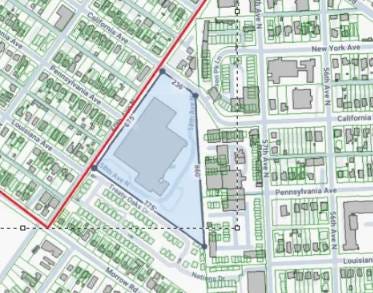
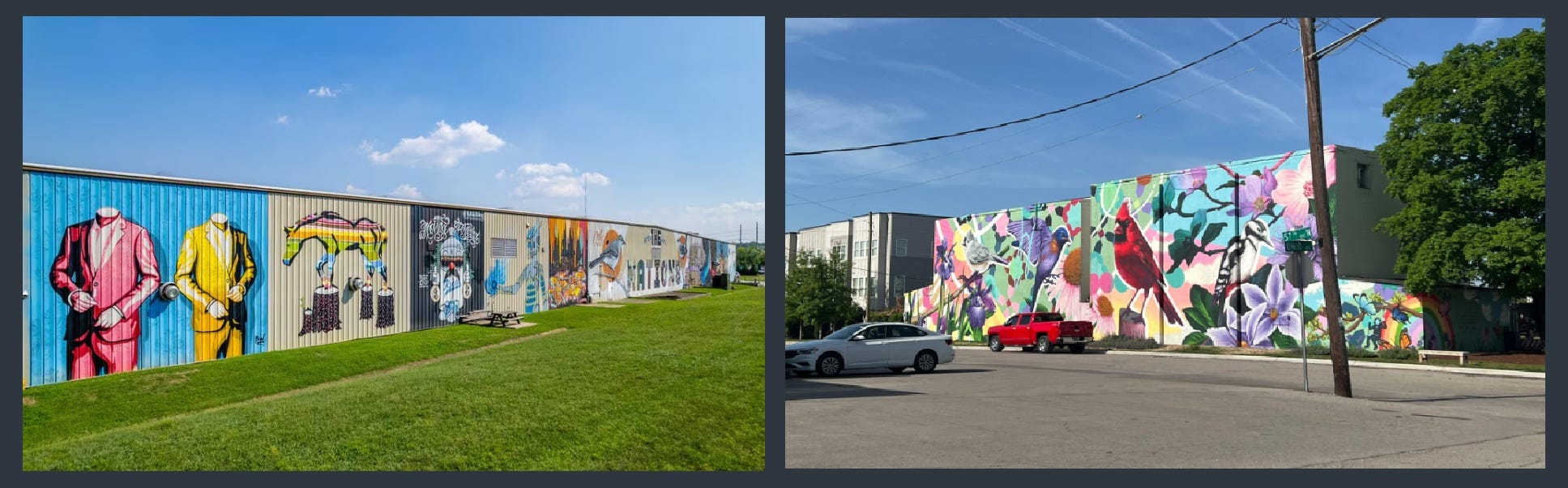
It is incredibly easy for massive zoning fights to get lost in the shuffle of daily life, mainly because the bureaucratic timeline is built to help you forget or lose interest. You might have assumed the battle over the 8-acre Altera development (the massive 296-unit apartment fortress proposed at the triangular center site with the art wall on California Ave - image above) was over or forgotten.
It isn’t.
Decode the City - Stay Informed
Today, I want to reintroduce this issue because it is vital to our future, and a recent article I published is directly relevant. We need to step back from the standard defensive arguments over towering height, monolithic scale, traffic, sewer lines, or the failure to prioritize preservation and maintenance. Instead, we must elevate this conversation to the larger planning perspective.
From listening to neighbors in The Nations, the specific conflict is really about building a place where people genuinely wish to live, a place where we can enjoy the unique, quirky blend of The Nations, where historic, new residential, and industrial uses have learned to vibe together. In what other neighborhood is the majority of the community actively pro-mixed-use with residential and pro-industrial blend? Yet, in Nashville's zoning petri dish - The Nations - our own city government continues to push out-of-scale, vertical bedroom warehouses. Even back in 2015, the general plan designated this exact site for commercial mixed use. What gets lost in this bureaucratic shuffle is the need to use architectural anthropology and city-building knowledge to build a place, and not just a bedroom.
For years, this 8-acre site was promised to be our Mixed-Use Hub, a true neighborhood center where locals could gather, grab a coffee, and connect. A genuine Village Square or some element that facilitates “gathering.”
For elected officials and policymakers, when you encounter neighborhood pushback, consider the scenario above, the very reason residents experience trust issues regarding zoning, and why we refuse to blindly "find comfort" in our elected gatekeepers. This bait-and-switch is exactly the problem.
Instead, the developer, with the support of the District Council Member, is executing a bait-and-switch, attempting to replace a potential community hub with multiple monolithic, 60-foot-tall apartments and a tiny, token commercial box.
Here is the unvarnished truth: In 2026, when a city plan fails to address gathering places and commercial needs, what remains is a warehouse of bedrooms. When this occurs, you are just another bedroom community. If the initiative diminishes the opportunity for places to walk-to, the relationship between utility and soul is completely lost in Davidson County’s drive for housing production. Today, Nashville has built so much supply that we statistically have more than one physical housing unit for every two living human beings in the county (averaging roughly 1.9 residents per housing unit). We have more supply per capita than at any time in history. How many do we need? And at what cost? (Certainly not more for the wrong housing market segment.)
Walkability means absolutely nothing if the very destinations we want to walk to are erased, or if the opportunity to create new ones is lost for decades to bedroom warehouses. Stacking “heads in beds” does not create a livable city; it creates a pop-up apartmenthood where isolated residents are forced to drive elsewhere just to find a human connection. In fact, in planning circles, The Nations, supplemented by an enabling new Urban Design Overlay, is colloquially becoming known as exactly that: an “urban bedroom warehouse district.” The overlay is totally devoid of a “third place” (gathering place) framework, guidance on people connectivity, and the simple architectural cues needed to spark curiosity and actually draw residents out.
Over the past ten years, The Nations has more than doubled its housing units, with huge monolithic apartment buildings providing over 1,500 new units (most built in the last four years) and more on the way. Do you consider the results more walkable? More livable? An enhancement to the neighborhood vibe? Did the cost of living improve? Did you get sidewalks? Was the infrastructure improved? Where are the gathering places?
Struggling retail has little to do with a lack of bedrooms when our bedroom count is already sky-high. With about 3,700 units per square mile, The Nations has a density substantially higher than that of almost anywhere else outside the downtown urban core.
When growth meets culture and challenges the fabric of a place, we feel it. Have we worked to sync these issues, or is the stimulus being adopted by our leading government officials simply a “warehousing of bedrooms” solution at the expense of livability itself? Did new policies provide any protections for our valued vulnerable community residents (the anchors)?
When the public is asked to participate in planning, we must show up with insight and excitement for what our neighborhood could be. We aren’t just saying “NO” to an apartment building. We are saying “YES” to a Village Square, a Main Street, or pocket-gathering “third” places, the spaces outside our front doors where we can actually gather and dwell.
To understand and see a case study for the anthropology of what makes a great place, read my new article, The Seaside Lesson: Modern Planners Copy the Density, but Forget the Soul.
Decode the City - Stay Informed
If you’re new to the story, read the original posting below.
Please don’t let this get lost in the shuffle. Let’s elevate the place over the portfolio. This is only one sample from The Nations, but there are many more.
— Chris Remke @builttothink / Voices of the Nations / Save Our Nashville Neighborhoods
Christopher Remke [AIA ret.] brings an unusual combination to real estate analysis: the quantitative rigor of a veteran Design-Build-Development Advisory Professional merged with the cultural awareness of a Context-Sensitive Urbanist. As Principal of Linked, L. L. C., he’s the rare voice who can deconstruct a pro forma, read municipal debt structures, and simultaneously ask whether the project destroys or enhances the neighborhood’s social fabric.
This dual perspective - analytics meets urbanism - allows Chris to expose what architects, planners, builders, and conventional real estate experts miss: how financialization, zoning manipulation, and tax policy don’t just change property values, they fundamentally alter how cities function as communities.
As President of Save Our Nashville Neighborhoods (SONNinc.org), Chris fights extraction-urbanism’s standardized templates and champions genuine neighborhood diversity. Through his writing, he operates in “Decoder Mode,” making complex policy accessible while revealing the truth behind political narratives.
His mission is simple:
Neighborhoods need a voice, Working People need a voice, and the City needs a gut check.
Because transparency builds trust. Manipulation destroys it.
No posts
Comments
Nothing yet. Say the first thing.
Sign in to join the conversation.