
We’ve been asked why Build Up Dietitians often speaks out against integrative and functional practitioners (both MD’s and RD’s) when the Academy of Nutrition and Dietetics has the DIFM (Dietitians in Integrative & Functional Medicine) DPG (Dietetics Practice Group).
Mostly it’s because we often see those who claim they practice or follow integrative and functional medicine to be more likely to endorse/promote/sell pseudoscience.
Does this mean ALL functional and integrative practitioners are suspect?
No.
and we’re happy to help YOU find that 🦄unicorn and avoid those 🦆quacks and shills.

Here are some things to check for:
🚩🛒See if their website features a “SHOP” where they sell supplements, detoxes, cleanses or diet books (that they’ve written)
🚩Do they offer food sensitivity or other questionable tests under a “SERVICES” tab? or do they encourage this sort of testing?
🚩Do they attempt to “other” themselves by claiming they are different/better than traditional or conventional medicine and “Big Pharma”? This often creates distrust in medical providers, treatment, tests and medical institutions. (and why do they not create the same distrust in “Big Supplement”?)
🚩Do talk about “root cause” and use words/phrases like: leaky gut, adrenal fatigue, inflammation, hormone balancing, or mention “toxic” chemicals with little or no explanation or context or blame them for a wide variety of symptoms that many would normally experience (weight gain, tiredness, fatigue, etc) to those faux diagnoses.
🚩Do they claim they provide nutrition counseling or medical nutrition therapy, but have no dietitians on staff? Or do they use wellness coaches or nutrition coaches who are not educated or credentialed in nutrition?
🚩Are they #antivax #antifluoride #antiGMO and do they promote an appeal to nature logical fallacy?
For more on integrative and functional medicine:
From McGill OSS Beware the Trojan Horse of Integrative Medicine
From Quackwatch Be Wary of "Alternative," "Complementary," and "Integrative" Health Methods
From dietitian Abby Langer Here Are My Issues with Some Functional Medicine Practitioners and Practices
From dietitian Amy Wollenkamp Why I turned my back on functional medicine....

6 CEU’s applied for - pending approval
The code IAFNSBuildUP2026 can be entered to reduce the fee for virtual participation from $40 to $15. The registration page is: https://iafns.org/2026-iafns-annual-meeting-registration/
If any RDNs in the DC area would like to attend in-person, they can reach out to IAFNS directly and inquire about discount options – am2026@iafns.org.
🛒Partner Merch Store - Donut Season

Check out all the nutrition specialty t-shirts in the Donut Season store! Use promo code: BUDSpring26 for 15% off.
Make your recommendations at this hyperlink:
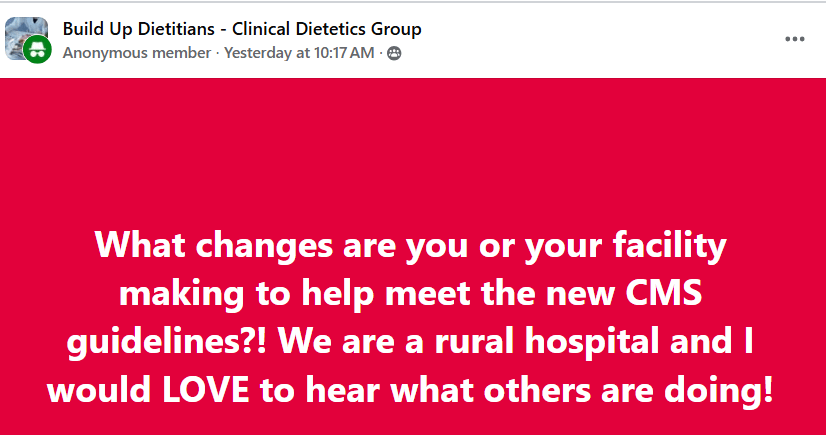
New CMS Guidelines: Hospital Nutrition Service Obligations in Light of Updated Federal Nutrition Guidelines
Comments from RDs
Kara E. “We’re not making any changes to our current practices in my system (we have 3 community hospitals beds 60-130). We already do a lot of things that capture the recommendations…”.
Kathy H. “Wow, what complete c**p from government. So, the cancer patient that needs as many calories as possible and every food hurts their mouth with ulcers and they can’t get pudding. How many of our patients have to have their pills crushed and put in pudding or yogurt for swallowing?”
Reva B. “I’m at a VA hospital and we’re waiting for our own national guidance. I am curious about others as well.”
Amy N. “We are taking soda, cranberry juice, and desserts off of the patient menu.”
Michelle D. “…my hospital is not changing anything because we strive to do almost all of these anyway. In Hawaii where I work at a state hospital, a law was passed that all state institutions need to be striving towards 50% locally sourced foods with an emphasis on foods from scratch cooking. We are at 30% right now but have higher months. I think we will be okay but can always improve more!”
Deeona W. “At one facility, we are removing juice, soda, ice cream, pudding, ham and turkey from the menu, but they are still available if requested by patients. A few of the items that we discussed removing have a purpose so, with our policy we are going to have a section that explains the reasoning behind a few of the menus. At another facility we are not doing much unless the surveyors specifically point out the menu and tell us to change/update.”
Christina B. “I am in a rural hospital in ND. I couldn’t even get patients to eat English muffins. Had to take them off the menu. I can’t imagine if we tried “salmon with quinoa”.
Kimberly A. “For now, looking to reduce sugar sweetened beverages (except on clear liquid diets). Making water the standard option unless something else is requested.”
What do you think of this image? Is it something you might want to use with patients/clients?
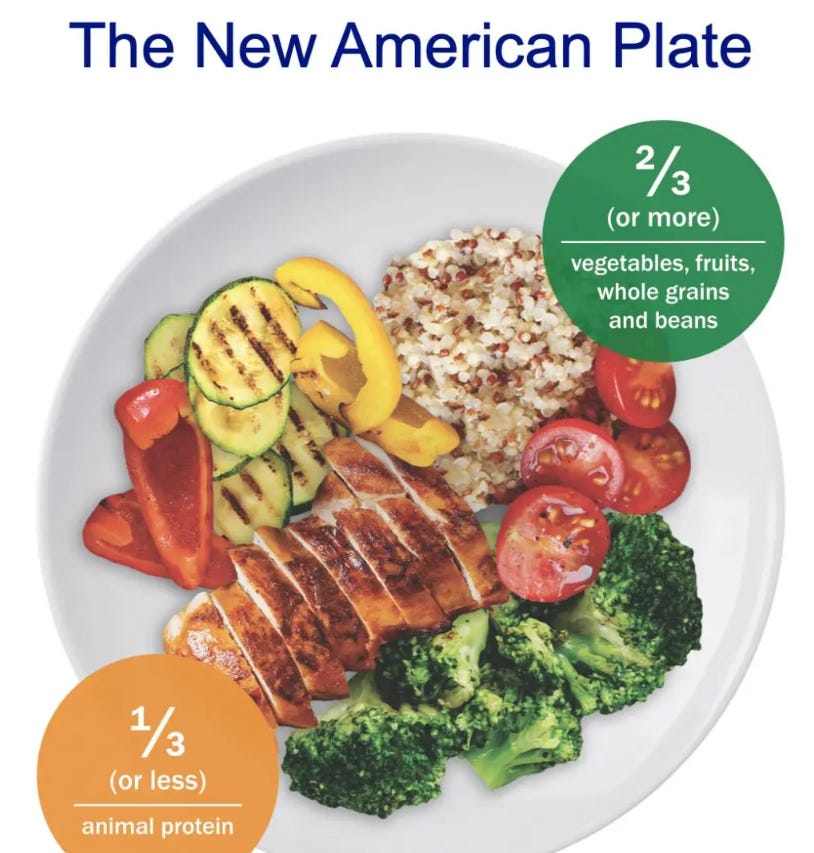
“…The New American Plate illustrates AICR’s 2/3 to 1/3 plate principle—filling 2/3 or more of your plate with colorful plant foods such as vegetables, fruits, whole grains, beans, nuts and seeds and filling the remaining 1/3 or less of your plate with animal foods such as poultry, seafood, lean red meats, eggs and dairy….”
☑️Treating Depression Successfully Requires a Multi-Pronged Strategy | by Mandy Willig, PhD, RD
“…Exercise and nutrition can play an important role in managing depressive symptoms, but very rarely do they fully replace therapy and medications. Saying that someone with clinical depression can stop using traditional treatment therapies if they move more and eat better food could cause people to not seek treatment when they need it most….”
☑️🎙️PODCAST: Restoring the Balance: An Approach to Nutrition Education in Primary Care by Institute for Healthy Childhood Weight
“Dr. Sandra Hassink is joined by Dr. Natalie Muth and Registered Dietitian Carrie Hamady to explore balanced approaches to nutrition and engage in meaningful conversations about healthy eating with families. They tackle popular nutrition topics, including high-protein diets and saturated fats. They also discuss how to identify credible sources of nutrition information.”
Comments
Nothing yet. Say the first thing.
Sign in to join the conversation.