
Hey Friends 🖐️,
I got the chance to talk with a fellow HW product manager and Substack author. Adesh is a 0-1 product leader in the renewable energy, HW/SW integration, and AI workflow spaces.
As software gets saturated by AI, companies are rapidly moving towards the physical world for differentiation. I enjoyed talking to Adesh because he embodies the next wave of builders.
We discussed how the future will belong to generalists who, while they do possess domain expertise, have the ability to orchestrate multiple, broad fields.
A great example is in the energy space, which is moving towards an intelligent, decentralized infrastructure. We also uncovered some career tips and product development frameworks. Enjoy!
Check out Adesh’s work here 👇
I’m a product and systems thinker who has spent the last eight years figuring out how to make hardware, software, and AI play nice together in the energy sector.
My career has been defined by the 0 to 1 journey of industrial energy products. I’ve led the lifecycle of everything from commercial energy storage systems and microgrids to energy management platforms. Currently, I’m at Palmetto, where we’re working to accelerate the transition to sustainable energy for homeowners.
We’ve spent decades building energy as linear infrastructure, but we’re moving toward a world where energy is an interactive, decentralized platform. My job is to bridge that gap by taking complex, heavy engineering and turning it into a seamless, go-to-market product strategy.
Because I’m a builder at heart, my weekend projects usually look a lot like my day job. I run Simplergy, a newsletter where I break down complex energy tech for other operators into simply easy to understand language. Most recently, I launched EquipDB, which is a free, open source database for the BESS (Battery Energy Storage) industry. I built it (with the help of an AI agent named Remo) specifically to solve the ‘PDF datasheet nightmare’ that every hardware engineer knows all too well.
I’m driven by the belief that the next decade of innovation won’t just happen in the cloud, it’s going to happen in the physical world, powered by smarter, cleaner infrastructure.
If I had to pick one, it would definitely be building Energy Management Systems (EMS). It’s an IoT product at its core. The brain that monitors, controls, and optimizes a complex mix of inverters, batteries, and EV chargers.
I’ve always been fascinated by the Nest or Tesla Powerwall effect, how a single, well designed piece of hardware can suddenly unlock massive utility for everyone, from the homeowner to the after sales service team. Working on EMS was my deep dive into that world of HW-SW integration.
The most rewarding part wasn’t just the high level orchestration, though. It was the intricacy of the firmware development. There’s a unique kind of satisfaction in solving the low level communication hurdles between a battery and a charger, knowing that those technical wins directly translate into a more resilient grid and a better experience for the end user. It’s where the abstract goal of ‘electrification’ becomes a physical reality you can actually measure.
I’ve found that the definition of Product Management changes depending on the ‘gravity’ of the product. PMing for a pure play software company is a different beast than PMing for a service company enabled by hardware. While there are overlaps, three core differences define the hardware experience:
Regulation: In software, you’re often limited only by your imagination and the tech stack. In hardware, regulation drives the roadmap. Being deeply knowledgeable about codes, standards, and UL certifications is a necessity. Every decision we make is tethered to supply chain dependencies and safety standards that simply don’t exist in the unregulated world of software.
Iteration Cycle: In hardware, the undo button is incredibly expensive. The speed of development is naturally slower because every decision carries a high magnitude impact on the COGS (Cost of Goods Sold). You are working in a highly constrained environment with intense stakeholder dependencies. In software, you ship and iterate. In hardware, if you miss a requirement before the molds are cast, you might delay a launch by six months or more.
Domain Expertise: Building connected products requires a unique kind of polymath leadership. You’re managing a symphony of mechanical, electrical, firmware, and cloud engineering. As a PM, you have to speak all those languages fluently. A single missed detail in the firmware to hardware handoff can lead to a product that doesn’t meet industry standards or, worse, a complete production halt.
At its core, the goal of a HW PM is to de risk high stakes decisions. You carry a high degree of ownership, but you have to balance that by ensuring total cross-functional alignment. In this role, stakeholders look to you for a definitive opinion. It’s not just about being right it’s about having the conviction to lead and the diplomacy to keep diverse teams moving toward the same goal.
The challenges also shift depending on the stage of the company. In an early-stage venture, your job is to bring clarity to chaos and define the product’s soul. In a later stage organization, the focus shifts to sustaining product lines and staying ahead of evolving market requirements. Ultimately, it’s a constant balancing act: managing expectations, staying obsessed with strategic priorities over mere execution, and maintaining a strong, real-time pulse on the market.
If you want to excel in hardware, you need a toolkit that can handle the ‘friction’ of the physical world. It’s a niche role that requires a very specific blend of technical grounding and strategic intuition. I’d boil it down to four essential pillars:
Bringing clarity to chaos: Hardware development is inherently messy. You’re managing shifting lead times, technical bottlenecks, and manufacturing constraints. Your primary job is to be calm in the storm and distilling all that noise into a clear, actionable path for your engineering and operations teams.
Pulse of the market: Because your iteration cycles are so long, you have to be a bit of a futurist. You aren’t just building for today’s market, you’re building for where the market will be in 18 to 24 months. If you lose your pulse on where the industry is heading, you risk shipping a product that is obsolete the day it arrives at the warehouse.
Domain Expertise: You don’t need to be the person writing the firmware or designing the PCB, but you must speak their language. You need enough ‘bits and atoms’ fluency to understand how a mechanical change impacts the electrical design or how a firmware tweak affects the end user experience.
Bias for action: In hardware, silence is expensive. If a problem arises on the factory floor or a certification is delayed, you can’t afford to wait. You need the bias for action to tackle the issue immediately.
I have learnt a ton of product development approaches from various experts like reading BH blogs, BUILD by Tony Fadell’s and few others. One of the frameworks that’s my favorite is by Daniel Elzalde from his book B2b innovators map. In it he provides a very structured way to approach a problem for IoT product development.
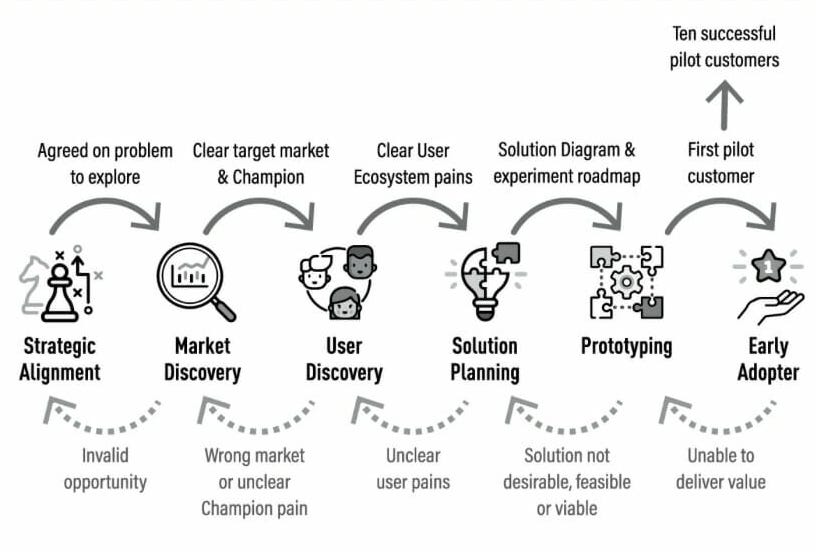
In addition to the above, the classic Phase Gate is one of the other frameworks that helps in ensuring a systematic approach to product development. Making sure all the stakeholders are aligned, no requirements have been skipped and de-risking the product at every stage.
In the B2B hardware space, especially in energy and electrification, you find it through validation. Because our products are critical infrastructure, the GTM strategy is less about marketing and more about integration.
It’s a Beta to Reference model. You partner with 2–3 Alpha customers, early-adopting installers, or fleet managers and treat them as design partners. You’re ensuring your product plays nice with their existing workflows.
You can’t A/B test a physical inverter in the field. Instead, we validate PMF through :
Technical Feasibility (The Lab): Can the hardware physically do what we claim?
Operational Fit (The Pilot): Does it survive the ‘real world’? Does an installer find it intuitive, or does it add two hours to their job? If the field crew hates it, you don’t have PMF.
Economic Validation (The ROI): This is the ultimate test. In B2B energy, PMF is achieved when the customer’s LCOE (Levelized Cost of Energy) or operational savings clearly outweigh the hardware’s Total Cost of Ownership.
In energy tech, no product is an island. PMF is often dictated by Interoperability. If your hardware doesn’t integrate with the utility’s software or building energy management system, the market won’t adopt it. We validate this by ensuring our API and firmware support the symphony of devices already on-site.
GTM varies for B2B vs B2C products, as in the energy space, you have to design products considering an installer, homeowner, facilities manager, utility company, or a field service technician. So ensuring there’s a strong understanding of the distributor’s network and aligning with their goals becomes the most critical path.
For over a century, the blueprint of our electricity system hasn’t fundamentally changed. We’ve relied on a centralized model, massive power plants sending electrons one way across thousands of miles of poles and cables. It was a 20th-century solution that is now colliding with the 21st century reality.
Between the total digitalization of our economy and the aggressive electrification of transport and heat, we are putting a tremendous stress on a grid that was never designed for this load. To put it in perspective, global electricity demand is projected to rise by nearly 3.4% annually through 2026, yet in many developed regions, the wait time for new grid interconnections has ballooned to over 2 years. We are trying to run a high speed digital economy on an analog backbone, and the inefficiency is becoming expensive, especially as AI makes energy costs a primary competitive metric.
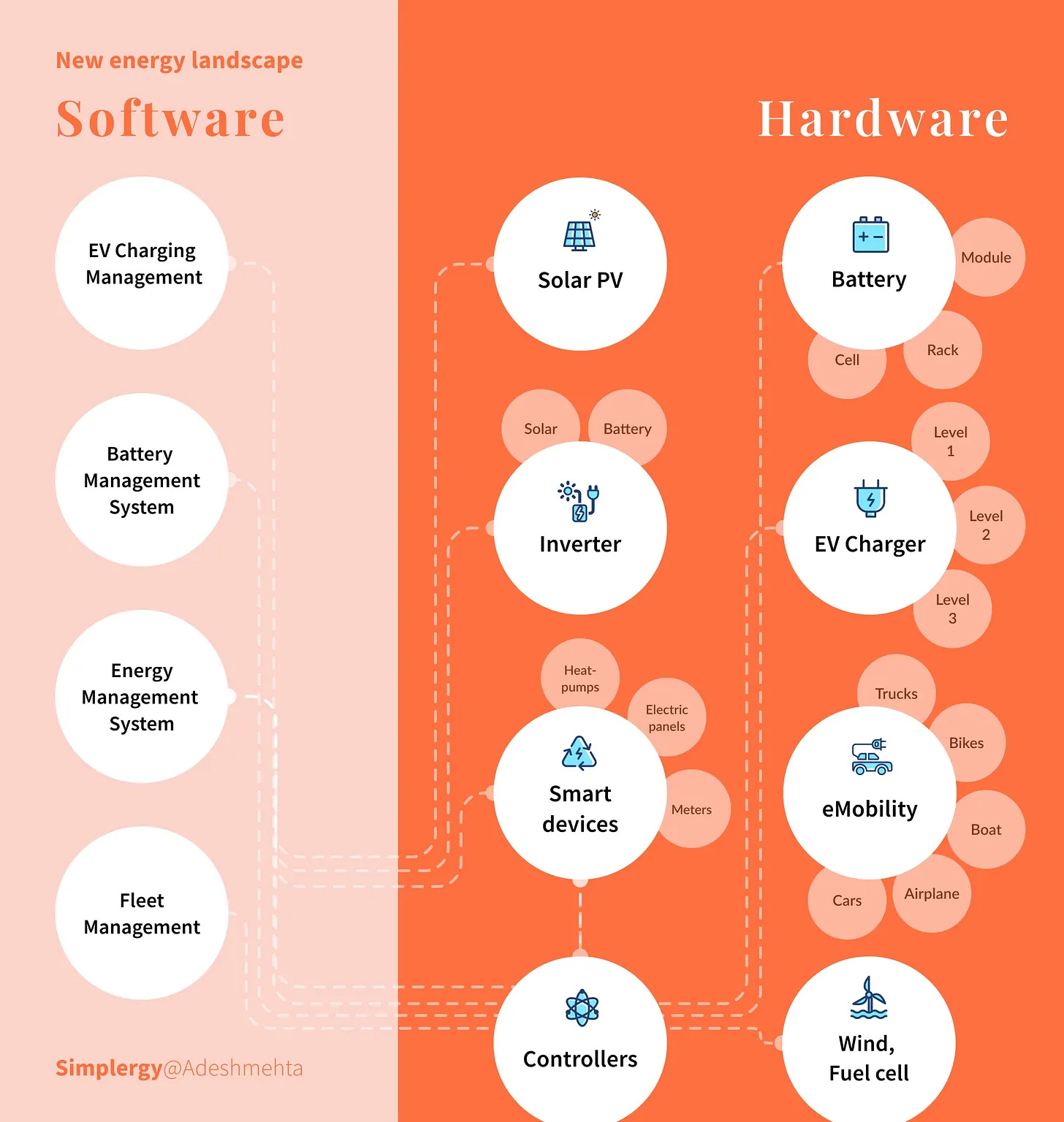
I believe we are witnessing the birth of a new energy landscape. We are moving away from total central dependence toward a world of Distributed Energy Resources (DERs). Every home and business is becoming a micro power plant, equipped with solar, batteries, heat pumps, and EV chargers. These aren’t just appliances anymore. They are interconnected assets that allow for energy independence, lower bills, and a smaller carbon footprint.
For developing nations, this is even more critical. It’s a path to escape the volatility of oil imports and geopolitical instability. By building local, renewable capacity, these nations can bypass the centralized stage entirely, much like they skipped landlines for mobile phones.
The Full Stack Energy Model represents a shift from a linear, centralized infrastructure to an integrated, software driven platform. While traditional energy models focus on moving electrons from point A to point B, the full stack model focuses on orchestrating those electrons through a combination of generation, retail, and technology. Traditional models generated revenue based on consumption (selling more kWh) where as the full stack model generates revenue based on optimization and energy as a service.
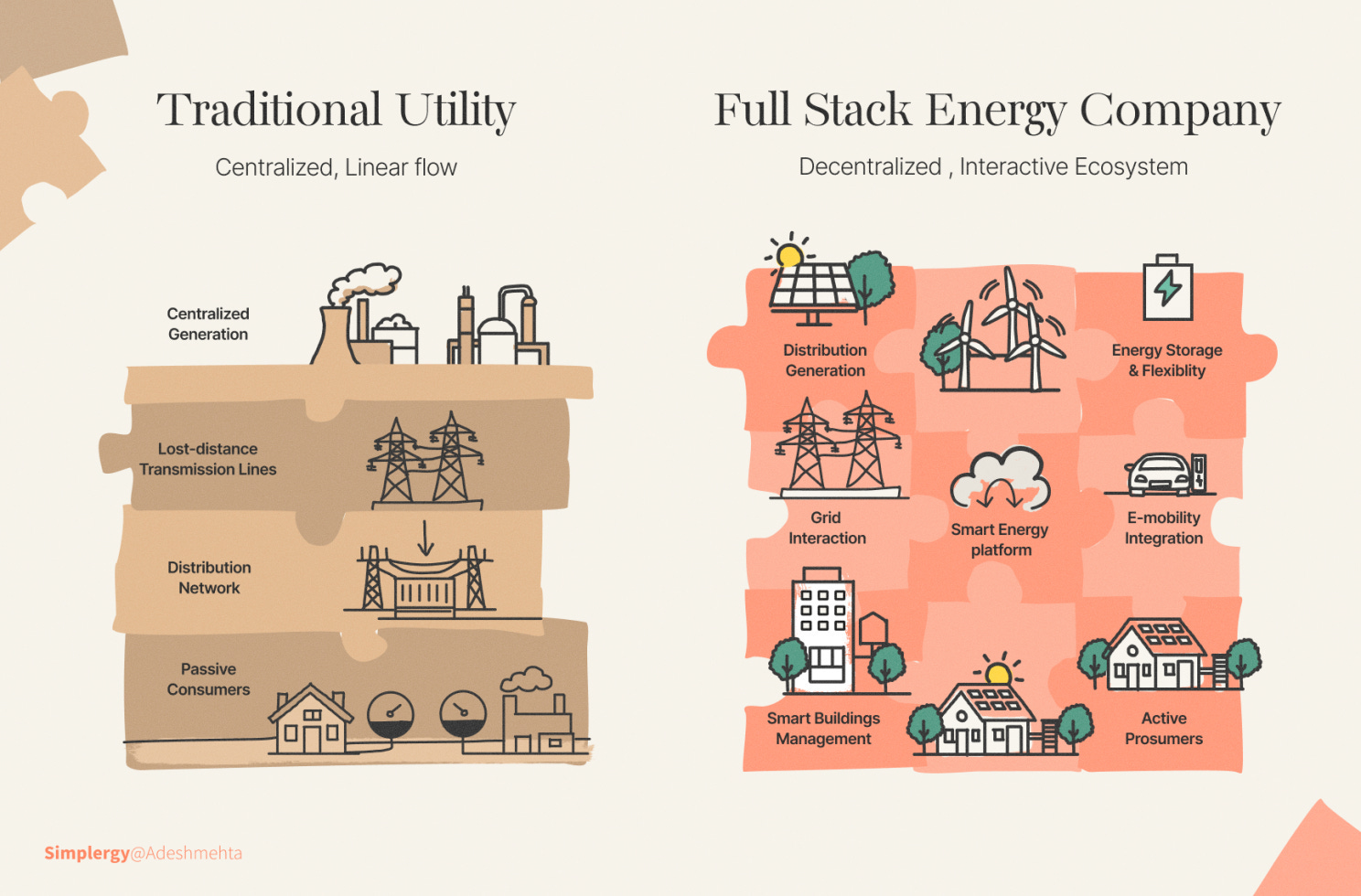
Key components include:
Vertical Integration: Companies like Fuse Energy or Octopus Energy collapse the value chain. They don’t just resell power, they own the “studio” (renewable generation), the distribution (the app), and the recommendation engine (AI trading).
Distributed Energy Resources (DERs): The model relies on a decentralized network of hardware, including solar panels, EV chargers, and residential batteries. These assets allow the customer to become a “prosumer” both consuming and producing power.
The Software Layer: This is the “brain” of the stack. It uses AI to manage gigawatts of individual devices, balancing the grid in real time. This turns thousands of homes into a Virtual Power Plant (VPP) that can rival the output of a traditional gas plant.
Think of a Virtual Power Plant (VPP) as a digital symphony of hardware. It’s an aggregation of smart, distributed devices like batteries, heat pumps, and water heaters that can collectively act with the capacity of a traditional power plant.
Take a home battery, for example. It often sits with unused capacity for large portions of the day. A VPP extracts that underutilized energy and directs it back to the grid during peak events, like a heatwave in the summer when electricity demand is at its highest.
By calling on these distributed assets, utilities can balance the grid in real time without spending billions on new infrastructure upgrades. In exchange, the utility incentivizes the battery owners, which significantly reduces the Total Cost of Ownership for the homeowner. It’s a win win, the grid stays resilient, and the prosumer turns their hardware into a revenue generating asset.
Energy has emerged as a primary bottleneck for AI deployment as the industry pivots from model training to inference. The massive compute requirements translate directly into higher energy intensity per operation, making power consumption a critical factor in data center economics alongside hardware costs. Because current grids are not equipped for this surge, energy is now a major value chain constraint; a single facility can consume as much power as thousands of U.S. homes. While the ultimate goal remains 100% renewable power, meeting current timelines and economic demands requires a strategic mix of various energy assets.
To optimize the levelized cost of electricity, these data centers utilize Uninterrupted Power Systems (UPS), advanced cooling, solar panels, and energy storage. However, infrastructure challenges remain; obtaining electrical permits can take 12 to 18 months, or even longer, depending on the region. With demand effectively guaranteed, OEMs are now prioritizing high quality production and shorter lead times to combat historic delays, such as the 128 week wait for large power transformers.
Product leaders are adopting cross industry techniques to solve these challenges, such as battery manufacturers implementing automotive development processes to ensure quality. By applying first principles thinking and a user centric approach, they are reinventing how this critical hardware is brought to market.
One of the biggest shift is moving beyond just simple monitoring to autonomous decision making. Traditional smart grids tells when something is wrong and provide predictive intelligence, whereas Physical AI fixes the issue in real time without human intervention. We will see AI agents managing microgrids - making autonomous decisions and this will enable managing the renewable energy assets smartly. We are moving from predictive analytics to active orchestration of physical assets.
Another area is filing up deployment gap, where we have technology for clean energy but the installation process is complex and time consuming or we do not have labor. Imagine using autonomous robots to deploy solar panels on a roof or in large land to build solar farms.
Its never been a better time to connect bits and atoms. Bits dominated the last few decades and now with convergence of AI x compute x embedded systems its been an incredible time to building autonomous infrastructure at scale.
To be honest, I didn’t set out to be a Hardware PM, I chased my curiosity and, in many ways, I got lucky. I’ve realized that there isn’t a standard training manual for this role because HW PMing is more art than science. It requires a specific blend of taste, judgment, and deep expertise that you can only really develop by being in the trenches.
For me, domain knowledge enabled me to get into the HW PM path. I have spent most of career in the renewable energy field, which gave me holistic knowledge about the industry, customers, different technologies. To break into this space, you either need to have strong domain knowledge or have the ability to learn quickly. Additionally having knowledge about operations or supply chain can be helpful. Make sure you understand lead times and COGS.
Ultimately, HW PMing is different based on the type of company you’re targeting, for eg: HW PM at Tesla will be different compared to PG&E. Other tips are to build a physical product portfolio by doing side projects, joining early stage startups, or working with design teams.
One of the books that shaped up my thinking about approaching a job or even if you’re an entrepreneur is The Startup of You by Reid Hoffman. Overall I’d focus on four areas.
Full Stack PM : In todays world with knowledge becoming available so easily across any domains, for anyone to succeed, they need to have a full stack approach. Don’t be narrowly focused, but rather have a broader and more holistic attitude while problem solving.
Be curious: Read, write, and meet with people in your space. You learn alot over time by simply asking questions.
Think long term: Your career is a marathon, not a sprint. Find the right set of people to work with for sustained growth.
Be valuable: Add value before seeking help. Attend events, post online, share insights about your space, and build in your spare team. Think of yourself as a startup and opportunities will find you.
For more tips, follow Adesh’s work here 👇
Our readers have been requesting a practical guide to taking a hardware idea from concept to mass market.
We’ll be covering principles including HW product sense, business feasibility, go to market planning, user desirability, and technical viability.
Our goal is to help beginners or even experienced product makers sharpen their craft. Drop your email below for access to initial modules and early bird pricing.
Make sure you check out some other articles:
No posts
Comments
Nothing yet. Say the first thing.
Sign in to join the conversation.