
This is a follow-up article to “How to Find the Best Deep Tech Accelerator for Your Startup" where I discussed how to figure out if an accelerator fits your needs, and “Stop the Accelerator Merry-go-round,” where I discussed how to use accelerators as strategic tools.
The Takeaway: Deep Tech Dirt is a new website for deep tech founders that lets them give and receive honest intel about accelerators, investors, grants, conferences, and all other parts of the deep tech ecosystem. And I’m looking for your input and feedback to keep it on track.
Last week, I was running a workshop on developing a funding strategy for startups. We were talking about sources of non-dilutive funding when one of the founders spoke up.
“Why isn’t there a website where you see all of the details about accelerator programs in one place? Like which ones have a fee, which ones take equity, which ones invest? And then something about whether the accelerator is worth it. I would pay $10-20 per month to get all that information in one place.”
“That’s a great idea,” I said. “And I’m working on something just like that.”
This post is going to be a little different than my usual posts. I’m going to share with you an experiment I’m launching: an experiment in building a community for deep tech founders, especially PhD founders, where they can find the right resources at the right time for their startup. Think Glassdoor for deep tech meets Reddit. And I’m asking for your input to make sure I’m on the right track.
One of the hardest parts of being an entrepreneur is not wasting your time.
And there are lots of ways to waste it: building a product no one wants, talking to investors who don’t have money to write checks, working on an accelerator curriculum you’ve done for the third time.
In my last post, I discussed the challenges of finding an accelerator that fits your needs. But the reality is that finding anything you need—investors, lawyers, accountants, grants—is a huge time suck for founders. This is especially true for first-time founders coming from technical backgrounds. I asserted that the best way to cut through the noise is to talk to the founders who’ve been through it.
Search engines can help you find the lists, and LLMs can help provide a synthesis of lists and Reddit forums, but neither can give you the unvarnished truth of someone who’s lived the experience.
But connecting with founders is its own challenge. Founders are extremely busy, hustling to achieve the next milestone to unlock a customer or investor. So, finding time to ask questions and get answers may seem impossible.

I asked myself: Is there a way to surface founder intel without having to have an individual conversation with a founder?
So, I started working on a new idea. What if there were a website just for deep tech founders where they could share their honest take on accelerators, investors, and other parts of the deep tech startup ecosystem? A Glassdoor for deep tech.
It would need to be just for founders to encourage openness and avoid spam. There would need to be a curated foundation of knowledge to ensure there was a source of truth for conversations. There would need to be transparency of who was posting, but also occasional anonymity to let people avoid retribution for unflattering stories. And it would need to be useful, helping solve problems that founders have all the time.
Fortunately, turning an idea into a reality suddenly became an order of magnitude easier less than a year ago, thanks to new artificial intelligence coding tools. I installed Claude Code and started building.
In fits and starts, I created Deep Tech Dirt, a website where deep tech founders can provide honest intel to other founders on accelerators, investors, grants, conferences, and pretty much anything else related to deep tech venture building.
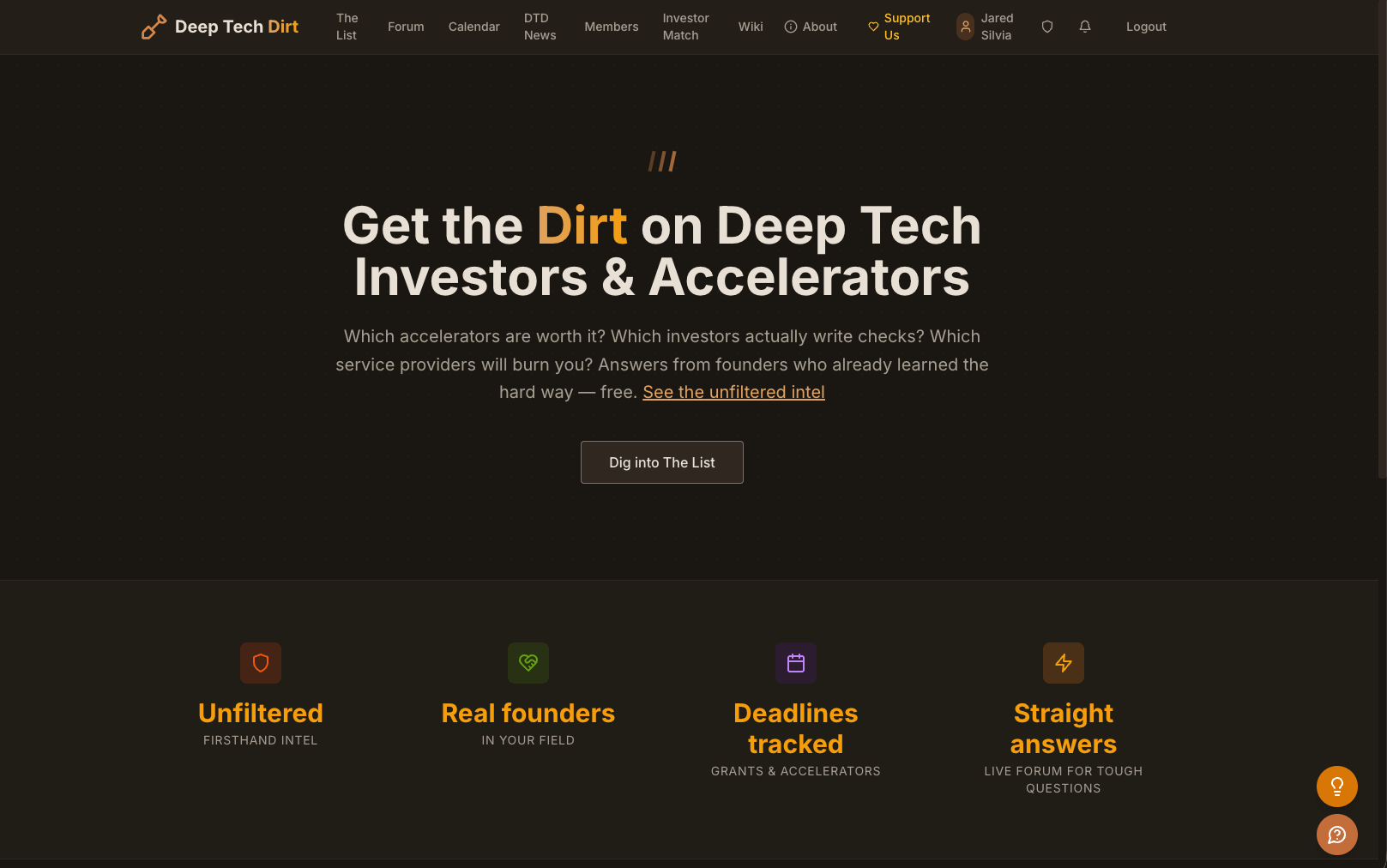
I’ve got a couple of test features that I think have promise. There is a list with investors, accelerator/incubator programs, conferences, and grants, but what’s unique is that founders can share intel on any entity they’ve worked with. Have a good experience? Sing their praises. Have a bad experience? Warn other founders.
The database is integrated with a news section. Venture deals or fund announcements are tagged to investors or programs. I’ve put a little analysis at the top to get a quick snapshot of deep tech investment trends, but I’m not sure it’s surfacing the right information, so let me know what you think.
I also have an investor match feature where you can submit your pitch deck, and the system suggests up to 30 investors who are prime candidates for outreach. This is still in beta testing, so I’m not sure if it’s truly useful. Take a look and tell me what you think.
As I said earlier, this is all a work in progress. And you can have a major influence on what it becomes.
So, I’ve built something, but I need your feedback. If you are a deep tech founder who’s either just starting out or who’s been toiling away for years, I want your reactions and thoughts to Deep Tech Dirt.
Love it? Awesome! What’s bringing you back for more?
Find it humdrum? Cool, but what problem do you have that it’s not solving for?
Please, visit the site and give me your hot take. Reply to this email or leave a comment on the post.
As I said, this is an experiment. Building an online community in 2026? That’s a truly epic challenge. But if it goes well, my hope is that we can make it a little easier for every future founder to start a deep tech startup.
If you enjoyed this article, please Like and Restack it. Thanks.
Jared Silvia, PhD, has worked in the energy and materials sector for over 15 years, as a consultant at McKinsey & Company, Director of Product Management and Marketing at Doosan GridTech, and CEO and Co-founder of BlueDot Photonics. He is now a Partner at Gliding Ant Ventures, where he co-builds deep tech companies with technical founders from science and engineering backgrounds.
Comments
Nothing yet. Say the first thing.
Sign in to join the conversation.