
This is a follow-up article to “Stop the Accelerator Merry-go-round,” where I discussed how to use accelerators as strategic tools.
The Takeaway: Determining whether a deep tech accelerator is a good fit for you or your startup can be challenging, especially if you come from a PhD or science-and-engineering background. Asking the right questions about mentors, networks, and outcomes is key. But the current search tools and LLMs fail you most of the time. You need firsthand insights from founders who participate in the programs.
A few months ago, I wrote about how to get the most out of an accelerator program. And I discussed how important it was to make sure the accelerator is a good fit. But I didn’t do a good job of describing how to tell if an accelerator is a good fit.
This is especially problematic for first-time founders from science and engineering backgrounds; it’s unlikely that you have any experience or network to evaluate accelerators.
I also realized that there aren’t great resources for telling whether an accelerator is a good fit. This creates an accelerator-fit gap that every founder has to deal with.
What is the accelerator-fit gap? It’s the challenge every founder faces when deciding whether an accelerator is a good fit and worth the time and energy to apply to and participate in. And it exists because the internet is full of resources that are outdated, anonymous, and generic.
Today I want to look at this particular challenge and what you, as a founder, need to do to overcome it.
First, we need to determine what information you should look for to assess fit. I’ve broken this search down to answering three questions:
In almost every accelerator I have been a part of, the mentors were the make-or-break feature of the program. These are the people who will understand your company the most deeply. A mentor should challenge your assumptions, brainstorm at both the strategic (e.g., who is the right customer) and tactical (e.g., how can we get you an introduction to the CTO of Company X) levels, and not just parrot the curriculum.
Accelerators that don’t expand your network are rarely worth it. You need to understand not just who is at the accelerator, but how readily the program organizers introduce participants to their network. If you can’t come out of an accelerator with dozens of meaningful new connections, it probably isn’t worth the time.
If both of the previous attributes look positive, this last question should be a given. But it’s always good to know that an accelerator created value for several founders and changed the likelihood of their success.
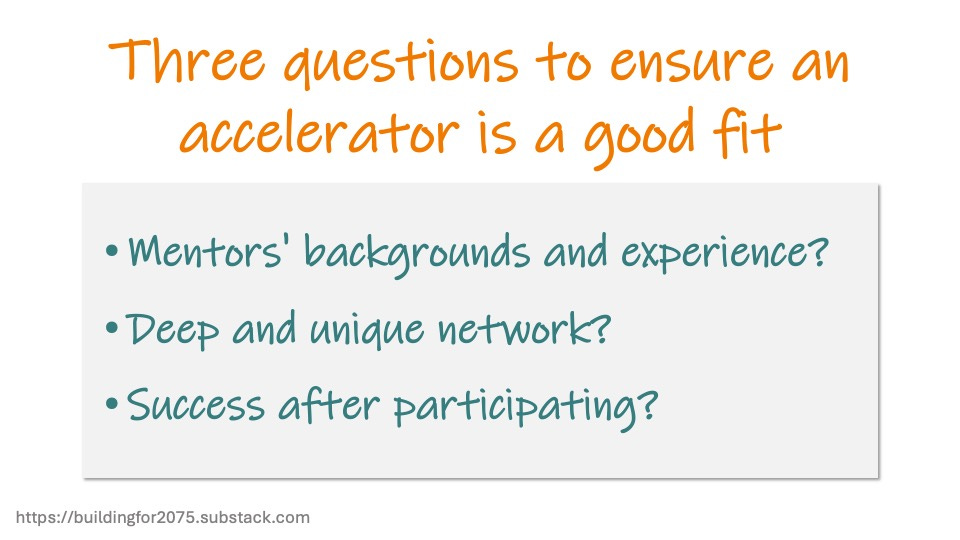
If you get a “yes” for each of these questions, that’s a strong signal that the accelerator is a good fit. You still need to consider the monetary and cap table impact of participating, but that’s secondary to deciding whether the program will give you what you need.
OK, you’ve got the questions to answer, so how do you get the answers? You probably will turn to a search engine or an LLM. But getting to the nuanced, tailored answer using these tools is not straightforward.
Don’t believe me? Let’s look at what happens when you search for accelerators.
You can Google search “best accelerators for cleantech startups,” and you get the typical combination of AI summary and blue links:
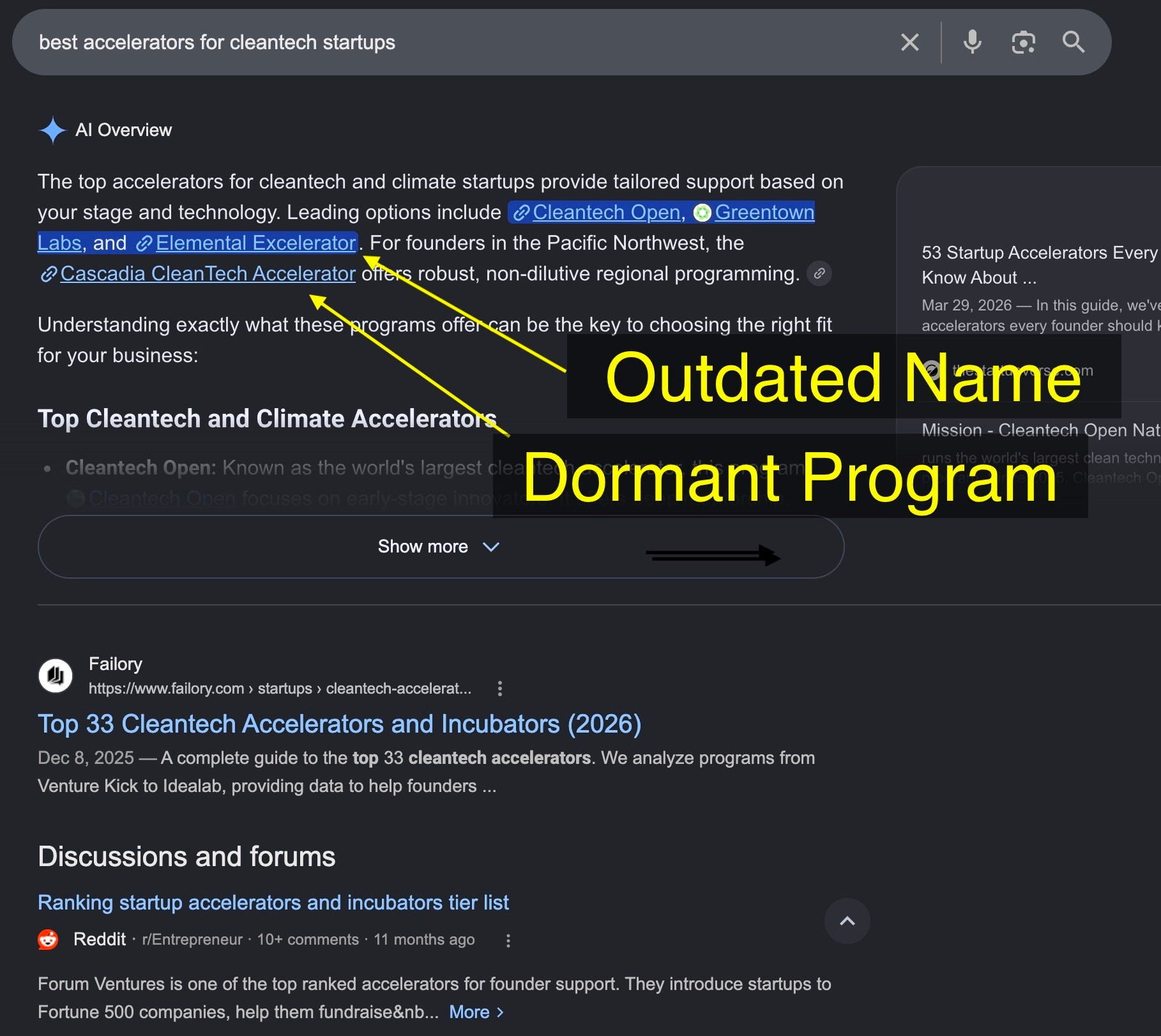
The AI summary leads off with three cleantech standards: Cleantech Open, Greentown Labs, and Elemental Excelerator. Fine, except that these three programs are like comparing apples, oranges, and bananas.
Cleantech Open is a classic accelerator, built on the Lean Startup and Business Model Canvas structures.
Greentown Labs is a classic incubator. You pay to be part of the space and community. There is informal programming, and mentors are available.
Elemental Excelerator no longer exists. The organization rebranded to Elemental Impact.1 They are a nonprofit investor that provides catalytic capital and coaching, great if you are ready for investment, but not helpful as an accelerator.
And in this AI summary, because I’m in the PNW, the Cascadia Cleantech Accelerator is called out. Unfortunately, this program hasn’t had a cohort in 2025 or 2026.
Great start, right?
Going down to the blue links, Failory’s list features prominently. Failory is a solid online resource for startups, and I appreciate their commitment to analyzing failed startups so people don’t repeat the same mistakes.
Their cleantech accelerator list, however, leaves me wanting more:
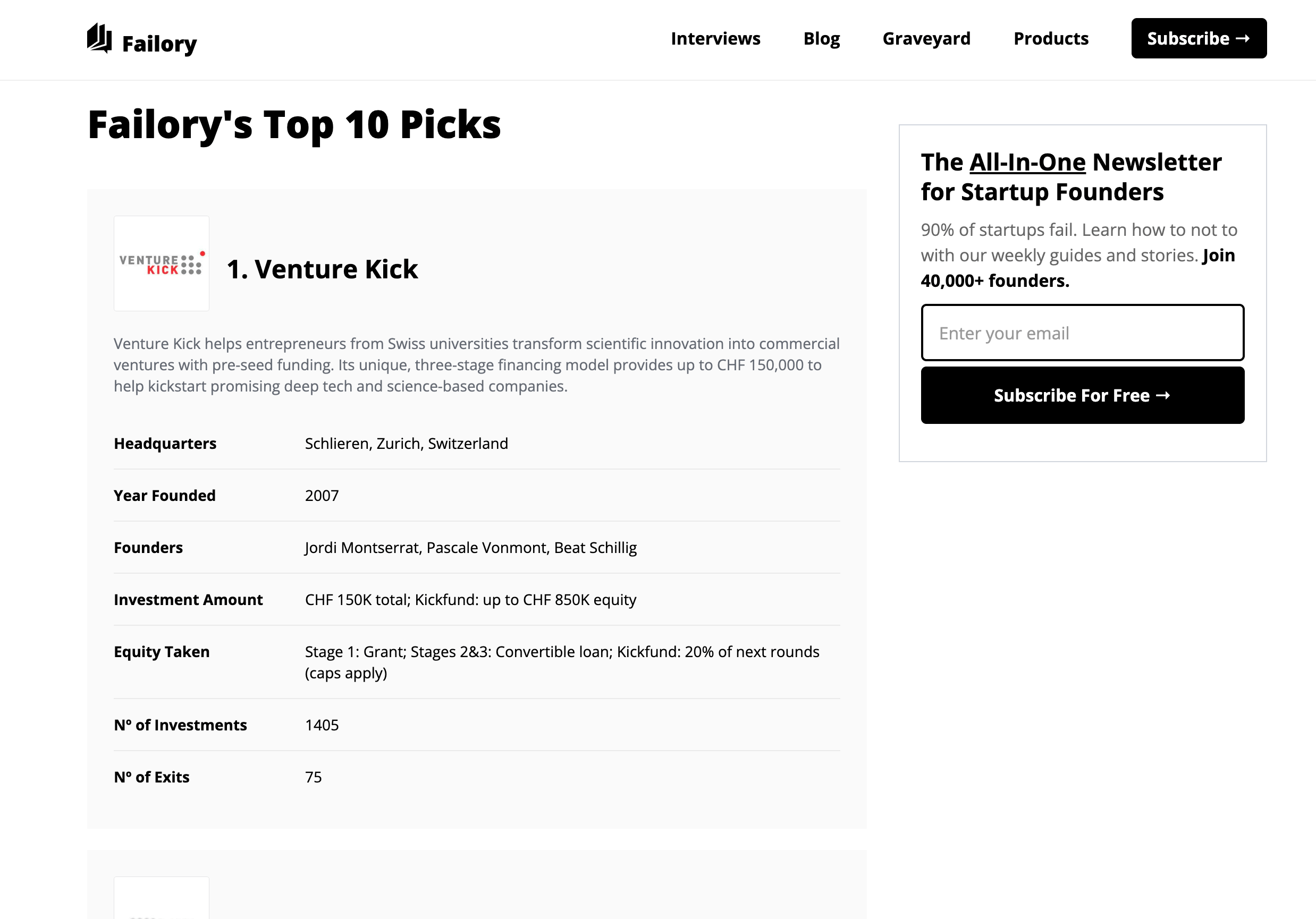
There’s a summary and seven facts about the program. You have to have faith that Failory has done its homework when it says Venture Kick is the best in 2026, or that it’s just sorting by the number of exits each program claims.
Is this useful? Half the battle is just finding relevant, active programs, so lists like these help with that. But there is really no way to gauge fit.
After the Failory list, the Reddit links appear. OK, now we have (hopefully) real people sharing their personal experiences about accelerators. But many posts are old, and anonymity doesn’t build trust or connections. And searching can be a nightmare.
OK, what does ChatGPT have to say about this?
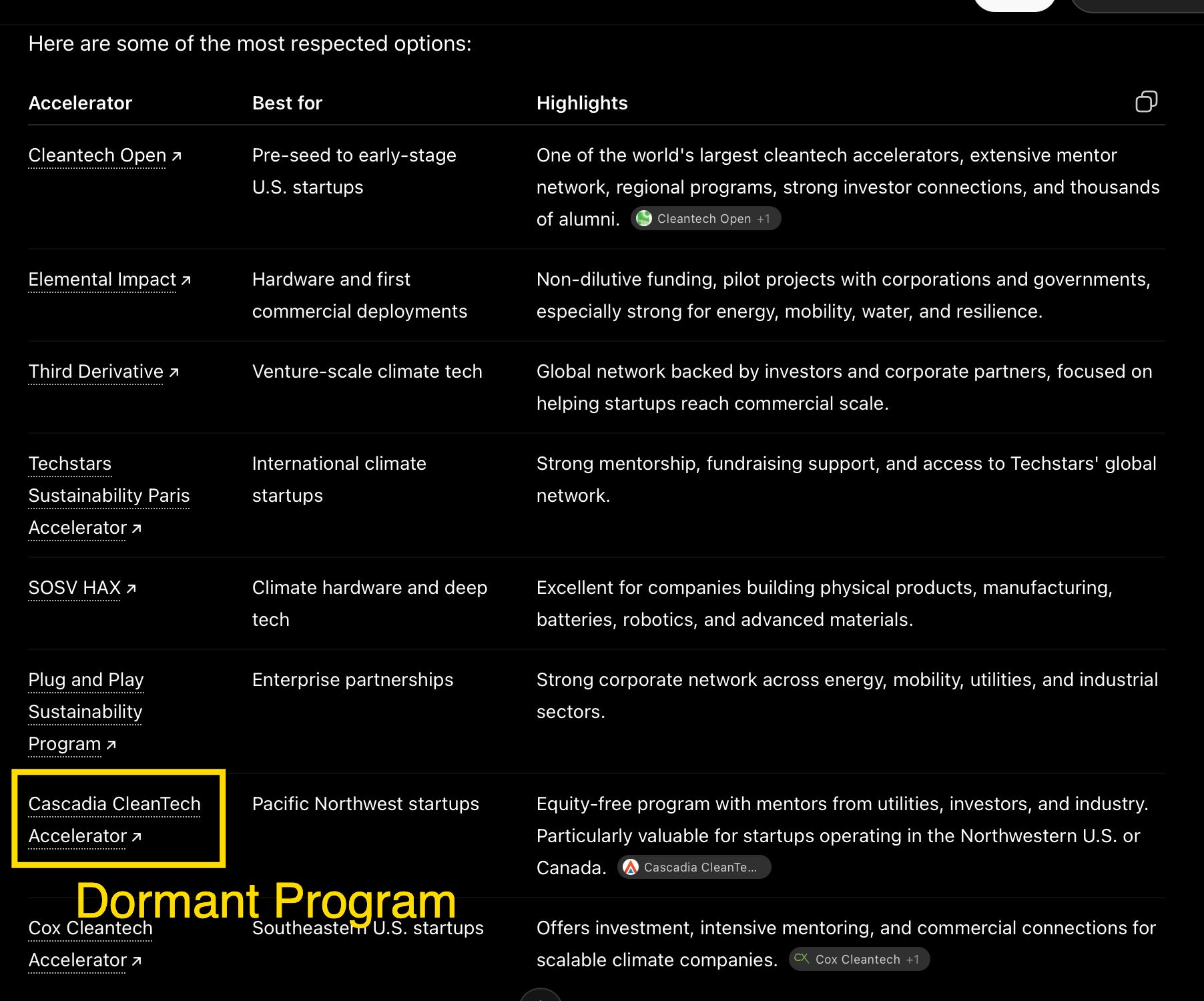
ChatGPT does a better job of casting a wider net, but it still reports some outdated info. Fortunately, it offers to create a tailored list of 5-10 accelerators if the user provides the startup's focus, funding stage, and location. When I do this (New battery materials to improve battery durability, between idea and prototype, and Seattle, WA), I get a slightly more tailored version, but the Cascadia Cleantech Accelerator is still on top.
Even if these tools were up to date and more tailored, would they give you the information you need to assess if you are a good fit? Maybe, but again, they never participated in the program, so are they really going to be able to tell you about the program's mentors, network, and outcomes? I don’t think so.
So where should you turn for answers to the three questions I described earlier? Founders who’ve been through it.
It’s obvious, I know, but it’s the truth. How is a search engine going to tell you about the quality of the mentors? How will an LLM assess the depth and uniqueness of the accelerator’s network?
Of course, this has its own challenge. Have you ever tried to schedule time between two startup founders? Two extremely busy people in a perpetual state of hustle? It’s like threading two needles at the same time, both constantly moving. Good luck.
Unfortunately, that firsthand knowledge from another founder is the information you need to make an informed decision.
Is there a way to surface founder intel without having to have an individual conversation with a founder?
In my next post, I will share how I have started building a tool to achieve this.
Have you ever been burned by an accelerator?
Was there a specific program that was game-changing for you?
Share your perspective in the comments.
If you enjoyed this article, please Like and Restack it. Thanks.
Jared Silvia, PhD, has worked in the energy and materials sector for over 15 years, as a consultant at McKinsey & Company, Director of Product Management and Marketing at Doosan GridTech, and CEO and Co-founder of BlueDot Photonics. He is now a Partner at Gliding Ant Ventures, where he co-builds deep tech companies with technical founders from science and engineering backgrounds.
https://elementalimpact.com/becoming-elemental-impact/
Comments
Nothing yet. Say the first thing.
Sign in to join the conversation.