
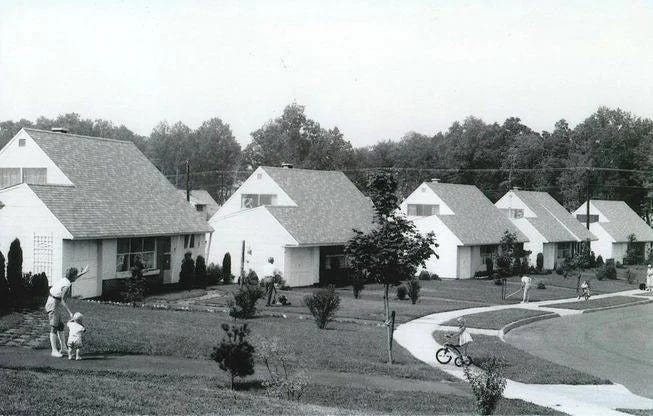
I want to write about the ongoing vibe shift in American communities. By “vibe shift” I do not mean a passing aesthetic trend or an online mood swing but the broader change in the underlying assumptions people make about how life should work: where to live, how to work, what a family looks like, what counts as success, and what kinds of places feel like they fit that life. I want to ask whether the economic and social conditions that made postwar suburbia feel rational, normal, and desirable still hold, if not, what will the future require.
The American economy is entering another period of evolution. AI is beginning to reshape work. Manufacturing is re-emerging under new political and industrial policies. At the same time, household structures, labor markets, and social expectations are shifting in ways that don’t fit neatly into the assumptions we’ve been using for decades. Reality is a lot more complex than most single-factor explanations.
People’s housing preferences are not abstract tastes. They are shaped by financial constraints, job requirements, family structure, peer norms, and the options actually available to them. Developers respond to markets as they exist, to what lenders will underwrite, and to what tax and regulatory systems reward. Local governments tend to be conservative in the literal sense: they aim to preserve the community structures that benefit their existing voters, not their future residents.
Many of our ideas about housing and community are still rooted in assumptions about the American economy and family life that are no longer stable. The institutions that regulate, fund, and build our places have been slow to catch up to the fact that the “ideal” American life is changing.
In this three part series I will look at the why the post-war suburbs worked (1945 - 1980), the demographic flip (roughly 1980- 2015) and conclude with what the next housing era needs (2015 - 2040 and beyond). In these pieces I’ve done my best to ground my observations using available data, to look at trends in employment, family composition, cost of living, demographic shifts and surveyed preferences.
I think it would be easy to just inject my opinion that successful places will attract people who just want walkability, mixed use, socio-economic diversity. After all, some of the most valuable places in the United States, our urban cores like New York, Chicago, Seattle embody these principles. When I read urbanist literature there is a kind of “optimism” and “repair” of broken systems, and in some ways it comes off as patronizing. How many of these writers live in a detached home somewhere? Does the future of America really look like mega metropolises? If we look at history, the growth and expansion of suburban places far outstripped the growth of these cities. People vote with their wallets.
What can we learn about demographic changes, family structure changes, income distribution and work changes that might give us a hint to the needs and preferences of future Americans? Where will baby boomers go when their houses become too much to handle? How will young Americans find their own path to ownership? What are the needs of an increasingly diverse American population?
The outcome of these pieces is to create a framework to better prepare our cities and towns for the future. All of our communities aim for growth and prosperity. But just like the elevator operator and houses with a parlour, if we fixate on a paradigm or vibe that no longer reflects America, we risk building the wrong things. And those who don’t catch on will miss the boat.
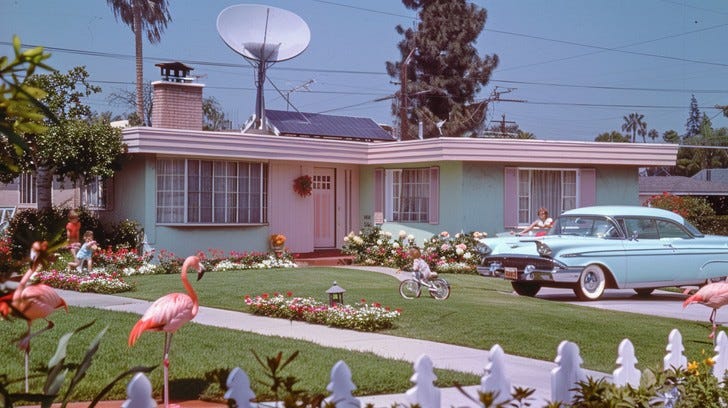
I think it’s hard to argue to the average American that they don’t want a beautiful detached house in a quiet neighborhood at a reasonable price and of course with minimal neighbourhood traffic and easy access to the freeway. For many this is the “ideal” way to live, a kind of democratic “everyman” vision that is at once both aspirational and the standard. It’s well known that this model requires incredible amounts of land both for the houses and the road/parking infrastructure. In a country as big as the US, why not continue that model?
In the United States, with abundant land and a long tradition of expansion, it once seemed obvious to keep building this way.
What were the vibes that led to the suburban ideal? We didn’t arrive there all at once. The desire to leave behind the city’s noise, crowding, disease risk, and disorder is much older than the postwar suburb. Nineteenth- and early twentieth-century city governments were preoccupied with fire, ventilation, sanitation, and other health risks associated with dense urban life. Residential suburbanization in the United States began long before 1945, but the postwar period scaled it from an upper- and middle-class pattern into a mass national model.
I think it’s worth calling out here that hundreds of years ago wealthy British people and their early American descendants also desired this convenience and luxury, creating country houses to get away from urban problems.

The economic growth of post-war America required millions of people to work at factories and cities had the workforces these places required. This growth also created an economic ladder for millions. The collective belief that millions of households could enjoy what had historically been elite privilege was radical. For the first time in human history, it appeared achievable in post-war America.
The suburban ideal worked because it fit the structure of the American economy at the time. In the decades after World War II, economic growth of postwar America required millions of workers in factories and industrial supply chains. Manufacturing offered a large share of relatively stable, wage-paying jobs. Suburbs provided housing for a rapidly growing population with rapidly improving incomes that could offer them better housing, access to vehicles and increasing disposable income.
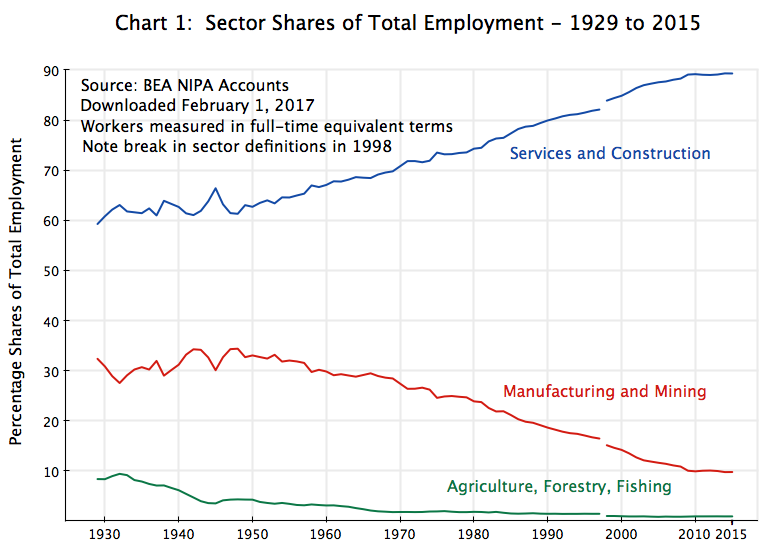
In 1945, manufacturing accounted for 38 percent of nonfarm employment, while services accounted for just 10 percent. By 1982, services had overtaken manufacturing as the nation’s largest employer. That later shift matters, but in the postwar decades many households could still imagine a clear ladder upward: from apartments in the city the move to a home in the hills was an achievable goal. In that context, long-term debt, homeownership, and spatial separation between work and home made sense. The suburban ideal was tightly aligned with the trajectory of the United States at the time.
The larger mechanisms of government policy also played a role. Public policy and technology helped turn suburban aspiration into a mass product. Federal housing policy in the 1930s and after reshaped mortgage finance by normalizing long-term, self-amortizing fixed-rate loans and expanding FHA-backed lending.
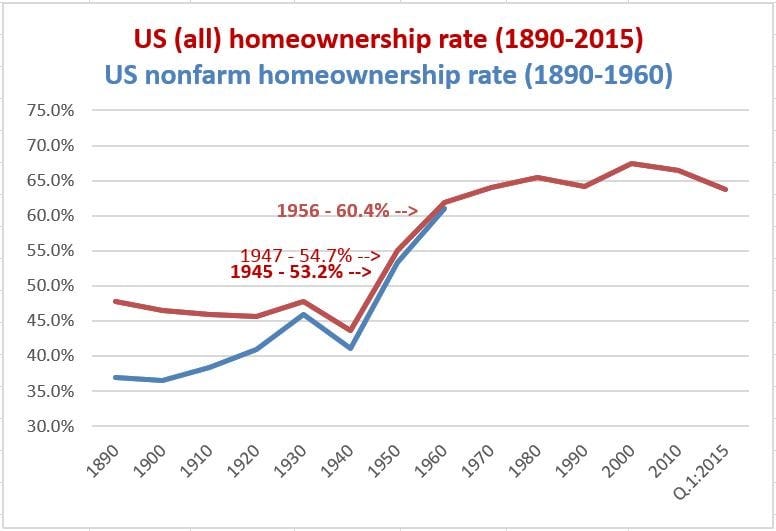
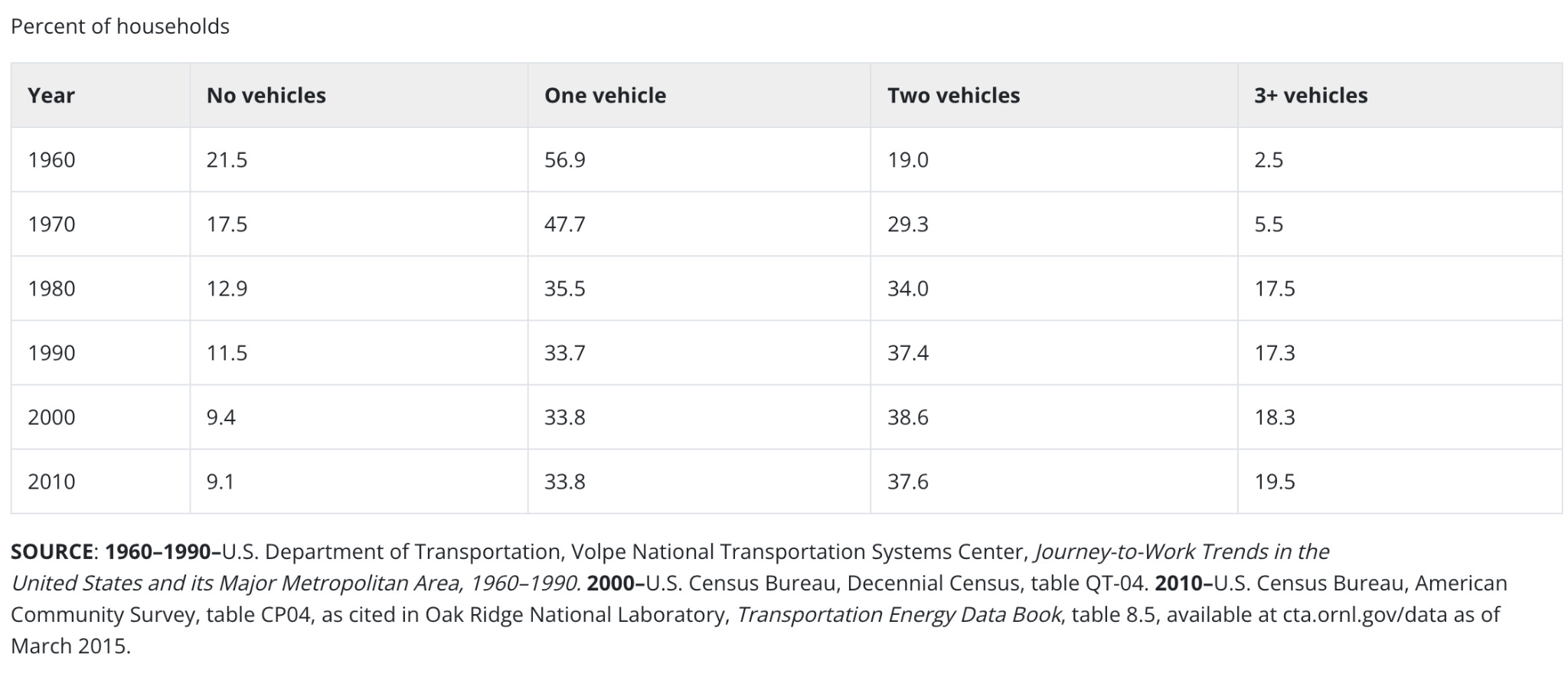
At the same time, the 1956 Federal-Aid Highway Act launched the interstate highway system, and car ownership surged. By 1960, about 78 percent of households had access to at least one vehicle, and by 1980 that figure had reached 87 percent. By 1960, 64 percent of workers already commuted by private vehicle, and that share would keep rising. Suburbia was a new settlement pattern made newly feasible by mortgage finance, personal transport, and public investment at national scale.
The growth of car ownership and the parallel creation of the interstate highway system meant that a growing number of these Americans had increasing mobility, and with relatively few others on the roads the convenience of one’s own “cottage in the woods” became possible. Commuting longer distances became practical, even luxurious.
Developers such as William Levitt recognized what these forces made possible. Levittown succeeded not because it invented demand, but because it industrialized supply. The model used standardized components, specialized crews, and assembly-line logic to mass-produce houses that a much larger share of Americans could afford. The first Levittown eventually housed more than 82,000 residents in over 17,500 homes, and at peak production the company gained a reputation for completing a house every 15 minutes. For many buyers, this must have felt like the future: a new house, modern appliances, a yard, and access to opportunity.
But this system was never universally open. Federal policy and private practice helped widen access to homeownership for many Americans while also entrenching racial exclusion through restrictive covenants, discriminatory underwriting, and redlining. The postwar suburb was a democratization of comfort for some households, but it was also built through structures that denied that opportunity to many others.
What this model required, though, was a kind of conformity to both live and aspire to the “American way”. This meant conforming to a specific life pattern: a nuclear family, stable employment, two or more cars, and predictable upward mobility. Zoning, lending standards, infrastructure investment, and homebuilding practices all quietly assumed that most households would look roughly the same.
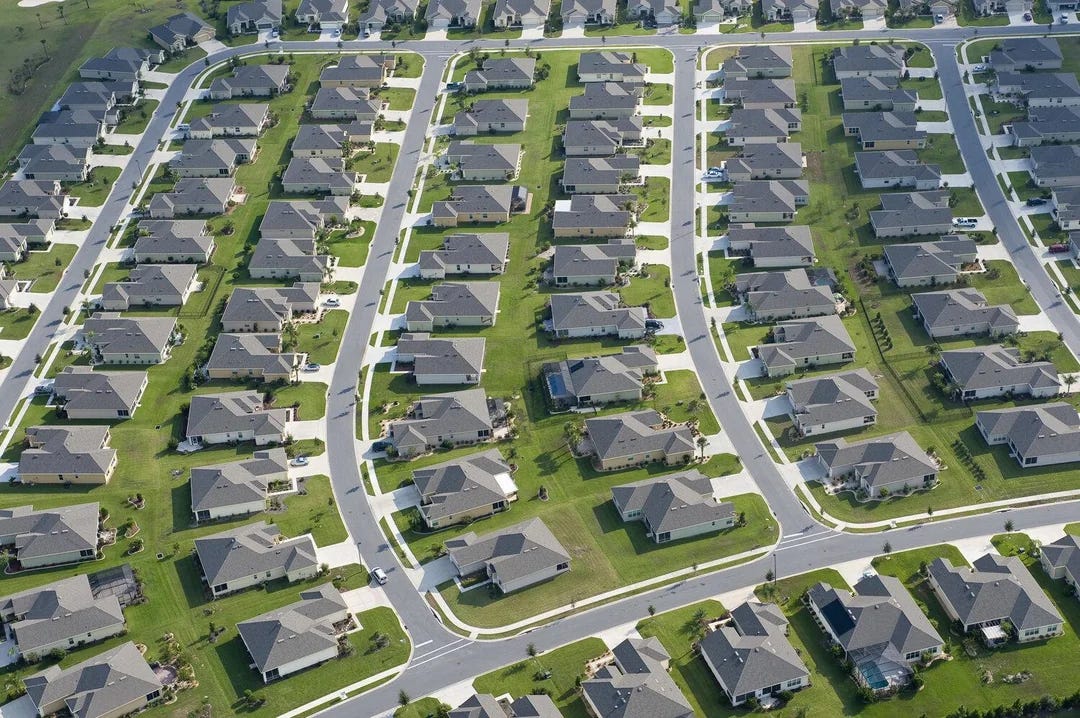
For decades, this assumption held. The suburban system didn’t just reflect preferences; it depended on a high degree of similarity across households in income, family structure, and life trajectory.
Social pressure and financial success are incredibly powerful forces in America. With exploding demand, Levitt and his imitators continued scaling this model nationwide. Once the model proved financially and politically successful, local governments began to hard-code it into law. Zoning, parking requirements and minimum lot sizes separated uses, limited density, and protected low-density neighborhoods from change. These changes were designed to preserve a tax base, stabilizing property values, and reassuring existing homeowners. Over time, suburban growth became self-reinforcing: local governments approved new subdivisions, extended roads and utilities, and counted on continued growth to help support the fiscal burden of maintaining that expanding network.
Critics such as Strong Towns have described this as a “growth ponzi scheme,” arguing that many municipalities enjoyed the short-term revenue from outward growth while pushing long-term maintenance liabilities into the future. Even without using that phrase, the underlying point stands: the model worked best when growth was broad, incomes were rising, and the bill for long-term maintenance had not yet fully come due.
As daily life reorganized around the automobile, commerce changed with it. Traditional downtowns had been built for pedestrians, short trips, and incremental storefronts. They were poorly suited to an economy in which more households expected to drive everywhere and park directly in front of every destination. There wasn’t enough parking in traditional downtowns for the traditional way of buying groceries from the butcher, the baker and the fruit stand or clothes from the suitmaker and supplies from the fabric store.
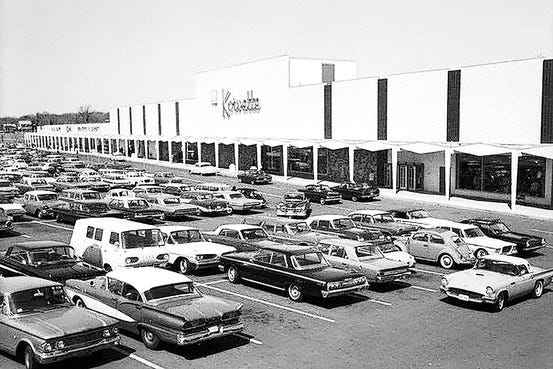
Towns and Cities, struggling to deal with the influx of traffic and parking issues brought on by growth of car use codified parking minimums with extremely optimistic growth built in. Parking rules were often set at maximum possible usage of a given space. The result was more land devoted to parking, more separation between buildings, and a built environment that made small-scale, walkable retail harder to reproduce.
Strip malls and shopping centers offered convenience and scale. These standardized forms of retail space were larger than the owner-operated stores of the past and led to the growth of national chains and the big box stores that we know today. Tax policies in the late twentieth century further accelerated standardized commercial development. The vibe shift accelerated with each new subdivision and strip mall, drawing more people away from cities and dramatically changing the patterns of everyday life.
The workforce was changing even as the suburban model matured. Over the long twentieth century, the United States moved workers out of agriculture, then gradually out of manufacturing, and into a much broader service economy. Agriculture, which once employed close to half the workforce, became highly mechanized and employed only a tiny share of workers by the late twentieth century.
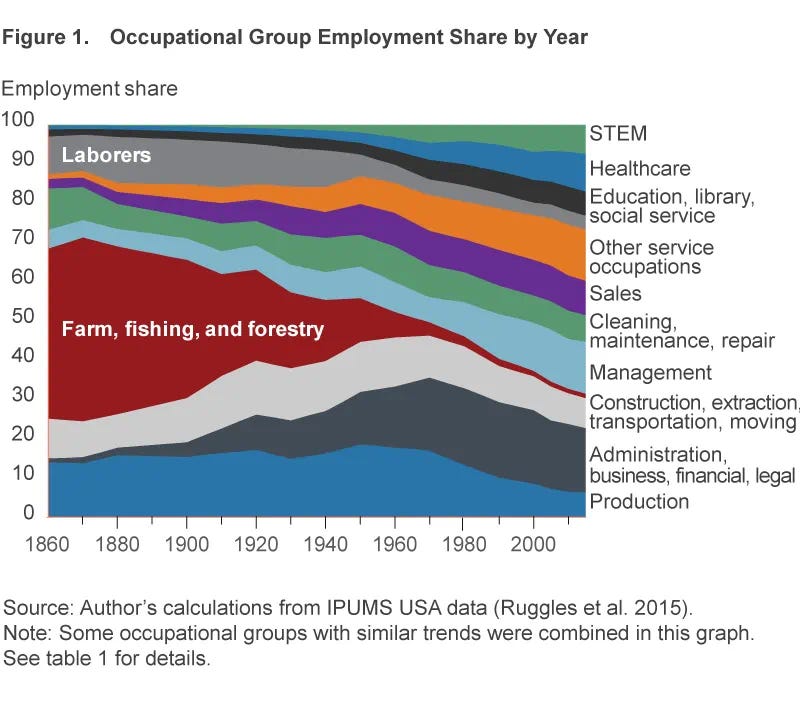
Meanwhile, manufacturing’s share of nonfarm employment fell while services kept rising: manufacturing accounted for 38 percent of nonfarm employment in 1945, but only 15 percent by 1996, while services rose from 10 percent to 29 percent over the same span. This matters because the suburban ideal rested on a world of relatively standardized household trajectories. As work became more varied, less geographically fixed, and more dependent on services, education, and office-based employment, the assumptions behind the one-size-fits-all suburb became less stable.
It is hard to separate cause and effect here. Did postwar prosperity produce the suburban landscape, or did that landscape help stabilize the social order that prosperity depended on? Probably both. What matters is recognizing that the suburban system depended on a specific alignment of forces: cheap energy, rising incomes, mass home finance, rapid household formation, auto mobility, and a workforce structure that made distance from the city feel manageable rather than costly. The American Dream was born, and for the baby boomer generation who grew up in this prosperity, it would set their expectations for their lives as well. Those conditions were powerful, but they were also temporary. By the end of the twentieth century, several had begun to weaken.
By the 1980s, the American economy and culture was beginning another major transition. Baby Boomers were entering their prime years of earning and starting families. The nature of work changed as manufacturing was losing ground to services as large corporations like AT&T paved the way for the services economy. Household structure was becoming more varied: Marriage was happening later, one-person households were becoming more common, and the old assumption that most families would move through the same life script was starting to break down. My next piece will look at that demographic and economic flip, and at why a housing system built for postwar conformity increasingly struggled to serve a more diverse and less predictable America.
No posts
Comments
Nothing yet. Say the first thing.
Sign in to join the conversation.