
If building better places were simply a matter of good ideas, we would have solved this by now. We have no shortage of plans, principles, or renderings, and can look to good examples around the world and across time. What we lack is a shared understanding of why our cities keep producing the same outcomes, even when we claim to want something different.
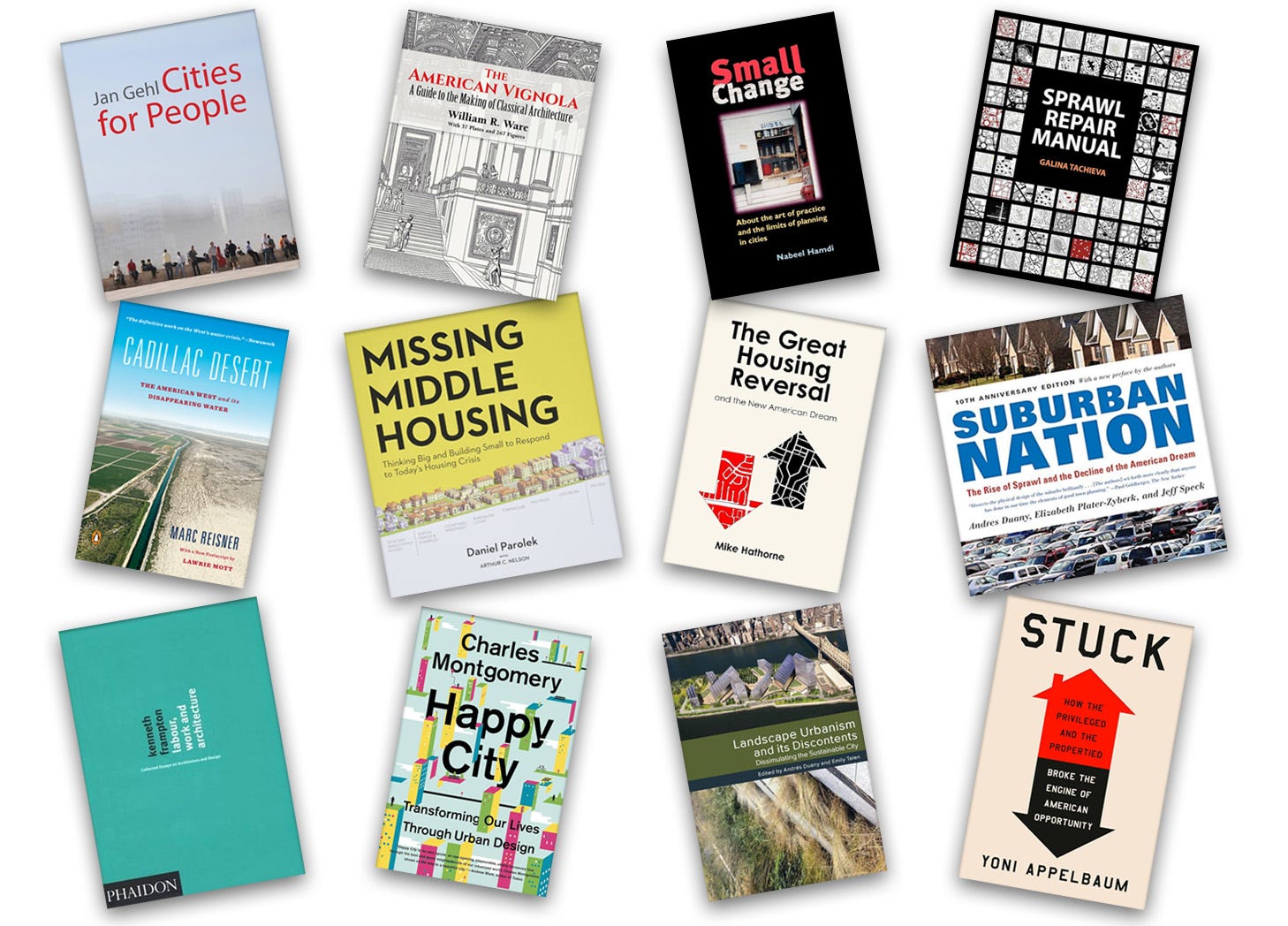
Last year I started on my journey towards building better places and as I made connections with practitioners in the business of place making: architects, builders, entrepreneurs and thinkers, many of them would recommend books that would be helpful in shaping my understanding of how things work. In 2025 I read books by Christopher Alexander, Leon Krier, and Michael Eliason that opened my eyes to some of the principles of building good places. I also started creating a list of other books, things friends recommended or in some cases sent to me, that can help give me a foundational understanding of how better places are made.
This reading list is an attempt to study the forces that produce the places we live in. These books look at housing, infrastructure, and urban form not as isolated design problems, but as the result of policy, economics, labor, tradition, and long-standing institutional choices. Some explain how we got stuck while others show what we stopped building, and how we might start again.
In 2026 I plan to read these books as a kind of “self-directed” course on urbanism, the theory in preparation for practice. My goal is to build smaller, more humane, and more affordable places, and I need to understand both the constraints and the opportunities embedded in the system. This list is meant to help do exactly that.
This list sits at the intersection of design, politics, economics, and implementation. Some of these books challenge the way cities are built. Others explain why reform is so hard. Together, they form a working library for anyone trying to move from ideas to better places on the ground.
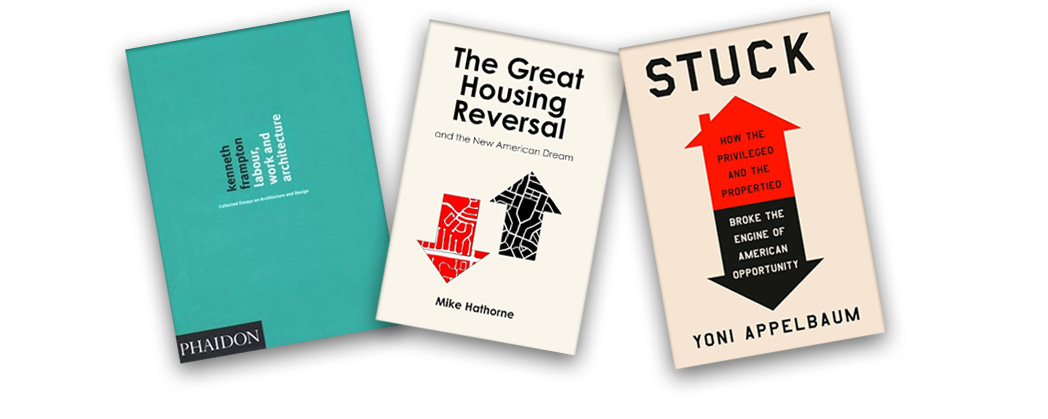
Why cities produce scarcity, and why reform is hard.
Frampton’s essays anchor architecture in material reality: labor, production, and political economy. This is a useful counterweight to design culture that treats buildings as images rather than outcomes of systems. For my work, it reinforces the idea that urban form is inseparable from who builds, who pays, and who bears risk. Cities are not shaped by vision alone, but by the conditions under which work happens.
Hathorn traces how housing in the U.S. shifted from a broad public good to a constrained asset class. The book is especially relevant to understanding why well-intentioned cities now struggle to allow enough housing. It provides political and institutional context for today’s affordability crisis. This helps ground reform efforts in history rather than treating current conditions as accidental.
Stuck frames the housing crisis as a crisis of mobility, not just supply. Appelbaum shows how land-use rules lock people out of opportunity and trap regions in place. This resonates with my focus on how regulation shapes everyday life. It is especially useful for communicating the stakes of reform to a general audience.
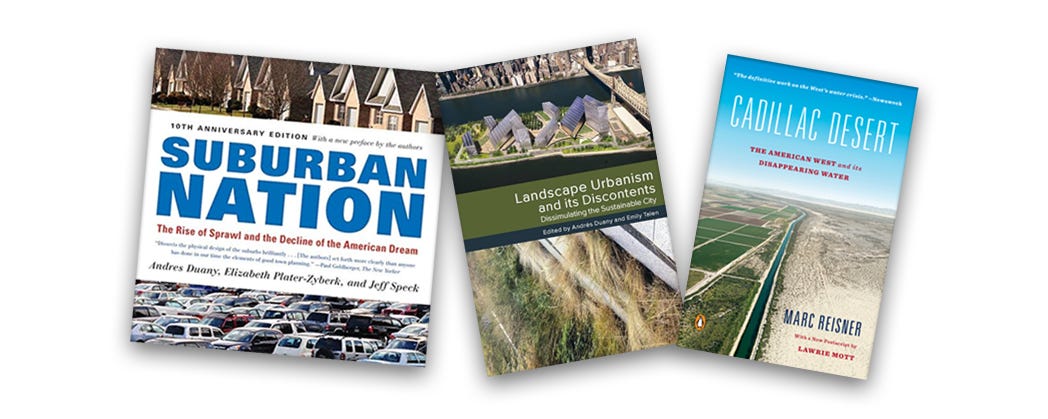
How sprawl became the default, and why it underperforms.
A foundational critique of postwar sprawl and its social, environmental, and fiscal costs. While some arguments feel familiar today, the book remains useful for how clearly it links zoning, street design, and daily life. It helps explain why so many American places feel hostile to walking and community. Much of today’s missing-middle debate is a direct response to the failures outlined here.
Duany’s critique is sharp and intentionally provocative. He argues that many sustainability narratives avoid the hard work of shaping walkable, human-scale streets. This book is useful because it challenges vague environmental language that does not translate into better places. It reinforces my belief that outcomes matter more than labels.
A sobering history of water infrastructure in the American West. Reisner shows how engineering ambition, politics, and denial created long-term environmental risk. For urbanism, the lesson is clear: growth must respect ecological limits. This book adds necessary realism to conversations about expansion and resilience.
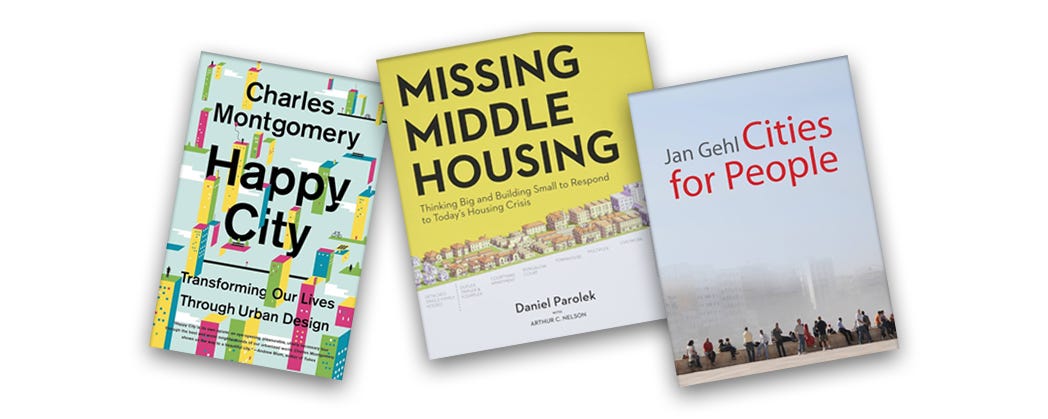
What we stopped building, and why it matters.
A clear and accessible guide to the housing types most American cities no longer allow. Parolek connects form, zoning, and neighborhood character in a way that resonates with planners and residents alike. This book underpins much of today’s gentle density movement. For my work, it serves as both vocabulary and proof that alternatives already exist.
Gehl’s work centers the human body: how people walk, linger, and interact. While widely cited, it remains essential for grounding design decisions in lived experience. This book reinforces why scale, speed, and comfort matter. It complements policy-focused work by reminding us who cities are ultimately for.
Montgomery makes a simple but powerful case: cities shape how we feel, not just how we move. Drawing on psychology, public health, and urban design, he shows how street design, housing patterns, and social infrastructure influence happiness and mental health. This book is useful because it reframes urbanism in human terms without drifting into abstraction. It reinforces why walkability, proximity, and small-scale form are not aesthetic preferences, but quality-of-life fundamentals.
How change actually happens.
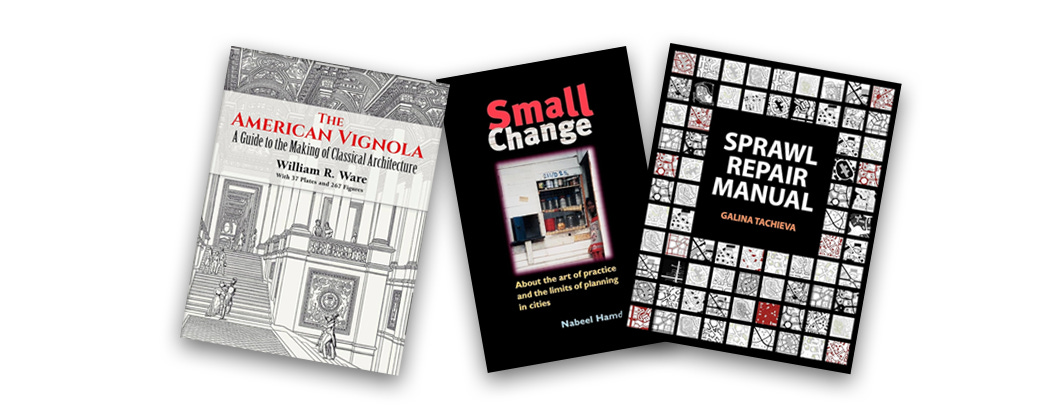
Tachieva focuses on fixing the places we already have rather than starting over. The book offers concrete strategies for retrofitting suburban form into something more walkable and productive. This is especially relevant for Southern and Sunbelt cities. It bridges design intent and implementation.
Hamdi emphasizes incremental action, local knowledge, and learning by doing. This perspective aligns closely with how small-scale development actually happens. Rather than grand master plans, cities improve through many modest decisions made well. It’s a practical philosophy for anyone working outside large institutions.
This book translates classical architecture into a practical guide for American builders. Its relevance is less about style and more about proportion, repetition, and legibility. These principles remain important for creating streets that feel coherent and humane. It’s a reminder that good form can be taught and reproduced.
I plan to write future posts drawing out lessons from these books as I work through them, especially where they intersect with housing reform, small-scale development, and the everyday mechanics of building better places. In the meantime, if any of these titles resonate, I welcome you to reach out to have a conversation. And if there are other books, essays, or publications you think belong on this list, I’m always interested in seeing what ideas others are engaging with. This work is better when it’s shared and debated, not done in isolation.
No posts
Comments
Nothing yet. Say the first thing.
Sign in to join the conversation.