
I haven’t been thinking about this week’s blog post at all. I pulled down a group of old wargaming magazines I bought at auction some time ago, pulled one out at random, and set a goal to learn to play whatever game came with that edition. I was determined to just start playing instead of spending hours thinking about it and going over my collection, only to get tired and go to bed without playing anything at all.
I got lost in the fun.
As you may know, I love wargames. Not because I support war or war-like behavior, but because of the effect they have on my mind. The planning, the strategy, the complexity—it feeds my brain in ways few other things do. And if you’ve been reading me for a while, you know I’m a huge fan of simulating the real world in a mechanical kind of way.
The magazine I pulled out was Command Magazine Issue #37. This particular issue came with not one, but two games—so much for picking one and running with it without looking back. But I settled on one and dove in.
What stood out to me wasn’t the setting, or the counters, or even the historical scenario—it was the step-reduction system it used. I realized this mechanic, common though it may be, was begging for a more narrative-friendly, RPG-adaptable version. So I broke it down, and tried to rebuild it.
The dawn of the 20th century saw an audacious challenge to the old world order. Japan, a once-isolated island nation now bristling with modern warships and disciplined armies, lunged at the Russian Empire—a colossus that had sprawled across Siberia and into Manchuria. The spark came in February 1904, when Japanese torpedo boats struck the Russian fleet at Port Arthur without warning. What followed was a brutal war of sieges and surprises leading to the Japanese being quite successful.
Yet the true crescendo came on land—the Battle of Mukden. For three weeks in the frozen Manchurian winter of 1905, 300,000 Russians and 250,000 Japanese clashed in a sprawling, chaotic melee of artillery duels and bayonet charges. When the smoke cleared, Japan stood victorious, though both sides were bloodied beyond belief. The war’s end shocked the world: a European power had been humiliated by an Asian nation for the first time in modern history.
The Treaty of Portsmouth, brokered by a weary Theodore Roosevelt, redrew the map of East Asia—and planted the seeds of revolutions, ambitions, and conflicts yet to come.
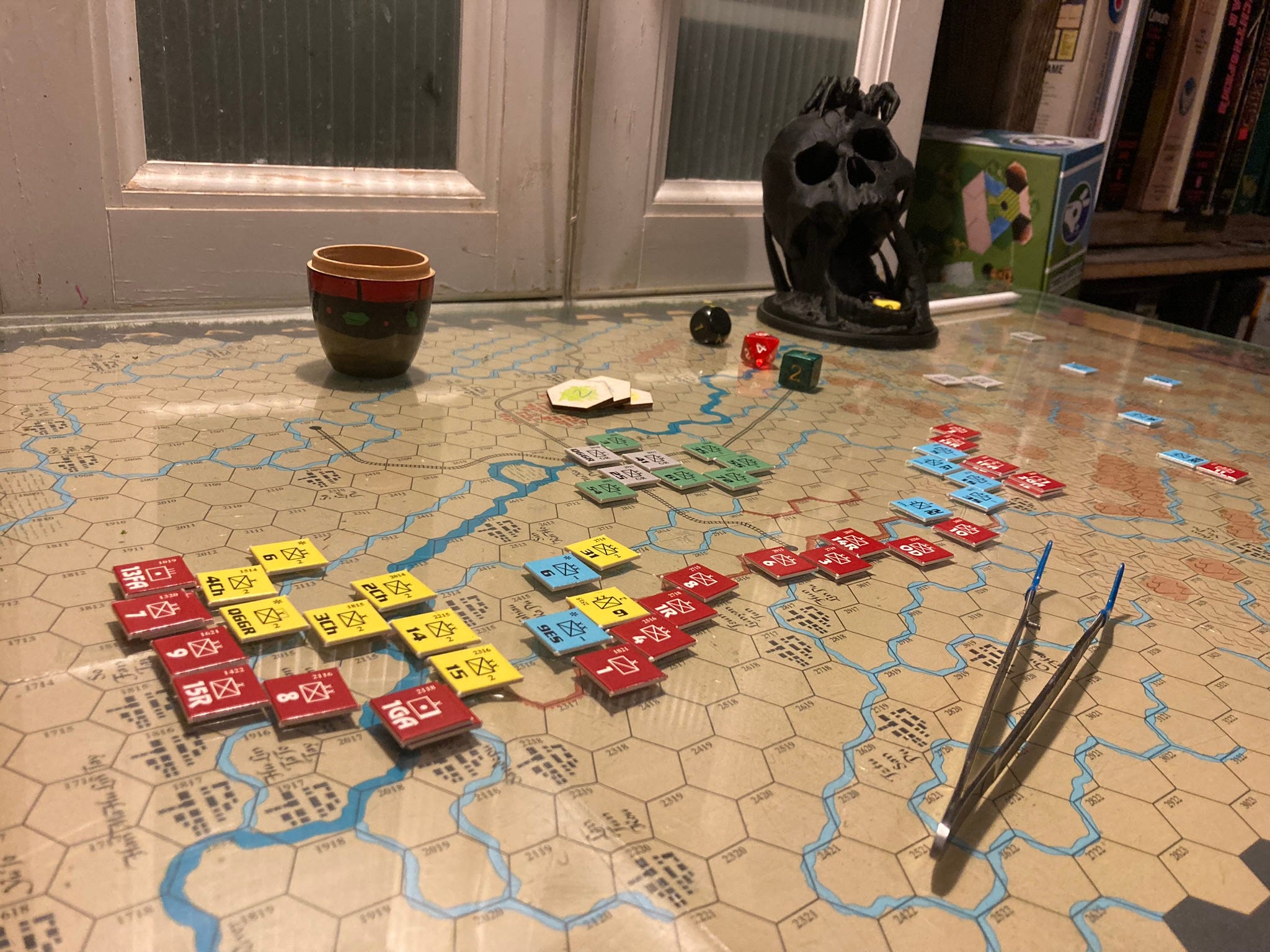
The Japanese (Red, me) trying to flank the some Russian Troops (Yellow, also me) and failing. The Russians figured out what I was doing and decided to pull back and widen their formation. Meanwhile, the green Russian troops (also me!) just activated some reserve troops on their way to settle into Mukden… Next set of movement phases will be me trying to prevent them from reaching the town, but I don’t think I’m going to succeed. They are harder to kill in there…
Mukden, while quite important historically, and was quite unknown to me until recently. As are most wars I’d have to admit. Most of my wargaming roleplay consists of my own homemade scenarios using rules I already know from games like Firepower, Ambush!, Squad Leader and sometimes Advanced Squad Leader. All of which are either solitaire or easily played solitaire. In fact I haven’t found a wargame yet that I cannot solitaire using the solo rules from Firepower.
The Mukden rules are about 12 pages long, and it’s fairly simple, with some advanced aspects worked in but not mandatory. You’re free to add them in after getting the hang of the game.
The mechanic I found most interesting is the combat section, where the overall fitness of a given unit is represented, utilized and tracked seemingly in an abstract way, by a series of numbers.
I’m describing a step-reduction combat strength system, where a unit's combat effectiveness degrades as it takes losses; a common but often customized mechanic in wargames. It’s used to simulate the natural cycle of soldiers dying, the breaking down of moral and leadership; the expected result of a troop at war.
Let’s break down how this might work in Mukden, 1905 and then how you could generalize it for other games such as mass battles in roleplaying games.
In many wargames, units don’t just die or survive—they degrade. Each time a unit is “hit,” it doesn’t vanish (usually), but becomes less effective. This is “step reduction.”
Think of a unit as a bundle of combat potential—as that potential is drained (through casualties, morale loss, fatigue, leadership breakdown), its ability to project force goes down too. Step reduction is how we reflect that downward spiral without micromanaging individual soldiers.
Mukden, 1905 models this nicely with printed Strength Point values that tick down: 10, 9, 8… etc. Each SP loss is a “step.”
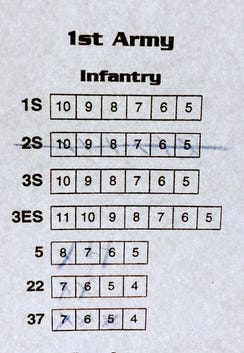
Please excuse my markings, I’m in the middle of war and don’t have a clean photocopy handy.
Each of these is a single unit or troop of soldiers, in this case about 2000-3000 give or take. The larger the value in the first box (left to right) the larger the the amount of soldiers, the better the group attacks, the better it’s ‘health’ (as in number of members) and how well it defends itself and anything else you want to know, is also represented, abstractly, by the value that remains. As the battle wages on, the boxes are crossed off as a given unit takes damage; losses soldiers, moral drops, leadership gets wonky, fear rises…
These details can be used to represent a variety of ‘troops’ for both yourself and your enemies in both mass warlike battles, or even smaller battles with say, 10-20 rats in a dungeon.
Instead of focusing on individual enemies, you could be focusing on them as a group and change the way you go about dealing with large chunks of enemies. Great for those us who are neurodivergent.
Adapting this SP-based step-reduction system for solo RPG mass battles means rethinking who makes the decisions, what gets randomized, and how the story emerges. You don’t have a GM to narrate or adjudicate, so you need mechanics that are both procedural and narrative-friendly, giving you meaningful control and surprise.
To generalize this system, let’s define SP as the sum of three major factors:
Troop Count / Mass — the raw number of bodies.
Leadership / Organization — the quality and influence of command.
Combat Quality / Cohesion — a composite value for morale, training, supply, species, equipment, etc.
We'll call these:
T (Troop Size)
L (Leadership Bonus)
Q (Quality/Cohesion Factor)
Then:
SP = T + L + Q
Let’s break those down shall we?
Let’s start with a baseline scale for what counts as 1 SP.
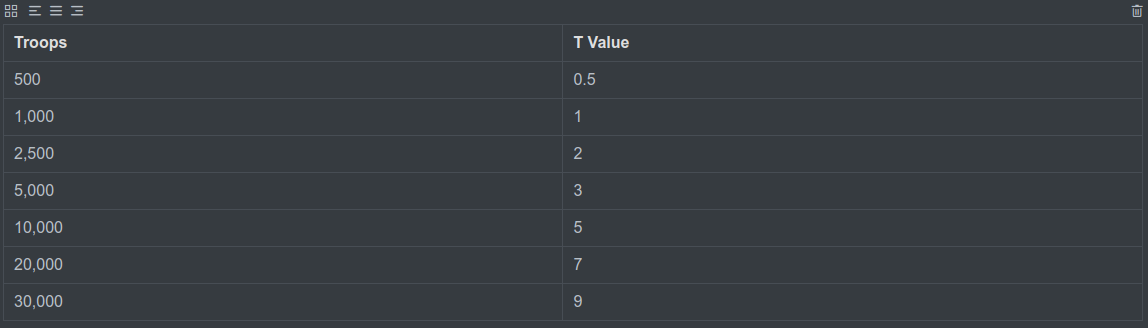
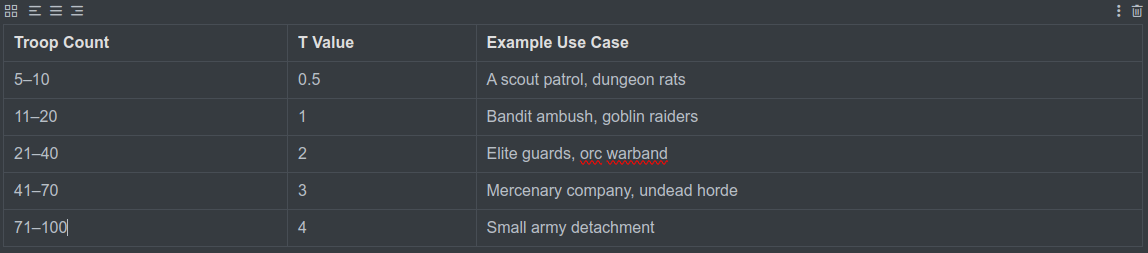
In the case of 0.5 always round up to the nearest whole number if it’s under 1, and round down if it’s greater than 1. This scaling can be logarithmic or exponential depending on how granular you want to go. Keep in mind that the step reduction system works best when there’s a visible progression — avoid too flat a curve.Further, please keep in mind that this value is relative and only one aspect that is taken into consideration.
Notes:
Round Fractions: If T=0.5, treat as 1 SP minimum (even a handful of foes can be dangerous).
Granularity: For tighter scaling (e.g., 5 vs. 10 troops), use T=0.5 vs. T=1 to reflect relative threat.
Stacking: Combine multiple small units (e.g., 3 groups of 10 goblins = T3 total) for larger battles.
10 Goblins (T=1) + 1 Hobgoblin Leader (L=1) + Poor Equipment (Q=0) = SP 2
20 Elite Dwarves (T=2) + Competent Captain (L=2) + Steel Armor (Q=2) = SP 6
Combat Flow:
Goblins attack (SP 2), roll a 4 → 1 SP damage to dwarves.
Dwarves counter (SP 5 after loss), roll a 6 → 2 SP damage → Goblins annihilated (SP 2 → 0).
Tiny Units (1–4 creatures): Treat as T=0.3 (round to 0.5 SP) but give them +1 to hit to reflect focus.
Morale: Small units break faster! Use SP ≤ 1 as a rout threshold.
This keeps the step-reduction system fast and dramatic even at micro-scale.
"Five heroes can change the world—or die trying."
Leadership can be rated on a 0–3 scale (or more if desired). This should reflect command capability, logistics, and how well the unit stays coherent under stress. Sample scale:
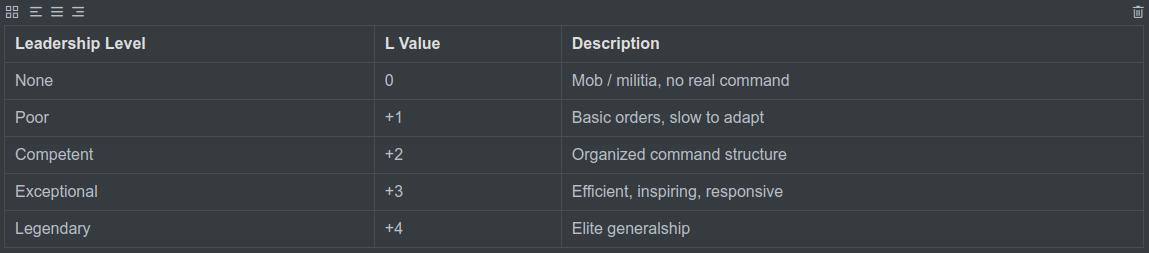
Leadership could also serve as a buffer — the first few SP losses come from poor coordination or morale cracks before affecting the body count. Optional, but flavorful. For example, I roll a percentile die (2d10) and place a chance of one choice, vs another. In my current battle (Mukden) for example, I placed a 40% chance of that the Russians wouldn’t recognize me attempting to flank them. That means anything above 40 and they notice. I rolled a 43, so the Russians did in fact notice and then they began to adjust their position to thwart my efforts.
I decided that my failure stung the Japanese ego a bit, and reduced my SP by 1 point; SP in this case represents the moral of the troops dropping. If I’m successful in the next round, I add that value back in since it’s more dynamic than say if I lost a 1000 soldiers. No getting those back unless I’ve got some necromancers.
A good place to have leadership is when you’re practicing this step reduction in real life. Dealing with daily ups and downs can effect our personal SP and reduce your moral.
Lucky for you, you can choose how to react to these daily events differently.
Leadership blooms in the quiet moments—when you soften your steps through life’s daily tides. Ups and downs may sway your spirit, yet you alone choose how to meet them.
To lead is to walk as an example. When storms come, do not sit. Stand—not with hardness, but with the supple strength of grass. Let the wind bend you; then rise again, smiling, roots unshaken.
"Life doesn’t get easier or more forgiving; we get stronger and more resilient."
— Steve Maraboli
This factor lets you reflect troop type, morale, racial/species bonuses, equipment, supply, and fatigue. You can approach this a few ways:
Option 1: Flat Value Table
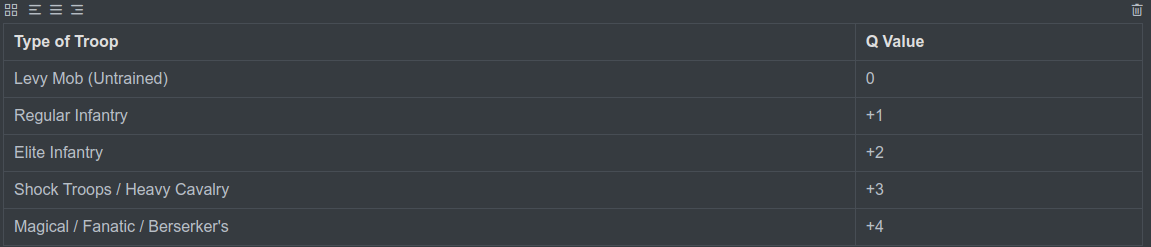
You could add modifiers for morale conditions here as well, but I cover morale in more detail in a bit. Feel free to look there as well.

So a unit of 10,000 fanatical Dwarven elites led by a legendary general might be:
T = 5
L = 4
Q = 3 (elite) + 2 (fanatic) = 5
Total SP = 5 + 4 + 5 = 14
Whereas 5,000 hungry goblins with no leadership might be:
T = 3
L = 0
Q = 0
SP = 3 + 0 + 0 = 3
Use the same formula to stat each force quickly:
SP = T (Troops) + L (Leadership) + Q (Quality)
As a solo player, use a Unit Roster Sheet where each army has a few units with names, roles, and their SP total (e.g. “Shield Wall – SP 6”, “Skirmishers – SP 3”). I like to use a die (d10, d12, etc.) placed next to each group to track its current SP — easy visual reference. Or sketch a grid/zone map with “boxes” representing unit positions and SP, like we saw above with Mukden.
You can track SP with chits, tokens, counters, or just pencil marks. As a unit loses SP:
Attack strength drops
Defense/resistance drops
Morale may test (optional mechanic)
You can also assign break points (e.g. “if SP drops below 3, make a morale test or rout”), or penalties at specific SP thresholds.
Optional idea: use color bands (like health bars) on SP values:
Green (Full Strength)
Yellow (Degraded)
Red (Critical)
Grey (Broken)
This gives you a visual shorthand for how dangerous a unit still is. I have quite a few transparent colored acrylic discs that I place over the units to give me an overall feel for the state of the battle.
Instead of comparing attack vs defense directly, this system uses a table (adapted from Mukden, 1905) to determine damage based on the attacking unit’s current SP and a single d6 roll.
You consult the table using the attacker’s SP total. The die result then tells you how many SP the defender loses. If no result is listed (marked “NE”), the attack has no effect.
This system is used for both attacking and defending units—the defender gets an immediate “defensive fire” counterattack using their current SP and a roll on the same table.
In Mukden stacking is rare and most times you are using single troop SP values. In your case, feel free to stack as many units as you like, or use the total SP from all surrounding units.
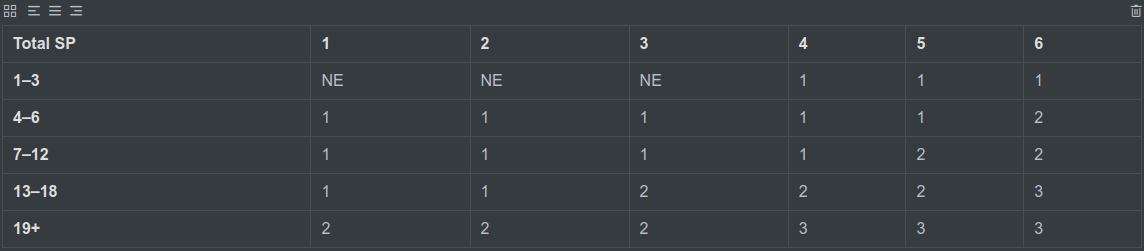
NE = No Effect
This result is the number of SP lost by the target.
Apply results immediately, then trigger morale if needed.
This keeps combat fast, swingy, and scalable—a lucky roll can be deadly, while weak units may struggle to do more than slow an enemy down.
After a unit takes damage, check for morale collapse using:
Q + L + d6 vs TN 8
TN = Target Number
Failure causes the unit to fall back, break formation, or rout—your call, based on the story.
After an attacking unit resolves its attack using the SP Combat Table, the defending unit immediately fires back—representing reactionary volleys, close combat, or counter-engagement.
Use the defender’s current SP, not their original total. Then Roll 1d6, just like you did for the attacker. Cross-reference SP and roll on the same Combat Table. And Apply any SP losses to the attacker. Finally, then proceed with morale checks as needed.
Attacker: Orc Warband (SP 11)
Defender: Dwarf Shield Wall (SP 8)
Orc rolls a 5 → looks up 11 SP + roll of 5 = 2 SP damage to Dwarves
Dwarves now at SP 6
Dwarves counterattack: roll a 3 → 6 SP + roll of 3 = 1 SP damage to Orcs
Orcs now at SP 10
Both sides then check for morale if required.
Morale is your unit's willingness to continue fighting despite losses, fear, or disorganization. Sometimes poor leadership also creates holes in a troops moral, like it did with Mukden, where the Russian side had to commanders, one of a higher rank, that didn’t like one another. They would often go against one another out of spite. This created tension amongst troops, and no doubt some also took sides.
Because you’re not a GM pulling narrative levers, build in player-triggered effects that impact the battlefield.
Infiltrate the enemy camp: If successful, drop the enemy general’s L → all affected units lose L to SP = panic!
Raise a banner to inspire: Spend 1 resource (e.g. HP, spell slot, morale point) to boost one unit’s Q by +1 for the battle
Call down divine/magical support: Spend Favor/Magic/Action Points to force a morale check on all enemies in a zone
You can make this procedural:
When a PC uses a resource during battle, roll 1d6. On 5–6, enemy loses 1 SP or fails a morale check.
This gives your PCs real battlefield agency.
Each unit has a Morale Value (often equal to or derived from SP or Q), and must roll above a certain Difficulty when:
They take a hit
A nearby friendly unit is destroyed
Leadership is lost
Facing terrifying foes (e.g. undead, dragons)
Morale Roll = SP or Q + d6 vs Difficulty (usually 7–10)
When a unit drops below a set SP threshold (say, 3 or 50% of original SP), make a morale roll or retreat/rout.
As I mentioned above, leadership can affect Morale. So how about we let L (Leadership value) boost Morale Rolls? A great general = courage under fire. Leadership should do more than just “add a number.” It should feel like a presence on the battlefield—an active force that keeps units together, inspires them to hold the line, and steps in when things start to unravel.
Let’s break it down into four key effects:
The most straightforward implementation:
Morale Roll = Q (or SP) + L + d6
This mechanic rewards smart players who concentrate leadership at the right place and time.
How about commanders use their L value actively in battle—especially in heroic, narrative RPG mass battles. A unit with solid leadership (L = 2 or 3) naturally stands stronger under pressure. This makes elite units under bad leadership vulnerable, and weaker units under a great general surprisingly tenacious.

Units inside a leader’s command range (e.g. 6 hexes, 12") could automatically re-roll failed Morale tests once. Ignore the first Morale test each turn. Gain “Steady” status (immune to fear or retreat effects).
You could represent this in the tabletop visually by drawing a circle or zone of influence around a commander. Units outside of it are:
More likely to rout
Slower to recover
Vulnerable to panic contagion (e.g. if a neighbor flees, they test too)
Lastly, Morale collapses often spread like wildfire in chaotic battles. Leadership is your firebreak.
When a unit routs or breaks, each adjacent unit must test Morale at –1. If the commander is nearby (in range and not already busy), they may intervene:
Roll Leadership vs. TN (Target Number)
If successful, prevent the spread of panic to 1–2 adjacent units
This reinforces the idea that good generals hold the army together under pressure, while bad ones lose control of the battlefield.
Finally, for your convenience, here is a quick cheat sheet of sorts:
SP = T (Troops) + L (Leadership) + Q (Quality)
Combat: Use SP Combat Table + Optional 1d6 to resolve attacks
Defensive Fire: Defender retaliates immediately using same method
Morale: Q + L + d6 vs TN 8 when damaged or stressed
Before we close this out, how about a quick battle example to give you some ideas and inspiration? I think it’s a good idea, plus it offers a visual experience, a narrative instruction to really drive everything home.
The wind howled through the narrow pass of Blackridge, where the Dwarven Shield Wall—SP 8 (T=3, L=2, Q=3)—stood firm against the advancing Orc Warband—SP 11 (T=5, L=1, Q=5). The dwarves, though outnumbered, were disciplined and led by Thrain Ironhelm, whose booming voice echoed off the cliffs. The orcs, a seething mass of axes and fury, charged with reckless abandon.
Orcs Attack (SP 11): Their warchief roared, and the horde crashed into the dwarven line. The player rolled a 5 on the Combat Table—2 SP damage to the dwarves.
The orcs’ axes bit deep, splintering shields. The dwarves reeled, their formation buckling (SP 8 → 6).
Dwarves Counterattack (SP 6): Thrain bellowed, "Hold the line!" The dwarves retaliated, rolling a 3—1 SP damage to the orcs.
A volley of crossbow bolts thinned the orc ranks, but the horde barely slowed (SP 11 → 10).
Morale Check (Dwarves): With losses mounting, the dwarves tested morale: Q (3) + L (2) + d6 (4) = 9 vs. TN 8. They held, but barely.
Orcs Attack Again (SP 10): The player rolled a 2—only 1 SP damage.
The dwarves locked shields, weathering the storm (SP 6 → 5).
Thrain’s Rally Action: The player spent Thrain’s leadership to Inspire (+1 to next roll). The dwarves counterattacked (SP 5 + 1 = 6), rolling a 6—2 SP damage!
"For the Mountain King!" Thrain’s cry ignited a ferocious push. Axes cleaved through orc flesh (SP 10 → 8).
Orc Morale Check: The warband’s Q (5) + L (1) + d6 (1) = 7 failed against TN 8. The orcs wavered, their charge faltering.
Dwarves Press the Advantage (SP 5): Rolling a 4, they dealt 1 SP damage.
The orcs, now disorganized, began to retreat (SP 8 → 7).
Chain Rout Test: The orc failure triggered a Morale Domino Effect. Adjacent units rolled at –1, and the warchief’s poor leadership (L=1) couldn’t stop the panic. The horde shattered, fleeing into the hills.
The dwarves stood victorious, though bloodied. Thrain’s leadership had turned the tide, proving that SP isn’t just numbers—it’s the story of courage, chaos, and the weight of command. The step-reduction system made every loss tangible, every roll a twist in the tale, and the battle felt alive.
For your games: Whether it’s 10 rats in a dungeon or 10,000 troops on a field, this system turns stats into stakes—and stakes into stories.
"Victory is not the absence of loss, but the will to stand after it." — Thrain Ironhelm (probably).
…and that’s about if for this time. I hope you are all finding these mechanics useful, and if not, let me know what you’d like to see. I’d love to hear about your needs, what frustrates you as a solilatire player. I’d love the chance to see if I can come up with a means for providing a mechanic to fit your needs.
I hope you are all doing amazing, and if not, well keep pushing forward. Don’t let life get you down; get up, give it the finger and keep pushing against the challenge. Appreciate you all and I’ll see you next time, here on the Solo Roleplaying Buddha.
No posts
Comments
Nothing yet. Say the first thing.
Sign in to join the conversation.