
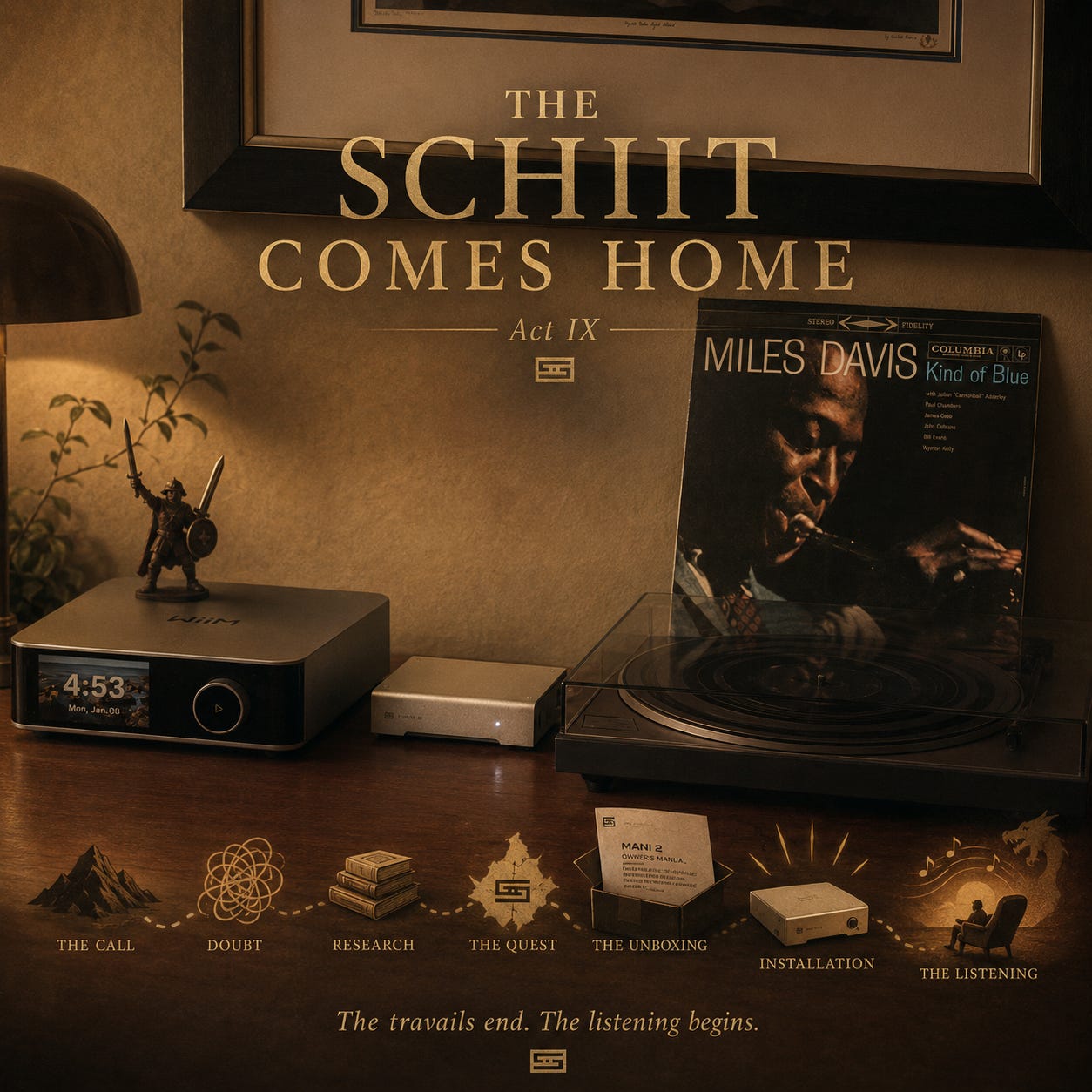
And then, after all of it, there it was.
Home.
Not ordered.
Not shipped.
Not processed.
Not out for delivery.
Not delivered to a receptionist.
Not declared.
Not taxed.
Not pre-transit.
Not in transit.
Not ready for pickup.
Home.
The Schiit Mani 2 had finally crossed the border, survived Shippsy, endured the declarations, absorbed the tax rituals, escaped the status screens, and arrived in the room where the whole absurd campaign began.
A tiny silver box.
A phono preamp.
A translator.
A diplomatic envoy between an old Danish turntable and the modern world.
And there it sat, quietly beside the WiiM Amp Ultra, beneath Miles Davis, in front of the Beogram 1602, as if this had all been obvious from the beginning.
The final chain was no longer theoretical.
Beogram to Schiit.
Schiit to WiiM.
WiiM to Boston Acoustic A70s.
A70s to the room.
The room to memory.
The box was opened.
Inside was the Mani 2, clean and silver, packed with the usual modern efficiency and one small Schiit Audio sticker from Texas, as though the entire procurement campaign needed a commemorative seal.
Then came the owner’s manual.
After days of MM, MC, MI, MMC, moving magnet, moving coil, moving iron, moving micro-cross, cartridge loading, gain settings, impedance, and the sort of technical fog that makes a man wonder whether he is assembling a stereo or applying to MIT, the manual offered its own blunt reassurance:
MMP MCP don’t know? Who cares?
Exactly.
After all the research, all the tracking, all the calculations, all the fallback planning, all the customs forms, all the HST sacrifice, and all the bureaucratic theatre, the manufacturer’s essential message was:
Relax.
Plug it in.
Play the record.
There was something deeply satisfying about that.
Because the whole journey had begun with one simple desire.
I wanted to play vinyl.
That was it.
Not participate in a cross-border logistics seminar.
Not become conversant in parcel-forwarding status terminology.
Not calculate tax friction like a minor economist trapped in a hobby.
Not learn that “pre-transit” is the modern equivalent of “standing by the door with boots on, possibly looking for keys.”
Just play a record.
And now the system was ready.
The Beogram had its translator.
The A70s had their signal.
The records had emerged from the Abyss.
Miles Davis stood watch.
Son House waited like a witness under oath.
Robert Johnson waited in the weather system.
Gershwin waited in the machinery of ghost hands.
Sonny Boy Williamson had arrived just in time, like a man leaning in the doorway with a harmonica and a grin.
The Schiit Chronicles had reached their proper ending.
Not because the story was over.
Because the obstacle had finally stopped being the story.
That is the danger of the modern world.
It can turn the simplest human act into a procedural campaign.
It can turn listening into logistics.
It can turn a record into a supply-chain dependency.
It can make a tiny box travel through more administrative states than some federal programs.
But eventually, if the gods of shipping and paperwork are satisfied, the machinery falls silent.
The forms are done.
The taxes are paid.
The package is home.
And the room is allowed to become a room again.
Not a tracking dashboard.
Not a procurement file.
Not a customs declaration.
A room.
A chair.
A turntable.
A record.
A needle.
A first crackle.
The return of sound as presence.
The Schiit came home.
The travails ended.
The listening begins.
To be continued, but only because the records have stories of their own.
No posts
Comments
Nothing yet. Say the first thing.
Sign in to join the conversation.