
The Schiit Chronicles led inward.
The Beogram.
The Boston A70s.
The Mani 2.
The WiiM Ultra Amp
The ritual machinery of sound.
Storm Chaser explained what I was really doing.
I was not building a record collection.
I was not becoming an audiophile.
I was not inventorying vinyl like some deranged cultural customs officer.
I was trying to recover weather.
The vanished atmosphere of rooms I once knew. Rooms where music was not background decoration, but the reason the room existed. Rooms where people listened, drank, dressed, smoked, talked, flirted, and understood that life was not meant to be lived under compliance lighting.
But once that truth surfaced, the question changed.
If the Beogram and A70s could become a weather machine at home, what about the old sites themselves?
What remained of the places where the weather first formed?
So I began visiting the old coordinates.
Not as a tourist.
Not as a historian.
Not even as a man trying to relive the past, because that is a mug’s game and usually ends with overpriced drinks, bad lighting, and the sad realization that your knees have become unionized.
I went as a storm chaser.
Looking for pressure changes.
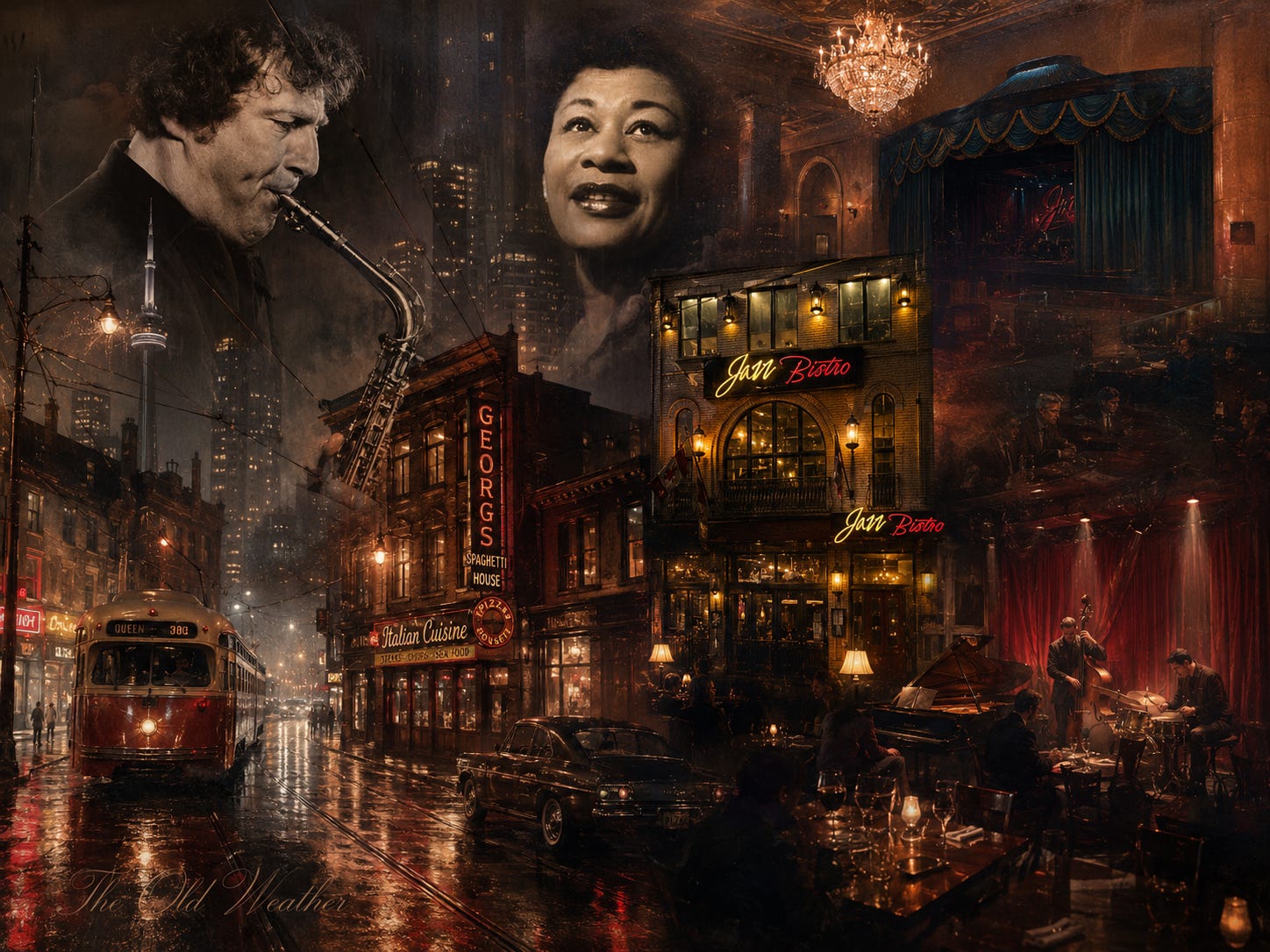
I had recently been to Top of The Senator, now the Jazz Bistro.
That one still carries something. Changed, of course, because everything changes. But enough remains that memory does not have to work too hard. The place still has continuity. A traceable line back to the kind of Toronto that existed before the city became a glass spreadsheet with restaurants in the lobby.
Then there was Bourbon Street.
Or rather, where Bourbon Street used to be.
That is the more difficult kind of pilgrimage. Not the place itself, but the absence of the place. The old weather system replaced by the usual modern arrangement of real estate, glass, efficiency, and the quiet murder of character by square footage.
Bourbon Street had once meant music, smoke, American jazz artists, Paul Desmond, Stan Getz, and that particular adult atmosphere that cannot be recreated by branding consultants because they would first have to understand adulthood.
It even had cigarette girls then.
Not because cigarettes were noble. They were not.
But because the room still had weather. Human weather. Imperfect weather. The kind that came with polish, risk, low light, murmured conversation, and the faint sense that something might happen after midnight.
Standing outside where it used to be, I knew I would have made an unusual sight if I had simply stood there sipping coffee and gazing into memory.
A man with a Tim Hortons in hand, staring at a vanished jazz club at Queen and University, trying to hear Stan Getz through the traffic.
That might have looked odd.
At Dundas and Sherbourne, less so.
George’s Spaghetti House was different again.
George’s has been closed for years, but the building is still there. That matters. Sometimes the building is enough. Not because bricks remember in some mystical sense, but because the body does. You stand near the old doorway. You look at the angle of the street. You feel the scale of the neighbourhood. You let the mind do its work.
I walked toward 290 Dundas with a Tim’s firmly in hand.
It was the best I could do.
The corner of Dundas East and Sherbourne was always sketchy. That was part of it. Not decoration. Not pathology dressed up as charm. Just part of the pressure system. A little danger. A little grime. A little friction. The sort of urban edge that made entering a music room feel like crossing a threshold.
The weather was never made of beauty alone.
It was made of contrast.
The street outside and the room inside.
The grit and the polish.
The cold air and the warm room.
The sketchy corner and the disciplined musicianship.
The city’s rough edge and the elegance of people who still knew how to occupy a night.
That is what modern life so often fails to understand.
It tries to remove the rough edges and ends up sanding down the meaning.
It makes things safer, cleaner, brighter, more managed, more expensive — and somehow less alive. It replaces atmosphere with fixtures. It replaces rooms with concepts. It replaces memory with development renderings full of fake people drinking fake coffee in fake sunlight.
But geography still has power.
Even when the club is gone.
Even when the sign is gone.
Even when the door no longer opens into the room you remember.
You can stand near the coordinates and feel something stir.
Not fully.
Not reliably.
But enough.
Enough to remember Oscar Peterson at George’s and The Senator.
Enough to remember Bourbon Street and the American players who passed through Toronto like weather fronts from the south.
Enough to remember Eartha Kitt and Ella Fitzgerald singing in the Imperial Room at the Royal York.
Enough to remember Diana Krall plying her trade in the clubs before the world fully claimed her.
Enough to realize that these memories had not disappeared.
They had gone quiet.
The tote helped reopen them.
The Beogram gave them a machine.
The A70s gave them air.
But the old addresses gave them ground.
That is why this little pilgrimage matters.
It is not nostalgia.
Nostalgia tries to drag the past back into the present and force it to perform.
This is different.
This is recognition.
A man walks past the places where weather once formed. He carries a coffee because the world no longer provides cigarette girls and table service for memory. He stands where a club used to be. He looks at a building that survived the music. He lets the city, however diminished, speak through what remains.
And for a moment, if the angle is right, the past does not return.
It resonates.
That is enough.
The quest is not to restore the old rooms.
They are gone.
The quest is to find the fragments they left behind.
A doorway.
A street corner.
A building face.
A hotel room.
A record.
A saxophone tone.
A piano phrase.
A coffee in hand on Dundas East.
A man standing still long enough for memory to catch up.
That is what storm chasing has become.
Not chasing storms in the sky.
Chasing the old weather of a life.
Following pressure systems through records, rooms, buildings, streets, and remembered sound.
The Beogram brings the weather home.
But sometimes you still have to go outside and stand where the storm used to begin.
No posts
Comments
Nothing yet. Say the first thing.
Sign in to join the conversation.