
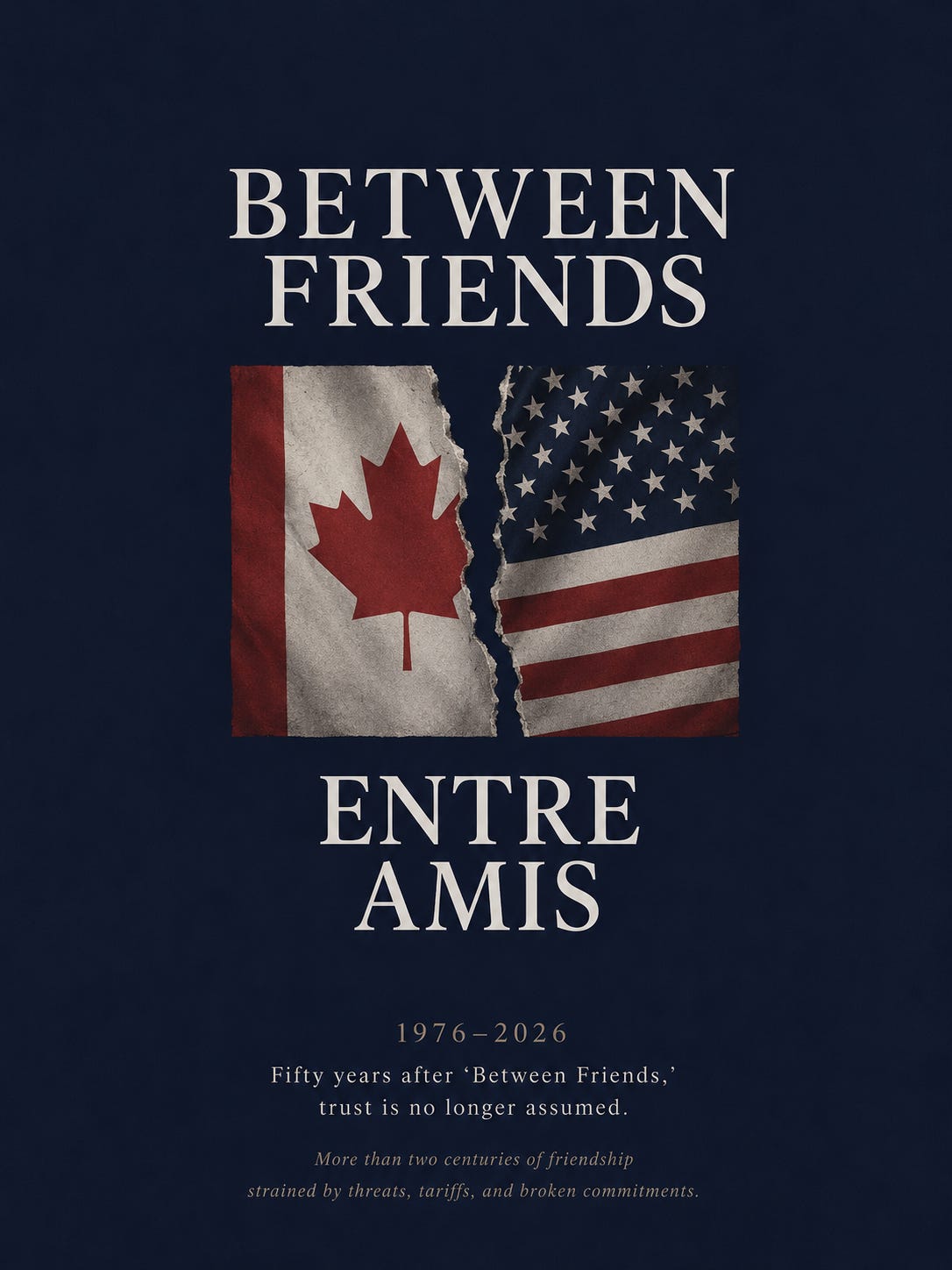
Before deciding who is right, stop listening to the talking heads.
Ignore the partisan propagandists, the social-media fabulists, the conspiracy merchants and the politicians who have already decided what you should believe.
Think for yourself.
Strip away Trump. Strip away Carney. Strip away the personalities, the outrage and the latest theory explaining what really happened behind closed doors.
Start with the agreement.
We already had one.
CUSMA established the rules governing Canada-U.S. trade and contained dispute-resolution procedures specifically designed for occasions when one country believed the other had violated those rules.
The United States imposed tariffs anyway.
Canada invoked the dispute mechanisms. Yet rather than resolving the original disagreement within the framework both countries had negotiated and signed, we ended up in a much broader negotiation in which Canada was being asked to make additional concessions simply to restore access that CUSMA was supposed to protect in the first place.
So why should Canada believe the next agreement will be treated differently?
We can negotiate another 500 pages of tariff schedules, safeguards, exemptions and dispute-resolution clauses. But if one party can simply invoke national security, impose tariffs and force everyone back to the negotiating table, the problem is no longer the wording of the agreement.
It is the credibility of the counterparty.
That is what makes the eleventh-hour American demands particularly troubling. Canada was being asked to surrender additional policy freedom in exchange for another American promise of market access.
But an agreement is only worth something when both parties can reasonably expect the other to honour it when honouring it becomes inconvenient.
CUSMA has already provided the test.
That is why walking away from a bad replacement agreement may have been considerably more rational than signing one.
Before judging whether Canada should have accepted the latest American offer, establish what Canada already had.
Otherwise, we are debating the price of replacing a warranty without first asking why the original warranty failed.
Question 1 — What did CUSMA actually guarantee?
CUSMA was not merely a political statement promising “good relations.” It created a legal framework for North American trade. For qualifying goods that met the agreement’s rules of origin, the basic rule was that the parties would not simply impose new customs duties at will, and most originating goods were entitled to duty-free treatment under the agreed tariff schedules. It also required national treatment for goods from the other parties and established detailed rules governing origin, customs procedures, market access and other aspects of cross-border commerce.
Just as importantly, CUSMA anticipated that disagreements would occur. Chapter 31 created a state-to-state dispute-resolution system specifically for disputes over the interpretation or application of the agreement, including situations where one country believed another had failed to carry out its obligations. It provided for consultations and, if necessary, formal panel proceedings.
That matters because Canadian businesses did not build factories, supply chains and investment plans on the vague hope that the United States would remain friendly.
They relied on negotiated rules.
So before discussing what Canada should concede in a new agreement, ask a simpler question:
What exactly was the protection Canada believed it had already purchased through CUSMA — and what happened to it when the dispute began?
Question 2 — When the dispute arose, were the agreed procedures used?
Canada invoked CUSMA’s dispute mechanisms.
What happened next?
Did the dispute proceed toward resolution under the agreement, or did tariffs remain in place while the issue was shifted into a broader political negotiation?
That distinction matters.
Because if the agreed dispute-resolution process can effectively be bypassed by maintaining the disputed measure and opening a new negotiation, then the practical value of that process needs to be questioned.
Question 3 — If the existing agreement could be set aside in practice, what makes the next agreement more credible?
This is the central question.
What provision in a new agreement would prevent another administration from invoking national security, imposing tariffs and demanding further negotiations?
If the answer is “another dispute-resolution clause,” we already had one of those.
The problem is therefore not simply drafting a better contract.
It is determining whether the counterparty can credibly commit to respecting it.
Question 4 — Are Canada’s concessions reversible to the same degree as America’s promises?
Suppose Canada changes industrial policy, alters trade relationships, restricts dealings with third countries or restructures supply chains in exchange for tariff relief.
Those may be costly, long-term decisions.
What happens if Washington restores the tariffs six months later?
Canada may have surrendered something difficult to recover in exchange for market access that can again be withdrawn by executive action.
A sensible agreement must therefore compare not merely the headline benefits, but the permanence and reversibility of each side’s commitments.
Question 5 — What is the economic value of an agreement whose enforcement depends primarily on the goodwill of the stronger party?
Businesses understand this instinctively.
A contract is worth less when enforcement is uncertain.
The same is true of trade agreements.
If Canadian companies can no longer assume that negotiated market access will survive a change in political mood, they will invest differently, source differently and value U.S. access differently.
They will demand a higher return before making investments dependent upon that access.
That uncertainty has an economic cost.
Trust, in economics, is not sentimental.
It has a price.
Question 6 — What would have to change before Canada could reasonably trust another agreement?
Better wording?
Stronger enforcement?
Automatic retaliation?
Binding arbitration?
Meaningful limits on national-security exceptions?
Or is the real requirement evidence, accumulated over time, that signed agreements will again be treated as obligations rather than temporary conveniences?
That is the question Canadian negotiators should answer before signing anything.
This is not ultimately about whether Donald Trump is a bully, whether Mark Carney is trustworthy, whether the Canadian media are saints or propagandists, or which partisan interpretation dominates social media this week.
Those are distractions.
The economic question is much simpler:
Can Canada reasonably rely upon the United States to honour the next trade agreement when doing so becomes politically inconvenient?
If the answer is yes, demonstrate why.
If the answer is no, then Canada should not trade permanent concessions for temporary promises.
Because an agreement that cannot be relied upon is not really an agreement.
It is an intermission between negotiations.
No posts
Comments
Nothing yet. Say the first thing.
Sign in to join the conversation.