
Canada and the United States may be close to announcing a new trade agreement. We already know how the political presentation will work.
Washington will emphasize every Canadian concession as proof that President Trump forced Canada to capitulate. Ottawa will compare the agreement with the most punitive tariffs Trump threatened and declare that catastrophe was heroically avoided.
Both stories may contain fragments of truth. Neither tells us whether the agreement is economically good for Canada.
Reports suggest that U.S. tariffs on Canadian steel and aluminum could be reduced from the threatened 50% to 25%, possibly subject to quotas. Changes to Canadian dairy-import licences, the return of American alcohol to provincial shelves and access to Canadian critical minerals have also been discussed.
But the complete agreement has not been released. We do not yet know the quota volumes, product exemptions, rules of origin, implementation schedules, enforcement provisions or full list of Canadian concessions.
Any confident verdict is therefore premature.
The devil is in the details, not the narrative—especially when both governments benefit from gaslighting their respective populations about what those details mean.
Citizens need something better than duelling press conferences.
They need QSix.
Before accepting anyone’s declaration of victory or defeat, ask six questions.
Compare the agreement with Canada’s position before the dispute—not merely with Trump’s worst tariff threat.
Which tariffs disappear? Which remain? What products qualify? What are the quotas, exemptions and rules?
Dairy access? Critical minerals? Procurement rights? Regulatory control? Retaliatory measures? What is their economic value?
After every benefit, concession and cost is counted, will Canadian exports, investment, production, employment and market share rise or fall?
Which industries remain exposed? How far is the agreement from stable, duty-free and quota-free trade?
When do the provisions take effect? How long do companies have to survive? When can either government reopen or terminate the arrangement?
Those six questions turn a political announcement into an economic ledger.
Now we need to inspect the bathtub.
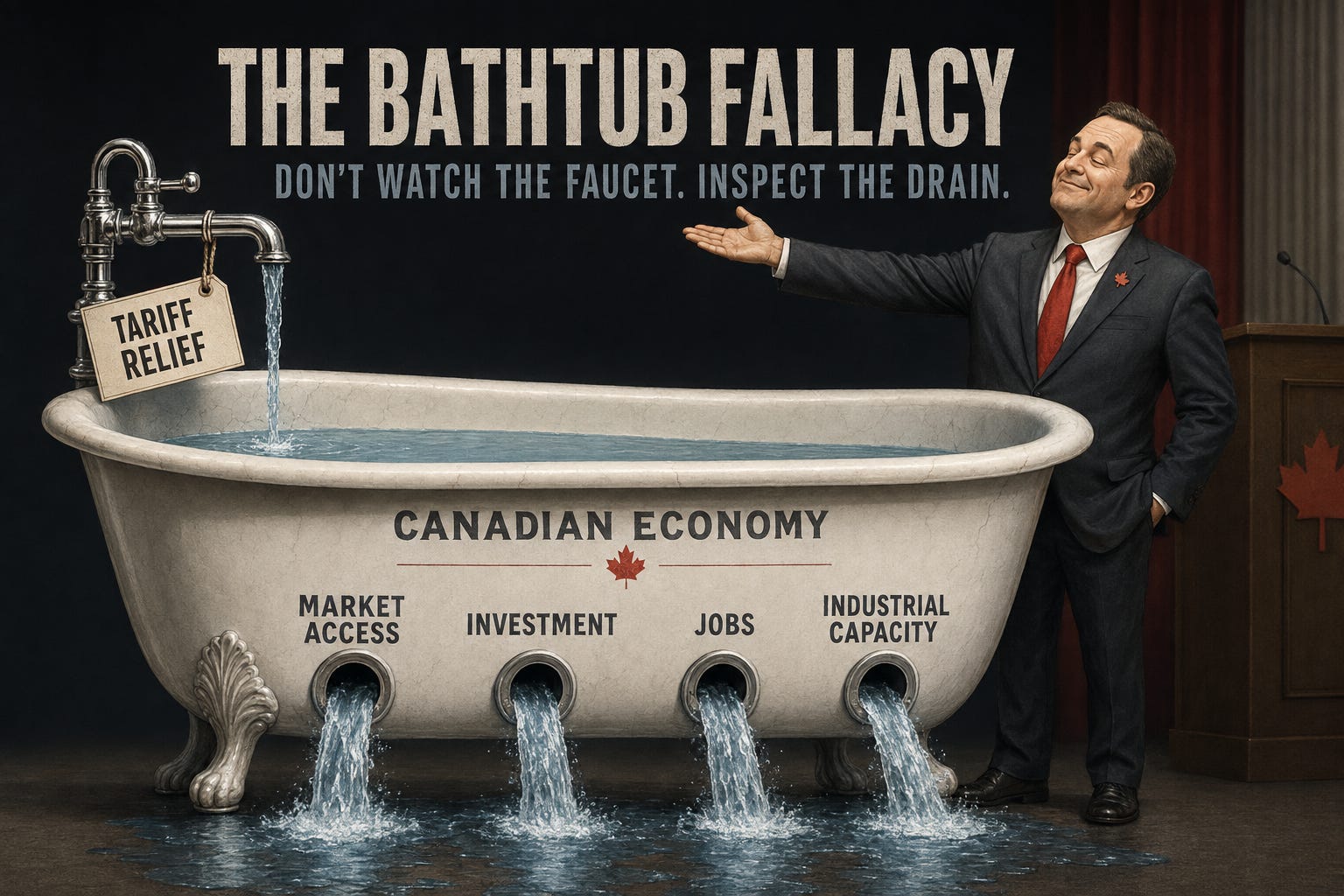
The Bathtub Fallacy is the mistake of judging progress by watching what is flowing into the tub while ignoring how much water is already there—and how quickly it is draining away.
Governments love faucets.
They announce tariffs reduced, exemptions secured, markets reopened and investments promised. Each announcement is presented as another stream of economic progress pouring into Canada.
But the water level is determined by both the faucet and the drain.
While Ottawa points to tariff relief flowing in, Canadians must measure what may be flowing out:
Existing market access
Export volume
Industrial capacity
Business investment
Employment
Canadian market share
Regulatory independence
Bargaining leverage
Public money paid in subsidies and compensation
A government can turn on a new faucet while leaving three drains open and still declare that it is “filling the tub.”
That is not economic analysis. It is plumbing by press release.
The choice of baseline will largely determine whether this agreement appears successful.
There are at least three possible comparisons:
The agreement versus Canada’s pre-dispute access under CUSMA.
The agreement versus tariffs currently being imposed.
The agreement versus the threatened 50% tariff regime.
Ottawa will naturally prefer the third comparison.
If a threatened 50% tariff becomes 25%, the government can claim that it cut the tariff in half. That sounds impressive—until we remember that Canadian goods previously entered the United States under much more favourable conditions.
Reducing a newly manufactured threat is not necessarily creating an economic gain.
If someone threatens to take $100 from you and eventually takes only $50, you have not earned $50. You have lost $50.
The proper baseline is Canada’s economic position before the coercion began:
Tariff rates
Quota-free access
Export volumes
Market share
Production capacity
Employment
Investment
Supply-chain integration
Regulatory rights
Dispute-resolution protections
A deal that is better than the threatened disaster but worse than the original trading relationship may be the least damaging option available. It should not be falsely presented as an economic victory.
Avoiding a larger loss and achieving a gain are not the same thing.
Headline tariff rates tell us surprisingly little.
We need the tariff schedules by product and tariff code. We need to know which Canadian goods qualify, which are exempt and which derivative products face separate treatment.
Most importantly, we need the quotas.
A reported 25% tariff on steel means little without knowing:
How much steel qualifies for that rate
Whether exports above the quota face a 50% tariff
Whether quota volumes are based on normal trade or depressed recent exports
Whether quotas expand with market demand
Whether they apply nationally or by producer and product
How import licences will be distributed
Whether unused quota can be transferred or carried forward
Suppose the lower tariff applies only to a restricted volume of Canadian steel while exports above that ceiling face the higher rate. In that case, describing the agreement simply as a “25% tariff” would be technically convenient and economically misleading.
The meaningful calculation is:
Effective tariff burden = Total duties paid ÷ Total value of affected exports
We also need to know whether Canadian companies face new rules of origin, customs documentation, certification requirements or supply-chain restrictions.
Nominal market access can become commercially useless when buried beneath administrative costs and delays.
These are tariffs wearing bureaucratic moustaches.
Trade agreements are exchanges, not gift baskets.
Every Canadian concession must be identified, quantified and compared with the value of the access Canada receives.
Potential concessions may include:
Changes to dairy-import licence allocation
Increased access for American agricultural products
Returning American alcohol to provincial stores
Preferential access to Canadian critical minerals
Energy-supply commitments
Government procurement access
Changes to foreign-investment rules
Regulatory or product-standard concessions
Limits on Canadian export controls
Removal of retaliatory tariffs
Restrictions on Canada’s ability to retaliate later
Returning American liquor to store shelves may be economically minor. Changes to dairy access, procurement, industrial policy or critical-mineral rights may not be.
Critical minerals are especially important because their value is not limited to this year’s sales. They affect future industrial development, defence production, technology supply chains and Canada’s bargaining power.
Trading a long-term strategic asset for temporary tariff relief could produce a favourable press conference and an unfavourable decade.
The correct calculation is:
Net Canadian benefit = Access gained − Access lost − Concessions granted − Compliance and adjustment costs
Without values attached to both sides of that equation, the word “deal” tells us nothing about whether it is a good one.
A national trade agreement cannot be judged from a single average.
Its effects will differ across steel, aluminum, automobiles, forestry, dairy, agriculture, energy and critical minerals. They will also differ across Ontario, Quebec, Western Canada and Atlantic Canada.
For each major sector, Canadians need to know:
Annual exports affected
Percentage of production exposed
Expected change in export volumes
Canadian market share before and after the agreement
Plant capacity utilization
Investment gained, cancelled or relocated
Direct and supply-chain employment affected
Changes in wages and hours worked
Regional concentration of losses
Downstream costs for Canadian manufacturers
A deal can appear mildly positive in a national estimate while devastating particular industries and communities.
We must also distinguish who formally pays a tariff from who ultimately bears its cost.
American importers initially pay U.S. tariffs. But the economic burden can be distributed among:
American consumers through higher prices
American importers through lower margins
Canadian exporters through price reductions
Canadian workers through lower production and employment
Canadian shareholders through reduced profits and investment
Canadian communities through plant closures and lost tax revenue
Saying that Americans pay the tariff does not establish that Canadians escape the damage.
If American buyers substitute U.S. or foreign suppliers, Canadian exporters can lose sales, market share and economies of scale. Investment may then migrate south of the border to avoid future political risk.
The statutory payer and the economic loser are not necessarily the same person.
A deal should not be judged only by what it temporarily settles. It must also be judged by what it leaves unresolved.
We need to know:
Which Canadian industries remain subject to tariffs
Whether quota restrictions become permanent
Whether exemptions can be withdrawn unilaterally
Whether national-security tariffs remain available
Whether Canada retains meaningful retaliation rights
Whether affected industries require subsidies or compensation
Whether the agreement restores predictable access
Whether it reduces or increases Canada’s dependence on the United States
Compensation must also be counted honestly.
If Ottawa spends billions subsidizing industries damaged by the agreement, those payments are not evidence that the deal succeeded. They are part of its cost.
The money comes from taxpayers, borrowing or reduced spending elsewhere. Government does not possess a magical compensation orchard behind Parliament. It redistributes the losses and sends out a press release.
The long-term question is whether the agreement moves Canada toward productive investment and secure market access—or merely keeps vulnerable industries alive until the next tariff ultimatum.
Timing can turn a theoretical benefit into a practical failure.
The agreement must disclose:
Effective dates
Phase-in periods
Quota-reset dates
Transition arrangements
Review provisions
Sunset clauses
Dispute-resolution timelines
Enforcement mechanisms
Termination rights
Interaction with the CUSMA review
An exemption that begins after companies have cancelled investments or closed production lines is not much of an exemption.
A dispute mechanism that takes two years to produce a ruling may be legally impressive and commercially useless.
We must also ask whether the agreement provides durable access or simply a pause until the next American political demand.
Market access that can disappear with the next presidential social-media post is not secure market access.
It is rented stability.
When the agreement is released, Canadians should ignore the adjectives and look for these numbers:
Trade-weighted effective tariff rates
Quota volumes and above-quota tariffs
Percentage of Canadian exports covered
Value of exemptions obtained
Value of Canadian concessions
Expected change in real export volumes
Expected change in Canadian market share
Investment gained, cancelled or redirected
Production capacity gained or lost
Full-time jobs, hours worked and real wages
Compliance and customs costs
Consumer-price effects
Government compensation and subsidy costs
GDP and GDP-per-capita effects
Tax revenue gained or lost
Duration and enforceability of market access
Dollar-valued trade figures must also be separated from physical volumes.
Export revenue can rise because prices increased even while Canada ships fewer goods. Likewise, GDP can rise while output per person, productivity or real household income deteriorates.
One attractive number does not establish broad economic progress.
That is the Bathtub Fallacy in a suit and tie.
A good agreement would:
Restore broad and predictable access to the U.S. market
Minimize tariffs and quotas
Preserve commercially workable rules of origin
Protect Canadian investment and production
Avoid sacrificing strategic assets for temporary relief
Include rapid and enforceable dispute resolution
Prevent unilateral tariff escalation
Produce benefits exceeding the value of Canadian concessions
Improve Canada’s position against the pre-dispute baseline—or at least restore it as closely as possible
A bad agreement would:
Normalize permanent tariffs
Restrict exports through tight quotas
Shift production and investment into the United States
Trade strategic resources for temporary exemptions
Weaken Canadian regulatory or retaliatory authority
Require continuing public subsidies to offset industrial damage
Leave Washington free to reopen the agreement through new threats
Produce a net loss compared with Canada’s position before the dispute
There may also be a third possibility: a damaging agreement that is nevertheless less damaging than allowing the threatened tariffs to take effect.
That may be the best deal available under coercive circumstances. But intellectual honesty requires calling it damage control—not victory.
Until the complete legal text, schedules, quotas, exemptions, concessions and sector-by-sector economic effects are available, no one can responsibly declare this a good deal or a bad deal.
Premiers, union leaders, industry associations, journalists and economists should all be asked the same question:
Compared with what?
Compared with a threatened 50% tariff, the agreement may look like relief.
Compared with Canada’s previous access, it may represent a significant deterioration.
Compared with the concessions Canada must make, it may prove beneficial, neutral or deeply expensive.
We do not yet know.
What we do know is that both governments have powerful incentives to manipulate the comparison. Trump needs a Canadian surrender. Carney needs a Canadian victory. The political narratives are already written; they are merely waiting for numbers to be inserted.
Citizens should refuse to choose between two advertising campaigns.
Apply QSix. Establish the original stock. Measure every inflow and outflow. Determine the net direction. Identify what remains missing. Examine the timeline.
Above all, do not stare at the faucet while the tub empties.
When the agreement is finally released, don’t tell us how much water Trump graciously turned back on.
Show us what Canada paid for the tap—and how much water remains in the tub.
#CanadaUSTrade #TradeDeal #Tariffs #CUSMA #CanadianEconomy #TradePolicy #Manufacturing #QSIX #BathtubFallacy #JunkEconomics
No posts
Comments
Nothing yet. Say the first thing.
Sign in to join the conversation.