
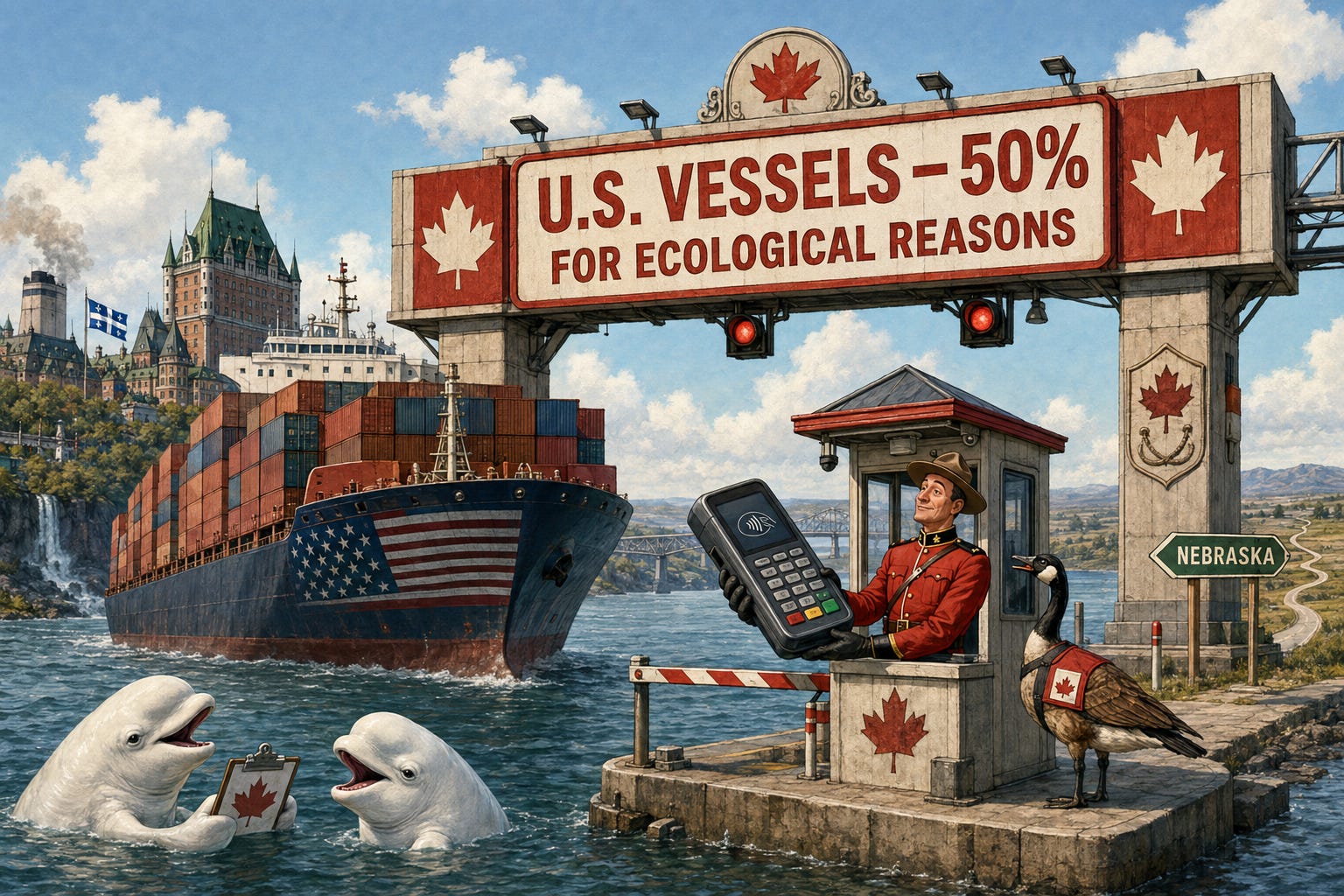
OTTAWA — Canada announced today that American commercial vessels will be prohibited from travelling between Montréal and the Gulf of St. Lawrence unless they pay a 50% tariff on their cargo and apologize to a beluga.
The government emphasized that the waterway has not been closed.
“It remains completely open to every vessel we permit to enter,” explained the newly appointed Minister of Open Waterways and Closed Waterways.
The measure follows Iran’s successful demonstration that international law becomes surprisingly flexible when a country controls something everyone else needs.
Canadian officials rejected suggestions that the fee amounts to retaliation against Washington’s 50% tariffs.
“Retaliation is ugly and protectionist,” said the minister. “This is a Gender-Inclusive Marine Biodiversity and Reciprocal Fairness Contribution.”
The fee was established after government scientists discovered that American ships displace Canadian water without replacing it.
“Every foreign vessel entering the St. Lawrence pushes some of our water aside,” explained one researcher. “For too long, Canada has supplied this buoyancy free of charge.”
Officials also raised concerns that American ships cast shadows over Canadian fish, creating an unacceptable aquatic microaggression.
The new regulations will apply to:
American-flagged vessels;
American-owned vessels;
vessels carrying American cargo;
vessels travelling to or from American ports;
vessels thinking about America;
and ships registered in Liberia but somehow owned by a corporation in Delaware operating from an office above a vape shop.
Exemptions may be granted to vessels transporting emergency supplies, provided the emergency is certified by Environment Canada, Fisheries and Oceans, Indigenous Services, Parks Canada, the CBC and three hereditary salmon.
Applications will take between six weeks and eleven winters.
The Northwest Passage will be placed under a similar environmental protection regime. Canada has invited Russia to establish a joint Arctic toll system based on the two countries’ shared commitment to sovereignty, conservation and invoicing Americans.
“We may disagree over Ukraine, NATO and the occasional threat of nuclear annihilation,” said a Canadian official, “but we can all agree that American ships look much more environmentally responsible after paying us.”
Washington immediately protested that Canada cannot interfere with peaceful passage through an international waterway merely to extract political and economic concessions.
The irony was last seen floating face-down near Cornwall.
President Trump threatened to respond with a 100% tariff on Canadian water.
“We import tremendous amounts of Canadian water,” Trump said. “Possibly all of it. Canada has been flooding America for years through rivers. Nobody has ever seen anything like it.”
The White House later clarified that rain originating over Canada may also be subject to duty.
Canadian officials welcomed the threat, noting that retaliatory rainfall tariffs would be paid entirely by Canadian clouds and would therefore cost Americans nothing.
The Parliamentary Budget Officer estimated that the St. Lawrence toll could generate anywhere from C$40 billion to six fish, depending on whether ships continue using the route after it has been made economically impossible.
The government nevertheless promised to spend the anticipated revenue immediately.
Prime Minister Carney praised the initiative as a triumph of Canadian sovereignty.
“For too long, Americans have treated our waterways as though geography entitled them to affordable passage,” he said. “From now on, they will enjoy affordable passage at twice the price.”
Asked whether Canada was weaponizing a strategic waterway, the prime minister rejected the premise.
“Canada does not weaponize trade,” he said. “We sustainably manage access to it until our demands are met.”
American vessels unwilling to pay the tariff remain free to select an alternative route.
Officials recommend Nebraska.
No posts
Comments
Nothing yet. Say the first thing.
Sign in to join the conversation.