
I was recently looking through a list of vintage speakers for sale on Facebook Marketplace.
The original question was simple enough.
Were any of them better than my Boston A70s?
The names alone were enough to trigger memories.
Dynaco.
Advent.
Bozak.
Wharfedale.
KLH.
Names that once filled radio advertisements and the windows of audio shops that have long since disappeared.
Suddenly I was no longer sitting in front of a computer screen.
I was sixteen years old again.
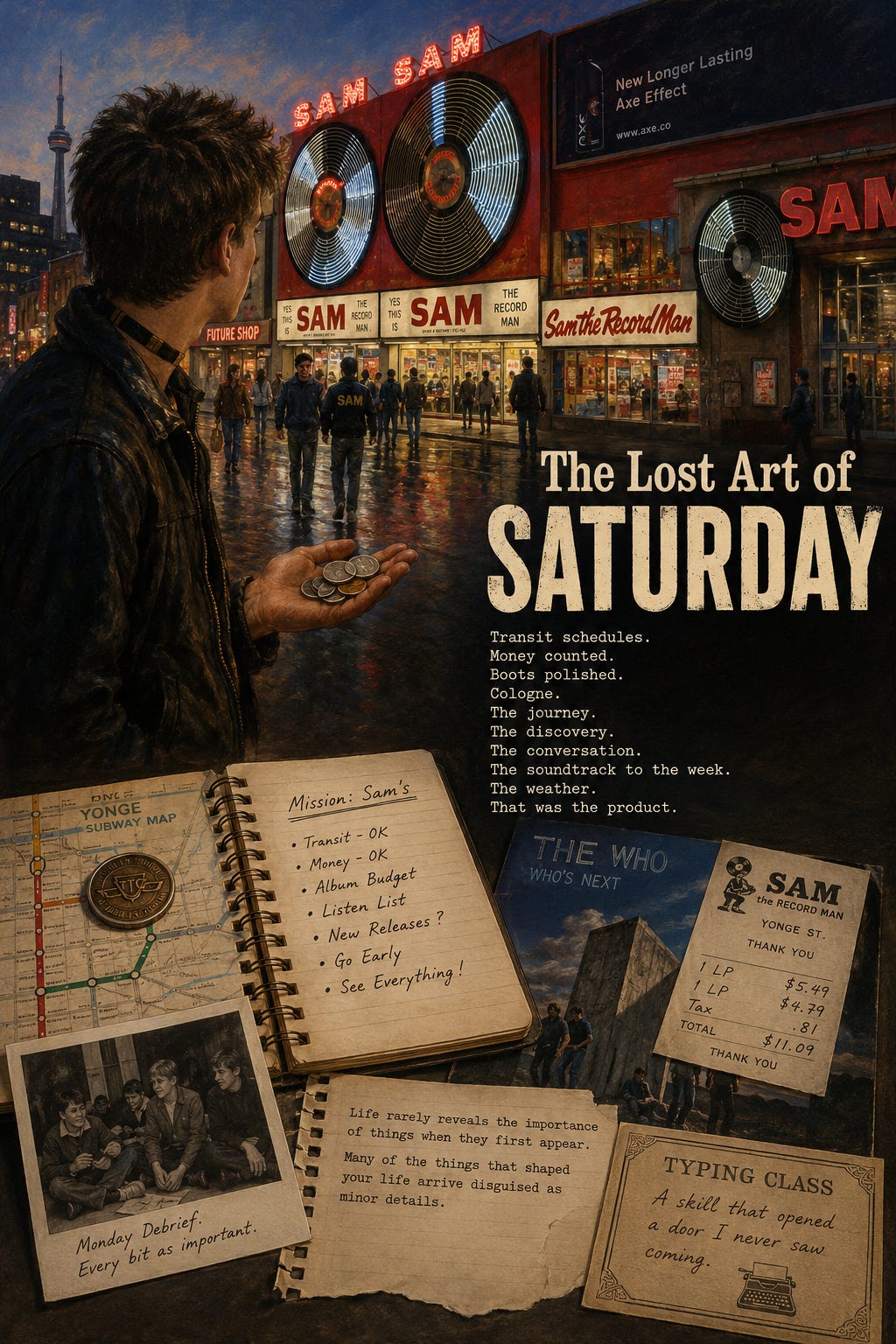
Saturday morning.
The mission had been planned all week.
Transit schedules checked.
Money counted and recounted.
Enough for the TTC fare and, if fortune smiled, a new album.
Perhaps two if there was a sale.
The preparation itself was part of the ritual.
Boots polished.
Hair combed and carefully styled.
Black-and-yellow neck choker in place.
A touch of cologne.
Not because there was a dance.
Not because there was a date.
Because I was going downtown to Sam’s on Yonge Street.
To an outsider, this would seem absurd.
A teenager preparing as though he were climbing Everest simply to buy a record.
But the record was never the point.
The trip was.
The anticipation began days before departure.
The experience continued long after returning home.
Monday morning brought the debrief.
Homeroom offered a brief summary.
Lunch period provided the opportunity for a full after-action report.
What did you buy?
What did you see?
Who was there?
What was playing in the store?
Did they have the new release?
Did you find anything unexpected?
The album itself occupied only part of the conversation.
The journey mattered equally.
The city.
The people.
The sights.
The sounds.
The smells.
The discoveries.
The music became inseparable from the experience surrounding it.
The record purchased on Saturday became the soundtrack to the entire week.
Monday brought discussion.
Tuesday brought another listening session.
Wednesday meant studying the liner notes.
Thursday often involved introducing a friend to the latest discovery.
By Friday anticipation was already building for the next expedition.
The album was not merely a product.
It was fuel.
Fuel for conversation.
Fuel for friendship.
Fuel for imagination.
Fuel for the next Saturday.
Today I can order a record in seconds.
A stored credit card.
A click.
An email confirmation.
A delivery notification.
Perhaps even a photograph proving the package has reached my front porch.
The transaction is objectively superior by almost every modern measure.
Faster.
Cheaper.
More efficient.
And yet something important has disappeared.
The old system contained friction.
We have spent fifty years trying to eliminate it.
What we failed to notice is that the friction was doing useful work.
Counting bills and coins was not merely a payment method.
It was a lesson in value.
You knew exactly how much money you possessed.
You knew exactly what the album cost.
You knew exactly what it had taken to earn those dollars.
The purchase connected effort to reward in a way that modern transactions rarely do.
Today the emotional experience often arrives weeks later in the form of a credit card statement.
Back then it arrived at the moment of purchase.
The old Saturday expeditions were gloriously inefficient.
They consumed time.
They required planning.
They demanded effort.
And because of that, they generated something modern commerce rarely produces.
Weather.
The record was not merely music.
It was anticipation.
Conversation.
Friendship.
Identity.
Discovery.
A catalyst whose effects lasted until the following Saturday when the cycle would begin again.
Looking back, I am not sure the record was ever the product.
The weather was.
The irony of this observation is not lost on me.
This entire realization emerged while browsing Facebook Marketplace on a tablet computer connected through fibre-optic networks, powered by algorithms designed to show me things I might want to buy.
A triumph of modern technology.
The algorithms wanted me to compare speaker specifications.
Instead they accidentally unearthed a lost civilization.
Which brings me to perhaps the most amusing realization of all.
None of this conversation would have been possible without a typing class I took more than fifty years ago.
At the time it seemed about as exciting as learning proper filing techniques or the care and feeding of office furniture.
Typing was practical.
Useful.
Necessary, perhaps.
But hardly inspirational.
I certainly did not walk out of class imagining that five decades later I would spend hours each day writing, researching, publishing essays, preserving memories, and conversing through devices that would have seemed indistinguishable from science fiction.
Had someone informed my teenage self that typing would become one of the most useful skills of my life, I would have laughed.
The future I imagined involved economics, airplanes, foreign countries, oil projects, contracts, and adventure.
Not keyboards.
Certainly not a glass tablet connected to invisible networks carrying conversations around the world.
Yet here we are.
The older I become, the more I appreciate that life rarely reveals the importance of things when they first appear.
A typing class.
A record store.
A pair of boots.
A black-and-yellow neck choker.
A Saturday afternoon spent wandering Yonge Street.
At the time they seem ordinary.
Trivial, even.
Only decades later do you discover that many of the things that shaped your life arrived disguised as minor details.
The record store disappears.
The albums are lost, sold, or worn out.
The transit tokens vanish.
The stores close.
The city changes.
But somehow the memory of counting out coins at the cash register, the anticipation of the journey, and the skill learned in an otherwise forgettable typing class remain.
Perhaps that is the real lesson.
Life is not built entirely from the grand events we remember.
It is built from thousands of seemingly insignificant experiences that quietly compound over time.
Like interest.
Only better.
Because instead of accumulating wealth, they accumulate meaning.
And unlike money, meaning tends to appreciate with age.
Observations from the Trail
Not all friction is waste.
Some forms of friction create anticipation, meaning, and appreciation. Eliminating every inconvenience may also eliminate part of the experience.
The transaction is not always the product.
The record was the excuse. The real product was the weather generated around it.
Value is easier to understand when effort is visible.
Counting cash connected work, sacrifice, and reward in a way that invisible digital payments rarely do.
Community amplifies experience.
The Monday debrief was every bit as important as the Saturday purchase. Experiences grow when shared.
Technology optimizes transactions, not necessarily meaning.
Modern systems excel at speed and convenience. Meaning still requires attention, participation, and memory.
Many of life’s most valuable lessons arrive disguised as ordinary moments.
A typing class. A record store. A Saturday afternoon. Their significance often becomes visible only decades later.
The weather survives longer than the product.
The album may be gone. The store may be gone. The city may have changed. Yet the feeling remains.
And perhaps that is why we keep searching for weather in the first place.
No posts
Comments
Nothing yet. Say the first thing.
Sign in to join the conversation.