
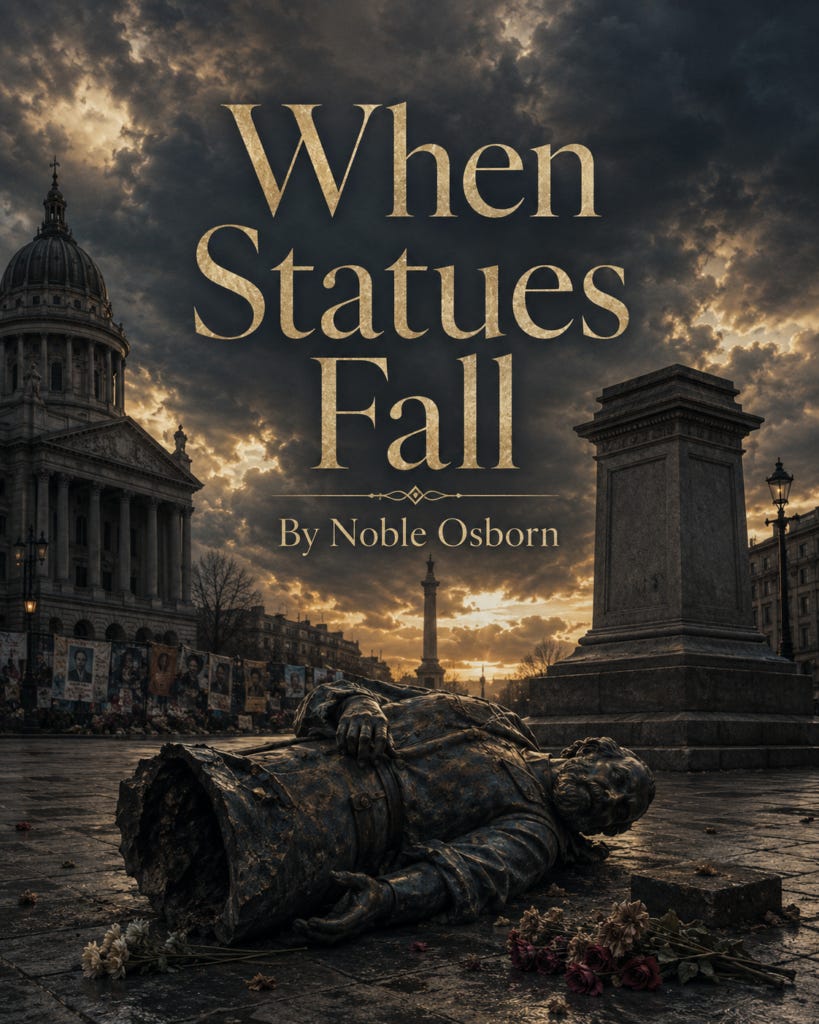
A statue does not fall all at once.
Long before the rope tightens, long before the crane arrives, long before the city council votes or the crowd gathers or the governor declares that history itself is under attack, the statue has already begun its descent. It falls first in the eye. Then in the conscience. Then in the story a city tells its children.
Bronze is patient. Marble is vain. Stone has the peculiar arrogance of believing that weather is the only thing that can undo it. But history has always known better. A monument can stand for a century and still be provisional. It can preside over courthouse lawns, traffic circles, capitol steps, cemeteries, plazas, and public parks with all the confidence of permanence, and then, in a single season, become evidence.
Evidence of who had power.
Evidence of who wrote the plaque.
Evidence of who was expected to bow their head beneath it.
Evidence of whose grief was made civic and whose suffering was made invisible.
That is the first truth hidden inside every argument over statues: the conflict is rarely between people who remember history and people who want to erase it. The deeper conflict is between those who mistake honor for history and those who have been forced to live beneath the consequences of that mistake.
A statue is not a textbook. It does not explain. It exalts.
It does not merely say, this happened. It says, look up.
That upward gaze is the whole matter. Public monuments train the body before they persuade the mind. They place one figure above another. They arrange the living below the dead. They turn civic space into a silent classroom where scale, height, polish, and placement do the teaching. The child does not need to read the inscription to understand who has been made important. The passerby does not need a lecture in imperial history to know that the man on horseback has been granted command of the square.
This is why statues trouble us. Not because they preserve the past, but because they continue to distribute authority in the present.
The defenders of old monuments often say that removing them erases history. But cities erase history all the time. They erase Black neighborhoods for highways. They erase Indigenous place names for developers. They erase immigrant labor behind clean facades. They erase women from plaques, queer people from archives, enslaved people from plantation tours, prisoners from the grand architecture of law, and the poor from the scenic vocabulary of civic pride. Erasure is not new. What is new, perhaps, is that the erased have begun to point back at the stone.
The statue, once accused, becomes strangely fragile.
It may be enormous. It may weigh tons. It may have survived storms, wars, neglect, pigeons, school field trips, and generations of civic indifference. But let one citizen ask, why is he still up there? and the metal begins to tremble.
There are statues that fall by revolution.
There are statues that fall by policy.
There are statues that fall by vandalism, by liberation, by court order, by referendum, by embarrassment, by crane.
There are statues that fall and are destroyed.
There are statues that fall and are moved indoors.
There are statues that fall and become better monuments in their broken state than they ever were on their pedestal.
There are statues that fall and reveal that the pedestal was always the more honest object.
The empty pedestal is one of the most powerful monuments human beings have invented. It does not tell us what to think. It shows us that thinking has happened. It marks the place where certainty failed. It allows absence to become visible. It interrupts the old choreography of reverence and replaces it with a question.
What used to stand here?
Why?
Who put it there?
Who wanted it gone?
Who still wants it back?
In that sense, a fallen statue is not the end of history. It is the beginning of history telling the truth about itself.
The old empires understood the language of falling stone very well. To conquer a city was to seize its images. Pharaohs carved their names over the names of predecessors. Roman emperors suffered damnatio memoriae, their faces chiseled away, their statues reworked, their public presence sentenced to oblivion. Churches rose on temples. Mosques rose on churches. Palaces became museums. Statues were buried, broken, restored, stolen, sold, worshipped, denounced, and dragged through streets.
No civilization has ever treated monuments as neutral.
The pretense that monuments are untouchable usually emerges only when the threatened monument belongs to the powerful.
When a dictator falls, the world understands the choreography. The statue is pulled down, beaten, defaced, climbed upon, kicked, decapitated, or paraded through the street. The image is symbolic, theatrical, sometimes manipulated, sometimes spontaneous, always hungry for cameras. The public destruction of the ruler’s likeness offers the body politic a substitute for the ruler’s body. The bronze takes the blows meant for the regime.
But democratic societies often become confused when the statue in question is not a dictator’s image but a civic inheritance. The marble is familiar. The square has traffic patterns around it. The bronze has become part of the weather. People say they never noticed it before, which is often another way of saying that it never threatened them.
For others, of course, the statue has always been loud.
A Confederate general in front of a courthouse is not a neutral object. It is not simply a reminder that a war occurred. It is a judgment cast in metal, placed where law is administered. Its horse does not merely gallop through memory. It patrols the civic imagination. It tells Black citizens approaching the building that the old order retained a ceremonial guard. It tells white citizens who built and preserved it that defeat could be aesthetically reversed. It turns treason into posture. It turns slavery into “heritage.” It turns historical guilt into decorative landscaping.
That distinction matters. A battlefield marker is not the same thing as an equestrian statue before a seat of government. A cemetery stone is not the same thing as a monument in a schoolyard. A museum artifact is not the same thing as a public idol. Context does not excuse everything, but context is often the difference between memory and honor.
History can survive relocation.
Honor cannot survive examination unless it deserves to.
This is the fear beneath many monument fights. Not that history will disappear, but that honor will be withdrawn. Not that future generations will know less, but that they may know more. Not that the dead will be forgotten, but that they will finally be remembered accurately.
When Edward Colston’s statue was pulled from its pedestal in Bristol and rolled into the harbor, the image traveled faster than any plaque ever had. A man long praised as a benefactor was made visible as a slave trader. The city did not lose history that day. It found the part of the story the statue had disciplined people not to see. Later, displayed damaged and horizontal, the statue became a stronger historical object than it had been while upright. The graffiti, the water stains, the battered surface, the very indignity of its posture — all became part of the record.
The fallen statue had acquired testimony.
The same is true, in a different way, of the bronze Robert E. Lee removed from Charlottesville. There was a time when his image stood above a public park as though the Lost Cause were still entitled to shade. Then came the years of argument, the white supremacist rally, the violence, the court battles, the removal, and eventually the melting. To some, this was desecration. To others, it was alchemy. Metal once shaped into racial hierarchy could be transformed into another public meaning. The point was not that Lee never existed. The point was that Lee no longer deserved to govern the square.
This is the real scandal of fallen statues: they expose that public memory has always been an act of selection.
Every monument is an edit.
Every pedestal is an omission.
No city has room for all its dead in bronze. No nation can carve every grief into stone. Choices must be made. The question is not whether we will choose. The question is whether we will keep pretending our choices are innocent.
Some monuments commemorate sacrifice. Some commemorate conquest. Some mourn. Some intimidate. Some invite reflection. Some demand obedience. Some were built to heal wounds. Others were built to hide them. Some became beloved despite their origins. Others became intolerable because the truth finally caught up to them.
It is tempting, in any age of upheaval, to draw a clean line between preservation and destruction. But the actual work of public memory is more complicated. There are monuments that should remain exactly where they are, but with fuller interpretation. There are monuments that should be removed from places of honor and placed in museums where they can be studied without being obeyed. There are monuments that should be left in fragments because their brokenness is the history. There are monuments that should be destroyed because their continued preservation serves no educational purpose strong enough to outweigh the harm of their veneration. There are monuments that should be answered by new monuments, not because addition solves everything, but because silence has had centuries to decorate itself.
And there are monuments that should never have been built at all.
A mature society should be able to say so.
The trouble is that nations often confuse maturity with politeness. They ask the wounded to be calm before the idol. They ask descendants of the dishonored to appreciate craftsmanship. They ask citizens to separate art from violence, bronze from ideology, stone from power. They ask for nuance only after having denied nuance for generations.
But a statue is already an argument without nuance. That is its appeal. That is its danger.
The man on the horse does not say, consider the contradictions of my life.
The imperial column does not say, remember the bodies beneath my victory.
The plantation monument does not say, this beauty was financed by bondage.
The conqueror’s arch does not say, listen for the languages I silenced.
The statue says, admire.
When admiration becomes impossible, the statue has failed its public function.
What follows should not be panic. It should be civic responsibility. A fallen statue asks a community to become literate in its own symbolism. It asks people who have inherited space to study the terms of that inheritance. It asks whether public land belongs to memory, myth, grief, truth, or power. It asks whether the past must always stand tallest because it arrived first.
In the United States, this question has become especially charged as the country approaches its 250th birthday. Anniversaries are dangerous for honest memory. They invite bunting. They invite selective narration. They invite speeches in which complexity is treated as ingratitude. The nation wants to celebrate itself, and celebration is often impatient with the dead who refuse to stay decorative.
But the 250th anniversary of a country is not only a birthday party. It is an audit.
What did the nation promise?
Whom did it exclude from the promise?
Who expanded the promise by force of protest, law, art, labor, blood, and refusal?
Which landmarks tell that story?
Which landmarks lie about it?
A country that cannot answer those questions honestly has no business demanding reverence.
The current fights over national park exhibits, museum language, slavery interpretation, Indigenous history, Confederate memorials, and queer visibility are not side issues. They are monument fights by other means. A display panel can be a monument. A missing paragraph can be a monument. A removed flag can be a monument. A restored statue can be a monument to backlash. A censored exhibit can be a monument to fear.
The battlefield has moved from stone to signage, from bronze to curriculum, from plinth to webpage. But the question remains the same: who controls the public story?
Those who wish to sanitize history often claim they are protecting unity. But unity built on omission is not peace. It is anesthesia. It numbs the body politic so the wound can remain untreated. The problem with truthful memory is not that it divides a nation. The problem is that it reveals divisions that were already there.
A monument does not create the wound.
It tells us where the wound was given permission to look beautiful.
This is why fallen statues matter. They are not merely evidence of anger. They are evidence of moral revision. Sometimes that revision is clumsy. Sometimes it is theatrical. Sometimes it gets things wrong. Human beings do not become wise simply because they have found a rope. But neither are societies virtuous simply because they own cranes and preservation boards. The slow official process can be cowardice in civic clothing. The sudden public toppling can be both illegal and historically clarifying.
The law and the conscience are not always synchronized.
There is danger in iconoclasm. Of course there is. A society that tears down every image it no longer understands will become rootless and vain. But there is also danger in idolatry, and idolatry is the more common civic habit. We leave things standing because they are expensive to move, because donors object, because tourists expect them, because officials fear backlash, because the dead have powerful descendants, because the living have learned to walk around the insult.
At some point, walking around the insult becomes participation in it.
The question, then, is not whether statues should fall. Some should. Some should not. Some should be lowered rather than toppled. Some should be reinterpreted, relocated, encircled by counter-memory, or made to answer for themselves. The harder question is whether we are willing to stop pretending that height is innocence.
The statue on the pedestal is not above politics. It is politics made vertical.
The fallen statue is not outside history. It is history changing posture.
Perhaps this is why the image unsettles us so deeply. A fallen statue resembles a corpse, but also a stage prop. It reveals the theatricality of power. It shows the seams. The heroic figure, once horizontal, becomes oddly human, even ridiculous. The horse no longer charges. The sword points nowhere. The noble chin, designed for sunlight, scrapes the pavement. The whole machinery of awe collapses into material: bronze, bolts, hollow casting, municipal paperwork.
And yet something sacred may happen there, not in the destruction itself, but in the pause after it.
People gather around the absence.
They take photographs.
They argue.
They mourn.
They celebrate.
They ask what should come next.
That question — what should come next? — is the only question worthy of a public square.
Not every empty pedestal needs to be filled. Sometimes absence should remain long enough to educate the eye. Sometimes a city should have to look at the vacancy it made, the vacancy it inherited, the vacancy it mistook for completion. Sometimes the most honest monument is a cleared space where citizens can finally see one another without a dead man between them.
Still, we will build again. Humans always do.
We will raise names, walls, markers, gardens, plaques, arches, fountains, glass, steel, stone. We will commemorate those we once ignored. We will make mistakes. We will overcorrect. We will discover new silences inside our own acts of repair. We will learn that no monument is final, because no generation owns the whole truth.
That should humble us.
A monument is not a promise that memory has been settled. It is an invitation to return and ask whether the settlement still holds.
When statues fall, they do not erase the past. They expose the bargain the past made with power. They remind us that public honor is not an inheritance to be guarded blindly, but a responsibility to be renewed, revised, and sometimes revoked.
Let the museums keep the evidence.
Let the archives keep the names.
Let the classrooms teach the conflict.
Let the cemeteries hold the dead.
But let the public square belong to the living, too.
Because stone remembers what we ask it to remember.
Bronze repeats what we command it to repeat.
And every generation, sooner or later, must decide whether it has inherited a monument, a warning, or a lie.
No posts
Comments
Nothing yet. Say the first thing.
Sign in to join the conversation.