
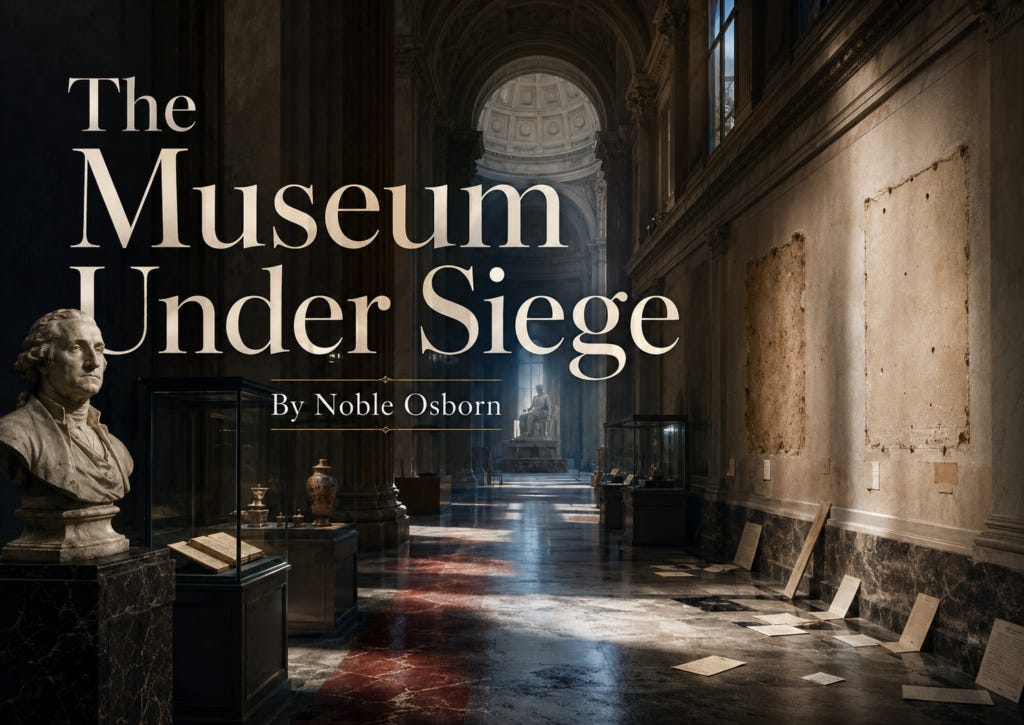
A museum does not have to burn to be under siege.
No army has to break its doors. No mob has to scatter its cases. No conqueror has to ride in and carry the marble heads away in crates. Sometimes the siege begins more quietly than that. A memo arrives. A committee is appointed. A phrase is questioned. A wall text is softened. A label disappears. A display is “temporarily” removed. A portrait remains, but the wound beside it is taken down.
Then the room looks almost the same.
That is the genius of the gentler siege. It does not need to destroy the building. It only needs to discipline the story inside it.
Museums have always pretended, at least a little, to be neutral. The marble floor, the climate-controlled glass, the hush of the gallery, the careful distance between object and viewer — all of it suggests that what is displayed has somehow escaped the mess of human argument. But nothing enters a museum innocently. Someone chooses what is saved. Someone chooses what is centered. Someone chooses what receives light, what receives explanation, what receives apology, and what is left in storage to wait out the century.
A museum is not a warehouse of facts. It is an argument with doors.
This is why the museum has become one of the great political battlegrounds of our time. Not because museums are suddenly political, but because the politics of memory have become harder to disguise. Every nation wants its monuments to flatter it. Every empire wants its museums to justify the journey of the stolen thing from someone else’s altar to its own glass case. Every anxious government wants history to behave like a hymn.
But history is not a hymn.
History is a chorus with missing voices. It is testimony and contradiction. It is the king’s robe and the enslaved hand that embroidered it. It is the battlefield and the widow. It is the explorer’s map and the village that did not consent to being discovered. It is the founding document and the person standing outside the hall, uncounted by the men inside. To ask a museum to tell only the uplifting part is not to protect the public from ideology. It is to replace inquiry with obedience.
The attack on museums usually announces itself as restoration. It promises to restore pride, restore unity, restore greatness, restore balance, restore sanity. The language is medicinal. Something has gone wrong, the public is told. The museum has become diseased by shame. The labels have grown too critical. The exhibits have wandered too far from celebration. The nation has been made to feel guilty in rooms that should have made it feel proud.
There is a dangerous softness in that argument. It appeals to the tired. It appeals to the defensive. It appeals to anyone who has mistaken discomfort for attack. It says: you should be able to enter the nation’s memory without being asked anything difficult. You should be able to admire the house without being told who built it. You should be able to praise the founder without meeting the people he owned. You should be able to stand before the flag and never hear the names of those the flag did not protect.
But a museum that cannot make a citizen uncomfortable is not a museum. It is a showroom.
The question is not whether national museums should include triumph. Of course they should. Nations are not sustained only by shame. There is beauty in public achievement. There is courage in abolition, suffrage, civil rights, labor struggle, artistic invention, scientific discovery, immigration, endurance, and reform. There are moments in American history worthy of reverence. There are lives worthy of bronze. There are documents worthy of being preserved beneath glass.
But triumph without wound becomes propaganda.
The mature museum does not choose between love and truth. It understands that love without truth is childish, and truth without love is merely accusation. The work of public memory is harder than either flattery or condemnation. It must hold contradiction. It must let the visitor feel admiration and grief in the same room. It must allow the object to remain beautiful while refusing to hide the violence that made its beauty possible.
That is why museums frighten those who want power to have the final word. A statue can be ordered upright. A flag can be raised. A speech can be written. But a museum, at its best, is full of evidence. Evidence is unruly. It resists the neatness of myth. It asks the viewer to stand longer than comfort allows.
The label is the smallest monument in the room.
It is also one of the most dangerous. A label can turn treasure into testimony. It can tell us that the silver was mined by forced labor, that the robe was taken during conquest, that the photograph was staged, that the family fortune came from an industry with blood in its machinery. A label can introduce a name that power preferred to omit. A label can rescue the dead from decorative silence.
This is why the struggle over museums so often becomes a struggle over wording. Not only what is shown, but how it is named. Not only whether slavery appears, but whether it is called slavery. Not only whether Indigenous removal appears, but whether the verb admits who removed whom. Not only whether LGBTQ history appears, but whether it is allowed to stand as public history rather than special pleading. Not only whether race appears, but whether race is treated as a central force in the nation’s making or as an impolite interruption of patriotic atmosphere.
A government that controls the labels controls the moral grammar of the room.
This is especially true in national museums and parks, where the visitor enters not simply as a spectator but as a citizen. The National Mall is not only a landscape. It is a curriculum. The Smithsonian is not only a museum complex. It is a civic nervous system. National parks are not only scenic preserves. They are outdoor archives where battlefields, birthplaces, homes, trails, burial grounds, rivers, and ruins teach the public what the nation has decided to remember.
When those sites are pressured to become “uplifting” at the expense of being honest, something essential is lost. Not merely a panel. Not merely a sentence. A nation loses the habit of looking at itself directly.
Consider the President’s House in Philadelphia, where the architecture of freedom and the architecture of enslavement occupy the same historical ground. George Washington lived there while serving as president. Enslaved people lived and labored there too. To tell only the story of executive dignity would be easier. It would be cleaner. It would let the public stand near the Liberty Bell without hearing the iron in its echo.
But the truth is not clean.
The truth is that American liberty was declared, debated, built, compromised, contradicted, and deferred in spaces where unfree people were present. The truth is that the founders were not marble when they lived. They were men with brilliance and blindness, courage and cruelty, imagination and appetite. To say so is not to vandalize the republic. It is to refuse the laziness of worship.
The same tension moves through every museum that tries to tell a national story. What should a child see first: the flag or the blood beneath it? What should a visitor carry away: pride, sorrow, gratitude, rage, responsibility? The answer, of course, is not singular. A serious museum does not issue an emotion at the door. It builds a room where feeling becomes thought.
This is what authoritarian memory cannot tolerate.
Authoritarian memory requires simplicity. The leader is heroic. The past is glorious. The enemy is corrupting. The nation is innocent. Shame is foreign. Criticism is betrayal. Complexity is weakness. The museum, under such pressure, must become a chapel of approval.
Democratic memory, by contrast, is noisy. It understands that a people strong enough to govern themselves must be strong enough to hear the truth about themselves. It does not ask museums to humiliate the nation. It asks them to mature it.
There is a reason the museum fight grows more intense around anniversaries. Birthdays are dangerous for nations. They invite pageantry, and pageantry prefers clean lines. The 250th anniversary of the United States arrives with fireworks already waiting in the warehouses and speeches already being polished in offices. There will be bunting, flyovers, parades, commemorative coins, red-white-and-blue branding, and the soft glow of official nostalgia.
But an anniversary is not only a birthday party. It is also an audit.
Two hundred and fifty years is long enough for a country to stop demanding childish praise. Long enough to admit that founding promises can be beautiful even when the founders failed them. Long enough to understand that criticism is not the opposite of patriotism. Long enough to know that a democracy’s strength is not measured by how little shame it admits, but by how much truth it can survive.
A museum worthy of that anniversary would not offer the country a lullaby. It would offer a mirror.
In that mirror would be invention and genocide, abolition and enslavement, immigration and exclusion, suffrage and suppression, jazz and internment camps, moon landings and lynching trees, public schools and segregated doors, Pride marches and police raids, veterans and broken treaties, national parks and displaced nations, the Statue of Liberty and the border cage.
This is not because America is only terrible.
It is because America is real.
The museum under siege is the museum being told to become less real.
And yet museums are not innocent institutions in need of uncomplicated defense. They have their own sins. They have displayed stolen bodies and stolen gods. They have made beauty out of conquest. They have turned sacred objects into educational material for people who did not understand their holiness. They have treated colonized cultures as dead cultures, as though a people became more collectible once empire had wounded them. They have elevated donors, softened provenance, buried embarrassment, and mistaken possession for stewardship.
The museum is not pure. That is why it matters.
A compromised institution can still become a place of reckoning. A collection born in empire can become a site where empire is named. A gallery built from wealth can still tell the truth about wealth. A national museum can still teach citizens that inheritance is not absolution.
But this requires courage from curators, historians, educators, archivists, conservators, librarians, docents, and guards — the often invisible keepers of public memory. It requires them to resist both fashionable simplification and political intimidation. It requires them to remember that scholarship is not a mood. Evidence is not a partisan accessory. Context is not vandalism. The past does not belong to whoever currently holds office.
The past belongs to the dead, the living, and the not-yet-born who will inherit what we were brave enough to preserve.
When a museum removes a difficult exhibit, the loss is not only intellectual. It is civic. A visitor who might have encountered an uncomfortable truth instead encounters a blank space. A child who might have learned that freedom was contested learns only that freedom was inevitable. A citizen who might have been invited into responsibility is handed admiration instead.
Blankness is not neutral.
Silence has a politics.
The empty wall speaks too. It says someone was afraid of what used to be here. It says the evidence was inconvenient. It says memory was judged too dangerous for public display. It says the people named in that vanished panel have been asked, once again, to wait.
And they have waited long enough.
Museums must not become rooms where nations go to avoid themselves. They must remain rooms where nations practice honesty in public. That does not mean every exhibit will be perfect. It does not mean every curatorial choice will be wise. It does not mean visitors should surrender judgment to experts. Museums should be argued with. They should be questioned, revised, expanded, challenged, corrected.
But correction is not censorship. Debate is not erasure. Revision is not obedience.
The difference matters.
A living museum changes because new evidence emerges, new scholarship deepens the frame, new communities speak, new questions become visible. A captured museum changes because power prefers a prettier story. One is growth. The other is laundering.
The museum under siege asks us to decide what kind of public memory we want. Do we want rooms that make citizens larger, or rooms that keep them comfortable? Do we want history as inheritance, or history as decoration? Do we want monuments that can survive truth, or monuments so fragile they require the removal of every wound around them?
The answer will not be found only in Washington. It will be found in county museums, school field trips, tribal archives, battlefield visitor centers, university galleries, historical societies, house museums, roadside markers, digital collections, and the small local rooms where someone’s grandmother donated a dress, a photograph, a letter, a tool, a quilt, a church program, a protest sign, a wedding portrait, a military uniform, a newspaper clipping, a name.
Every archive is a promise against disappearance.
Every label is a hand extended across time.
Every museum, however grand or humble, asks the same question: what do we owe the truth once the people who lived it can no longer speak?
At their best, museums answer: everything.
Not because truth is comfortable. Not because truth is patriotic in the easy sense. Not because every visitor will agree with every sentence on every wall. But because a people who cannot bear the truth of their own making cannot be trusted with the future.
The museum under siege is not only a building in danger.
It is a democracy being tested by its own reflection.
And as the nation prepares to celebrate itself beneath fireworks and flags, the question is not whether the museum will allow America to feel proud.
The question is whether America is brave enough to feel honest.
No posts
Comments
Nothing yet. Say the first thing.
Sign in to join the conversation.