
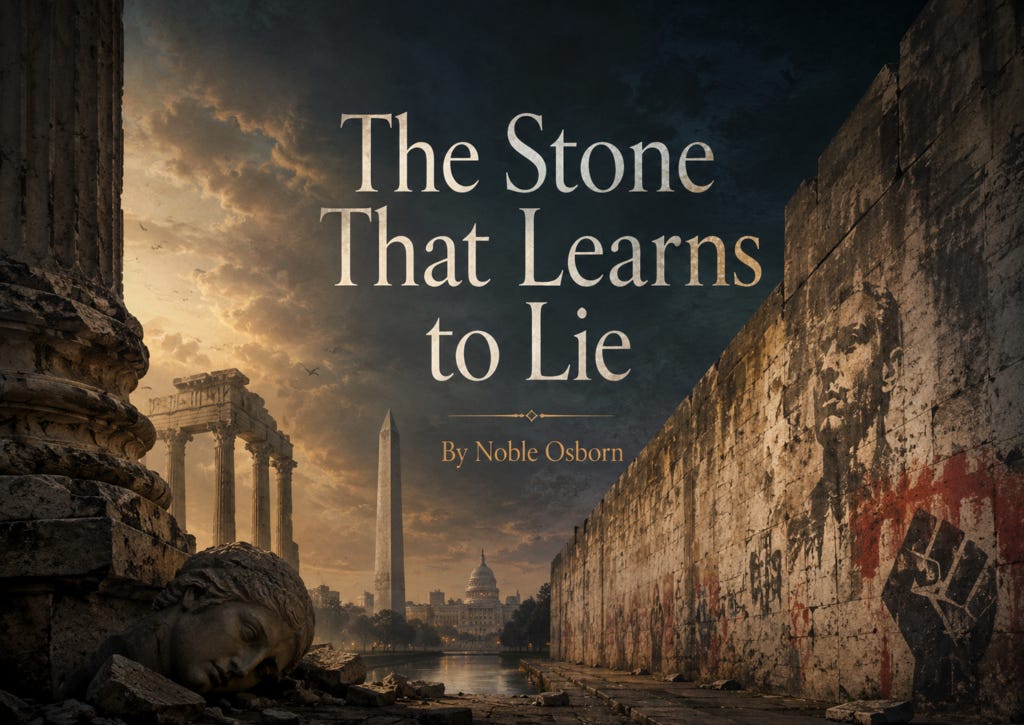
A monument begins with ambition.
Someone, somewhere, decides that memory should no longer be trusted to the body alone. The story is too large for a mouth, too fragile for a generation, too useful to be left in the hands of grief. So the living raise stone. They stack brick. They pour concrete. They carve a face into mountain, lift a column toward the sky, name a street, mark a battlefield, dedicate a plaza, install a plaque, polish the bronze, flood the obelisk with light.
They say: remember this.
What they often mean is: remember this the way we tell it.
That is where the lie begins.
Not always at first. Not every monument is born false. Some rise from sincere grief. Some from gratitude. Some from civic hope. Some are the most human of gestures: a hand placed against time, asking not to be erased. The grave marker, the shrine, the memorial wall, the candle left beneath a name — these are not lies. They are refusals. They are what the living build when the dead have gone beyond reach but not beyond consequence.
But landmarks have long lives, and long lives are dangerous. A structure built by one generation must stand before another. The stone does not age the way the story does. The bronze remains while the language around it changes. The pedestal survives after the empire that commissioned it begins to look obscene. The temple keeps its columns after the gods have gone silent. The wall remains after the fear that built it has become shame. The statue stands in the square long after the schoolchildren have learned to ask why this man, why here, why still.
A landmark is never only what was built.
It is what later generations are asked to accept without question.
This is why monuments make such poor corpses. They do not stay buried. They return at anniversaries. They flare under protest. They are dragged back into the public argument whenever a nation wants to pretend its past is settled. A monument, left alone long enough, becomes less an object than a witness. It watches the story told in its name change around it. It watches the flags come and go. It watches the school tours, the wreath-layings, the riots, the cleanings, the restorations, the defacements, the selfies. It watches the living discover what the dead chose not to say.
Then, slowly, the stone begins to lie.
Or perhaps more precisely, the lie that was always hiding inside the stone becomes easier to see.
Consider the obelisk.
In ancient Egypt, the obelisk was not neutral architecture. It was solar, royal, divine. It announced power by reaching upward, a blade of permanence drawn against the sky. When later nations borrowed the shape, they borrowed more than elegance. They borrowed the old grammar of command. The Washington Monument stands in this inherited language: an Egyptian form in an American capital, a vertical claim that the republic, too, wished to speak in eternity.
And yet even that monument carries interruption in its body. Its construction did not proceed as one clean act of national devotion. It stalled. Politics, funding, war, and time left their mark. The stone itself changes shade partway up, as though the monument’s own skin remembers the years when the nation could not finish what it had started.
That interruption may be the truest part of it.
Officially, the monument honors George Washington: commander, president, founding figure, civic ideal. But no American monument can remain safely inside the official sentence. Around it gather all the contradictions of the country that built it. Revolution and slavery. Liberty and exclusion. Union and civil war. The marble aspiration of democracy and the long record of who was denied its shelter. The obelisk does not resolve these contradictions. It only stands among them, white and severe, asking to be mistaken for certainty.
This is the danger of height. From a distance, height looks like clarity.
Up close, the seams remain.
The Statue of Liberty offers another kind of transformation. She was not born with all the meanings now placed upon her. No landmark is. Meaning accrues. It migrates. It attaches itself like weather. A statue gifted as an emblem of liberty became, through poetry, proximity, and the human drama of arrival, one of the great symbols of immigration. Emma Lazarus did not sculpt the statue, but she altered its soul. A poem changed the national reading of bronze.
That, too, is a kind of landmark-making.
There are monuments of stone, and there are monuments of interpretation. Sometimes the second outlasts the first. Without the words placed at her feet, Liberty might have remained a more abstract figure: torch, crown, republic, enlightenment. With the poem, she became maternal. She became harbor. She became threshold. She became the imagined first witness to millions who arrived by water, carrying hunger, fear, names, children, gods, languages, and the terrible bravery of beginning again.
But even this meaning can be betrayed.
A nation can praise the Mother of Exiles while building cages. It can print her image on postcards while treating the stranger as contamination. It can recite welcome as mythology while legislating suspicion as policy. The statue does not change. The country does. Or rather, the country reveals which parts of itself were always conditional.
The landmark does not lie because it welcomes.
It lies when the nation points to it as proof that welcome still governs.
This is the pattern repeated across centuries. A landmark is built to stabilize meaning, but meaning is never stable because human conscience is not stable. What one age calls conquest, another calls theft. What one age calls civilization, another calls erasure. What one age calls order, another calls violence. The monument remains, but the moral weather shifts.
The Berlin Wall is perhaps the rare monument that became most meaningful only after it failed.
It was not built as a memorial. It was built as a wound with guards. It cut through streets, families, windows, graves, memory. It made ideology physical. It turned suspicion into concrete and then asked the world to call that concrete security. For those trapped by it, the wall was not metaphor. It was patrol, barbed wire, paperwork, absence, death. It was the shape of the state pressing itself against the body.
Then it fell.
And once fallen, it changed again. The wall that once existed to prevent crossing became a pilgrimage site for crossing. Fragments became souvenirs. Graffiti became inheritance. The scar became lesson. The barrier became proof that even enormous structures can be temporary when the human will against them becomes larger than fear.
But here, too, the lie is waiting.
It is too easy to visit the Berlin Wall as a completed moral tale. It is too easy to stand before its remnants and imagine that walls belong to the past, that ideological division was a twentieth-century fever from which the world has recovered, that concrete was the problem rather than the fear that asked for concrete. The fallen wall can become its own kind of false comfort. It can allow later generations to condemn the old barrier while applauding new ones.
Every wall says it is different.
Every wall insists it is necessary.
Every wall claims the wound is actually protection.
And still, human beings remain strangely proud of walls. We build them around cities, temples, borders, prisons, neighborhoods, sacred precincts, private gardens, public fears. We build them to keep out enemies and then discover we have trapped ourselves inside the imagination that required them. We build them as symbols of strength and later inherit them as evidence of terror. We build them in stone, law, zoning, language, doctrine, and silence.
Walls are monuments that pretend to be practical.
That is their genius.
A statue announces itself as meaning. A wall claims to be merely useful. Yet walls often reveal a civilization more honestly than its statues do. A statue shows whom a society wishes to honor. A wall shows whom it fears. The Great Wall, the city wall, the prison wall, the border wall, the segregation wall, the schoolhouse wall, the wall of a cave marked by hands and animals before written language — all of them are surfaces where human beings make their anxieties visible.
Even sacred walls are not simple.
The Western Wall is not merely a wall. It is remnant, wound, prayer, longing, argument, devotion, politics, inheritance. It holds the tension of a place where faith and history press so tightly against each other that no stone can be touched innocently. To one person, it is the holiest accessible remnant of an ancient temple complex. To another, it is inseparable from contested sovereignty, occupation, and the unresolved griefs of Jerusalem. The stone receives prayers in its cracks, but it also receives the weight of history’s competing claims.
This is what landmarks do when they stand long enough.
They stop belonging to one story.
The original builders almost never intend this. Power prefers simple monuments. It wants one face, one inscription, one ceremonial use. It wants the crowd to look up and feel awe before it has time to think. But time is a vandal no regime can fully police. Time brings new witnesses. It brings the descendants of the excluded. It brings historians, activists, mourners, tourists, children, skeptics, lovers, and those who were supposed to remain invisible. They arrive at the monument and refuse to behave as the monument expected.
Sometimes they bring flowers.
Sometimes they bring hammers.
Sometimes they bring a flag.
Stonewall was not built to be a monument. That matters.
There was no founding ceremony for queer liberation on Christopher Street. No government commissioned the uprising. No polished inscription announced that history would begin here. The landmark was made by refusal. By bodies that had been harassed one time too many. By people whose existence had been treated as vice, nuisance, illness, and crime. By a bar, a raid, a street, a crowd, a night that would not disperse quietly.
Only later did the nation learn to call it a landmark.
This is one of the most powerful reversals in public memory: a place once marked by policing becomes marked by pilgrimage. A site of humiliation becomes a site of pride. The street remembers what the law would rather forget. The building becomes less important than the rupture it witnessed. Stonewall proves that not all monuments descend from power. Some rise from resistance. Some are not built upward but forced into visibility from below.
And because of that, Stonewall also proves how fiercely memory can be edited after the fact.
A landmark does not protect its own meaning. Recognition is not preservation. A site can be named, celebrated, mapped, photographed, and still be softened into something more comfortable than the truth. The roughness can be polished away. The drag queens can become background. The trans women can be made inconvenient. The anger can be turned into rainbow merchandise. The police violence can be reduced to atmosphere. The uprising can be renamed celebration before the wound has healed.
This is how a landmark learns to lie without moving an inch.
Not always by what is added.
Often by what is removed.
Public memory is a form of architecture. It has foundations, load-bearing walls, locked rooms, decorative facades, and carefully concealed basements. Nations are especially skilled at this. They build monuments to bravery while hiding the bodies that bravery required. They build museums to civilization while storing stolen gods behind glass. They build memorials to freedom while avoiding the names of those freedom excluded. They build capitols with domes and columns, then call the building neutral because the marble is clean.
But marble is never clean.
Someone quarried it. Someone paid for it. Someone was not allowed through the front door. Someone’s land became the plaza. Someone’s labor became invisible. Someone’s story was deemed too divisive for the plaque. The monument may appear silent, but silence is one of the oldest languages of power.
This is why fights over monuments are never really fights over the past.
They are fights over permission.
Who is permitted to grieve publicly? Who is permitted to be honored? Who is permitted to say that the hero was also a tyrant, that the founder was also an enslaver, that the explorer was also an invader, that the missionary was also an agent of empire, that the benefactor’s fortune came from suffering, that the statue in the square has been teaching children a moral lesson the city no longer wishes to defend?
When a monument falls, its defenders often speak as though history itself has been attacked.
But history is not stone.
History is the argument the stone was interrupting.
There is a difference between remembering and revering. A nation can remember a figure without placing him above the public square. A city can teach conquest without making conquered people walk beneath the conqueror’s bronze shadow. A museum can preserve an object without pretending ownership is innocence. Removal is not always erasure. Sometimes removal is the first honest sentence a place has spoken in centuries.
Still, destruction alone is not wisdom. A toppled statue does not automatically produce understanding. An empty pedestal can become either a question or a vacuum. It can invite a better memory, or it can leave behind only the thrill of having won the day’s argument. The work is not finished when the rope tightens, when the crane arrives, when the plaque is unscrewed. The harder work begins afterward.
What do we place there now?
A name?
A wound?
A garden?
Nothing?
A silence honest enough to remain empty?
There are monuments that should stand, monuments that should fall, and monuments that should be forced to tell the truth in public. The answer cannot be one rule for every stone. Some landmarks are graves, and graves require tenderness. Some are sacred sites, and sacred sites require humility. Some are propaganda, and propaganda does not become heritage simply by surviving long enough. Some are beautiful and still morally compromised. Some are ugly and historically necessary. Some are beloved by those who were never harmed by what they celebrate.
The question is not whether the past should remain visible.
The question is whether visibility should still be mistaken for honor.
Perhaps the most honest landmark is the ruin.
The ruin does not pretend wholeness. It does not ask us to believe in permanence. Its brokenness is part of its testimony. A fallen column, a shattered wall, a roofless abbey, a bombed church, a preserved fragment of concrete — these do not lie in the same way triumphal monuments lie. They admit that time has happened. They allow absence to remain visible. They do not always explain the wound, but they refuse to cover it with fresh paint and patriotic lighting.
Ruins understand what monuments resist: that survival is not the same as innocence.
This may be why we are drawn to them. Ruins do not flatter us. They warn us. They say: this, too, believed itself permanent. This empire also had engineers. This god also had priests. This market also had coins. This wall also had guards. This city also had children. This language also had lullabies. This power also thought the future would pronounce its name with gratitude.
And now the grass grows through it.
The stone that learns to lie is not evil. It is obedient. It keeps doing what it was made to do long after the moral world has changed around it. It stands. It receives light. It gathers ceremony. It repeats the posture of certainty. The lie belongs to the living who refuse to revise the meaning. The lie belongs to those who call discomfort vandalism, who call context disrespect, who call correction erasure, who call inherited honor history.
Landmarks do not ask to be innocent.
We ask them to absolve us.
That is the temptation. To stand before the monument and feel continuity instead of responsibility. To believe that because something has endured, it has been justified. To mistake age for wisdom, height for virtue, beauty for truth. To let stone do our remembering for us so that we do not have to remember more carefully.
But a mature people should be able to stand before its landmarks without surrendering judgment. It should be able to love a place and still interrogate it. It should be able to preserve beauty without preserving lies. It should be able to say: this mattered, and this harmed; this inspired, and this excluded; this belongs to our history, but it no longer deserves our worship.
The purpose of memory is not comfort.
The purpose of memory is contact.
Contact with what happened. Contact with who paid. Contact with what was hidden. Contact with what remains unfinished. A landmark worthy of the future must be able to bear that contact. If it cannot survive the truth, then it was never a monument. It was only a mask.
Stone can hold many things. Names. Dates. Borders. Prayers. Ashes. Myths. Warnings. Lies. It can hold a nation’s vanity and a widow’s grief, an empire’s appetite and a pilgrim’s hope. It can hold the first handprint on a cave wall and the last spray-painted word on a collapsing barrier. It can hold what we meant, what we feared, what we ruined, what we refused, what we finally learned to see.
But stone cannot decide what memory means.
That burden remains with us.
Every generation inherits a landscape already marked by someone else’s certainty. Our task is not to leave it untouched. Our task is to learn how to read it. To ask which stones still speak, which stones deceive, which stones mourn, which stones threaten, which stones have been forced to carry too much, and which stones are waiting for the missing names.
A landmark is not the end of memory.
It is where memory stands still long enough for the living to answer.
No posts
Comments
Nothing yet. Say the first thing.
Sign in to join the conversation.