
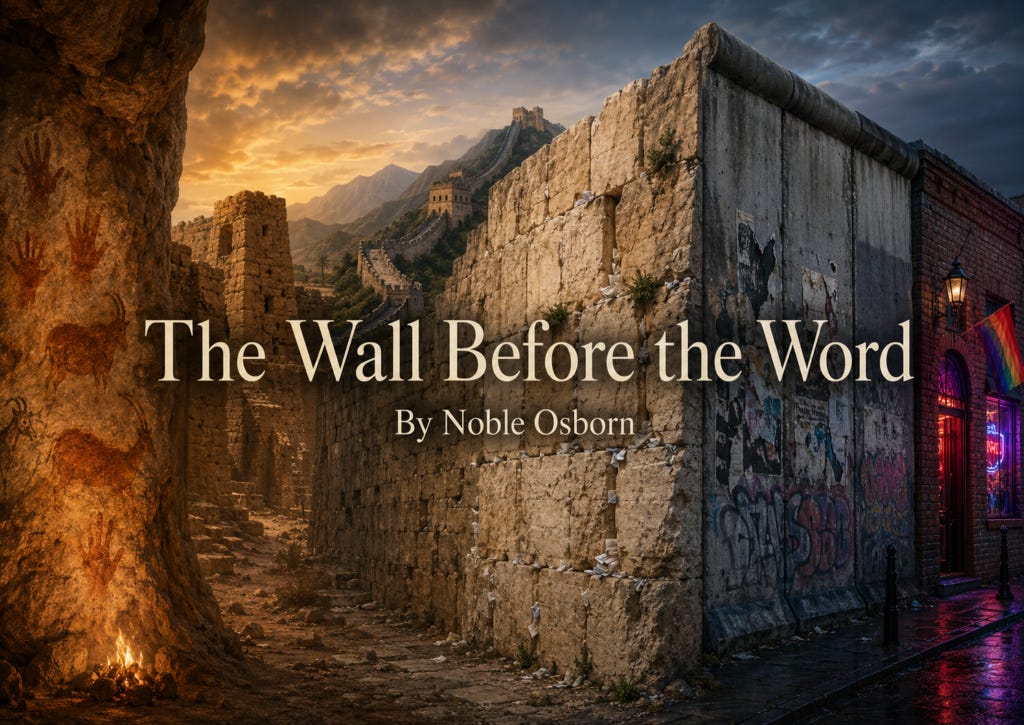
Before we had monuments, we had walls.
Before we had constitutions, tablets, flags, treaties, charters, borders, commandments, or law, we had the surface in front of us. Stone. Limestone. Mud brick. Cave face. Mountain flank. The hard vertical fact against which the human hand first learned to say: I was here. I saw this. I feared this. I worshipped this. I survived long enough to leave a mark.
The wall came before the word.
It is possible to imagine the first wall as shelter. A barrier against wind. A skin between the fire and the dark. A surface at the back of a cave where animal bodies flickered in torchlight and became more than animals. Horses, lions, rhinos, bison, hands. The first galleries were not museums. The first artists were not signing work for patrons. The first viewers were not tourists with tickets and timed-entry reservations. They were people inside the animal dark, people who understood the world as appetite, weather, blood, hunger, movement, death.
They knew pictures before prose.
This is where the wall begins in human consciousness. Not as property line, not as statecraft, not as military technology, but as a place where fear becomes visible. The cave wall did not keep the world out. It brought the world in. It turned memory into image. It made the unseen animal return. It made the hunt repeatable. It gave the eye somewhere to go when language had not yet learned how to carry such weight.
Even then, the wall was not neutral. No wall ever is.
A wall says there is this side and that side. Even when it is only the back of a cave, it teaches direction. Here is the fire. There is the dark. Here are the people. There are the beasts. Here is the image we can make. There is the world we cannot control.
Perhaps every wall since has been a variation on that first division.
The wall as canvas.
The wall as warning.
The wall as altar.
The wall as border.
The wall as prison.
The wall as prayer.
The wall as the place where power announces itself and where resistance learns to answer back.
By the time Jericho raised its stones, the wall had become more than a surface. It had become a declaration. Here is settlement. Here is water. Here is grain. Here is permanence. Here is something worth protecting and something worth attacking. The ancient walls of Jericho do not simply belong to archaeology or scripture. They belong to the human turn toward enclosure. They mark one of the earliest moments when a community looked at the world beyond itself and decided that survival required height, thickness, labor, and vigilance.
There is something almost heartbreaking in that achievement.
A wall means people have gathered enough to fear losing what they have gathered. It means the field has become harvest, the spring has become possession, the settlement has become identity. The wall is pride, yes, but it is also anxiety made architectural. It is the knowledge that abundance attracts violence. It is civilization’s first confession: we have made a life, and now we are afraid someone will take it.
The stones of Jericho do not merely say keep out. They say we have something to keep.
That distinction matters, because it has never left us.
The Great Wall of China expanded the wall from settlement defense into imperial grammar. It is too vast to be understood only as a structure. It is a sentence written across landscape. Wall, tower, pass, watchpoint, road, signal, repetition. Dynasty after dynasty added to the long northern argument until geography itself seemed recruited into the work of empire.
The Great Wall is magnificent because it is impossible. That is part of its power. It was not simply meant to stop bodies. It was meant to draw a civilizational line in the mind. Here is the cultivated center. There is the threatening outside. Here is order. There is chaos. Here is the empire that names itself. There are the people against whom it defines itself.
Of course, walls never do this work cleanly.
People cross them. Traders cross them. Soldiers cross them. Stories cross them. Languages seep through the cracks. Marriages, raids, bargains, betrayals, migrations, hunger, ambition, and weather all pass through eventually. No wall has ever been as absolute as the ruler who ordered it imagined it to be. Still, rulers keep building them because walls flatter power. They make fear look disciplined. They make politics look like engineering. They turn anxiety into an object that can be photographed, patrolled, expanded, repaired, and praised.
A wall lets a government pretend the problem is outside.
This may be why humanity remains so proud of walls. They are proof of effort. Proof of command. Proof that someone had enough authority to summon hands, quarry stone, fire brick, pour concrete, string wire, raise watchtowers, and call it necessity. The builder of a wall gets to stand before the people and say: I have done something. I have protected you. I have made the danger visible. I have placed it on the other side.
There is a seduction in that.
There is also a lie.
Because the wall never only reveals what a society fears. It reveals what a society believes about itself. The wall tells us who counts as citizen, neighbor, pilgrim, invader, stranger, contaminant, threat. It tells us who may approach and who must be held away. It tells us what kinds of bodies are imagined as dangerous before they ever arrive.
And then there are walls that do not keep people out, but gather them in.
The Western Wall, known to many as the Wailing Wall, is not a wall of defense in the public imagination now, though it began as part of an ancient retaining structure around the Temple Mount. It is a remnant, and remnants are different from monuments. A monument is often built to instruct the future. A remnant survives into the future and begins instructing us despite ourselves.
At the Western Wall, stone becomes grief’s address.
Hands touch it. Foreheads lean against it. Prayers are folded into paper and pressed into cracks. The wall does not merely stand. It receives. It is not a border in the same way the Great Wall is a border, nor a military obstacle in the way the Berlin Wall was an obstacle. It is a surviving edge of catastrophe, an object through which absence becomes touchable.
That may be the deepest mystery of sacred walls. They are not powerful because they are complete. They are powerful because something has been lost.
The Western Wall teaches the opposite lesson of imperial architecture. The empire wants the wall to say: look what we can build. The shrine says: look what remains. One is triumphal, the other devotional. One looks outward with command. The other draws the body close enough to whisper.
A wall can divide.
A wall can defend.
A wall can also become the last surface left against which a people may place its sorrow.
That is why the language of walls cannot be separated from the language of mourning. Even the phrase “Wailing Wall,” however freighted by outsider naming and older European usage, carries a truth about how public stone absorbs private grief. Human beings have always needed places where sorrow can go. We do not only build walls to resist the enemy. Sometimes we come to the wall because it is the only witness old enough to hold what we cannot.
Then came the modern wall, and with it, modern shame.
The Berlin Wall was not ancient. It had no mythic age to soften its brutality. It did not gather the aura of time around itself. It rose in living memory, a concrete confession that ideology had failed to persuade and therefore had turned to force. It did not protect a people from invasion so much as imprison them from departure. Its purpose was not merely to divide East from West, capitalism from communism, NATO from the Warsaw Pact, or one administration of Berlin from another. Its purpose was to stop human choice.
That is the obscenity of it.
A wall built to keep an army out belongs to one moral category. A wall built to keep citizens in belongs to another. The Berlin Wall exposed the terror that sits beneath authoritarianism: the fear that people, if allowed to leave, will leave. The fear that the state cannot survive comparison. The fear that loyalty must be poured in concrete because it has failed to grow in the human heart.
And yet even this wall became a canvas.
Graffiti found it. Protest found it. Photographers found it. Memory found it before history could tidy the edges. The Berlin Wall became one of the twentieth century’s great visual metaphors not because it was strong, but because it was absurd. It cut through streets, families, transit lines, neighborhoods, and imagination. It turned a city into a diagram of distrust.
When it fell, the world watched people climb the thing that had been built to forbid crossing. Hammers struck concrete. Strangers embraced. Pieces were chipped away and carried off like relics from a defeated religion. Here was a wall whose destruction became more sacred than its construction. Humanity, which loves to build walls, also loves the spectacle of tearing them down.
Perhaps that is because we understand the wall twice.
We understand the need for it when we are afraid.
We understand the evil of it when we are the ones trapped on the wrong side.
This double knowledge runs through the whole history of walls. They comfort the people they enclose until the enclosure becomes captivity. They protect the city until the city becomes a prison. They define belonging until belonging becomes exclusion. They promise order until order becomes cruelty with a gate in it.
Then there is Stonewall, which is not a wall in the ancient sense at all, and yet belongs in this lineage as surely as Jericho or Berlin.
Stonewall is a name first. An inn. A bar. A place in Greenwich Village where the people pushed to the edges of law, family, employment, medicine, religion, and public respectability found temporary shelter under imperfect conditions. It was not a temple. It was not a palace. It was not a national monument when history arrived there. It was a room where people who had been made illegal gathered anyway.
That matters.
Because sometimes the wall is not the thing built around the people. Sometimes the wall is the social force pressing against them. Shame is a wall. Law is a wall. Police power is a wall. The closet is a wall. The family’s silence is a wall. The church door is a wall. The school policy is a wall. The employer’s suspicion is a wall. The doctor’s diagnosis is a wall. The obituary that erases the lover is a wall.
Stonewall became a landmark because people finally struck back against an architecture that had no single visible surface.
The raid was not new. The humiliation was not new. The violence was not new. What changed was the refusal. Outside the Stonewall Inn, a crowd gathered and did not dissolve into obedience. People who had been trained by law and culture to disappear instead became visible. They made a street into a threshold. They turned a place of harassment into a birthplace of public memory.
This is why Stonewall remains so powerful as metaphor. It is a wall that became a door.
It did not end oppression. No honest history would claim that. It did not produce equality overnight. It did not gather every queer person into safety, nor did it represent every queer experience without conflict, exclusion, racism, sexism, transphobia, class division, or later institutional simplification. But it did something landmarks often do at their most potent: it gave a movement a place to point toward.
Here.
Here is where something broke open.
Here is where the wall began to answer back.
That is what makes the politics of Stonewall’s memory so urgent. To preserve the building while editing the people is not preservation. It is laundering. A landmark emptied of its inconvenient truth becomes a stage prop for the very forces it once resisted. If Stonewall is remembered without transgender people, without drag queens, without gender-nonconforming bodies, without the poor, the unhoused, the Black and brown queer people, the sex workers, the bar patrons, the people most vulnerable to police power, then Stonewall becomes another wall: a polished surface placed between the public and the truth.
Every monument is vulnerable to this.
The wall survives.
The story is altered.
The plaque is rewritten.
The guidebook is softened.
The blood dries into heritage.
The riot becomes a celebration.
The celebration becomes a brand.
The brand becomes a safe flag for institutions that would never have stood outside the door when standing outside the door was dangerous.
This is how memory is domesticated.
Walls help us see the process more clearly because walls are honest in their form. They say separation even when they are beautiful. They say boundary even when they are holy. They say someone has decided where one thing ends and another begins.
What makes a wall moral or immoral is not the presence of division itself. All human life involves boundaries. A home has walls. A garden has a fence. A temple has thresholds. A nation has borders. A body has skin. Without some boundary, there is no intimacy, no shelter, no room, no sacred interior, no private grief, no protected child asleep against weather.
The question is not whether walls are always wrong.
The question is what the wall is protecting, whom it is punishing, and what truth it requires us not to see.
A hospital wall protects healing. A prison wall enforces custody. A border wall performs suspicion. A museum wall frames art. A school wall can shelter learning or hide indoctrination. A church wall can gather the faithful or exclude the wounded. A bedroom wall can hold the sweetness of privacy. A closet wall can suffocate the soul.
We should be honest about this. Walls are not simple. They are among humanity’s oldest tools, and like all old tools, they have been used for tenderness and terror alike.
The cave wall gave us image.
Jericho gave us enclosure.
The Great Wall gave us empire.
The Western Wall gave us remnant and prayer.
The Berlin Wall gave us ideological captivity.
Stonewall gave us resistance.
The modern wall gives us the recurring temptation to mistake exclusion for safety.
So what do we do with walls now?
We inherit them, first. That is unavoidable. We inherit the walls we did not build and the myths attached to them. We inherit sacred walls and prison walls, garden walls and ghetto walls, frontier walls and museum walls, digital walls and courtroom walls. We inherit language itself as a kind of wall, giving shape to what can be said while shutting out what has not yet found its name.
Then we decide whether to maintain, breach, mark, mourn, repaint, preserve, reinterpret, or dismantle.
That is where the moral work begins.
A society reveals itself not only by the walls it builds, but by the walls it refuses to question. There are walls we call security because we do not want to call them fear. There are walls we call tradition because we do not want to call them exclusion. There are walls we call sacred because we do not want to admit that someone was kept outside the sanctuary. There are walls we call history because we prefer stone to accountability.
But history does not live in stone alone.
History lives in the hands that touch the stone. It lives in the bodies stopped at the gate. It lives in the prayers folded and pressed into cracks. It lives in the people shot while crossing. It lives in the lovers who found one another in bars the law despised. It lives in the artists who painted animals on cave walls before there were alphabets to translate awe into speech.
The first wall taught us to remember.
Every wall since has asked what, and whom, we intend to forget.
No posts
Comments
Nothing yet. Say the first thing.
Sign in to join the conversation.