
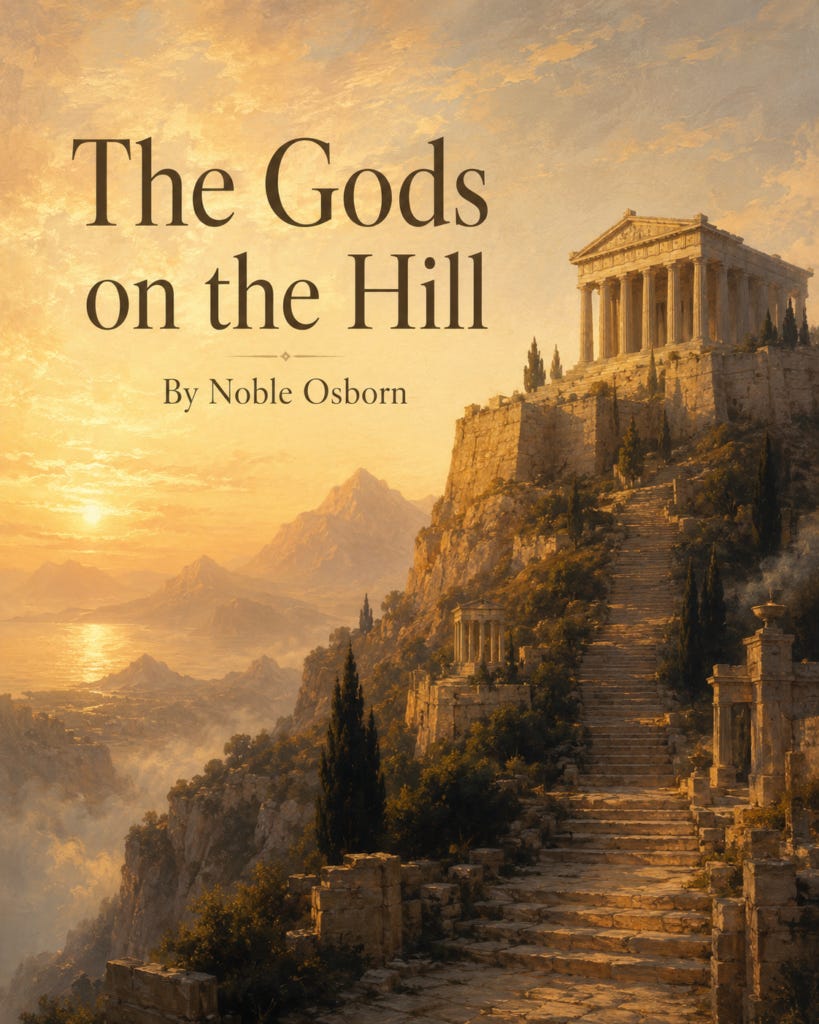
Before the monument became a postcard, it was a climb.
That may be the oldest truth hidden inside so much of what humanity has built in the name of gods, kings, ancestors, or nations. We did not only mark the earth. We raised ourselves above it. We found hills and mountains and ridges and cliffs and then taught them to speak. We dragged stone upward. We carved steps into slopes. We built temples where the wind could reach them first. We made the difficult approach part of the devotion.
There is something almost too obvious in this to notice. The sacred place is often above us. The shrine waits on the hill. The oracle sits beneath the mountain. The temple crowns the acropolis. The monastery clings to the cliffside. The prophet climbs. The pilgrim ascends. The ruler goes up to meet heaven and comes down with authority.
Even before architecture, height had language. A mountain does not need a priest to feel holy. It performs the part without instruction. It gathers weather around itself. It interrupts the horizon. It receives the first light and keeps the last shadow. To stand below one is to feel small in a way that is not always humiliating. Sometimes smallness is the beginning of reverence.
Human beings, ever ambitious and ever afraid, learned from that.
If the cave wall was the first page, and the city wall the first boundary, then the sacred hill may have been the first stage. It offered a place from which power could be seen. A place where the living could look upward and imagine that someone, or something, was looking back.
The Acropolis of Athens may be the most famous expression of that old instinct: the city lifting its gods above itself. The word itself means the high city, but the Acropolis is not merely high ground. It is architecture turned into declaration. It is the civic body teaching stone to say: this is who we are, this is what we honor, this is what we survived, this is how beauty becomes a form of government.
The Parthenon does not sit quietly on the Athenian rock. It presides. Even damaged, even looted, even scaffolded, even translated through centuries of empire, tourism, scholarship, and argument, it retains the authority of a thing designed to be seen from below. It was built for Athena, but it also became a monument to Athens itself: to democracy, empire, mathematics, proportion, victory, civic pride, and the perilous human habit of mistaking beauty for innocence.
That is the complication of sacred architecture. It is rarely only sacred.
The temple may belong to a goddess, but it also belongs to the city that paid for it, the laborers who built it, the enemies whose defeat made it possible, the rulers who claim it afterward, the tourists who consume it, the nations that make it an emblem, and the museums that carry its fragments across seas and centuries.
A hill can hold a god. It can also hold a political program.
This is why the gods so often live above the marketplace. From the height, religion and statecraft can pretend they are separate while sharing the same staircase. The citizen climbs toward the divine, but also toward the image of the city. The pilgrim sees heaven, but also power. The monument sanctifies the order beneath it.
The Acropolis is not alone in this. Delphi, set against the slopes and cliffs of Mount Parnassus, made geography itself part of prophecy. The sanctuary of Apollo was not merely a place to receive answers. It was a place arranged to make the questioner feel the weight of asking. The approach mattered. The mountain mattered. The shining rocks mattered. The god of light and knowledge did not speak from a flat civic office. He spoke from a landscape that seemed already half-translated into myth.
In such places, the earth becomes collaborator.
The mountain does not need to be explained in order to be used. It already possesses the necessary drama. The ravine, the spring, the cliff, the exposed path, the sudden view — these are not background details. They are the original architecture. The temple is the addition, the human signature placed upon a holiness the landscape had already suggested.
There is humility in that, but also appropriation. The sacred hill begins as wonder and becomes management. Priests keep the calendar. Rulers sponsor the building. Pilgrims follow prescribed routes. Offerings accumulate. Stories become doctrine. The wild place is domesticated by ritual. What began as awe becomes administration.
Still, something of the original terror remains.
We climb because the body understands what the mind may resist: elevation changes perception. The world below becomes ordered. Streets become lines. Fields become patterns. People become movement. From the hilltop, the city can be imagined as a whole, and whatever can be imagined as a whole can be ruled, blessed, judged, or mourned.
That may be why emperors have always loved mountains.
Mount Tai in China offers one of the clearest examples of sacred height as imperial theater. The mountain was not simply admired; it was used as a cosmic meeting place between earth and heaven. Emperors climbed it to perform rites that placed their reign within a larger order. Stone inscriptions, temples, tablets, and ceremonial memory turned the mountain into an archive of authority. Nature became monument. Ascent became legitimacy.
Here the sacred hill does not merely hold a temple. The mountain itself is the temple.
That distinction matters. A building can be destroyed, rebuilt, renamed, or repurposed. A mountain is harder to erase. It does not need walls to enclose the sacred. Its scale is its enclosure. Its summit is its altar. Its slopes are its nave. Its path is its liturgy. The pilgrim’s fatigue becomes part of the prayer.
There is a democracy to climbing, at least in theory. Everyone who ascends must negotiate the same gravity. The emperor may bring banners, guards, priests, and inscriptions, but the mountain still requires his breath. The peasant and the sovereign both meet the incline. The divine may be imagined at the summit, but the body remains stubbornly earthly all the way up.
This may be one reason sacred heights endure. They cannot be reduced entirely to doctrine or empire. No matter how many rulers carve their names into stone, the mountain keeps older company: weather, trees, animals, snow, sunrise, erosion. Human authority arrives with ceremony. The mountain answers with time.
Not all sacred elevation is vertical in the obvious sense. Sometimes the sacred place is not a hill but a raised idea. Lumbini, in Nepal, does not depend upon altitude for its sanctity. Its power comes from birth, memory, pilgrimage, and a pillar. It is revered as the birthplace of Siddhartha Gautama, the Buddha, and its landscape gathers meaning not by towering over the world, but by marking the place where a life began that would transform how millions understood suffering, desire, compassion, and release.
In that sense, Lumbini complicates the whole idea of sacred height. It reminds us that humanity does not only climb to find the holy. Sometimes we elevate a place by returning to it. We lift it through reverence. We raise it with story, footsteps, flowers, inscriptions, and centuries of longing.
The holy place need not tower. It must only gather.
Still, even at Lumbini, the human instinct to mark the sacred becomes architectural. A birthplace becomes a pilgrimage site. A garden becomes a world landmark. A pillar becomes testimony. The invisible event is given visible form, and suddenly memory has a location toward which the body can travel.
This may be the true beginning of every landmark: not height, not size, not age, but return.
A place becomes sacred because people come back to it. They bring children. They bring grief. They bring questions. They bring offerings. They bring governments. They bring cameras. They bring armies. They bring restoration crews. They bring arguments about ownership, access, authenticity, and truth. The landmark survives, but never unchanged. Every generation approaches with its own hunger and leaves fingerprints on the stone.
The gods on the hill are never alone.
Around them gather architects, soldiers, pilgrims, sculptors, merchants, conquerors, monks, tour guides, thieves, scholars, nationalists, preservationists, and the tired ordinary traveler who has climbed too many steps in the heat and is suddenly, unwillingly, moved. Sacred architecture depends upon that possibility: that even after everything has been explained, sold, ticketed, reconstructed, photographed, and argued over, some remnant of awe may still ambush the body.
That is why ruins can be more powerful than intact monuments.
A perfect temple tells us what a civilization wanted to project. A ruin tells us what time has done to the projection. It lets us see both ambition and failure in the same glance. The broken column may be more honest than the completed façade. The missing statue may speak more freely than the restored one. The fragment refuses the lie of permanence.
We visit ancient sacred places with modern eyes, but the old lesson remains uncomfortable: human beings have always tried to build upward in order to escape the knowledge that everything falls.
The hill was supposed to help.
From the summit, death looked smaller. From the temple steps, the city looked ordered. From the mountain path, the heavens seemed nearer. From the sacred precinct, the ruler seemed chosen. From the shrine, suffering seemed answerable. From the high place, the horizon widened, and with it, perhaps, the soul.
But elevation is not innocence. Some of the most beautiful places human beings have built were built with unequal hands. Some of the most sacred stones stand beside histories of conquest, exclusion, erasure, and labor without names. The gods on the hill have often been asked to bless what men below them intended to do anyway.
This is one of the central troubles of monuments. They do not merely remember. They authorize.
A temple says: this matters. A mountain shrine says: this path is holy. A citadel says: this city is defended. An imperial inscription says: this reign belongs to heaven. A national monument says: this story is official. A pilgrimage site says: this memory is alive.
The danger begins when the monument insists that no other story may stand beside it.
And yet, we keep climbing.
Perhaps because the human animal needs more than shelter. We need vantage. We need ceremony. We need a place from which to look back at the plain of ordinary life and feel, however briefly, that it has pattern. We need to believe that suffering can be placed somewhere, that gratitude can be carried somewhere, that the dead can be remembered somewhere, that the divine might meet us somewhere.
The hill gives us the grammar of ascent. The temple gives us a sentence to say once we arrive.
In July 2026, as the United States turns toward its own anniversary, its own monuments, its own obelisks, its own marble arguments, it is worth remembering that national landmarks are late arrivals in a very old human story. Before the capital, there was the citadel. Before the courthouse, the temple. Before the museum, the shrine. Before the flagpole, the sacred tree, the carved pillar, the mountain path, the altar catching dawn.
The question is not whether we will make landmarks. We always have.
The question is what we ask them to hide.
The Acropolis still rises over Athens, but it no longer belongs only to the Athenians who built it. Mount Tai still gathers pilgrims and history, but no emperor can fully possess its height. Lumbini still marks a birth, but the meaning of that birth exceeds every border drawn around it. Delphi no longer answers the questions of kings, yet the silence of its stones may be wiser than many living oracles.
The gods on the hill have watched us build empires and excuses. They have watched us carve names into stone and then pretend the stone chose the names itself. They have watched us climb with offerings, weapons, petitions, cameras, and flags.
They have watched us mistake height for virtue.
Still, the old sacred places offer something more than warning. They remind us that awe was once larger than ownership. Before the monument became a brand, before the shrine became a jurisdiction, before the temple became a ruin protected by admission gates and restoration plans, there was a human being looking up.
That gesture remains.
To look up is to admit incompletion. To climb is to confess that we are not yet where we wish to be. To build on a hill is to make visible the longing to be nearer to whatever we fear, love, worship, or cannot name.
Perhaps that is why the gods were placed there.
Not because heaven was closer at the summit, but because we were more aware of the distance.
No posts
Comments
Nothing yet. Say the first thing.
Sign in to join the conversation.