
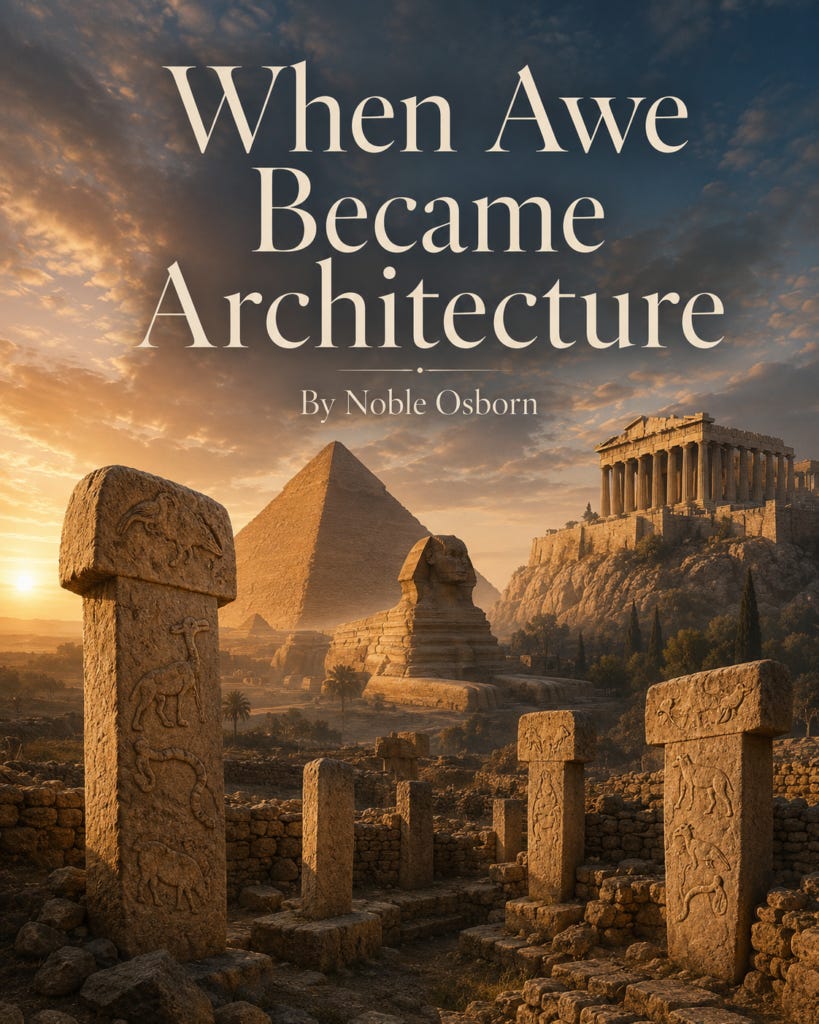
Before the monument had a name, there was awe.
Before there were nations to raise obelisks, courts to issue landmark decisions, museums to polish stolen gods behind glass, or tourists to stand in curated wonder beneath the sanctioned angle of a camera, there was the first human impulse to stop walking and make something stand.
A stone. A circle. A pillar. A chamber. A mound above the dead. A mark on a wall. A place where the ordinary world seemed to thin.
This may be the truest beginning of architecture: not shelter, but meaning. Not the hut, but the shrine. Not the practical wall against weather, but the impossible wall against oblivion. Somewhere in the long dusk of prehistory, human beings began to understand that memory needed a body. Grief needed a place. Fear needed an altar. Power needed height. The dead needed directions. The gods, if they existed, needed somewhere to arrive.
So we lifted stone.
That gesture has never really ended.
Every monument since has been a descendant of that first refusal to let the world pass over us without a mark. The pyramid, the temple, the sacred hill, the burial mound, the obelisk, the church, the mosque, the courthouse, the national memorial, the roadside cross, the family headstone — all of them belong to the same ancient grammar. They are sentences written in weight. They say: someone was here. Something happened here. Someone must remember.
The earliest monuments were not built because human beings had already mastered civilization. Some may have been built because human beings were still trying to understand what civilization could be. At Göbekli Tepe, in what is now southeastern Turkey, massive T-shaped limestone pillars rise from a world older than cities, older than writing, older than kings. These were not monuments built after empire had organized labor and tribute. They were raised by hunter-gatherers, by people we once imagined as too preoccupied with survival to spend themselves on architecture of ceremony.
But there they are: carved pillars, animal forms, enclosures, ritual space.
Awe did not wait for the city.
That matters. It changes the order of the human story. We like to imagine that first we gathered, then we farmed, then we governed, then we prayed in increasingly elaborate buildings. But perhaps the sacred place came earlier than we thought. Perhaps the need to gather around mystery helped teach us how to gather around grain, law, and labor. Perhaps before we had bureaucracy, we had ceremony. Before we had the state, we had the circle.
There is something almost devastating in that possibility.
It means monumentality may not have begun as vanity. It may have begun as hunger — not hunger of the stomach, but hunger of the mind confronted with death, sky, animal, season, and dream. It may have begun with a community trying to hold itself together around what it could not explain.
This is the tenderness we often lose when we speak of monuments. We move too quickly to empire, conquest, bronze generals, marble presidents, kings disguised as gods, gods disguised as kings. We know what monuments become once power discovers them. We know how easily stone learns to flatter. But the oldest architecture of awe asks us to pause before cynicism. It asks us to imagine a people without writing, without parliament, without flag, without museum label, standing together beneath a carved pillar and feeling that the world was larger than the visible day.
The monument began as encounter.
Then, inevitably, it became command.
In Malta, the great megalithic temples rise from islands that turned stone into thresholds. Ġgantija, Ħaġar Qim, Mnajdra, Tarxien — names that feel half carved, half breathed — belong to a tradition of sacred building that predates many of the better-known monuments of antiquity. Here, too, architecture seems less like decoration than orientation. These were spaces of ritual, alignment, procession, and return. They suggest that human beings were already learning to choreograph wonder.
That is one of the secret powers of the monument: it teaches the body how to feel.
A stair tells us to ascend. A corridor tells us to move inward. A chamber tells us to lower our voice. A column tells us to look up. A threshold tells us we have crossed from one condition into another. Even before doctrine, architecture instructs. The temple does not merely house belief. It trains belief into posture.
Stand here.
Enter there.
Bow now.
Look upward.
Be small.
Remember.
By the time Egypt perfected the pyramid, awe had become not only architecture, but statecraft. The pyramid is not a modest object. It does not suggest. It declares. It rises from the desert with the terrifying simplicity of geometry made political. The king is dead, and yet the king has become more permanent than any living body could hope to be. His tomb is a mountain. His afterlife is an engineering project. His authority continues in stone after breath has failed.
There is genius in the pyramid, and there is violence.
That is not a contradiction. Many of the world’s greatest monuments hold beauty and coercion in the same shadow. To stand before the pyramids is to stand before human brilliance organized at a scale that also raises uncomfortable questions: whose labor made eternity possible for one man? Whose backs hauled the sacred ambition of the elite? Whose lives became the invisible mortar of the afterlife?
The pyramid is both wonder and warning.
It tells us that human beings can imagine beyond death. It also tells us that power, once given access to awe, will use it to enlarge itself. A tomb becomes a theology of hierarchy. A royal body becomes a cosmic event. The dead ruler does not vanish into the earth like other dead. He ascends, is guarded, aligned, sealed, surrounded with ritual technology. Monumentality turns mortality into command.
The Sphinx watches nearby with a different kind of silence.
If the pyramid is height, the Sphinx is gaze. Lion body, human head, guardian, riddle, horizon-being — it does not merely mark a place. It seems to confront time itself. Its face has been read, damaged, restored, imagined, photographed, mythologized, and sold on a thousand postcards, but its oldest power remains stranger than its fame. It is the creature at the threshold, the beast that tells us monument was never only about size. It was also about presence.
Some monuments rise.
Some watch.
Some guard.
Some accuse.
This is why antiquity still troubles the modern eye. We think we visit ancient monuments as spectators, but the best of them reverse the gaze. They make us feel observed by something we did not build and cannot fully possess. The tourist takes a photograph, but the monument has already taken something older from the visitor: scale, certainty, the illusion of originality.
In Greece, the sacred hill becomes civic theatre.
The Acropolis does not rise like the pyramid from a desert plain. It commands differently. It gathers city, temple, democracy, empire, victory, art, and ruin into a single elevated argument. The Parthenon, in particular, has spent centuries being recruited into one story after another: temple, treasury, church, mosque, ruin, national emblem, museum dispute, aesthetic ideal. It has been worshiped, converted, damaged, plundered, restored, reproduced, and invoked as proof of nearly every Western fantasy about beauty and reason.
That is the trouble with monuments that survive. They outlive their first meanings and become available to later ambition.
A building raised to Athena becomes a trophy of empire, then a symbol of democracy, then a centerpiece in arguments over cultural patrimony and museum possession. Its stones remain in Athens; some of its sculptures remain elsewhere; its image circulates everywhere. The monument becomes both place and argument. It belongs to geography, but also to memory, theft, scholarship, nationalism, tourism, and longing.
By the time a monument is famous enough, everyone wants to claim descent from it.
This, too, is part of awe becoming architecture. The structure itself may be local, but the meaning becomes imperial. We do not merely preserve ancient monuments. We enlist them. We ask them to validate our politics, our museums, our schools, our aesthetics, our chosen version of civilization. A column is never only a column once a nation has learned to pose beside it.
China’s sacred mountains offer another form of monumentality: the natural world made ceremonial through repetition, inscription, pilgrimage, and imperial attention. Mount Tai is not architecture in the simple sense, and yet it has been made architectural by human reverence. Temples, paths, gates, stone inscriptions, rituals, imperial sacrifices — these do not replace the mountain. They translate it into a sacred order.
Here, the landmark precedes the monument.
The mountain was already there. Human beings did not build its height. Instead, they built meaning around it, upon it, toward it. They made ascent into devotion. They made landscape into hierarchy. They turned a natural form into a political and spiritual axis.
This may be one of the oldest human habits: mistaking height for holiness, or perhaps recognizing that height does something to the human soul. The hill, the mountain, the raised platform, the tower, the dome, the spire — all of them repeat the same ancient desire to rise from the dust and speak to whatever we imagine lives above us.
At Lumbini, the monument works through another kind of sacred geography: birthplace.
Some places matter because something was built there. Others matter because something happened there before architecture arrived to protect the memory. A birth, a death, a revelation, a battle, a martyrdom, a crossing, a wound. The shrine comes afterward, like a hand placed over the heart of history.
The birthplace of the Buddha became a place of pilgrimage not because of height or military triumph, but because memory gathered around origin. Here, the architecture serves humility before event. It marks the delicate claim that from one human birth, an entire spiritual path entered the world.
Not all monuments are built to dominate. Some are built to kneel.
This distinction matters because our modern debates about monuments often flatten them into a single category. We speak of removal or preservation, heritage or erasure, pride or shame, as if every landmark were doing the same moral work. But ancient monuments teach us otherwise. Some were tombs. Some were calendars. Some were stages for rulers. Some were offerings. Some were maps of heaven. Some were borders between human and divine. Some were attempts to hold the dead close. Some were attempts to make the living obedient.
The question is never only whether a monument is old, beautiful, or famous.
The question is what it asks of us.
Does it ask us to remember honestly, or worship falsely? Does it enlarge the human story, or narrow it to the glory of the powerful? Does it mourn, threaten, welcome, warn, sanctify, conceal? Does it tell us who belonged, or who was forced to build belonging for someone else? Does it survive as witness, or continue as propaganda?
Antiquity does not absolve the monument. Age is not innocence. Ruin is not redemption. A broken statue may still carry the intention of domination. A temple may still reveal the economy of exclusion beneath the beauty of its columns. A pyramid may still gleam with the afterlife of a king while leaving the laborer nameless.
And yet, to reduce the ancient monument only to power is also a failure.
There is still the hand that carved. The eye that aligned stone with sun. The community that gathered in a circle before the first city had learned its own name. The mourner who brought an offering. The pilgrim who climbed. The builder who understood that stone could make silence speak. The artist who saw an animal spirit in limestone. The astronomer-priest, the mason, the anonymous bearer of weight. These people are not nothing because kings took credit. Their work remains, often more honestly than the names of those who commanded it.
In this way, ancient monuments are double records. They preserve authority, but they also preserve labor. They preserve belief, but they also preserve doubt. They preserve the official story, but also the fingerprints of those who had no official voice.
Perhaps this is why we keep returning to them.
Not simply because they are beautiful. Not simply because they are famous. But because they reveal the origin of an argument we have never settled. What should stand? Who decides? Whose memory becomes public? Whose grief receives stone? Whose god gets a temple? Whose ruler gets a mountain? Whose dead are named, and whose are buried beneath the monument itself?
The modern world likes to imagine itself more sophisticated than antiquity, but our gestures remain remarkably familiar. We still raise monuments after national trauma. We still argue over sacred sites. We still use architecture to project permanence. We still build towers when we want to look powerful and memorials when we do not know where else to put our sorrow. We still turn courthouses into temples of law. We still place flags beside stone and ask the arrangement to become truth.
The forms change. The hunger does not.
Awe became architecture because human beings could not bear for meaning to remain invisible. We needed death to have a door. We needed power to have a stage. We needed the divine to have an address. We needed memory to have weight.
That need has given us some of the most beautiful things we have ever made.
It has also given us some of the most dangerous.
The monument is never neutral because awe is never neutral. Awe opens the soul, and whatever enters there can be holy, humane, manipulative, or monstrous. A society’s landmarks reveal not only what it loved, but what it feared. Not only what it remembered, but what it hoped no one would ask. Not only what it built, but what it was willing to bury in order to build it.
To begin this issue in antiquity is to begin before America, before marble presidents, before border walls, before museum vitrines, before landmark decisions and national anniversaries. It is to begin with the human creature looking into the terrible largeness of existence and answering with stone.
That first answer was not enough.
So we kept building.
We built tombs to deny disappearance. We built temples to invite the gods. We built walls to divide danger from belonging. We built pillars to lift the eye. We built shrines over births, deaths, revelations, victories, defeats, and wounds. We built monuments until the earth itself became a library of human longing, indexed by ruin.
And now we inherit them.
Not as passive admirers. Not as tourists of the permanent. Not as children told to stand quietly before greatness and mistake silence for reverence. We inherit them as witnesses with obligations. We must learn to read stone the way we read law, scripture, myth, and family memory: closely, suspiciously, tenderly, with attention to what is present and what has been cut away.
The first monuments do not ask us merely to marvel.
They ask us what we are still building, and why.
They ask which of our present certainties will one day look like arrogance under sand. They ask which of our sacred places will remain sacred after power has finished using them. They ask whether beauty can survive the truth of its making. They ask whether a nation can stand before its own monuments and tell the difference between memory and worship.
Before the monument had a name, there was awe.
After all these centuries, there still is.
The question is whether we have learned to deserve it.
-By Noble Osborn
This Substack is reader-supported. To receive new posts and support my work, consider becoming a free or paid subscriber.
Comments
Nothing yet. Say the first thing.
Sign in to join the conversation.