
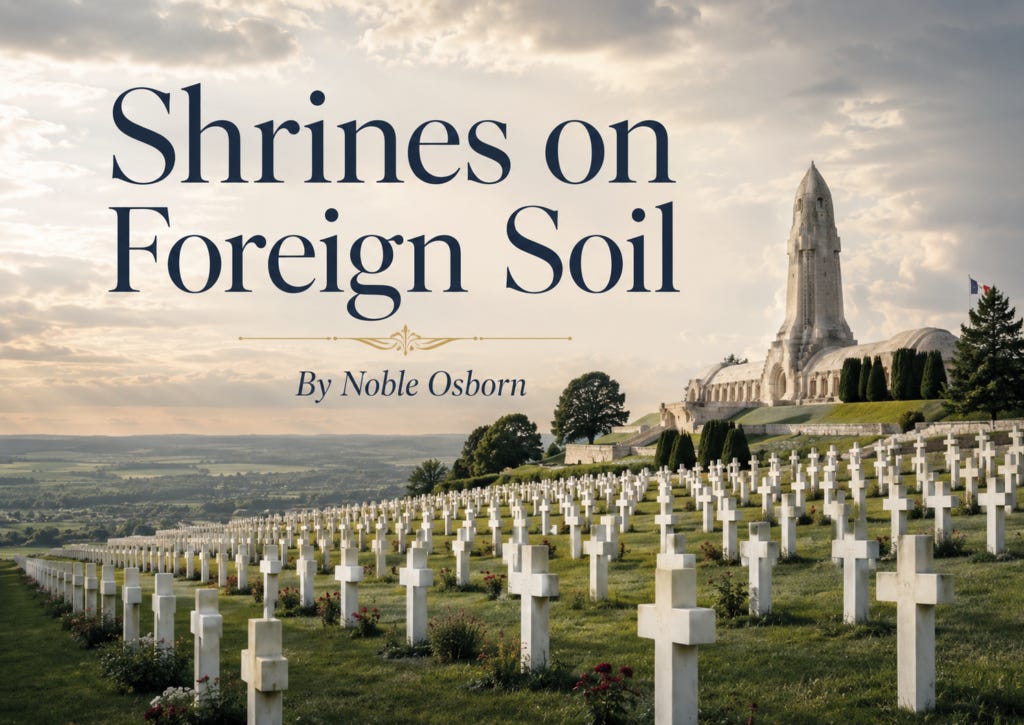
There are places where a nation becomes smaller than its dead.
Not humbler, necessarily. Nations are rarely humble by instinct. They arrive with flags, hymns, uniforms, ministers, wreaths, motorcades, polished shoes, and cameras waiting for the solemn angle. They know how to make ceremony out of grief. They know how to teach children where to stand, what to salute, when to remove the hat, how long silence should last before it begins to look ungoverned.
But in the cemetery abroad, beneath a foreign sky, something in the arrangement changes.
The flag is still there, but it no longer owns the wind. The anthem is still sung, but it rises through air that belongs to someone else. The marble is carved in one language while the birds answer in another. The dead lie beneath soil that is not, legally or spiritually, the homeland they left. Their country comes to them by ship, by wreath, by delegation, by school group, by aging veteran, by child tracing a name with a finger. It comes annually, dutifully, sometimes theatrically. But the earth itself remains foreign.
That is the tension at the heart of every shrine on foreign soil.
A nation wants to say: these are ours.
The ground answers: they are here.
Between those two truths, memorial architecture begins.
The most familiar version may be the military cemetery abroad: the ordered rows, the white stone, the clipped grass, the chapel, the reflecting pool, the names of the missing, the careful geometry by which a state tries to make mass death legible. At Normandy, the American dead look out over the beach where the living came ashore and the future asked its terrible price. There is beauty there, impossible beauty, the sort that makes one suspicious of beauty itself. The crosses and Stars of David stand in disciplined whiteness above the grass. The sea is not far away. The wind moves as if it has learned the script.
Visitors arrive expecting solemnity. They find scale.
Scale is the language such places speak first. One grave can be intimate. Ten graves can be unbearable. Thousands of graves become architecture, and architecture is where grief risks becoming national instruction. The cemetery does not merely mourn. It teaches. It arranges sacrifice into sightlines. It tells a visitor where the eye should go, where the body should pause, where the nation has placed its version of the dead.
This is not inherently false. The dead really did die. The mothers really did receive telegrams. The bodies really did fall into mud, surf, sand, hedgerow, trench, field, jungle, road, and ruin. The names of the missing really do stand in for those whose bodies were never recovered, identified, returned, or understood. No honest person can walk through such a place and sneer at mourning.
But neither should any honest person forget that national mourning is never innocent of national storytelling.
A shrine abroad is never only about death. It is about distance. It is about the long arm of memory. It is about whether a country can extend its emotional border beyond its political one. It is about whether the dead remain citizens when the soil above them does not.
The phrase “foreign soil” has always carried a strange charge. It suggests danger, romance, estrangement, conquest, exile. To die on foreign soil is to die away from the familiar arrangements of home: the family church, the local cemetery, the old road, the grandmother’s plot, the town whose gossip might have known you before history swallowed you whole. It is to become part of a landscape that did not raise you and yet must now hold you.
That holding is a kind of treaty.
Not conquest. Not ownership. A treaty.
The land does not cease being French because American soldiers are buried there. Belgium does not become British because Commonwealth dead are tended there. Turkey does not become Australian because Gallipoli became sacred in the Australian imagination. France does not become Canadian because Vimy Ridge rose into one of Canada’s foundational myths. These places are not colonies of grief, or at least they should not be treated as such. They are places where one nation’s dead depend on another nation’s patience, generosity, law, and landscape.
That dependence matters.
It means remembrance is not unilateral. A foreign shrine requires a host. It requires groundskeepers, agreements, roads, permissions, weather reports, diplomacy, repair budgets, archivists, gardeners, translators, and local tolerance for the annual return of someone else’s grief. It asks the living residents of one country to make room for the dead of another. It asks the surrounding villages and cities to accept that, for some visitors, their home is also a battlefield, a pilgrimage destination, a wound.
There is nobility in that, when it is done with care.
There is also danger.
For shrines on foreign soil can become instruments of self-flattery. They can reduce complicated wars to clean narratives of sacrifice. They can turn local suffering into backdrop. They can allow visiting nations to mourn their own dead while barely seeing the people who lived, starved, hid, collaborated, resisted, rebuilt, and buried their own beneath the same sky. The foreign cemetery can become a stage on which the visiting nation performs virtue before returning home unchanged.
The better shrines resist that temptation.
They do not make death useful too quickly. They do not pretend the dead explain the war. They do not confuse reverence with absolution. They allow discomfort to remain in the air.
That is why the most powerful memorials abroad are often those that understand restraint. The stone does not shout. The names do not need adjectives. The grass does not sermonize. The architecture gives the visitor enough order to keep from collapsing, but not so much order that the tragedy disappears into design.
At Vimy Ridge, the Canadian monument rises pale and spectral over the French landscape, its figures carved in sorrow, not triumph. It has often been treated as a birthplace of Canadian national consciousness, the hill where separate divisions fought together and a young country saw itself reflected in sacrifice. That is the story nations like to tell: unity forged by trial, identity purchased through courage, a people discovering themselves in the fire of history.
There is truth in such a story.
There is also the darker question beneath it: why do nations so often require the dead to confirm that they are real?
A young country wants a monument because it wants proof that it has suffered enough to be taken seriously. An old empire wants a monument because it wants proof that its losses were noble. A republic wants a monument because it wants proof that its wars were sacrifices rather than ambitions. Every memorial abroad contains some version of this longing. The dead are asked to carry more than their own names. They are asked to carry meaning.
That may be the heaviest burden placed upon them.
The Commonwealth war cemeteries scattered across the world carry another layer of this complexity. They speak in the language of equality: headstones of similar size, names recorded carefully, rank subdued beneath the common fact of death. In that uniformity there is a radical tenderness. The general and the private are made small before mortality. The empire, at least in stone, pretends to have learned humility.
Yet empire is still present.
It is present in the map. In the distances. In the fact that soldiers from India, Africa, the Caribbean, Canada, Australia, New Zealand, and Britain could be gathered into wars declared elsewhere and buried across continents under a shared imperial grammar. The cemeteries honor them, yes. They preserve names that might otherwise have vanished. But they also mark the reach of the system that sent so many far from home in the first place.
A shrine can be beautiful and still be implicated.
This is one of the central truths of landmarks: beauty does not acquit history.
A cemetery may be immaculate while the war it remembers remains morally tangled. A memorial may be moving while the empire that built it remains guilty. A monument may preserve names and still omit causes. The white stone may gleam without illuminating everything.
Perhaps this is why shrines abroad need visitors who know how to read against the architecture.
Not to vandalize reverence. Not to cheapen sacrifice. But to understand that memorials are written things. They have authors, patrons, silences, exclusions, revisions. They are edited landscapes. They decide whether the dead are presented as sons, soldiers, martyrs, liberators, victims, citizens, heroes, or proof. They decide whether the local people appear as grateful recipients, invisible scenery, fellow mourners, or not at all.
The danger is not that memorials tell stories.
The danger is that we forget they are telling them.
This becomes especially important when foreign shrines are endangered again by violence, politics, neglect, or climate. A cemetery abroad is not removed from history once it is built. It does not become permanent by being solemn. The war memorial can find itself inside a new war. The pilgrimage road can be blocked. The caretakers can be forced away. The headstones can be damaged by artillery, bulldozers, floodwater, heat, salt, erosion, or indifference. Even the dead do not fully escape the living.
There is a cruel clarity in that.
We build memorials because we want memory to survive us. Then history returns to test the materials.
Stone cracks. Bronze stains. Borders close. Governments change. New armies roll through old cemeteries. A shrine abroad depends on the decency of strangers and the stability of agreements made by people who believed, perhaps arrogantly, that their signatures could instruct the future.
This is where the foreign shrine becomes more than patriotic architecture. It becomes a measure of civilization.
Not because civilization is proved by how beautifully a nation honors its own dead. That is the easier thing. Almost every nation learns to love its own martyrs. The harder test is whether we can honor the dead of others. Whether we can maintain graves whose flags are not ours. Whether we can preserve names written in languages we do not speak. Whether we can resist turning every cemetery into a battlefield of present rage.
The shrine abroad asks: can memory cross a border without becoming possession?
The answer is sometimes yes.
It is yes in the caretaker who clips the grass around a grave belonging to a boy from a town he has never visited. It is yes in the local schoolchildren who learn the names of soldiers who could not have imagined them. It is yes in the elderly visitor who kneels where a brother, uncle, grandfather, or family legend ended before the family’s future could begin. It is yes in the village that allows the foreign dead to remain part of its landscape without surrendering its own story.
But the answer is never guaranteed.
Foreign shrines require maintenance not only of stone, but of humility. They require the visiting nation to remember that gratitude is not rent. They require the host nation to remember that hospitality toward the dead is one of the oldest moral gestures human beings possess. They require all nations to remember that the grave is not an embassy. It is not a fort. It is not a little island of one country planted inside another. It is a place where sovereignty bows, briefly, before mortality.
That bow is what makes the shrine sacred.
In July 2026, as the United States rehearses its 250 years of independence, the temptation will be to look inward: toward Philadelphia, Washington, battlefields, founders, documents, fireworks, marble columns, and the old mythology of becoming. But America’s memory has never remained within its borders. It is scattered across France, Belgium, Italy, Luxembourg, Tunisia, the Philippines, Mexico, and beyond. Its dead lie where its power traveled, where its alliances held, where its wars landed, where its ideals were tested by blood.
The question is not only what America remembers.
The question is where America has asked others to remember for it.
That is a more unsettling question. It requires us to see national memory as something dependent, not self-sufficient. No country, however powerful, can fully tend its dead alone once they lie beyond its borders. Even empire needs gardeners. Even a superpower needs permission. Even victory requires a host.
There is something almost tender in that dependence, if we are willing to see it.
The foreign shrine interrupts the fantasy of national independence. It says: your history lives here too, but not by your will alone. It says: your dead are safe because someone else opens the gate. It says: the story you tell about sacrifice rests on another people’s soil, another people’s law, another people’s weather.
And perhaps that is why these places move us so deeply. Not only because they are solemn. Not only because they are beautiful. Not only because they gather the dead into order. But because they expose the vulnerability beneath all national memory.
A monument at home can pretend to mastery. A shrine abroad cannot.
It must ask.
It must be received.
It must be tended.
It must admit, whether the nation wishes to or not, that memory is never held by one people alone.
The dead may belong to their families, their comrades, their countries, their gods, or no god at all. But the ground beneath them belongs to history, and history is never solitary. It is layered, disputed, borrowed, hosted, translated, and weathered by every generation that passes through.
So the shrine on foreign soil should not be approached as a possession.
It should be approached as a promise.
A promise made by the dead, who gave more than any nation can honestly repay.
A promise made by the living, who agree to keep saying their names.
A promise made by the host, who allows another people’s grief to take root.
A promise made by the visitor, who must leave with more than reverence.
Because if all we do at such places is admire the stone, we have misunderstood the shrine. The stone is not the memory. The cross is not the sacrifice. The flag is not the dead. The grass, however perfect, is not peace.
The shrine is the obligation.
It is the quiet demand that we become worthy of the care we ask from others. It is the reminder that no nation can sanctify itself by burying its dead beautifully while refusing to examine why they died. It is the rebuke to easy patriotism, easy victory, easy mourning.
And it is, at its best, a small mercy.
A place where the foreign is allowed to become intimate. A place where the dead are not returned home, but are not abandoned either. A place where the soil of one country holds the grief of another and, for a moment, the border softens.
The dead remain far from home.
But someone has planted flowers.
Someone has opened the gate.
Someone has remembered.
No posts
Comments
Nothing yet. Say the first thing.
Sign in to join the conversation.