
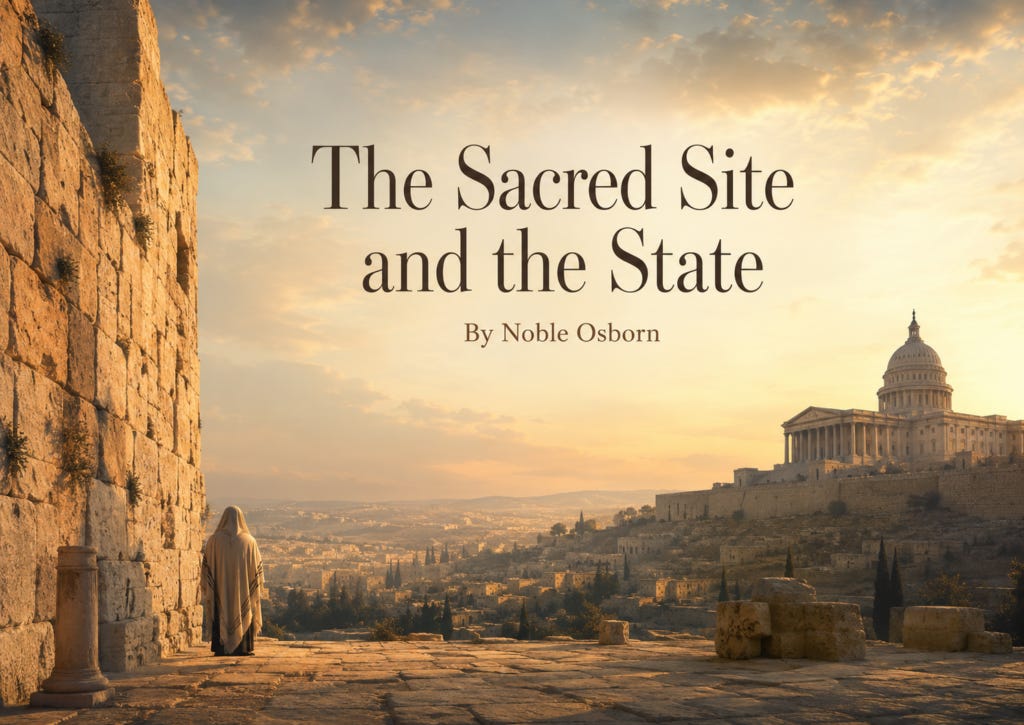
A shrine does not always announce itself with bells.
Sometimes it is a cathedral, built of stone, glass, incense, and centuries of knees bent against the floor. Sometimes it is a wall where generations have pressed prayers into cracks. Sometimes it is a hill, a river bend, a grove, a cave, a schoolhouse, a football field, a courthouse lawn, a desert clearing, a classroom wall, or a patch of public land that the government sees as acreage and a people see as the body of God.
The problem begins there.
The state prefers categories. It wants maps, titles, owners, boundaries, statutes, easements, permits, leases, lesson plans, and display requirements. Faith rarely arrives so obediently. It exceeds the survey line. It lingers in the mountain after the deed has changed hands. It kneels in the schoolyard after the bell. It asks to be excused from the book. It asks to remain visible in the room. It asks not to be mined, paved, bulldozed, or reduced to interpretive signage.
A sacred site is not simply a place where religion happened. It is a place where memory and devotion have become inseparable from the ground itself.
That is why the modern argument over church and state has become, in many ways, an argument over landmarks. What is a cross on public land after one hundred years? A Christian symbol? A war memorial? A historical artifact? A civic inheritance? What is a football coach’s prayer at midfield? Private devotion? Government endorsement? A moment of gratitude? A quiet pressure placed upon children who know exactly which adults hold power over their bodies, scholarships, playtime, and praise? What is a classroom copy of the Ten Commandments? Moral history? Religious instruction? Cultural literacy? An announcement about whose God has been granted a frame and a wall?
What is a sacred Apache site when copper lies underneath it?
The state often claims neutrality in these matters. It says it is merely preserving history, merely permitting speech, merely offering equal access, merely honoring tradition, merely managing land, merely giving parents a choice, merely allowing communities to remember who they are.
But neutrality is rarely neutral to the person outside the favored story.
A Christian cross can become “heritage” in a way a Muslim prayer space rarely does. A Bible verse can be called “historical context” while a queer family in a children’s book becomes “indoctrination.” A settler cemetery can become hallowed ground while an Indigenous ceremonial landscape becomes available for extraction. A monument can be protected because it is old enough for the state to call it tradition, while a living practice is treated as an inconvenience because it still has demands.
The sacred, once it enters public space, reveals the state’s oldest habit: it decides which forms of reverence are allowed to look natural.
For much of American civic life, the official promise has been separation: no established church, no compulsory creed, no state-approved path to heaven. The First Amendment is often described as a wall, though even that metaphor has never stood without argument. Some see the wall as a protection for religion, keeping the government’s hands away from the altar. Others see it as a protection for the public square, keeping the altar from becoming law. Still others look at the wall and ask who built it, who benefits from it, and why some faiths have always seemed able to pass through more easily than others.
The question was never whether religion would exist in public life. It always has. The question was whether the state could resist the temptation to prefer one sacred language over another.
In recent years, that resistance has weakened.
The Supreme Court has increasingly treated religious exclusion from public benefits as discrimination, religious expression by public employees as protected speech, and religious objections by parents as claims that public schools must accommodate. Supporters describe this as a correction, a necessary restoration of free exercise after decades of hostility toward religion. They argue that faith does not become dangerous merely because it appears in public, that citizens do not surrender their consciences at the schoolhouse door, that a pluralistic society must make room for religious people as religious people, not only as silent participants in a secular civic script.
There is truth in that. A nation cannot claim liberty of conscience while demanding that faith vanish from sight. A Jewish student should not have to choose between a test and a holy day. A Muslim teacher should not be treated as suspect for wearing a hijab. A Sikh public servant should not have to erase his articles of faith to serve his neighbors. A Christian coach, a Buddhist nurse, an atheist soldier, a Hindu councilwoman, a queer rabbi, a Native ceremonial leader — all remain whole people when they enter public life.
The state should not require spiritual amputation as the price of citizenship.
But accommodation and establishment are not the same thing. Nor are liberty and dominance. The danger is not that religious people bring their faith into public life. The danger is that the state begins arranging public life around the faith of the powerful and calling everyone else unreasonable for noticing.
A child in a classroom understands symbolism more quickly than adults admit. The wall teaches before the teacher speaks. A framed commandment, a required prayer, a forbidden book, a permitted slur, a missing flag, a censored family, a displayed scripture — each becomes part of the room’s architecture. Children are not constitutional scholars. They do not parse coercion the way courts do. They know who is centered. They know who is tolerated. They know who disappears when the lesson begins.
This is why public schools have become one of the central sacred battlegrounds of the American state.
A school is not a church, but it is one of the first public temples a child enters. It has rituals, bells, pledges, holidays, songs, portraits, rules, punishments, and stories about what kind of person the nation wants to produce. Every curriculum is a map of belonging. Every omission is a small exile. The fight over religion in schools is therefore never only about religion. It is about childhood, authority, sexuality, race, national memory, parental power, and the fear that someone else’s child might grow up free from the story we inherited.
When parents object to LGBTQ-inclusive books on religious grounds, the legal question may be framed as free exercise. But the civic question is larger: can public education acknowledge queer existence without being accused of violating someone else’s faith? If the mere presence of a same-sex family in a storybook becomes a religious burden, then queer life itself is being treated as a kind of unwanted sermon. The child with two mothers is no longer a classmate with a family; he becomes contested content. The transgender child is no longer a student; she becomes a parental notification problem.
This is how erasure often arrives now. Not with a bonfire, but with an opt-out form.
And yet, the religious parents are also making a claim about sacred duty. They believe they are responsible before God for the formation of their children. To dismiss that concern too quickly is to misunderstand the seriousness with which many families understand moral education. The hard question is not whether parents care. Of course they do. The hard question is whether one family’s religious formation should grant it veto power over another family’s public visibility.
A pluralistic school cannot become a private sanctuary for every household. At some point, children must learn that the world contains people their parents would not have chosen for them. That is not indoctrination. That is society.
Still, the courtroom keeps returning to the same anxious threshold: exposure. Is exposure to difference a burden on faith? Is seeing another life an injury? Is hearing another story a form of compulsion?
A landmark decision can answer one case and unsettle a country.
The same tension appears in the renewed push to place the Ten Commandments in public school classrooms. Defenders often insist that the commandments are not merely religious but historical, foundational, moral, part of the legal inheritance of the West. But even if one grants the historical argument, the display does not float above theology. It speaks in the imperative. It announces a covenantal authority. It names God. It tells the room which sacred vocabulary deserves permanent architecture.
A classroom wall is not a museum wall. A museum may contextualize. A classroom commands. Its displays are not passive; they are part of the state’s voice to children.
The deeper problem is not the presence of religion in history. Any honest education must teach the role of religion in law, art, war, abolition, colonization, civil rights, empire, charity, violence, liberation, and oppression. To teach history without religion would be absurd. The problem comes when teaching about religion becomes using government space to privilege a religion’s claims.
There is a difference between studying the Ten Commandments and mounting them over a child’s desk.
There is a difference between teaching the Bible as literature and making one sacred text the moral wallpaper of public education.
There is a difference between religious literacy and religious placement.
The state knows the difference. It simply pretends not to when pretending is useful.
Public monuments reveal the same evasions. The longer a religious symbol stands, the more courts and communities may call it history. A cross erected for war dead can become, over time, not only Christian but civic, not only sectarian but commemorative. Time softens the edges of endorsement. Moss grows over motive. Generations pass, and the state says removal would show hostility rather than neutrality.
There is something emotionally understandable in this. People love the landmarks they inherit. They attach memory to them. They drive past them after funerals. They meet beneath them. They photograph children in front of them. A monument can become part of a place’s emotional weather even for those who do not share its original creed.
But the passage of time does not make power disappear. It can also launder it.
When the state preserves a religious monument because it is old, it may be preserving not only memory but the era when one faith could occupy public land without asking permission. The question is not whether old symbols must always come down. The question is whether the state can admit what they are. A mature country should not need to lie about its monuments in order to keep them. If a cross is a cross, say it is a cross. If it has become a war memorial too, say that also. Let the complexity stand. But do not ask the non-Christian citizen to accept erasure as the price of civic peace.
The sacred site becomes most painful when the state does not want to display religion, but to destroy it.
Oak Flat, known to many Western Apaches as Chi’chil Biłdagoteel, is not a classroom wall or a courthouse monument. It is land. It is a living ceremonial place, a landscape tied to prayer, coming-of-age rituals, identity, and ancestral continuity. To the mining company, it is part of a copper project. To the government, it is a transfer, a land exchange, a policy choice, a balance of economic interest and consultation. To the Apache people fighting for it, it is irreplaceable.
This is where the language of religious liberty often reveals its hierarchy.
A coach’s prayer receives constitutional tenderness. A parent’s objection to a storybook receives procedural accommodation. A public cross receives historical patience. But Indigenous sacred land can still be placed on a path toward destruction because the state’s property power is treated as something different, something harder, something more sovereign than devotion.
What is religious freedom worth if it protects the symbol more readily than the sacred ground?
The American legal imagination has always struggled with Indigenous religion because Indigenous sacredness often does not fit the architecture the state recognizes. It may not be a church. It may not have pews, steeples, articles of incorporation, Sunday services, or a clean boundary between culture, land, history, and worship. It may be a mountain, a spring, a grove, a migration path, a place where stories are not metaphors but obligations. The state looks for a building. The sacred is the land.
This mismatch is not innocent. It is colonial.
A government built through dispossession cannot neutrally define sacred space without confronting the fact that much of the land it manages was sacred before it was federal, state, private, leased, mined, drilled, fenced, or mapped. The question of sacred sites is therefore also a question of conquest. Who gets to translate holiness into law? Who gets to decide whether a ceremony is burdened, whether a landscape is destroyed, whether consultation was enough, whether mitigation can replace a place?
There are wounds no plaque can repair.
This issue of sacred sites and the state does not ask for a naked public square, scrubbed of every prayer, symbol, and inheritance. That vision is neither possible nor desirable. Human beings mark public life with meaning because we are meaning-making creatures. We build memorials because grief needs a place to stand. We raise temples because awe asks for architecture. We keep cemeteries because the dead remain members of the community. We argue over walls because boundaries are never only physical. We place words in classrooms because we know children are always being formed.
The better question is not whether sacred meaning belongs in public life.
It does.
The better question is whether the state can hold sacred meaning without turning it into a weapon.
A democracy worthy of its name must make room for the kneeling citizen without making the watching child feel compelled to kneel. It must teach religion without preaching it. It must honor history without disguising endorsement as heritage. It must protect parents without allowing them to erase other families. It must preserve old monuments honestly, not with the sentimental fog of false neutrality. It must understand that Indigenous sacred land is not less sacred because it does not resemble a church. It must remember that public space belongs not to the loudest faith, but to the whole people.
This is difficult work. It always has been. Pluralism is not a clean table. It is a crowded altar, a contested classroom, a courthouse lawn, a desert under threat, a wall full of prayers, a book some parent fears, a child who simply wants to be seen.
The state will always be tempted to simplify. It will say: this is history, not religion. This is speech, not coercion. This is land, not a shrine. This is tradition, not preference. This is accommodation, not erasure. This is neutrality, not power.
But the sacred has a way of exposing the lie.
Wherever people gather to remember what they owe the dead, the divine, the earth, or one another, the state eventually arrives with a rule. Sometimes the rule protects. Sometimes it permits. Sometimes it frames. Sometimes it extracts. Sometimes it tells a child which story counts and which story must wait outside.
A sacred site is where law discovers its limits.
The stone may belong to the government. The wall may stand on public land. The classroom may be funded by taxpayers. The monument may be maintained by the city. The desert may appear on a federal map. But meaning is not so easily owned. Holiness is not created by permit. Reverence is not extinguished by title transfer. And memory, once rooted in a place, does not politely leave because the state has found another use for the ground.
Every landmark in this issue asks some version of the same question: what do we do with the places where human beings have placed their fear, longing, power, grief, and hope?
The sacred site asks the question most sharply.
Not what do we build.
Not what do we preserve.
But what do we dare to touch and still call ourselves free?
This Substack is reader-supported. To receive new posts and support my work, consider becoming a free or paid subscriber.
Comments
Nothing yet. Say the first thing.
Sign in to join the conversation.