
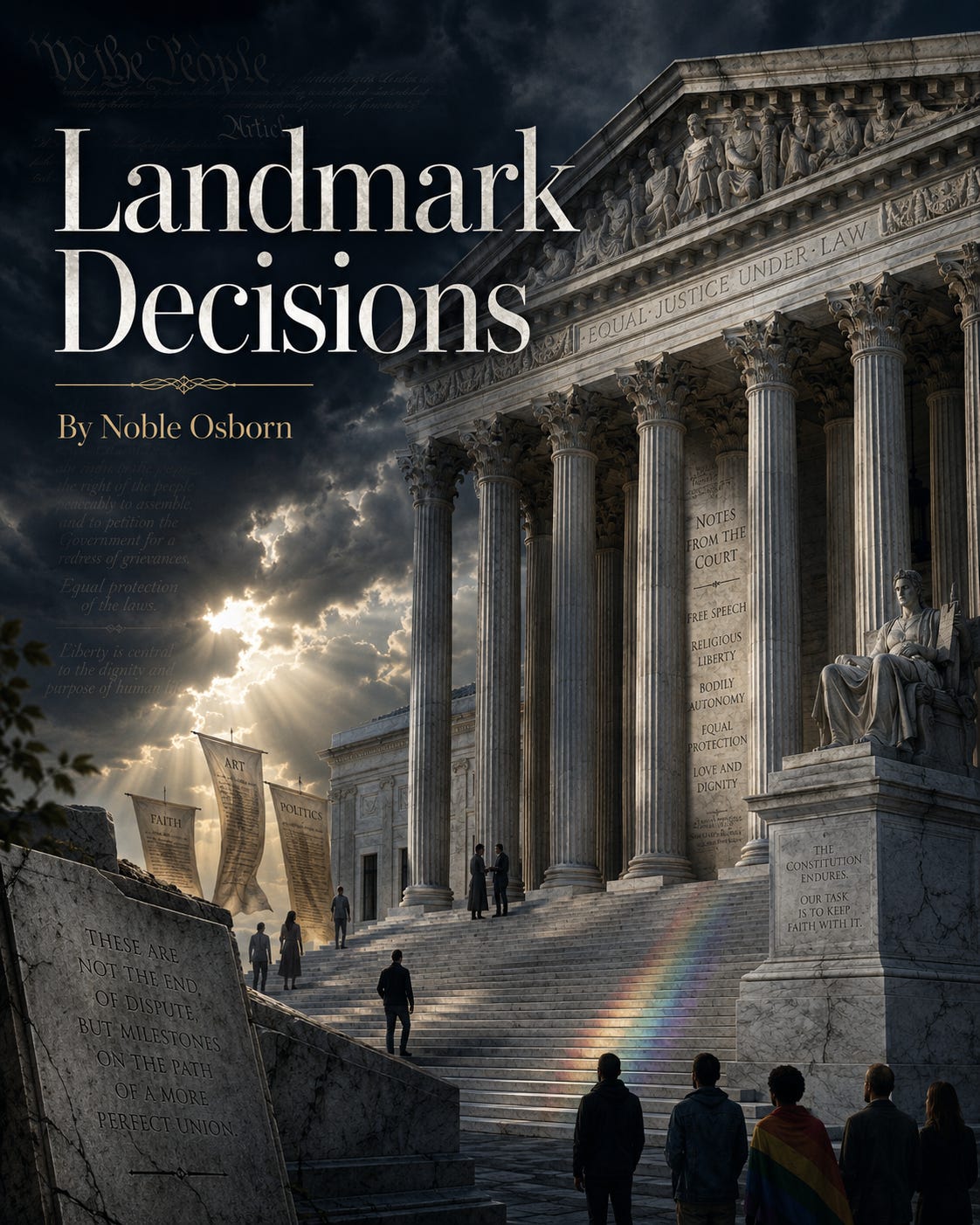
Not every monument is made of stone.
Some are written in ink, bound in leather, archived behind glass, cited by number, and carved not into the skyline but into the daily permissions of ordinary life. Some do not rise over a city. They rise over a body. They decide who may marry, who may speak, who may refuse, who may pray, who may teach, who may be seen, who may be erased, who may carry a pregnancy, who may end one, who may enter a schoolroom without becoming a controversy.
We call them landmark decisions, which is one of the more revealing phrases in American law. A landmark is supposed to help us know where we are. It gives the traveler a point of orientation. It says: here. This happened here. This is where the road turns. This is where the border begins. This is where the city remembers itself.
But the law’s landmarks do not always clarify the landscape. Sometimes they shatter it.
A court opinion can be a bridge. It can be a gate. It can be a shrine. It can be a wall. It can be the map that brings one people home and the deed that evicts another. It can lift an old humiliation from the shoulders of the living, or it can return a nation to a cruelty it had once promised itself it had outgrown.
In marble buildings, beneath carved pediments and solemn columns, the republic performs one of its strangest rituals. People enter with private wounds and public arguments. They bring marriages, pregnancies, schoolbooks, cakes, websites, pronouns, prayers, medical treatments, campaign money, maps, flags, guns, graves, and the terrible little question that haunts every democracy: who counts?
Then nine human beings, robed into something resembling permanence, answer.
The answer becomes architecture.
This is the monument that most Americans live inside without ever visiting. The Washington Monument may puncture the sky, and the Lincoln Memorial may sit broad and temple-like beside the Reflecting Pool, but a Supreme Court decision can enter the hospital, the workplace, the bedroom, the school, the polling place, the church, the classroom, the wedding chapel, the museum, and the mouth.
It can decide what words are protected. It can decide whose faith bends the public square. It can decide whether the state may compel an artist to make something she does not believe, or whether a business open to the public may refuse the public it dislikes. It can decide whether a teacher may say gay, whether a child may read a book, whether a therapist may dress harm in the costume of counsel, whether a doctor may treat a transgender child, whether a woman’s body belongs first to herself or to the state in which she happens to stand.
These are not abstractions. They are not merely “cases.” They are the invisible landmarks by which people route their lives.
The trouble with legal monuments is that they are rarely honest about their own weather.
A stone monument admits erosion. It stains. It cracks. It gathers soot and bird droppings. It requires restoration or neglect. It shows the passage of time whether we wish to see it or not. Law pretends to be cleaner than that. It comes dressed as reason. It speaks in precedent, scrutiny, burden, history, tradition, equal protection, due process, free exercise, speech. It builds its walls out of vocabulary. It teaches us to mistake polish for neutrality.
But no landmark decision arrives outside history. Every opinion stands in the weather of its age.
There was a time when the Court’s architecture expanded the meaning of citizenship. Brown became a landmark because it told a segregated nation that separate schools were not equal schools, no matter how many officials had insisted otherwise. Loving became a landmark because it told states they could not make race the jailer of marriage. Obergefell became a landmark because it recognized what millions of families already knew: that dignity was not a favor granted by heterosexual majorities, and that marriage, if it was a fundamental right, could not remain a gated estate.
These decisions did not solve the country. No landmark does. A landmark can mark the turn without completing the journey. Brown did not end racism. Loving did not end the policing of intimacy. Obergefell did not end anti-queer animus. But each changed the map. Each made it harder for the nation to pretend that exclusion was merely custom, or that custom was innocence, or that innocence could be claimed by those who held others outside the gate.
There are decisions that feel like doors opening.
Then there are decisions that feel like locks being changed while people are still inside the house.
Dobbs became one of those landmarks. Not because it created a new architecture of freedom, but because it demolished one. For nearly half a century, Roe and Casey had functioned as legal ground beneath reproductive autonomy. Imperfect, contested, politically battered ground, certainly, but ground nonetheless. Dobbs did not merely change doctrine. It changed geography. It made rights depend more brutally on state lines. It turned travel into strategy, poverty into punishment, and pregnancy into a jurisdictional condition.
A landmark can be a ruin at the moment of its construction.
This is what we must understand about the phrase itself. Landmark does not mean moral achievement. It means consequence. A landmark decision is not necessarily good. It is large. It is visible from far away. It changes direction. It tells future arguments where they must begin.
Dred Scott was a landmark. Plessy was a landmark. Korematsu was a landmark. History’s map is full of legal monuments that should have been warning signs. A country may build a courthouse, call it justice, and still use it to sanctify theft, internment, segregation, forced birth, disenfranchisement, and disappearance.
The court becomes most dangerous when it speaks as though history has no living victims.
In recent years, the legal landscape has become especially jagged where faith, speech, art, education, and LGBTQ life meet. These are not separate subjects anymore, if they ever were. They have become a single contested territory.
The artist appears before the law and says: do not make me speak.
The queer couple appears before the law and says: do not make our existence an exception to public life.
The parent appears before the law and says: do not make my child absorb a lesson that contradicts my faith.
The teacher, librarian, or student appears before the law and says: do not make my life unsayable because someone else has called my existence indoctrination.
The therapist appears before the law and says: counseling is speech.
The survivor of conversion therapy replies: speech can wound, and professional power can become a ritual of erasure.
The state appears and says: we regulate conduct.
The Court asks whether the conduct is really speech.
Everyone knows that the answer will decide much more than the case.
This is where landmark decisions become landmarks in the older sense. They mark territory. They announce who has reached the high ground. They decide which side of the wall the vulnerable will wake up on.
In 303 Creative, the Court considered the rights of a website designer who objected to creating wedding websites for same-sex couples. The case sat at the intersection of art, commerce, speech, and civil rights. To one side, the fear was compelled expression: the state forcing an artist to create a message she did not believe. To the other, the fear was public accommodation hollowed out by aesthetic conscience: the old refusal of service, washed clean and reintroduced as speech.
That is the power of legal language. It can transform the same door into two entirely different symbols. For one person, the door is coercion. For another, the door is exclusion.
The Court chose speech.
But speech is not a meadow. It, too, is architecture. It has gates, plazas, balconies, private rooms, public stages. When the Court elevates one speaker’s conscience, it may lower another person’s access to ordinary life. When it protects artistic refusal, it may invite a thousand future litigants to rename discrimination as expression. When it defends expression in the abstract, it must still answer the human question waiting outside the shop: who is left standing in the street?
A landmark decision often becomes most powerful in the imagination of those who were not parties to it. One ruling gives permission to arguments the Court insists it has not made. Another ruling frightens people whose rights were not directly named. The law moves by doctrine, but the country moves by signal.
This is why LGBTQ landmarks are so fragile. The map of queer life in America has never been a clean march from darkness into light. It has been a series of openings and reprisals, parades and police raids, marriage licenses and bathroom bills, pride flags and bans, legal dignity and legislative contempt. Stonewall became a landmark because people fought back against the machinery that had made hiding seem like survival. Obergefell became a landmark because love stepped into the courthouse and demanded legal recognition. Bostock became a landmark because employment discrimination could no longer hide behind the technicalities of sex.
But every landmark has enemies who learn its weak points.
If marriage equality stands, attack the schools. If employment protection stands, attack healthcare. If healthcare is too technical, attack sports. If sports are too narrow, attack books. If books are too local, attack pronouns. If pronouns are too small, attack flags. If flags are too symbolic, attack the symbols until public memory itself becomes exhausted.
This is how rights are not only overturned, but worn down.
Mahmoud placed religious objection and LGBTQ-inclusive school materials into direct constitutional conflict. The case was not only about books. It was about whether the public school is a common civic room or a corridor of private opt-outs. It was about whether exposure to difference is an educational condition or a religious burden. It was about the strange American tendency to describe marginalized people as an ideology the moment children are asked to know they exist.
Skrmetti moved the battle to the body. There, the Court upheld Tennessee’s restrictions on certain medical care for transgender minors. Chiles moved the battle into the therapeutic room, where the Court treated Colorado’s conversion-therapy restriction as a speech problem rather than simply professional regulation.
The pattern is unmistakable. Queer and transgender life is being litigated not only as identity, but as curriculum, treatment, expression, parental authority, religious liberty, professional speech, and state power. The courtroom becomes the new town square because the old town square has already been made hostile.
A landmark decision is never just a ruling. It is a weather system.
After Dobbs, clinics closed or moved. Patients traveled or could not. Doctors hesitated. Legislatures accelerated. Families recalculated. After Obergefell, couples married, estates stabilized, hospital rooms opened, children gained legal parents, and a private vow became public standing. After Bostock, employees who had long lived at the mercy of a supervisor’s prejudice gained a federal sentence they could carry into human resources like a shield. After 303 Creative, religious conservatives and free-speech advocates celebrated a boundary against compelled expression, while civil rights advocates warned that the boundary might become a doorway for new refusals.
The Court writes. The country rearranges itself.
This is why landmark decisions belong in an issue about monuments. They behave like monuments. They gather pilgrims and protesters. They are quoted ceremonially. They are despised ceremonially. They become shorthand for whole moral universes. Roe. Dobbs. Brown. Obergefell. Bostock. Citizens United. Hobby Lobby. Masterpiece. 303 Creative. Skrmetti. Mahmoud. Chiles.
Say the name, and people know which flag has been raised.
Like monuments, court decisions also ask us to confuse permanence with legitimacy. They stand because power has placed them there. That does not mean they deserve reverence. Some should be defended. Some should be mourned. Some should be dismantled. Some should be remembered only as evidence of what a nation was willing to do while calling itself lawful.
There is a civic maturity in knowing the difference.
The American legal imagination has always loved marble. It loves columns and robes and Latin phrases. It loves the theatrical hush of institutional gravity. It loves the idea that law descends from some clear height untouched by appetite, party, money, fear, religion, race, gender, or ambition. Yet the Court is not above the nation. It is one of the nation’s instruments. Sometimes it restrains the mob. Sometimes it refines the mob’s desire into doctrine.
This does not mean law is meaningless. It means law is human.
And because it is human, it must be watched.
The monument that cannot be questioned becomes an idol. The precedent that cannot be revisited becomes a prison. The Court that cannot be criticized becomes a priesthood. Democracy requires reverence for law, but not worship of judges. It requires institutions, but not surrender. It requires memory long enough to know that the same building has issued both liberation and cruelty.
Perhaps that is the lesson of landmark decisions: they do not tell us who we are once and for all. They reveal who had power at the moment the question was asked.
The rest is struggle.
A decision may open the gate, but people still have to walk through it. A decision may build the wall, but people still gather at its base. A decision may declare the matter settled, but the wounded rarely experience injustice as settled. They experience it as daily architecture: the clinic too far away, the schoolbook removed, the marriage questioned, the pronoun mocked, the form that has no box for them, the job lost, the doctor afraid, the artist refusing, the state waiting, the court speaking.
Not every monument is made of stone.
Some are made of sentences.
Some stand over us.
Some shelter us.
Some must be torn down before anyone can breathe freely in their shadow.Not every monument is made of stone.
Some are written in ink, bound in leather, archived behind glass, cited by number, and carved not into the skyline but into the daily permissions of ordinary life. Some do not rise over a city. They rise over a body. They decide who may marry, who may speak, who may refuse, who may pray, who may teach, who may be seen, who may be erased, who may carry a pregnancy, who may end one, who may enter a schoolroom without becoming a controversy.
We call them landmark decisions, which is one of the more revealing phrases in American law. A landmark is supposed to help us know where we are. It gives the traveler a point of orientation. It says: here. This happened here. This is where the road turns. This is where the border begins. This is where the city remembers itself.
But the law’s landmarks do not always clarify the landscape. Sometimes they shatter it.
A court opinion can be a bridge. It can be a gate. It can be a shrine. It can be a wall. It can be the map that brings one people home and the deed that evicts another. It can lift an old humiliation from the shoulders of the living, or it can return a nation to a cruelty it had once promised itself it had outgrown.
In marble buildings, beneath carved pediments and solemn columns, the republic performs one of its strangest rituals. People enter with private wounds and public arguments. They bring marriages, pregnancies, schoolbooks, cakes, websites, pronouns, prayers, medical treatments, campaign money, maps, flags, guns, graves, and the terrible little question that haunts every democracy: who counts?
Then nine human beings, robed into something resembling permanence, answer.
The answer becomes architecture.
This is the monument that most Americans live inside without ever visiting. The Washington Monument may puncture the sky, and the Lincoln Memorial may sit broad and temple-like beside the Reflecting Pool, but a Supreme Court decision can enter the hospital, the workplace, the bedroom, the school, the polling place, the church, the classroom, the wedding chapel, the museum, and the mouth.
It can decide what words are protected. It can decide whose faith bends the public square. It can decide whether the state may compel an artist to make something she does not believe, or whether a business open to the public may refuse the public it dislikes. It can decide whether a teacher may say gay, whether a child may read a book, whether a therapist may dress harm in the costume of counsel, whether a doctor may treat a transgender child, whether a woman’s body belongs first to herself or to the state in which she happens to stand.
These are not abstractions. They are not merely “cases.” They are the invisible landmarks by which people route their lives.
The trouble with legal monuments is that they are rarely honest about their own weather.
A stone monument admits erosion. It stains. It cracks. It gathers soot and bird droppings. It requires restoration or neglect. It shows the passage of time whether we wish to see it or not. Law pretends to be cleaner than that. It comes dressed as reason. It speaks in precedent, scrutiny, burden, history, tradition, equal protection, due process, free exercise, speech. It builds its walls out of vocabulary. It teaches us to mistake polish for neutrality.
But no landmark decision arrives outside history. Every opinion stands in the weather of its age.
There was a time when the Court’s architecture expanded the meaning of citizenship. Brown became a landmark because it told a segregated nation that separate schools were not equal schools, no matter how many officials had insisted otherwise. Loving became a landmark because it told states they could not make race the jailer of marriage. Obergefell became a landmark because it recognized what millions of families already knew: that dignity was not a favor granted by heterosexual majorities, and that marriage, if it was a fundamental right, could not remain a gated estate.
These decisions did not solve the country. No landmark does. A landmark can mark the turn without completing the journey. Brown did not end racism. Loving did not end the policing of intimacy. Obergefell did not end anti-queer animus. But each changed the map. Each made it harder for the nation to pretend that exclusion was merely custom, or that custom was innocence, or that innocence could be claimed by those who held others outside the gate.
There are decisions that feel like doors opening.
Then there are decisions that feel like locks being changed while people are still inside the house.
Dobbs became one of those landmarks. Not because it created a new architecture of freedom, but because it demolished one. For nearly half a century, Roe and Casey had functioned as legal ground beneath reproductive autonomy. Imperfect, contested, politically battered ground, certainly, but ground nonetheless. Dobbs did not merely change doctrine. It changed geography. It made rights depend more brutally on state lines. It turned travel into strategy, poverty into punishment, and pregnancy into a jurisdictional condition.
A landmark can be a ruin at the moment of its construction.
This is what we must understand about the phrase itself. Landmark does not mean moral achievement. It means consequence. A landmark decision is not necessarily good. It is large. It is visible from far away. It changes direction. It tells future arguments where they must begin.
Dred Scott was a landmark. Plessy was a landmark. Korematsu was a landmark. History’s map is full of legal monuments that should have been warning signs. A country may build a courthouse, call it justice, and still use it to sanctify theft, internment, segregation, forced birth, disenfranchisement, and disappearance.
The court becomes most dangerous when it speaks as though history has no living victims.
In recent years, the legal landscape has become especially jagged where faith, speech, art, education, and LGBTQ life meet. These are not separate subjects anymore, if they ever were. They have become a single contested territory.
The artist appears before the law and says: do not make me speak.
The queer couple appears before the law and says: do not make our existence an exception to public life.
The parent appears before the law and says: do not make my child absorb a lesson that contradicts my faith.
The teacher, librarian, or student appears before the law and says: do not make my life unsayable because someone else has called my existence indoctrination.
The therapist appears before the law and says: counseling is speech.
The survivor of conversion therapy replies: speech can wound, and professional power can become a ritual of erasure.
The state appears and says: we regulate conduct.
The Court asks whether the conduct is really speech.
Everyone knows that the answer will decide much more than the case.
This is where landmark decisions become landmarks in the older sense. They mark territory. They announce who has reached the high ground. They decide which side of the wall the vulnerable will wake up on.
In 303 Creative, the Court considered the rights of a website designer who objected to creating wedding websites for same-sex couples. The case sat at the intersection of art, commerce, speech, and civil rights. To one side, the fear was compelled expression: the state forcing an artist to create a message she did not believe. To the other, the fear was public accommodation hollowed out by aesthetic conscience: the old refusal of service, washed clean and reintroduced as speech.
That is the power of legal language. It can transform the same door into two entirely different symbols. For one person, the door is coercion. For another, the door is exclusion.
The Court chose speech.
But speech is not a meadow. It, too, is architecture. It has gates, plazas, balconies, private rooms, public stages. When the Court elevates one speaker’s conscience, it may lower another person’s access to ordinary life. When it protects artistic refusal, it may invite a thousand future litigants to rename discrimination as expression. When it defends expression in the abstract, it must still answer the human question waiting outside the shop: who is left standing in the street?
A landmark decision often becomes most powerful in the imagination of those who were not parties to it. One ruling gives permission to arguments the Court insists it has not made. Another ruling frightens people whose rights were not directly named. The law moves by doctrine, but the country moves by signal.
This is why LGBTQ landmarks are so fragile. The map of queer life in America has never been a clean march from darkness into light. It has been a series of openings and reprisals, parades and police raids, marriage licenses and bathroom bills, pride flags and bans, legal dignity and legislative contempt. Stonewall became a landmark because people fought back against the machinery that had made hiding seem like survival. Obergefell became a landmark because love stepped into the courthouse and demanded legal recognition. Bostock became a landmark because employment discrimination could no longer hide behind the technicalities of sex.
But every landmark has enemies who learn its weak points.
If marriage equality stands, attack the schools. If employment protection stands, attack healthcare. If healthcare is too technical, attack sports. If sports are too narrow, attack books. If books are too local, attack pronouns. If pronouns are too small, attack flags. If flags are too symbolic, attack the symbols until public memory itself becomes exhausted.
This is how rights are not only overturned, but worn down.
Mahmoud placed religious objection and LGBTQ-inclusive school materials into direct constitutional conflict. The case was not only about books. It was about whether the public school is a common civic room or a corridor of private opt-outs. It was about whether exposure to difference is an educational condition or a religious burden. It was about the strange American tendency to describe marginalized people as an ideology the moment children are asked to know they exist.
Skrmetti moved the battle to the body. There, the Court upheld Tennessee’s restrictions on certain medical care for transgender minors. Chiles moved the battle into the therapeutic room, where the Court treated Colorado’s conversion-therapy restriction as a speech problem rather than simply professional regulation.
The pattern is unmistakable. Queer and transgender life is being litigated not only as identity, but as curriculum, treatment, expression, parental authority, religious liberty, professional speech, and state power. The courtroom becomes the new town square because the old town square has already been made hostile.
A landmark decision is never just a ruling. It is a weather system.
After Dobbs, clinics closed or moved. Patients traveled or could not. Doctors hesitated. Legislatures accelerated. Families recalculated. After Obergefell, couples married, estates stabilized, hospital rooms opened, children gained legal parents, and a private vow became public standing. After Bostock, employees who had long lived at the mercy of a supervisor’s prejudice gained a federal sentence they could carry into human resources like a shield. After 303 Creative, religious conservatives and free-speech advocates celebrated a boundary against compelled expression, while civil rights advocates warned that the boundary might become a doorway for new refusals.
The Court writes. The country rearranges itself.
This is why landmark decisions belong in an issue about monuments. They behave like monuments. They gather pilgrims and protesters. They are quoted ceremonially. They are despised ceremonially. They become shorthand for whole moral universes. Roe. Dobbs. Brown. Obergefell. Bostock. Citizens United. Hobby Lobby. Masterpiece. 303 Creative. Skrmetti. Mahmoud. Chiles.
Say the name, and people know which flag has been raised.
Like monuments, court decisions also ask us to confuse permanence with legitimacy. They stand because power has placed them there. That does not mean they deserve reverence. Some should be defended. Some should be mourned. Some should be dismantled. Some should be remembered only as evidence of what a nation was willing to do while calling itself lawful.
There is a civic maturity in knowing the difference.
The American legal imagination has always loved marble. It loves columns and robes and Latin phrases. It loves the theatrical hush of institutional gravity. It loves the idea that law descends from some clear height untouched by appetite, party, money, fear, religion, race, gender, or ambition. Yet the Court is not above the nation. It is one of the nation’s instruments. Sometimes it restrains the mob. Sometimes it refines the mob’s desire into doctrine.
This does not mean law is meaningless. It means law is human.
And because it is human, it must be watched.
The monument that cannot be questioned becomes an idol. The precedent that cannot be revisited becomes a prison. The Court that cannot be criticized becomes a priesthood. Democracy requires reverence for law, but not worship of judges. It requires institutions, but not surrender. It requires memory long enough to know that the same building has issued both liberation and cruelty.
Perhaps that is the lesson of landmark decisions: they do not tell us who we are once and for all. They reveal who had power at the moment the question was asked.
The rest is struggle.
A decision may open the gate, but people still have to walk through it. A decision may build the wall, but people still gather at its base. A decision may declare the matter settled, but the wounded rarely experience injustice as settled. They experience it as daily architecture: the clinic too far away, the schoolbook removed, the marriage questioned, the pronoun mocked, the form that has no box for them, the job lost, the doctor afraid, the artist refusing, the state waiting, the court speaking.
Not every monument is made of stone.
Some are made of sentences.
Some stand over us.
Some shelter us.
Some must be torn down before anyone can breathe freely in their shadow.
No posts
Comments
Nothing yet. Say the first thing.
Sign in to join the conversation.