
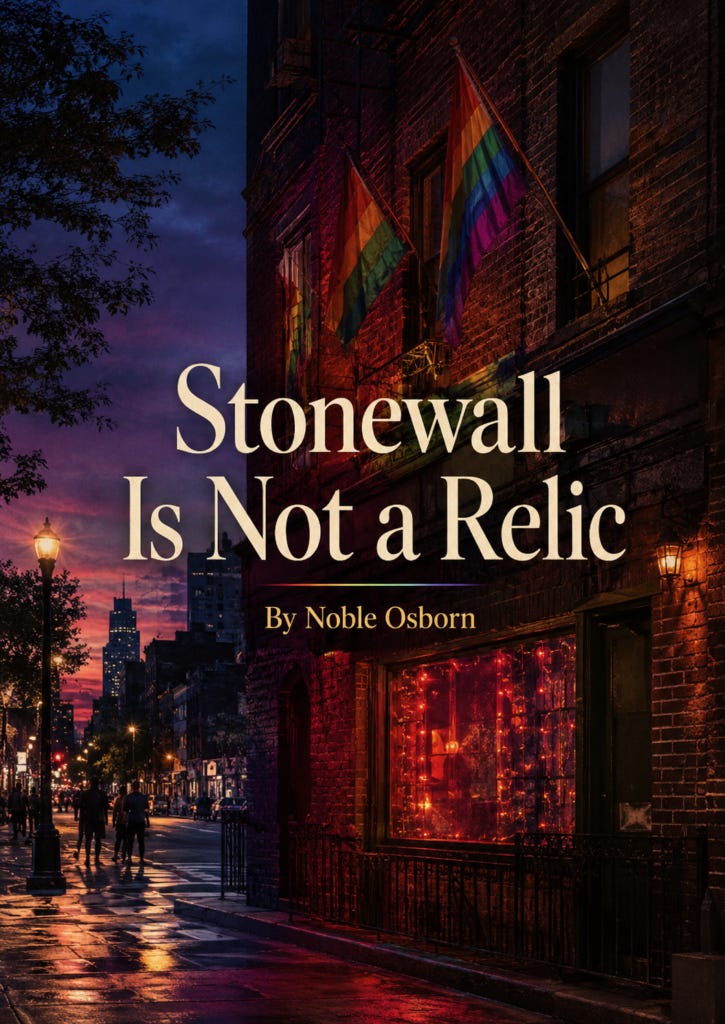
Stonewall is a strange name for a place where something broke open.
It sounds immovable. It sounds defensive. It sounds like something meant to keep people out, to hold a line, to make a boundary endure. A stone wall does not invite. It stands. It refuses. It divides the world into here and there, inside and outside, belonging and trespass.
And yet, Stonewall became a door.
In the long history of landmarks, this is what makes it different. The pyramids rose for kings. The temples climbed toward gods. The obelisks pierced the sky on behalf of empire. The walls of cities announced fear, wealth, control, and dominion. But Stonewall, humble and crowded and ordinary by comparison, became a landmark because people who had been cornered inside history finally pushed back against the wall.
It was not built as a monument. It was not designed to awe. No pharaoh ordered it. No emperor measured it. No architect set out to make it eternal. It was a bar. A refuge. A risk. A place where people gathered because so few places would have them.
That is why Stonewall matters.
Not because it is beautiful in the conventional language of monuments. Not because it towers. Not because it wears marble well. Not because schoolchildren are marched before it and told to speak in reverent voices. Stonewall matters because it reminds us that sometimes the most important landmarks are not the places power builds to commemorate itself, but the places where the powerless refuse to disappear.
The July issue of this magazine moves through stone and shrine, wall and obelisk, museum and courtroom. We have looked at monuments as human declarations: this mattered, this happened, this must not be forgotten. But Stonewall asks a more dangerous question. What happens when the landmark is still alive? What happens when the story it tells is not safely sealed in the past? What happens when the nation names a place historic, then still tries to edit the people who made it so?
A relic is allowed to be quiet.
Stonewall is not a relic.
A relic sits behind glass. It may be admired without being obeyed. It may be visited without troubling the visitor. It may be preserved while stripped of its consequences. A relic asks for reverence. A living landmark asks for honesty.
Stonewall is still asking.
In the early hours of June 28, 1969, the police raid on the Stonewall Inn did not produce the obedience expected of it. Raids were not unusual. Harassment was not unusual. Humiliation was not unusual. For queer people in America, especially those without money, safety, whiteness, family protection, or gender conformity, public life was often a negotiation with threat. Bars could be sanctuaries, but they were also vulnerable. Gathering could mean survival, but it could also mean exposure.
The closet was not only personal. It was architectural.
It shaped where people could stand, how they could dance, who they could touch, which doors they could enter, which names they could use, and how quickly they had to scatter when authority arrived. Before Stonewall became a national monument, it was part of a geography of permission and punishment. Queer life existed, flourished, desired, sang, drank, loved, organized, and mourned, but it often did so in spaces the law could enter at will.
Then, one night, the wall answered back.
The story has been simplified over time, as all landmark stories are. History is not a clean statue. It is a crowded street. Stonewall was not one hero, one brick, one cinematic instant, one speech, one poster-ready face. It was a multi-night uprising born from accumulated insult and exhaustion. It belonged to drag queens, lesbians, gay men, bisexual people, transgender people, street youth, sex workers, neighbors, patrons, and those whose names never entered the archive. It belonged to those who fought openly and those who survived quietly. It belonged to those who were there and those who understood, afterward, that something had shifted.
A movement did not begin from nothing at Stonewall. There were organizations before it. There were activists before it. There were publications, meetings, legal challenges, quiet networks, coded languages, secret rooms, and brave people living visibly long before the nation cared to look. But Stonewall lit a flare. It made refusal contagious. It helped change the scale of queer politics from hidden endurance to public demand.
That is what a landmark does at its best. It does not create memory by itself. It concentrates it.
Stonewall concentrates the memory of being policed for existing. It concentrates the memory of bodies treated as criminal evidence. It concentrates the memory of chosen family. It concentrates the knowledge that the state has often met queer joy with paperwork, handcuffs, medical cruelty, religious sanction, and respectable disgust.
It also concentrates victory.
There is joy in Stonewall. There must be. The uprising is not only a wound. It is also a threshold. It gave later generations a place to point to and say: here, we were not ashamed. Here, we did not go quietly. Here, the night did not end the way power expected it to end.
That is why the fight over Stonewall’s meaning is not symbolic in the shallow sense. Symbols are never shallow when people live or die beneath them. A flag lowered from a landmark is not merely fabric moving from one position to another. A word removed from an official page is not merely a clerical adjustment. A letter cut from an acronym is not merely typography. These acts say something about who the state believes belongs inside the story.
The alphabet of queer life has always been political because naming has always been survival.
To be named is not everything, but to be unnamed by power is never innocent. The struggle over whether public history says LGBT, LGBTQ, LGBTQIA+, queer, trans, bisexual, nonbinary, or anything else is not a petty quarrel over language. It is a struggle over whether the record will admit the full human company of the movement. It is a struggle over whether transgender people, especially transgender women of color, will be treated as decoration in Pride month speeches while erased from the institutional memory of the very uprising they helped make legible to the nation.
Stonewall exposes the lie that monuments are settled.
If monuments were settled, no one would fight so hard to control them. No one would remove flags in the night. No one would soften plaques, rewrite websites, ban books, rename curriculum, or insist that the past be simplified for public comfort. The fight over Stonewall is part of a larger national habit: preserve the site, domesticate the story.
America is very good at turning rebellion into heritage once the rebels are safely dead, marketable, or blurred.
It does this with abolitionists. It does this with labor organizers. It does this with Indigenous resistance. It does this with civil rights leaders. It does this with women who were once called dangerous and are later printed on posters for schoolchildren. It does this with queer history, too. First comes criminalization. Then comes mockery. Then comes sanitized tribute. Finally comes the demand that the honored dead stop interfering with current policy.
Stonewall refuses that final step.
It refuses because queer people are not past tense. The questions that made Stonewall necessary did not disappear with marriage equality. They did not disappear with corporate rainbow merchandise. They did not disappear when the neighborhood changed, when tourism arrived, when politicians learned to pose beside Pride flags, or when the federal government finally admitted that a gay bar could be a national landmark.
The question remains: who is allowed to live openly without being punished for it?
That question appears now in schools, where the presence of LGBTQ books becomes a battlefield. It appears in courtrooms, where religious liberty and queer visibility are placed in collision, as though the mere knowledge of queer lives were an injury from which others must be shielded. It appears in health care, where transgender youth and their families are made into legislative targets. It appears in counseling offices, where old ideas about conversion return under the polished language of speech and conscience. It appears in public parks, where flags become suspect. It appears in museums, libraries, bathrooms, classrooms, sports fields, adoption agencies, funeral homes, wedding venues, and family dinner tables.
Stonewall is not a relic because the wall keeps moving.
It moves whenever a child is told that their family is too controversial for a classroom. It moves whenever a teenager learns that the word for who they are has been removed by adults who claim to be protecting them. It moves whenever a teacher is afraid to say “gay,” whenever a librarian is threatened for shelving a book, whenever a trans person becomes a campaign prop, whenever a court opinion converts lived equality into a question of someone else’s discomfort.
The wall is no longer only police at the door of a bar.
Sometimes it is policy. Sometimes it is curriculum. Sometimes it is a medical ban. Sometimes it is a flag rule. Sometimes it is a majority opinion. Sometimes it is the gentle voice of respectability saying, of course we honor you, just not like that, not here, not this visibly, not with those people included.
That is why Stonewall belongs in an issue about landmarks and walls. It is both.
It is a landmark because something happened there that changed the map of American civil rights. It is a wall because the people who gathered there knew what it meant to be pressed against one. It is also a warning: every wall that falls can be rebuilt in another form.
The Berlin Wall fell in public spectacle. The world watched concrete become souvenir. People climbed it, hammered at it, danced on it, took pieces home as proof that an age had ended. But some walls do not fall so dramatically. Some are dismantled by vocabulary, by recognition, by policy, by love. Some are rebuilt the same way.
Stonewall teaches us that liberation is not a single demolition.
It is maintenance.
That may be the least romantic truth about civil rights. Rights are not self-cleaning monuments. They do not remain bright because a court once wrote a beautiful sentence. They do not defend themselves because a president once signed a proclamation. They do not survive because a crowd once marched. Every generation inherits not only the victories, but the labor of keeping them honest.
A landmark can become a mask if no one tends the story underneath it.
That tending requires more than nostalgia. It requires telling the part of the story that makes the present uncomfortable. It requires saying that Stonewall was not simply about love winning. It was about policing. It was about poverty. It was about race. It was about gender. It was about the right to gather. It was about the violence of being made illegal. It was about people who had already lost families, jobs, housing, safety, and still found one another in the dark.
It was about joy as defiance.
That phrase can sound pretty now, but it was not pretty then. Joy has often been treated as evidence against queer people. Dancing was evidence. Clothing was evidence. Touch was evidence. A name was evidence. A body was evidence. The scandal of queer joy is that it refuses to behave like shame.
Stonewall’s deepest demand was not merely tolerance. Tolerance is too small a word for people who have had to fight their way into the public record. Tolerance says: you may exist if you do not inconvenience the architecture. Stonewall says: the architecture is the problem.
That is why the national monument matters. Not because federal recognition completes the story, but because it admits that the story belongs to the nation. Stonewall is not a local curiosity. It is not a niche site for a niche community. It is not an optional footnote in American memory. It is part of the country’s argument with itself over liberty, privacy, assembly, equality, embodiment, family, speech, faith, and public space.
To visit Stonewall honestly is to understand that LGBTQ history is American history, not an appendix to it.
This is where the phrase “landmark decision” becomes useful. Courts create landmarks too. Some are liberating. Some are devastating. Some open doors and some narrow them. A courthouse sentence can become as consequential as stone. It can decide who may marry, who may work, who may learn, who may be treated, who may refuse service, who may be protected, and who must carry the burden of someone else’s theology.
Queer Americans know that the law is a landscape.
There are peaks: Lawrence, which removed the criminal shadow from private intimacy; Obergefell, which recognized the dignity of marriage; Bostock, which affirmed that firing someone for being gay or transgender is sex discrimination under federal employment law.
There are cliffs too. There are decisions that remind us how quickly protection can become conditional, how easily equality can be reframed as conflict, how often the rights of queer people are balanced against the claimed injury of having to acknowledge them.
Stonewall stands at the intersection of these landscapes. It is not only a place where people resisted police. It is a place from which we can measure the distance between symbolic inclusion and actual safety.
The flag matters.
The words matter.
The plaques matter.
The schoolbooks matter.
The court cases matter.
The names matter.
A landmark without names becomes an empty stage. Someone else will always be willing to perform a cleaner version of history upon it.
This is the danger of turning Stonewall into a relic. A relic can be honored while its lesson is ignored. A relic can be polished while the living are abandoned. A relic can be used to prove progress while progress is being dismantled elsewhere. A relic allows a nation to say, we have already dealt with that.
Stonewall says no.
It says the raid is over, but the question remains. It says the crowd dispersed, but the demand did not. It says Pride is not merely a parade, not merely a month, not merely a market, not merely a palette applied to products once a year. Pride is a public refusal of disappearance.
And disappearance is still being requested.
Sometimes politely. Sometimes legally. Sometimes with a smile. Sometimes through the language of parents’ rights, religious freedom, local control, age-appropriateness, biological truth, public order, neutrality, or tradition. The vocabulary changes. The wall recognizes itself.
But so does resistance.
Every generation has its Christopher Park. Every generation has its door where authority enters expecting compliance. Every generation has its night when exhaustion turns into courage. Every generation has its young people who are told they are too much, too soon, too visible, too confusing, too political, too dangerous to name.
And every generation must decide what it will do when the flag comes down.
That is the living meaning of Stonewall. Not that one uprising solved the problem. Not that one monument protects the story forever. Not that one court decision secures the future. The meaning is simpler and harder: public memory must be defended by the public.
There are landmarks we inherit because someone else built them. There are landmarks we inherit because someone else survived them. Stonewall is both a place and a debt. It asks those who come after not merely to take photographs, but to remain alert. It asks us not to confuse recognition with permanence. It asks us to notice who has been left out of the plaque, whose letter has been removed, whose flag has been folded, whose name has been softened into absence.
The great monuments of the world often tell us what power wanted remembered.
Stonewall tells us what power wanted hidden.
That is why it still stands.
Not as a relic. Not as a ruin. Not as a quaint stop on the tour of a struggle completed. Stonewall stands as a living landmark because the wall it broke has never stopped trying to rebuild itself.
And because, somewhere, someone is still pushing back.
No posts
Comments
Nothing yet. Say the first thing.
Sign in to join the conversation.