
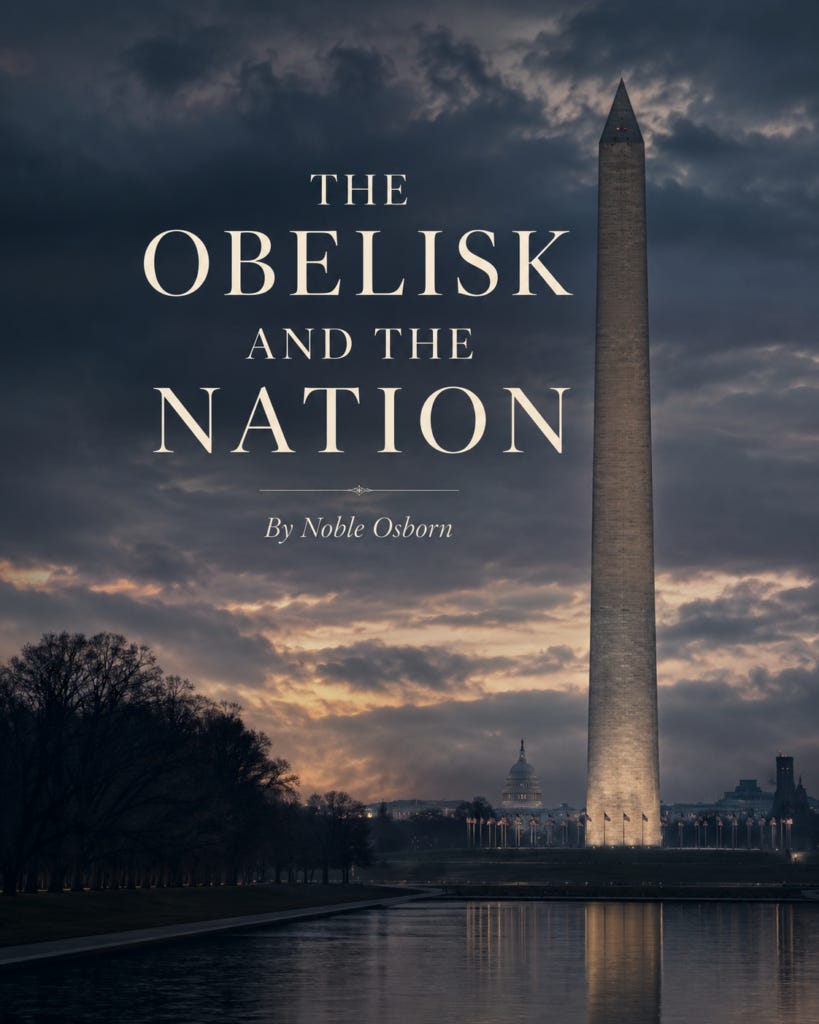
There is something almost too simple about the Washington Monument.
It does not have the narrative complication of a temple. It does not have the ruined grandeur of an ancient city. It does not possess the crowded theatricality of a cathedral, with saints and demons climbing over stone, nor the democratic tenderness of a memorial wall where names turn grief into alphabet. It is not a house. It is not a tomb. It is not an altar in any official sense.
It is a line.
A pale, enormous line drawn upward from the earth.
The monument rises from the National Mall with the severity of a command and the emptiness of a question. It points, but it does not explain. It towers, but it does not speak. It offers no face, no figure, no gesture of a man on horseback, no bronze hand extended toward the republic. Its language is not portraiture but geometry. Its argument is height.
This is what America chose, finally, for George Washington: not a likeness, not a chapel, not a palace, but an obelisk. A borrowed ancient form, Egyptian in ancestry, American in appropriation, civic in intention, and strangely lonely in effect. It stands like a punctuation mark at the center of national myth, a great exclamation point after a sentence the country has never stopped revising.
In July 2026, as the United States marks 250 years since the signing of the Declaration of Independence, that stone line becomes harder to read simply. The nation will dress itself in ceremony. Flags will multiply. Fireworks will lift their bright, temporary architecture into the sky. The old phrases will return: liberty, union, democracy, founding, freedom. The capital will glow with the ritual of self-congratulation, as capitals do when history gives them an anniversary large enough to stage.
And there, quiet above the noise, the Washington Monument will remain what it has always been: a symbol too clean for the country beneath it.
That is the trouble with obelisks. They simplify. They reduce complexity into ascent. They turn history into a vertical shape. They do not invite conversation so much as obedience of the eye. Look up, they say. Look higher. Look beyond the ground.
But nations are made on the ground.
They are made in fields and courthouses, in auction blocks and churches, in legislatures and prisons, in schoolrooms, kitchens, battlefields, borderlands, voting lines, hospital wards, marriage licenses, refugee camps, and graveyards. They are made in every place where law touches flesh. A nation is never as clean as its monument. It is never as silent as marble. It is never as unified as the view from a distance.
The Washington Monument honors a man who has been made, over time, into the preferred shape of American restraint. George Washington is often invoked less as a person than as a moral silhouette: the general who won, the president who stepped aside, the founder who refused a crown. He is the civic father summoned whenever the country wishes to remember itself as disciplined, deliberate, sober, and virtuous.
There is truth in that memory. Washington’s refusal to cling to power mattered. His departure from office mattered. His willingness to surrender command rather than become the military ruler of a new republic helped establish a precedent so fragile and important that every later transfer of power has stood, in some measure, beneath its shadow.
But American memory has always preferred its fathers polished.
The monument asks us to look up at Washington. History requires us to look at him whole.
He was not only the figure of republican restraint. He was also a wealthy planter whose world was built by enslaved people. He lived inside the contradiction the nation wrote into itself from the beginning: liberty declared in ink, bondage maintained in law, equality announced as principle while human beings were held as property. The monument does not say this. It was not built to say this. Obelisks are poor vessels for confession.
That does not make the monument false.
It makes it incomplete.
All monuments are incomplete. They have to be. Stone cannot hold the entire weather of a life, much less the storm of a nation. The danger comes when we mistake incompletion for innocence, when we allow a monument’s silence to become our own. The Washington Monument does not lie by standing. It lies only if we require it to tell the whole truth alone.
Perhaps this is why the monument’s own body is more honest than its mythology. Look closely, and the stone changes color partway up. The interruption is visible. The nation began the monument, stopped, fractured, fought, delayed, resumed, and finished it with different stone. The seam remains. Even at its most monumental, America could not hide the break.
That break may be the truest part of the structure.
The monument was imagined in reverence, interrupted by politics and conflict, and completed after the Civil War had remade the meaning of union. It began as a tribute to a founding father and ended as something else as well: a column rising over a country that had nearly destroyed itself over the question its founding refused to answer. By the time the capstone was set, Washington was no longer only the father of independence. He had become the ancestor of a nation that had survived itself at terrible cost.
Still, the monument does not bend toward tragedy. It does not kneel. It does not mourn. It rises.
This is its beauty and its flaw.
The obelisk offers no democracy of detail. It does not name the enslaved. It does not mark the Indigenous nations whose dispossession made the capital’s expansion possible. It does not remember the women excluded from the founding compact, the poor denied meaningful power, the Black citizens promised freedom and then abandoned to terror, the queer citizens who would wait generations to be acknowledged by the law, the immigrants alternately welcomed and hunted depending on the appetite of the age.
It cannot. That was not its design.
But we can.
That may be the work of a mature republic: not to tear down every monument that fails to tell the whole story, nor to worship every monument because it tells the story we were taught first, but to learn how to stand before public stone without surrendering our own moral intelligence.
The Washington Monument is not a history book. It is a landmark. A landmark tells you where you are. It does not tell you everything that happened there.
And where are we?
In 2026, we are a country standing at the edge of an anniversary with a divided soul. We are old enough to have myths, young enough to be reckless with them, powerful enough to export our symbols, and fragile enough to fear our own truths. We are a country still arguing over whose history counts, whose grief deserves architecture, whose rights are settled, whose citizenship is conditional, whose body can be governed, whose books can remain on shelves, whose marriages can endure the next court, whose prayers belong in public, whose dead are worth naming, whose monuments are heritage, and whose are warnings.
The obelisk watches all of this without expression.
It has watched wars and protests, inaugurations and insurrections, parades and marches, mourning and spectacle. It has watched citizens gather to demand the country become what it claimed to be. It has watched power pass peacefully, and it has watched that peace come under threat. It has watched children on field trips, veterans in silence, tourists with cameras, politicians with speeches, and strangers lying on the grass beneath a sky made theatrical by fireworks.
Its meaning has never belonged entirely to those who built it.
No landmark’s meaning does.
That is the secret life of monuments: they are never finished. Even when the last stone is set, history continues to lay its hands upon them. Each generation arrives with new grief, new pride, new suspicion, new knowledge. The monument stands still, but the country looking at it changes. The eye revises the stone.
For some, the Washington Monument remains a clean emblem of national gratitude. For others, it is a symbol of a founding too narrow to deserve uncomplicated reverence. For many, it is both. That doubleness is not failure. It is honesty. A country that can only love itself by forgetting itself has not learned patriotism. It has learned performance.
The difference matters.
Performance demands applause. Patriotism can survive critique.
Performance wants the monument lit perfectly, photographed cleanly, emptied of contradiction. Patriotism asks what kind of nation could stand in that shadow and still tell the truth. Performance says the past is sacred because it is past. Patriotism says the past is sacred because it shaped the living, and therefore must be examined with care.
The Washington Monument, in its silence, gives us room to decide which practice we are engaged in.
Perhaps that is why its emptiness is useful. It does not overexplain. It leaves a nation alone with itself. It refuses the comfort of narrative detail and offers instead a severe vertical mirror. We look up and pretend we are admiring stone. In truth, we are measuring distance: between promise and practice, founding and future, reverence and honesty, the country declared and the country delivered.
At 250 years, America does not need more childish monuments. It does not need cleaner myths. It does not need birthday pageantry that mistakes longevity for virtue. Empires have lasted longer. Tyrannies have staged grander parades. Stone has always been willing to serve power.
What America needs, if it is to deserve its own celebration, is the courage to understand its landmarks as beginnings of conversation rather than endings of argument.
The Washington Monument can stand. Let it stand. Let it rise in all its pale severity. Let it catch the morning light and the red flare of fireworks. Let schoolchildren tilt their heads back until the sky swallows the point of it. Let visitors take the elevator upward and look out over the city arranged like an argument in marble, lawn, water, and law.
But let no one pretend the view from the top is the whole republic.
The republic is also below. It is in the people not centered by the original design. It is in the names missing from the first story. It is in those who have had to force the nation to widen the meaning of its own words. It is in the unfinished work the monument cannot perform for us.
An obelisk is a promise made vertical.
But a nation is not made by pointing upward.
A nation is made by what it is willing to face when it looks back down.
No posts
Comments
Nothing yet. Say the first thing.
Sign in to join the conversation.