
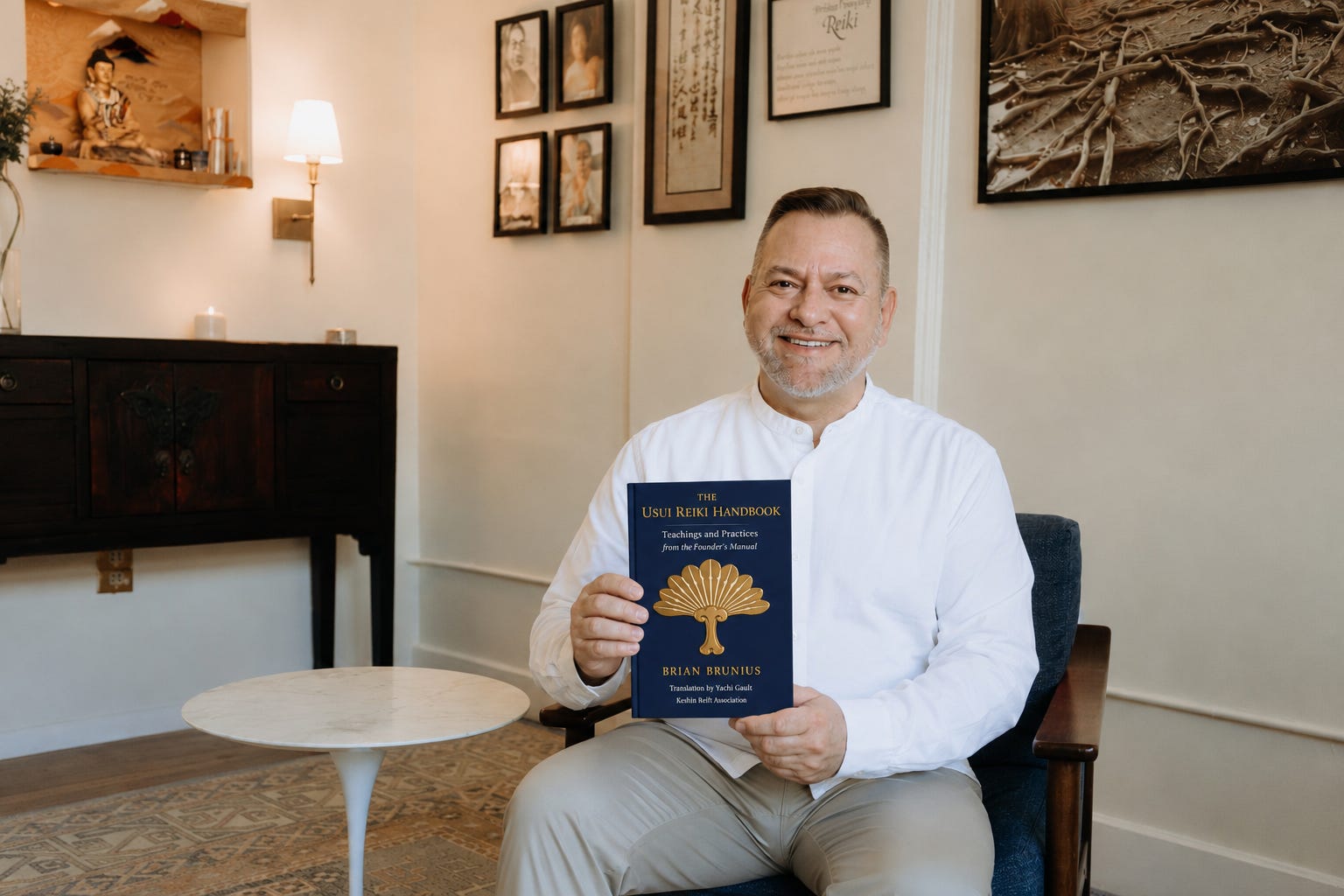
Ever since working with Yachi Gault to translate the Usui Reiki Ryoho Hikkei (Usui’s handbook for his Reiki students) into English, I’ve had the strange experience of repeatedly stumbling across passages that challenge assumptions many of us inherited about Reiki practice.
That has been one of the real gifts of finally having direct access to Usui’s student manual in English. So much of what we “know” about Reiki has been filtered through decades of retelling, simplification, interpretation, and reconstruction that it can be genuinely surprising to sit quietly with Usui’s own words and realize how differently he sometimes frames things.
One passage in particular has stayed with me.
Usui writes:
“The practitioner emits ki and light from the body. This ki and light are especially strong from the eyes, the mouth, and the hands.”
Then, a few lines later:
“If the practitioner gazes at the affected area for two or three minutes, or if they gently breathe on it, or if they stroke or place their hands there…”
What struck me immediately was how matter-of-fact this is.
There is no dramatic introduction to Gyoshi-ho, the practice of using the eyes in treatment, or Koki-ho, the practice of using the breath as part of treatment. There is no sense that Usui is revealing secret techniques reserved for advanced practitioners. He simply describes treatment as though using the eyes, the breath, and the hands together were perfectly natural.
And perhaps for him, they were.
Many of us inherited a version of Reiki that became heavily centered on the hands. As Reiki spread internationally, that emphasis makes practical sense. Hands-on treatment is easier to demonstrate, easier to organize pedagogically, and easier to standardize as Reiki moved further and further away from its original cultural context.
But rereading these passages, I found myself thinking that Usui never appears to describe Reiki as something confined to the hands at all.
Rather, Usui seems to describe the practitioner as the instrument.
The eyes matter because attention matters. The breath matters because the condition of the practitioner matters. And of course the hands matter because touch matters. Not as separate powers or isolated techniques, but as different expressions of the practitioner’s condition.
That may sound obvious when stated plainly, but I think it has profound implications for practice.
It also changed the way I think about Koki-ho. In modern Reiki circles, Koki-ho is often presented as an advanced Japanese technique, sometimes surrounded by an almost mystical aura. But in the Hikkei, Usui’s description is remarkably restrained. He simply says to “gently breathe on it.”
Gently.
That word feels important.
Not forcefully breathing. Not theatrically projecting energy. Not trying to create some dramatic energetic effect. Just gently breathing.
The more time I spend with the surviving Japanese material, the more I appreciate how understated Usui’s language often is. There is very little inflation in it. Much of the later mythology surrounding Reiki feels far more elaborate than the tone of the handbook itself.
Honestly, I find that deeply refreshing.
And the more I sit with these passages, the more they seem to point toward something many experienced practitioners already know through years of practice: treatment changes depending on the condition of the practitioner.
Breathing changes treatment. Attention changes treatment. Presence changes treatment.
Anyone who has practiced long enough has experienced this directly. A distracted practitioner does not feel the same as a settled practitioner. A strained practitioner does not feel the same as a relaxed one. Even the quality of touch changes depending on the condition of the person offering treatment.
Seen from that perspective, it suddenly makes perfect sense that Usui would mention the eyes, the breath, and the hands together. They are not separate “methods” in the modern sense. They are expressions of the whole practitioner.
Or perhaps more accurately, expressions of the practitioner’s presence.
I also suspect this reflects something broader within Japanese culture at the time. Breath was not understood merely as mechanical respiration. In meditation traditions, martial disciplines, and spiritual practices, breath was deeply connected to attention, steadiness, and the condition of the mind and heart. Within that context, it would actually be stranger if Reiki practice ignored the breath entirely.
And yet many Reiki practitioners today have never seriously experimented with using the breath as part of treatment at all.
Not because it was hidden, but perhaps because over time we collectively stopped noticing what was sitting there plainly in the text.
Perhaps some practitioners will recognize this immediately from their own experience.
If you’re interested in exploring these passages more deeply, Yachi Gault and I discuss them extensively in The Usui Reiki Handbook, our complete English translation and commentary on the Usui Reiki Ryoho Hikkei, designed to help practitioners engage directly with Usui’s original teachings.
If you'd like to explore these passages more deeply, you're welcome to stay.
No posts
Comments
Nothing yet. Say the first thing.
Sign in to join the conversation.