
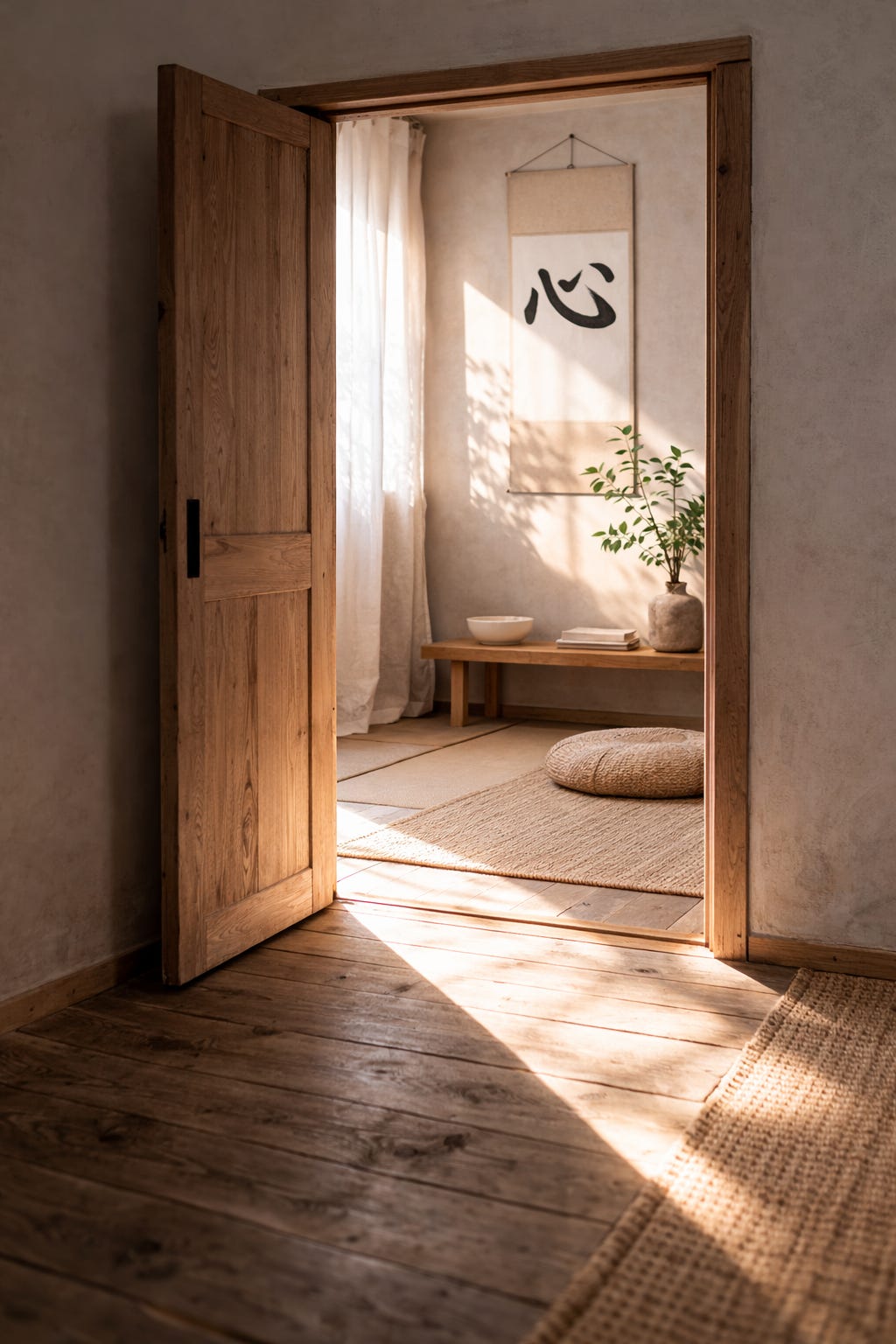
Kokoro is often translated as “heart” or “mind,” but neither translation fully captures what the word means. In Japanese thought, kokoro refers to the integrated center of a person’s inner life. Thought, feeling, intention, sincerity, perception, and character are not separate faculties. They are different expressions of a single underlying reality.
This differs from the way many Westerners have been taught to think about themselves. We often divide reason from emotion, intellect from feeling, and mind from heart. The Japanese understanding is less fragmented. Thinking, feeling, deciding, and perceiving all arise from the same center. They are different movements of kokoro.
This helps explain why Reiki practice was never intended to be merely psychological. For Usui, cultivation revealed itself through behavior. The condition of a person’s kokoro could be seen not only in meditation or spiritual practice, but in the ordinary circumstances of daily life.
It appears in how we respond when someone disagrees with us, how we behave when we are tired, how we speak when no one is impressed, and how we place our hands when nothing dramatic seems to be happening. These moments reveal more than our ideas about ourselves. They reveal the actual condition of our practice.
This is why kokoro cannot be separated from relationship. It does not exist as something sealed inside an individual. It becomes visible in the way we meet others. When correction is received without defensiveness, kokoro is visible. When the hands remain steady without performance or self-conscious management, kokoro is visible. When attention becomes simple, direct, and unforced, kokoro is visible.
At its clearest, kokoro is the alignment of inner condition and outer action. This alignment is sincerity. Not emotional purity. Not moral perfection. Not spiritual performance. Sincerity means that what is inwardly cultivated begins to appear outwardly in conduct.
The Reiki Precepts function as tools for shaping this inner condition. “Just for today” interrupts the mind’s tendency to scatter itself across regret, fear, fantasy, and control. Anger agitates kokoro. Worry unsettles it. Gratitude steadies it. Diligence strengthens it. Kindness harmonizes it. The Precepts are not commandments imposed from outside. They are practices that gradually reorganize the practitioner from within.
Through repetition, the field of kokoro becomes clearer. A practitioner begins to notice the moment anger takes hold, the moment worry begins to dominate, the moment pride enters the treatment room, or the moment attention drifts away from the person under the hands. This noticing is not failure. It is part of cultivation.
Usui described Reiki as a method for improving mind and body and for attaining a better way of life. Cultivating kokoro was at the center of that project. Reiki was not given only so people could feel energy, receive comfort, or have unusual experiences. It was given as a method of cultivation.
Over time, something begins to change. The things that once triggered immediate reactions no longer have the same power. The need to prove oneself softens. Listening becomes easier. Patience comes more naturally. Reactivity loses some of its force. The practitioner does not become perfect, but the space between stimulus and reaction begins to widen.
This is why Reiki practice is not primarily about sensation. Sensation may come and go. Heat, tingling, pulsing, and quietness may all appear, but they are not the measure of the path. The deeper measure is whether practice changes the way we meet life.
Cultivation is not interior decoration. It is structural reorganization. If we remain in practice long enough, we begin to notice the shift. Not primarily as an idea, and not only as a spiritual experience, but as conduct. We behave differently than we once did. We meet others with more steadiness, more honesty, and more care.
If you'd like to continue exploring these ideas, you're welcome to stay.
Comments
Nothing yet. Say the first thing.
Sign in to join the conversation.