
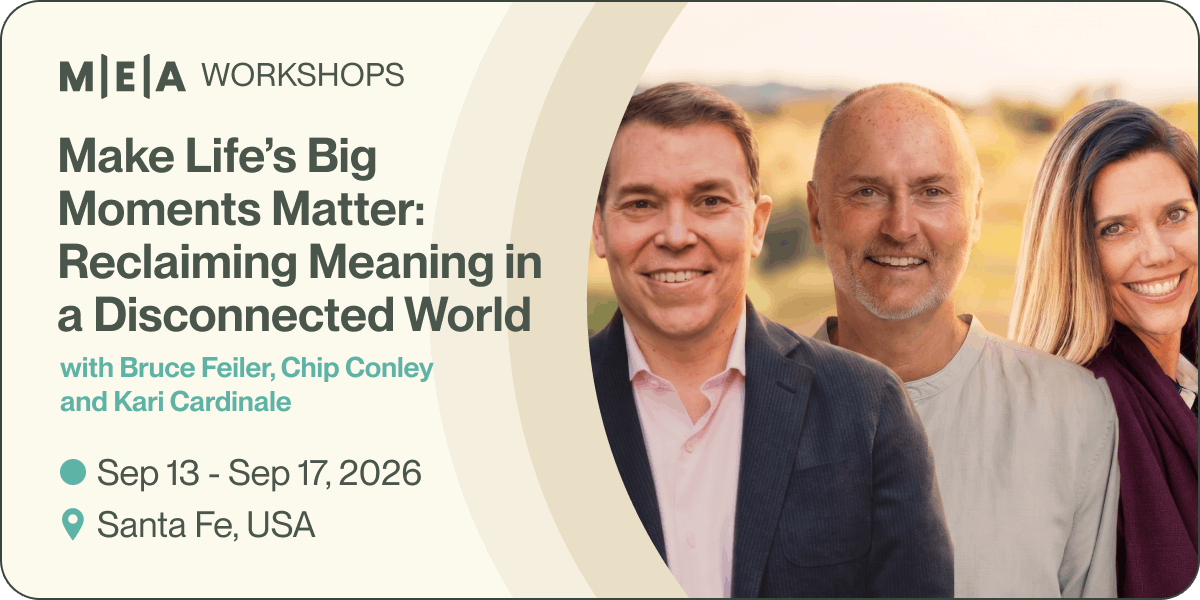
Are you in a life transition? Here’s a unique, meaningful, and fun way to get through it—with science-based solutions and a supportive cohort of friends. Join me; along with America’s beloved guru of midlife, Chip Conley; and the great folks at his Modern Elder Academy for a once-in-a-lifetime retreat in Santa Fe this fall. From September 13-17, I’m leading my first-ever, in-person course, “Making Life’s Big Moments Matter.” Spots are strictly limited and you can save 10% if you order by July 15. I hope to see you there!
Vacation season is upon us—and what better time to create a new family ritual. These rituals don’t need to cost of a lot of money or take a lot of planning: a campfire, a watermelon seed-spitting contest, a potato-chip taste-off; puzzle night, egg toss, cornhole; a sunset walk-and-talk, ice-cream making, s’mores. [Share your favorite summer rituals in the comments below.][
But the ritual would benefit from some creative thought.
A big pleasure of my life over the last few years has been interviewing scores of top ritual designers around the world. These folks are the ones people hire to do the creative thinking for them. I have benefited deeply from their wisdom, which fills the pages of A Time to Gather.
Today, I’d like to highlight three of these ritual designers and a lesson each can teach us about making meaningful rituals with our own families. At the end, I’ll share information about how to hear me in conversation with these wise leaders.
Sarah Kerr took a roundabout path to becoming a ritual designer. Sarah was born into a close-knit family in British Columbia. “I’m deeply wired for the collective. When my mom slammed her finger in the washing machine, my finger swelled up.” She went on to earn a master’s degree in environmental studies and a PhD in ritual healing, then opened the influential Centre for Sacred Deathcare in Calgary.
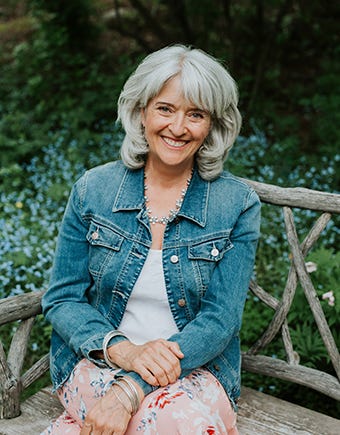
What Sarah learned from working with families in the painful hours around death is that rituals are designed to reinforce the family at precisely these moments of vulnerability.
Sarah shared a story of a family she worked with whose father died at three in the morning. “When I arrived, the room was a swirling gray, backwash-y eddy of murky energy. One grown daughter was standing, the other was lying on his body, crying. The wife was wandering around the room in shock.”
Sarah went to work. She opened a window, cleared out the medicines, then led the family through a ritual of cleansing and renewal.
“The archetype of what happens when we die is that there’s a village of the living and a village of the dead—and a river that connects the two. Our job in the village of the living is to build a canoe to convey the soul to the village of the dead. That canoe is built by love and fueled by grief.”
Sarah invited the family to take warm water and essential oil and tenderly wash the body, then suggested that the wife remove her husband’s wedding ring. “Think back to when you put this ring on his finger. Think back on the love you felt, the commitment you made. Now remove that ring with the same love and commitment. As you did the first time, you can seal those feelings with a kiss.”
When the mother finished, one of her daughters offered her a chain, which she used to suspend the ring around her neck.
Finally, Sarah pulled out a drum and began to beat. She handed each person a perfume bottle and asked them to anoint the forehead of the deceased.
“Then, with their hands on his head and their hearts in their throats, they gently push him across the river. His body remains, but his soul is departed.”
What happened next may be the most magical moment of all, she said.
“Everyone looks around and realizes, We are the family now. They take the same oil they used on the father and anoint one another. The circle has been remade. The village has been reborn.”
Casper ter Kuile is well on his way to becoming a beloved figure in the ritual world. No matter where I went in the last three years while working on A Time to Gather, people would say to me, “Do you know Casper?!” Then they would add, “But he’s way too busy to talk to you...”
Not only did he make time for me; he gave me the gift of friendship.
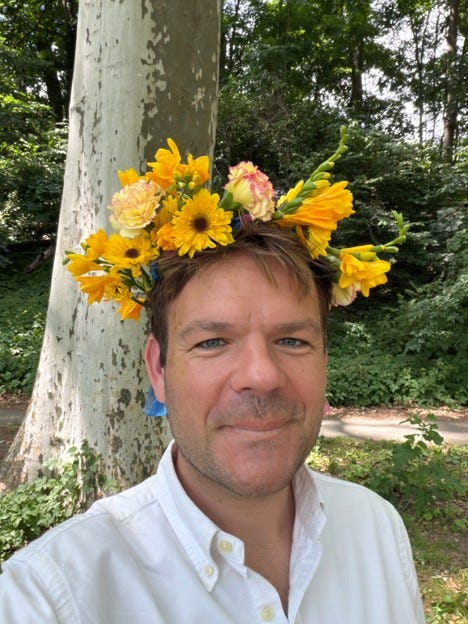
An England native of Dutch descent, Casper moved to the U.S. to attend Harvard Divinity School. He now lives in New York City, where he cofounded a wildly successful effort to create a new summer solstice ritual in Brooklyn’s Prospect Park.
Here’s how Casper described the idea in his wonderful Substack:
How do we remember that we belong to one other?
Mostly, we use words. We send a card or raise a toast. We tell stories. We pick up the phone. We have a hard conversation. We say I love you.
And those wordy ways are all beautiful and good!
But when the unit of belonging is bigger than a partnership, or a family, or a team—conversation becomes too complex a means for communion. When the “we” is as big as a community, a country, or even a cosmos...
We need ritual.
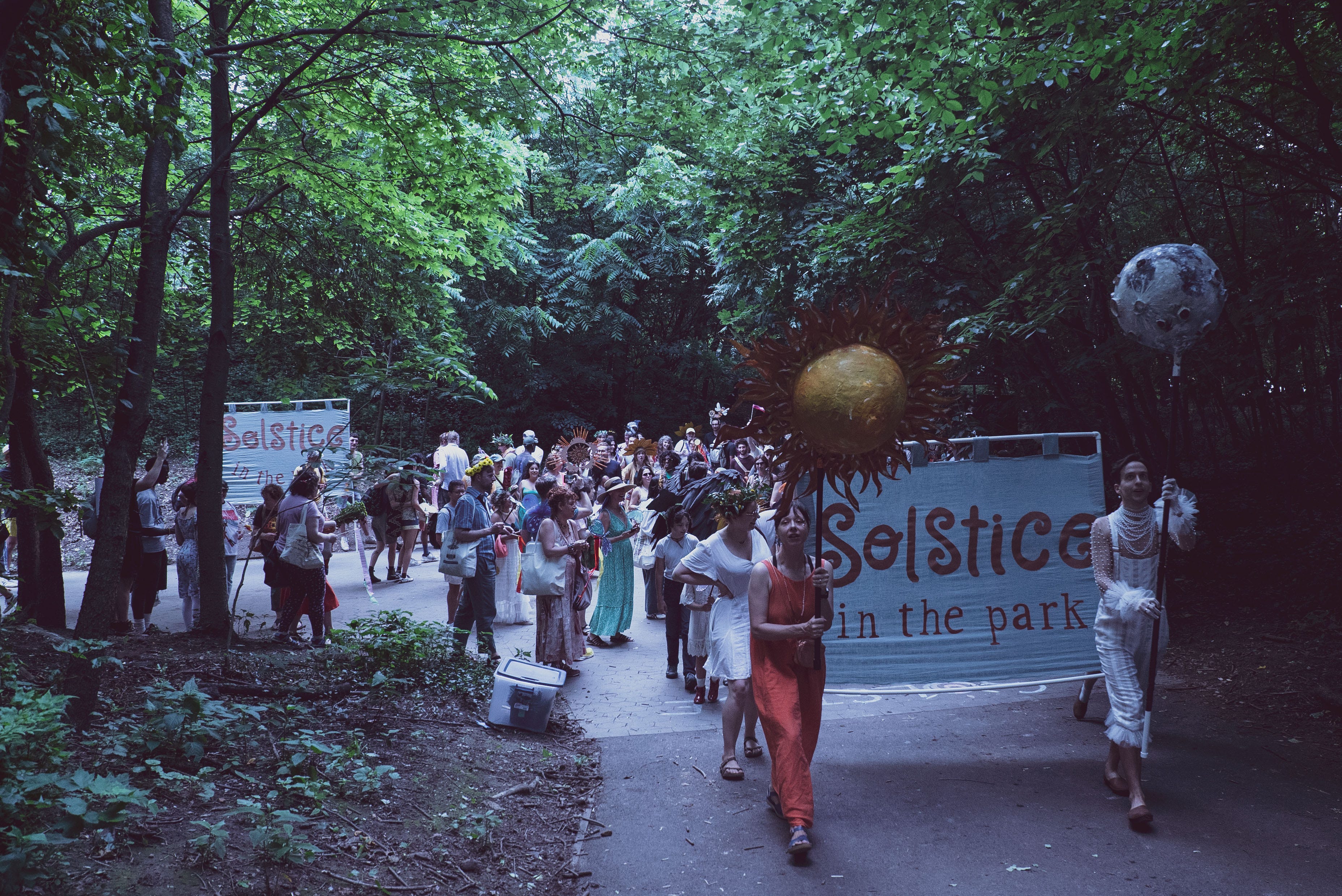
That’s why I co-created Solstice in the Park; a free, volunteer-run, community ritual to celebrate midsummer with song, dance, pageantry, and joyful folk culture. I hoped to cultivate an experience in which we were reminded of our mutual belonging—with one other and the whole web of life—and our natural capacity to transform.
On the longest day of the year, curious revelers gather at the of the park, dressed in extravagant headpieces containing feathers, flowers, and fruits. Parades are paraded, dances are danced, songs are sung.
Each of us, a single ray of sun,
That’s beaming down as one,
To warm the ground we’re walking.
Each of us, brings on the longest day,
And helps the light to stay,
When fall and winter come.
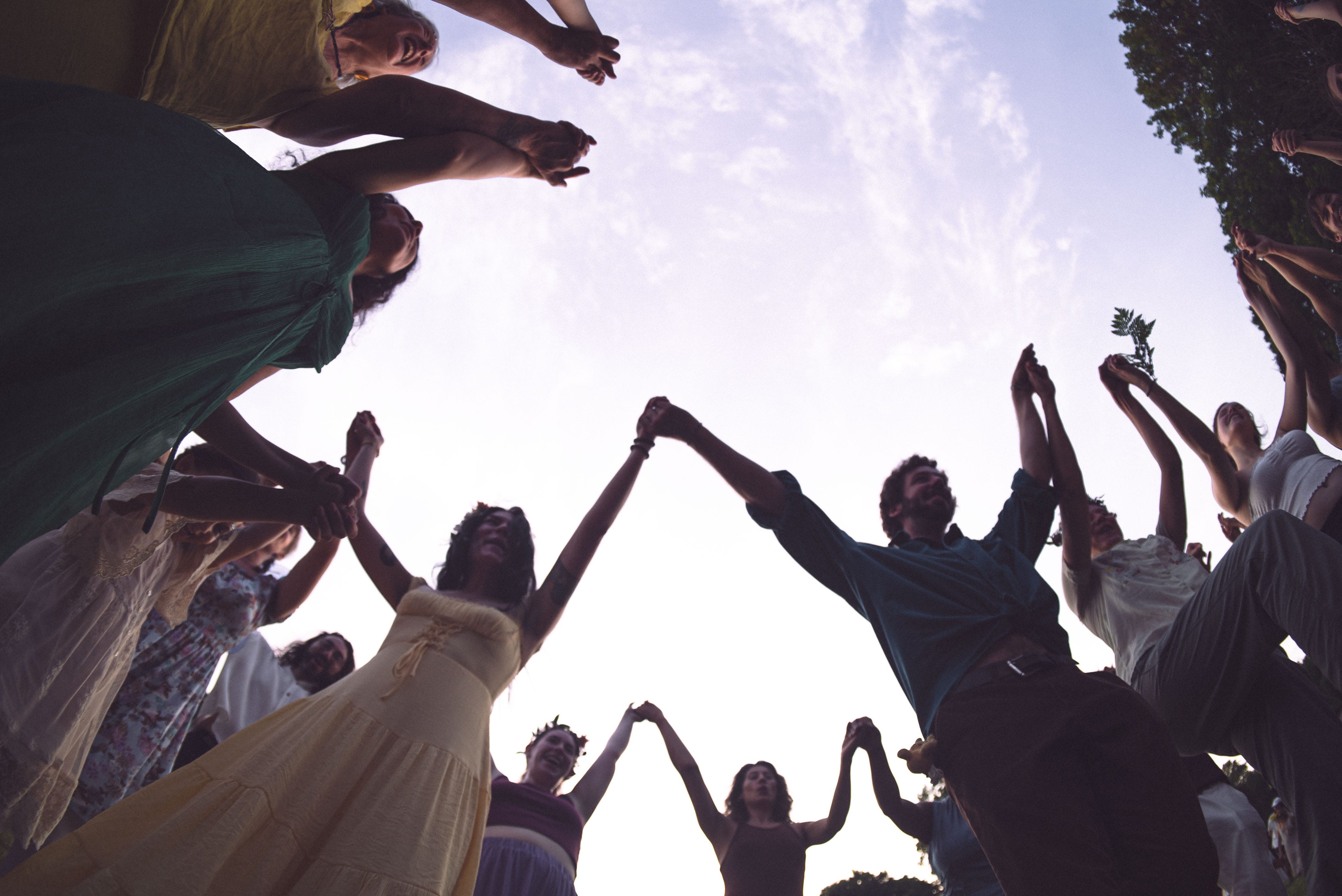
“People care about what they create,” Casper shared. “So the fact that nearly everything we’re wearing and parading with is handmade means that participants can feel the care and love that has gone into this day. And, it feels radically accessible!”
But most of all, he learned that making an effort can turn an ordinary summer day into a memory-filled spectacle of togetherness.
“The painting, puppet-building, logistics planning, myth-writing, people-introducing, planning work that makes a festival like this possible has also woven together a group of some twelve core organizers and tens more into closer relationship. The means of our creating cohered with the ends. The process was the product.”
Megan Sheldon came to ritual the hard way. “In the year that I was born, three of my grandparents died,” the Vancouver native told me, “including my mother’s mother, who was killed by a drunk driver. I was breastfed by a grieving mom, which I’m 100 percent sure shaped who I am.”
As a child, Megan loved rituals. “Every Sunday we would gather as a family and eat pancakes. My dad had very specific rules: You had to use the same mix of berries, the same kinds of toppings, in the same order.”

After college, Megan moved to Scotland to earn a master’s in cultural mythology. “My dad said, ‘What the hell are you going to do with that?’” The answer was work in book publishing, community building, and marketing, before starting a “brand mythology” company in Vancouver. She also got married and quickly pregnant.
“We had a very linear path laid out for ourselves,” Megan said. Seven weeks later she miscarried.
“I was walking around my house in a daze, crying. I found my way to the beach and picked up some stones. I had a Sharpie in my purse, so I wrote down names we had been thinking, dreams we had been sharing, anger I had been holding. Then I threw the stones into the ocean. I’m pretty sure people were thinking, What the hell is she doing? but each plunk released more emotions.”
Then Megan had another miscarriage.
And a third.
“By this point I was being even more intentional. With my third pregnancy loss, I went into the forest and found this beautiful grove. I brought paper, pens, matches, and a bowl of water. I wrote down all the things that had been weighing on me—timelines, due dates, expectations. I burned them and dropped the ash into water.”
Then she did what many millennial women would have done: She went home and told her story online. That’s when she found her people, her purpose, and the answer to her father’s question of what the hell she would do with her life.

Megan started designing rituals for friends then, with her husband, opened a ritual design app, Be Ceremonial, that allows users to pick and choose elements to create their own bespoke rite of passage. The most popular were rituals were blessings before birth, death anniversaries, celebrations of life, and rituals that mark a failed pregnancy, stillbirth, or death of a child.
“We have a ceremony-shaped hole in our lives,” Megan said. “What I discovered by giving people an open platform where they can create their own ceremonies is that they create ceremonies no one ever realized they wanted. All these new rituals are just ways to shift narratives. They’re intentional, symbolic actions that make us feel like we have some control over our own lives.”
And that’s surely the lesson for all us. You don’t need to wait for major life events to create lasting family memories. You can start where you are. So whatever transition you or your family is facing—whether happy or sad, joyful or rueful, welcoming a new chapter or saying goodbye to an old one—this summer you can create a gathering that turns that time of change into a moment of reconnection.
Then next year you can do it again.
To learn more from and be inspired by these great thinkers and doers, please check out my conversations with each of them, You can read my Substack Q+A with Casper here.
This Sunday, July 12, you can join a special live conversation with Megan and me as she launches her new book, Ritual Without Religion. Click here to register with a special 50% discount for readers of The Nonlinear Life by using the promo code RITUALSERIESGIFT.
Finally, I’ll be taping a conversation with Sarah early next week that she’ll post on her wonderful YouTube page.
In the meantime, please share your family summer rituals in the comments below!
🌞
Thank you for reading The Nonlinear Life. This is a reader-supported newsletter. You can support my work by ordering a copy of A Time to Gather or any of my other books. Click on the photo below to learn more.
Meanwhile, help us grow our community by subscribing, sharing, and commenting below. And you might enjoy reading these posts:
My CBS Mornings Interview about A TIME TO GATHER!
Pope Leo Calls for Human Gatherings to Counter AI
How Rituals Can Save Your Family — and the First Review of A TIME TO GATHER!
The Stories That Bind Us: My Most Popular Piece Ever
A Sudden Loss, A Missed Goodbye, A Lesson on How to Gather in Crisis
Or, you can contact me directly.
Comments
Nothing yet. Say the first thing.
Sign in to join the conversation.