
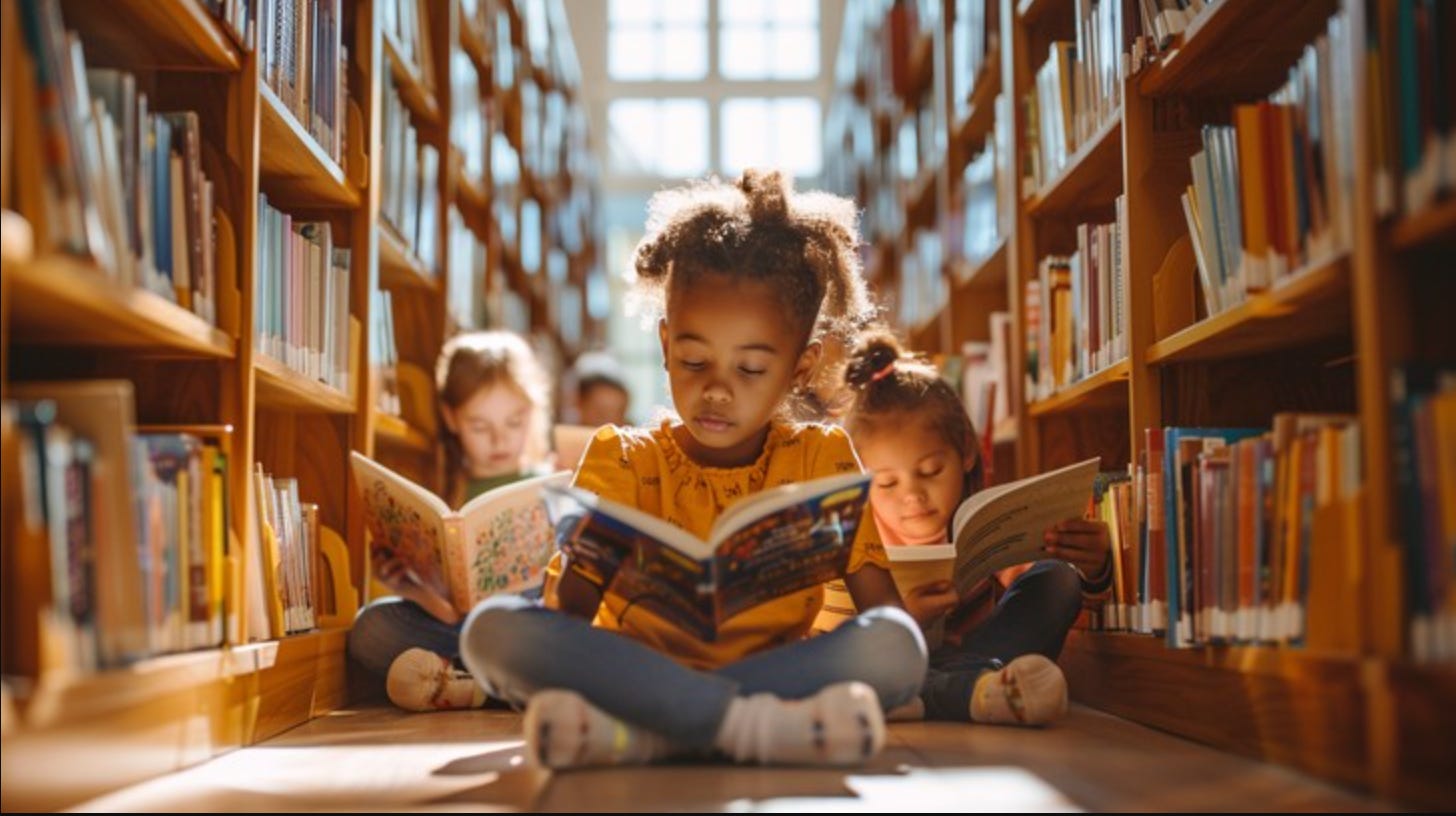
I was a bibliophile from an early age, long before I knew the meaning of the word. Books were never merely objects in my childhood home or assignments to be completed for school. They represented discovery, imagination, knowledge, and the possibility of entering worlds far beyond the boundaries of my own experience.
My father was a trustee of our local public library when I was young, and his service helped me understand that a library is much more than a building filled with books. It is a vital public institution: a place where knowledge is preserved, curiosity is welcomed, and people of every age and circumstance are invited to explore freely. Through my father, I learned to respect not only books themselves but also the civic importance of making them available to everyone.
My father and my grandmother taught me from a very early age to value reading, our local public library, and the librarians who made its collections accessible. Librarians were knowledgeable guides who could connect a curious reader with an unexpected author, subject, or realm of experience. These influential figures instilled in me more than a dutiful respect for literature. They gave me a genuine enthusiasm for exploring it.
Having access to a rich and varied supply of books from childhood onward has profoundly influenced the course of my life. Reading allowed me to encounter people, places, historical periods, and ideas that I could scarcely have imagined as a youth. It gave me the freedom to travel through time, cross cultural boundaries, examine unfamiliar beliefs, and consider lives very different from my own. Every book offered the possibility that the world was larger, more complex, and more fascinating than I had previously understood.
Over the years, that early access to literature has contributed to the development of my critical-thinking skills and to a lasting thirst for exploration. Books taught me to compare perspectives, question assumptions, follow evidence, and remain open to changing my mind. They also taught me that no single author, genre, historical period, or school of thought can provide a complete understanding of human experience.
My own history as a reader has therefore convinced me that the value of reading depends not only on how much we read but also on the range of voices and forms we encounter. A truly rewarding reading life includes classic literary works as well as contemporary ones, fiction as well as nonfiction, and voices from both familiar and unfamiliar worlds. Each contributes something essential. Together, they cultivate the imagination, knowledge, empathy, and intellectual independence necessary for a thoughtful life.
Reading is more than a way to gather information or pass the time. It is one of the primary means by which human beings encounter lives they have not lived, ideas they have not considered, and historical worlds they could not otherwise enter. A rich reading life can enlarge the imagination, sharpen judgment, deepen empathy, and strengthen our ability to participate thoughtfully in society. These benefits, however, depend partly on the breadth of what we read.
A genuinely diverse reading experience includes classic and contemporary literature, fiction and nonfiction, familiar voices and unfamiliar ones. Each kind of writing offers something distinct. Classics connect us to the intellectual and artistic inheritance of earlier generations. Contemporary works help us understand the conditions, conflicts, and possibilities of our own time. Fiction allows us to inhabit other perspectives through imagination, while nonfiction gives us factual knowledge, analysis, testimony, and argument. When these forms are read together, they illuminate and challenge one another.
Reading broadly is therefore not a matter of collecting cultural trophies or completing a prestigious list of books. It is a way of developing a mind capable of recognizing complexity. A reader who encounters only one period, genre, culture, or point of view may become well informed within a narrow field while remaining unaware of the assumptions that shape it. Diverse reading helps expose those assumptions. It teaches us to compare, question, interpret, and revise our understanding. In an age of rapid technological change, political division, and overwhelming quantities of information, these abilities are not luxuries. They are essential.
Classic works deserve a place in our reading because they provide access to the long conversation of human civilization. The term “classic” does not necessarily mean flawless, universally admirable, or permanently beyond criticism. A classic is better understood as a work that has continued to generate meaning across generations. Such works endure because their questions remain alive: What is justice? What do people owe one another? How does power corrupt? What makes a life meaningful? How should individuals respond to suffering, temptation, love, mortality, or social pressure?
Reading older works brings us into contact with societies whose customs and assumptions differ significantly from our own. Their unfamiliarity is part of their value. When readers enter the worlds of Homer, Sophocles, Shakespeare, Austen, Dickens, Tolstoy, Douglass, Dickinson, or Woolf, they encounter forms of language, social organization, moral reasoning, and artistic expression that may initially feel remote. The effort required to understand these works strengthens intellectual patience. It teaches readers not to expect every text to speak in the vocabulary of the present.
Classics also help us recognize the origins of ideas, images, and narrative patterns that continue to shape contemporary culture. Modern novels, films, political speeches, and everyday expressions frequently echo older stories. A reader acquainted with those sources can perceive layers of meaning that might otherwise remain invisible. Reading Frankenstein, for example, enriches present-day debates about scientific responsibility and artificial intelligence. Reading The Odyssey complicates our understanding of homecoming, identity, and heroism. Reading the speeches and autobiographical writings of Frederick Douglass reveals the relationship between literacy, freedom, and resistance.
Yet classic literature should not be treated as sacred simply because it is old. Its importance includes its capacity to be questioned. Some canonical works contain prejudices, exclusions, or assumptions that modern readers rightly find troubling. Engaging critically with such works is more valuable than either accepting them unconditionally or refusing to read them altogether. We can admire a work’s artistic achievements while examining its limitations. This combination of appreciation and criticism prepares readers to deal maturely with cultural inheritance: neither worshipping the past nor imagining that wisdom began in the present.
If classics connect us with historical experience, contemporary writing helps us interpret the world now taking shape around us. Present-day authors address realities that earlier writers could not fully anticipate: digital surveillance, climate change, global migration, new forms of work, rapidly changing identities, and the social consequences of artificial intelligence. Contemporary literature gives language to emerging experiences and makes visible aspects of modern life that may not yet appear in history books.
It also introduces readers to a wider range of voices. The traditional literary canon was shaped by institutions that often excluded or marginalized women, working-class writers, colonized peoples, racial and ethnic minorities, Indigenous communities, disabled people, and sexual minorities. Contemporary publishing has not eliminated these inequalities, but it has allowed more writers to describe their worlds in their own voices. Reading such works expands not only the number of perspectives available to us but also our understanding of what literature can be.
Contemporary books can correct, supplement, or challenge the stories inherited from the past. A historical event described from the perspective of a ruler may look very different when reconsidered through the experiences of laborers, displaced communities, or people living under colonial rule. New works often return to old events and ask whose memories were preserved, whose suffering was minimized, and whose achievements were forgotten.
Nevertheless, contemporary relevance should not become the only measure of a book’s worth. The newest work is not automatically the most insightful, just as the oldest is not automatically the wisest. Books written for the present moment may respond vividly to urgent concerns but lack the depth that becomes visible only with time. Reading contemporary writing alongside classics creates a productive balance. The old can reveal recurring patterns within apparently new problems, while the new can expose the blind spots of inherited traditions.
Fiction is sometimes described dismissively as invented or untrue. This confuses factual accuracy with every other form of truth. A novel may tell a story about people who never existed, yet reveal recognizable truths about grief, ambition, fear, friendship, injustice, and self-deception. Fiction does not merely report what happened. It asks what an experience feels like from within.
Through fiction, readers practice entering perspectives other than their own. A novel can place us inside the consciousness of a person whose background, beliefs, or circumstances differ profoundly from ours. This experience does not guarantee empathy or moral improvement, but it creates the conditions for both. For a time, readers must suspend their immediate judgments and attend to another person’s motives, memories, and fears.
Fiction also develops tolerance for ambiguity. In ordinary public debate, people are often pressured to divide the world into heroes and villains, success and failure, innocence and guilt. Serious fiction resists these simplifications. Its characters may act generously in one moment and selfishly in another. Their motives may be mixed, and their choices may have consequences they never intended. By engaging with such characters, readers learn to recognize contradiction without surrendering the possibility of moral judgment.
The imaginative demands of fiction also strengthen creativity. Readers must construct settings, voices, faces, and emotional atmospheres from words. Unlike more passive forms of entertainment, reading requires active collaboration between author and audience. This mental participation encourages flexible thinking—the ability to consider alternatives, imagine consequences, and understand that reality may appear different from another point of view.
Genre fiction contributes to this education as much as literary realism can. Science fiction tests the ethical consequences of new technologies and social arrangements. Historical fiction makes the past emotionally immediate. Mystery fiction trains attention on evidence, motive, and misdirection. Fantasy explores power, sacrifice, identity, and moral courage through symbolic worlds. No single form holds a monopoly on seriousness.
If fiction educates the imagination, nonfiction disciplines it through engagement with evidence. History, biography, science, philosophy, journalism, essays, and memoir all provide different methods for examining reality. A diverse reading life needs these methods because imagination without factual grounding can become fantasy in the least constructive sense: a comforting story protected from correction.
Nonfiction supplies knowledge that responsible citizenship requires. To evaluate public claims, readers need some understanding of history, economics, government, science, technology, and social institutions. Without this background, it becomes difficult to distinguish a strong argument from confident misinformation. Good nonfiction does more than deliver facts. It demonstrates how facts are selected, connected, interpreted, and contested.
Reading nonfiction critically is especially important because the label itself can create a false sense of certainty. Nonfiction is not neutral simply because it concerns actual events. Every historian chooses which evidence to emphasize. Every biographer interprets motives. Every memoir is shaped by memory. Every journalist works within limits of time, access, and perspective. Readers must therefore ask who is speaking, what sources support the account, what may have been omitted, and whether alternative explanations exist.
Different nonfiction genres also correct one another. Statistical analysis can reveal patterns across large populations, while memoir can show how those patterns are experienced by individuals. History can explain how institutions developed, while investigative journalism can document how they currently operate. Scientific writing can describe material processes, while philosophy can examine their ethical implications. Reading across these forms helps prevent any one method from being mistaken for a complete picture of reality.
The distinction between fiction and nonfiction is useful, but the two forms are most powerful when read in conversation. A historical study of war may explain strategy, political causes, casualties, and economic consequences. A novel about war may convey waiting, fear, confusion, grief, and moral injury. Neither account replaces the other. Together, they produce a more complete understanding.
The same is true of subjects such as migration, illness, poverty, race, family life, and environmental change. Nonfiction provides context and evidence; fiction provides emotional and imaginative access. Nonfiction tells us what conditions exist and how they developed. Fiction invites us to consider how people make meaning within those conditions.
Pairing genres can also expose the weaknesses of each. A fictional narrative may move us deeply while oversimplifying a historical reality. Nonfiction can correct that distortion. A factual account may be accurate but emotionally abstract, reducing human beings to trends and categories. Fiction can restore a sense of individual experience. The responsible reader moves between evidence and imagination, allowing each to test and enrich the other.
Diversity in reading also means crossing cultural, national, religious, racial, economic, and linguistic boundaries. Every person begins within a limited horizon. We inherit assumptions from family, education, community, media, and national history. These influences are not inherently harmful, but they become dangerous when mistaken for the whole of human experience.
Books allow readers to travel beyond that horizon. Literature in translation introduces different storytelling traditions and concepts that may have no exact equivalent in the reader’s first language. Works from other societies reveal that familiar institutions can be organized differently and that values assumed to be universal may be historically or culturally specific. Such reading can unsettle stereotypes by replacing vague categories with complex human voices.
Diverse reading should not, however, become a superficial exercise in sampling difference. One book cannot represent an entire nation, religion, or community. No author speaks for everyone who shares an identity. A single story may unintentionally reinforce stereotypes if readers treat it as definitive. Genuine breadth requires reading multiple writers from within the same tradition, including writers who disagree with one another.
Readers should also seek diversity of ideas, not merely of demographic backgrounds. This does not mean giving equal attention to every claim regardless of evidence or ethics. It means resisting the habit of reading only authors who confirm what we already believe. Intellectual growth often begins in discomfort. A challenging book can reveal weaknesses in our reasoning, force us to define our values more precisely, or show us that an opposing view is more complicated than its weakest version.
Modern reading environments make narrowness easy. Online stores recommend books similar to those we have already purchased. Social media platforms surround us with people who share our preferences. Political communities circulate the same authors and interpretations. These systems are convenient, but they can gradually transform personal taste into an intellectual boundary.
A reading echo chamber offers the pleasure of repeated confirmation. Its books tell us that our group understands the world correctly and that opponents are either foolish or malicious. Such reading may create confidence, but it rarely produces wisdom. Wisdom requires exposure to complexity, including evidence and experience that do not fit comfortably within our existing framework.
The solution is not to abandon personal interests. Deep specialization has genuine value, and pleasure is one of the best reasons to read. The goal is to combine depth with deliberate expansion. A reader who loves history might occasionally choose poetry. A reader devoted to contemporary novels might explore ancient drama. Someone who reads political commentary could add scientific writing, biography, or a serious work from a competing tradition. Small acts of curiosity can prevent preference from becoming confinement.
One of the greatest benefits of a varied reading life is the opportunity to compare. A book read alone can seem complete and authoritative. A book read beside another becomes part of an argument. Different accounts of the same event may disagree about causes, consequences, and responsibility. A modern adaptation of a classic may shift attention to a neglected character. A memoir may complicate the categories used in an academic study.
Comparison teaches readers to notice framing. Why does one author begin the story at a particular moment while another begins decades earlier? Why does one describe an event as progress and another as loss? What assumptions does each writer make about human nature, freedom, justice, or success? These questions turn reading from passive reception into active interpretation.
This habit carries into life beyond books. Citizens who can compare sources are less vulnerable to manipulation. Workers who can understand different perspectives collaborate more effectively. Leaders who read history and literature may better recognize unintended consequences. Individuals who engage with competing moral visions are more prepared to make thoughtful decisions when no option is perfect.
A diverse reading life cannot be completed. There is no final list that makes a person permanently well-read. Human knowledge continues to grow, new writers emerge, and old works acquire new meanings as circumstances change. Even rereading can be a form of diversity, because readers return as different people. A novel encountered at eighteen may seem transformed when read again at forty or seventy.
This lifelong practice should be ambitious but not joyless. Reading plans can be useful, yet guilt is a poor foundation for intellectual growth. People are more likely to sustain broad reading when curiosity leads the way. A compelling contemporary novel may open a path toward the classic that inspired it. A biography may generate interest in the subject’s historical era. A work of science writing may lead to philosophy, environmental literature, or speculative fiction.
Reading communities can strengthen this practice. Book clubs, libraries, classrooms, family conversations, and informal exchanges expose us to choices we might never make independently. Librarians and teachers are particularly valuable guides because they can connect readers with books that are accessible without being simplistic and challenging without being discouraging.
The goal is not to read everything. That is impossible. The goal is to remain aware that one’s reading is partial and to stay willing to expand it.
A diverse reading experience is essential because no single period, genre, culture, or perspective can contain the full range of human knowledge and possibility. Classics preserve enduring questions and connect us with the past. Contemporary works interpret the present and bring new experiences into public conversation. Fiction develops imagination, empathy, and comfort with ambiguity. Nonfiction provides evidence, explanation, and the tools of informed judgment. Read together, these forms create a deeper and more balanced understanding than any one of them can provide alone.
Broad reading does not require agreement with every author. On the contrary, its value often lies in productive disagreement. Books can challenge our loyalties, unsettle our assumptions, and reveal the limits of our experience. They can also remind us that people separated by centuries or continents have struggled with recognizable hopes and fears. Through that combination of difference and recognition, reading enlarges both intellect and humanity.
The call to action is simple: choose your next book deliberately. If you usually read contemporary fiction, select a classic or a work of history. If nonfiction dominates your shelves, add a novel, a collection of stories, or a book of poetry. Read an author from a culture unfamiliar to you. Pair an older work with a modern response. Discuss both with someone whose perspective differs from your own.
One book will not transform our understanding of the world, but a sustained habit of varied reading can. We should therefore treat our reading choices as opportunities—not merely to reinforce who we already are, but to encounter who others have been, to examine who we are becoming, and to imagine who we might yet become.
Thanks for reading Thinking Deeply. Subscribe for free to receive new posts via email and access the Thinking Deeply archive. If you find our discussions meaningful, please recommend Thinking Deeply to others. Remember, all subscriptions are free. Encouragement for civic responsibility should never be behind a paywall.
Comments
Nothing yet. Say the first thing.
Sign in to join the conversation.