
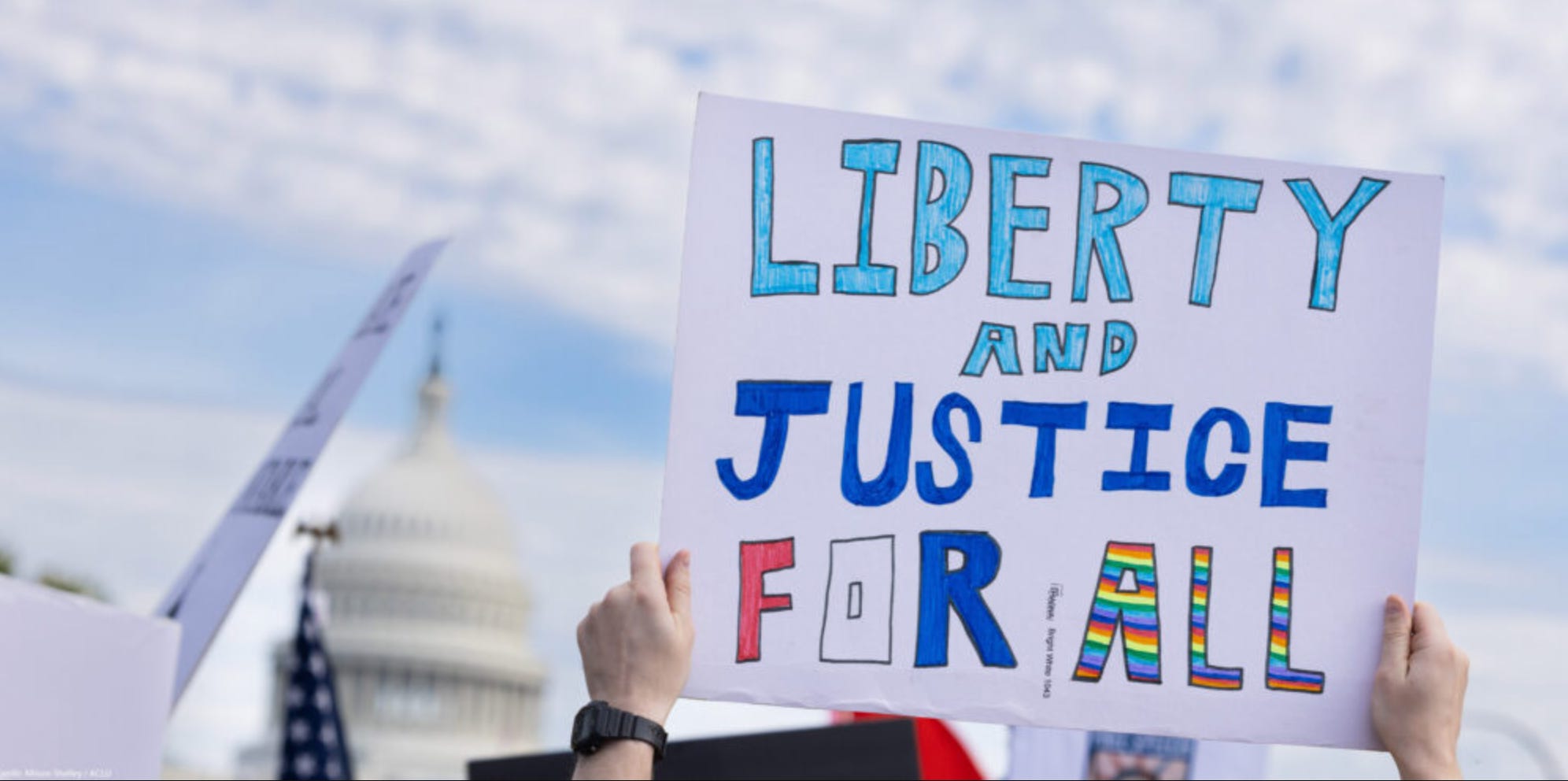
American history is often narrated as a steady march toward freedom: the Declaration of Independence proclaimed human equality; the Civil War destroyed slavery; the Reconstruction Amendments established national citizenship and voting rights; the Nineteenth Amendment enfranchised women; and the civil-rights legislation of the 1960s attacked segregation and racial disenfranchisement. According to this familiar account, each generation widened the circle of American democracy.
There is truth in that story, but it is not the whole truth. American progress has never been automatic or irreversible. Every expansion of rights has encountered an organized countermovement seeking to preserve an older hierarchy. Reconstruction was followed by Jim Crow. Women won a constitutional guarantee against sex-based voting discrimination, yet many women of color continued to be excluded. The Civil Rights Act of 1964 and Voting Rights Act of 1965 transformed the country, but later political and judicial decisions weakened important enforcement mechanisms.
The immigration policies of the Trump administration in 2025 and 2026 therefore did not appear outside American history. They emerged from its unresolved conflict between two rival understandings of the nation. One sees the United States as a constitutional democracy whose principles must eventually protect every person equally. The other treats the country as the possession of a preferred cultural, racial, religious, or ancestral group whose dominance must be defended.
Aggressive immigration sweeps, the detention of citizens and lawful residents, and the attempt to narrow birthright citizenship belong to this second tradition. Although the government has legitimate authority to enforce immigration laws, that authority is limited by the Constitution. Enforcement becomes unjust when it relies on fear, racial appearance, indiscriminate detention, the denial of due process, or the idea that the president may rewrite a constitutional definition of citizenship by executive order.
The lesson of American history is not that justice inevitably wins. It is that justice advances only when people organize to defend it.
Before the Civil War, the United States tolerated a profound contradiction. It proclaimed that “all men are created equal” while permitting the enslavement of millions. In Dred Scott v. Sandford in 1857, the Supreme Court went so far as to declare that Black Americans descended from enslaved people could not be citizens of the United States.
The Civil War destroyed the constitutional order that had protected slavery. The Thirteenth Amendment abolished slavery, except as punishment for crime. The Fourteenth Amendment, ratified in 1868, established national citizenship, prohibited states from denying any person due process, and guaranteed every person the equal protection of the laws. The Fifteenth Amendment, ratified in 1870, prohibited the federal government and the states from denying the vote because of “race, color, or previous condition of servitude.”
These amendments were revolutionary, but they did not immediately establish an equal right of all men to vote. The Fifteenth Amendment prohibited particular grounds of discrimination; it did not create universal adult suffrage or prevent every method of exclusion. States could still impose facially neutral rules and administer them discriminatorily. Women remained outside its protection, while many Native Americans and Asian immigrants were denied citizenship or political participation.
During Reconstruction, Black men voted, held public office, served on juries, and helped establish public-school systems across the South. For a brief period, the federal government attempted to protect this multiracial democracy through civil-rights laws and the Enforcement Acts.
The attempt was abandoned. White supremacist organizations used murder, threats, economic retaliation, and election violence to suppress Black political participation. When federal commitment weakened, Southern governments constructed the Jim Crow system through poll taxes, literacy tests, complicated registration rules, white primaries, and violence.
The Constitution had changed, but power on the ground changed back. That experience established a pattern that remains relevant: a right written on paper is vulnerable when the institutions responsible for enforcing it become unwilling to act.
The second great enlargement of voting rights came through the women’s-suffrage movement. After decades of organizing, Congress proposed the Nineteenth Amendment in 1919. It was ratified on August 18, 1920, and declared that the right to vote could not be denied or abridged “on account of sex.”
This achievement transformed American political life, but it too was incomplete. Black women in the South encountered the same poll taxes, literacy tests, intimidation, and violence directed against Black men. Native American women did not all become citizens until Congress enacted the Indian Citizenship Act in 1924, and even then some states continued to obstruct Native voting. Asian exclusion laws and racial restrictions on naturalization also prevented many immigrant women from becoming citizens and voters.
The suffrage struggle nevertheless established a vital democratic principle: political rights cannot legitimately depend on sex. It also demonstrated that constitutional change rarely begins with political leaders voluntarily surrendering power. It begins with people organizing, petitioning, marching, publishing, litigating, and sometimes accepting arrest or violence for demanding inclusion.
By the middle of the twentieth century, the contradiction between the Fifteenth Amendment and Jim Crow had become impossible to defend. Black veterans returned from fighting fascism abroad only to face segregation and disenfranchisement at home. Civil-rights activists organized boycotts, sit-ins, voter-registration drives, freedom rides, marches, and legal challenges. They were assaulted, jailed, bombed, and murdered, but their efforts forced the country to confront the distance between its principles and its practices.
The Civil Rights Act of 1964 prohibited discrimination in public accommodations and employment, authorized federal action against school segregation, strengthened voting protections, and attacked discrimination in federally funded programs. The Congressional Research Service describes it as one of the most significant federal laws of the modern era and notes that it addressed discriminatory voting practices as well as segregation and employment discrimination. Congressional Research Service overview.
The Voting Rights Act of 1965 went further. It prohibited literacy tests and similar devices and gave the federal government effective tools to intervene where state and local governments had systematically suppressed minority voting. Its original preclearance system required certain jurisdictions with histories of discrimination to obtain approval before changing their voting laws. Federal examiners could register voters where local officials refused to do so. Black registration and participation increased dramatically.
The act was necessary because abstract constitutional commands had proved inadequate. States had become skilled at replacing one discriminatory device with another whenever courts struck the first one down. The Voting Rights Act did not merely restate the Fifteenth Amendment; it created the enforcement machinery needed to make the amendment real. A Congressional Research Service history explains how the act responded to the failure of earlier protections.
This history teaches an essential lesson: formal equality is insufficient when officials can evade it through procedure, intimidation, selective enforcement, or administrative delay. A right without an effective remedy can become little more than a ceremonial promise.
It is tempting to regard the Reconstruction Amendments, women’s suffrage, and the civil-rights legislation of the 1960s as stages in a continuous upward progression. In reality, American history moves through conflict, advance, and reaction.
The same country that adopted the Fourteenth Amendment later upheld racial segregation in Plessy v. Ferguson. The nation that celebrated liberty enacted the Chinese Exclusion Act. The federal government confined Japanese Americans during World War II without individualized findings that they had committed crimes. Southern states developed Jim Crow after the Fifteenth Amendment. Modern voting restrictions expanded after the Supreme Court weakened the Voting Rights Act’s preclearance system in Shelby County v. Holder.
The expansion of rights has therefore been a recurring achievement, not an uninterrupted national habit. American institutions contain both democratic and antidemocratic possibilities. The Constitution can be used to protect minorities, but constitutional language can also be ignored, narrowly interpreted, or deprived of enforcement. Elections can remove abusive officials, but fear and resentment can also elect them.
The relevant question is not simply, “How can the country move backward after moving forward?” The answer is that the struggle never ended. People who experience equality as a loss of status frequently organize to reverse it.
Our task is to continually wage the fight to protect and preserve those rights fought for and won each time they are under attack. That period of attack on those rights is once again before us. And once more we must rise to protect and defend those rights.
A democratic government may regulate immigration, enforce removal orders, and deport noncitizens after lawful proceedings. Opposing arbitrary or abusive enforcement does not require denying that authority. It requires insisting that governmental power be exercised through law.
The Fifth Amendment protects “persons,” not only citizens, from deprivation of liberty without due process. The Fourth Amendment restricts unreasonable searches and seizures. Citizens, lawful permanent residents, asylum applicants, visa holders, and undocumented immigrants possess different rights under immigration law, but none exists entirely outside constitutional protection.
This is why the methods used during the Trump administration’s enforcement campaign matter. Masked or insufficiently identified officers, warrantless or questionable stops, rapid transfers between detention facilities, obstacles to obtaining counsel, and arrests based partly on appearance or location create conditions in which lawful residents and citizens can be swept into the system.
The administration has presented its operations as a campaign against dangerous criminals, repeatedly describing those arrested as the “worst of the worst.” That is the government’s stated justification, and removing a noncitizen convicted of a serious crime after lawful proceedings is different from indiscriminate street enforcement. But frightening individual examples do not justify treating every immigrant, or everyone who appears to be an immigrant, as presumptively dangerous.
Investigative reporting found that immigration agents held more than 170 American citizens during raids and protests in 2025. More than 20 reported being held for over a day without being able to contact a lawyer or family member. The total combined number of citizens questioned about their status and citizens arrested after being accused of interfering with agents, and the government disputed the characterization, saying it did not arrest citizens for immigration enforcement. Even with those qualifications, the documented cases expose the danger of a system operating with inadequate identification, transparency, and accountability. ProPublica’s investigation explains its evidence and counting method.
The word “kidnapping” expresses the terror experienced when unidentified or masked agents seize a person, and relatives cannot discover where that person has been taken. In precise legal writing, however, “detention,” “unlawful seizure,” or “arbitrary detention” may be more accurate until a court determines that a particular arrest was illegal. That precision does not minimize the wrong. On the contrary, it connects moral outrage to specific constitutional protections and enforceable remedies.
The attack on birthright citizenship goes to the heart of the constitutional settlement created after slavery.
Section 1 of the Fourteenth Amendment begins: “All persons born or naturalized in the United States, and subject to the jurisdiction thereof, are citizens of the United States and of the State wherein they reside.” Its purpose was to place national citizenship beyond the reach of state governments and to repudiate the exclusionary logic of Dred Scott.
On January 20, 2025, President Trump issued Executive Order 14160. It directed federal agencies not to recognize citizenship for certain children born in the United States when their mothers were either unlawfully present or lawfully present on temporary visas and their fathers were neither citizens nor lawful permanent residents. The order therefore reached not only undocumented families but also some families legally present as students, workers, or visitors. The White House order explicitly states these categories
The administration argued that these children were not “subject to the jurisdiction” of the United States in the constitutional sense. Its critics answered that people living in the United States, regardless of immigration status, are plainly subject to American laws, courts, and governmental authority. With narrow historical exceptions such as children of accredited foreign diplomats or hostile occupying forces, birth within the country has long established citizenship.
There was also a fundamental separation-of-powers problem. A president cannot amend the Constitution through an executive order. If the Citizenship Clause means what generations of courts, officials, and citizens understood it to mean, the executive branch cannot change that meaning by refusing to issue passports or recognize birth certificates.
On June 30, 2026, the Supreme Court rejected the order. It held that children born in the United States to parents who are unlawfully or temporarily present are subject to American jurisdiction and are citizens at birth. The Court’s decision in Trump v. Barbara states that holding directly. The ruling was a major defense of the Fourteenth Amendment, although the administration has continued exploring narrower attempts to restrict citizenship and “birth tourism.”
The episode remains deeply important even though the original order failed. It demonstrated that an administration was willing to test whether a constitutional guarantee could be narrowed by unilateral executive action. It also showed why courts, civil-rights organizations, state governments, lawyers, and affected families are essential to constitutional government. The Constitution did not enforce itself; people invoked it.
Immigration is a real policy issue involving border management, labor markets, asylum, humanitarian duties, local resources, and national security. Those subjects deserve serious debate. But political movements often replace that debate with a simpler emotional message: outsiders are invading, institutions have betrayed “real Americans,” and only extraordinary executive force can restore order.
Fear encourages voters to tolerate powers they would reject under ordinary conditions. Once an entire population is described as criminal or invading, individual evidence appears less important. Due process is portrayed as an obstacle, compassion as weakness, and legal restraint as disloyalty.
Birthright citizenship prevents government from creating a hereditary underclass born and raised in the United States but denied membership because of ancestry or a parent’s legal status. For that reason, it frustrates ethnonationalist ideas of citizenship. It says that American identity is fundamentally civic rather than racial or genealogical.
Attempts to weaken that principle are not merely about immigration procedure. They concern who is entitled to say “we” when speaking of the United States.
Modern presidents command vast enforcement agencies and frequently act through executive orders, emergency declarations, agency guidance, and administrative discretion. When Congress is divided or passive, presidents are tempted to test the limits of unilateral power.
The danger is greatest when executive officials treat the president’s electoral victory as authority to override statutes, courts, constitutional text, or individual rights. An election gives officials the power to govern within the Constitution. It does not suspend the Constitution.
Rights become vulnerable when legislatures avoid oversight, courts delay relief, agencies conceal information, local officials cooperate without safeguards, and the public becomes overwhelmed by the number of controversies. Authoritarian practices do not always arrive through a single dramatic abolition of liberty. They can develop through accumulated exceptions: one emergency power, one group denied normal process, one unlawful detention excused as a mistake, and one constitutional boundary tested after another.
These policies are unjust first because they punish people as members of a category rather than on the basis of individual conduct. A person’s appearance, language, occupation, neighborhood, or ancestry does not establish unlawful presence, much less dangerousness.
They are unjust because errors are not incidental when enforcement methods predictably produce them. A government that builds a system likely to detain citizens and lawful residents cannot dismiss every wrongful seizure as an unfortunate anomaly. It has a duty to design safeguards, identify its agents, document arrests, provide access to counsel, track citizen detentions, and correct mistakes immediately.
They are unjust because due process is not a technical privilege for sympathetic people. It is the procedure by which the government proves that it has lawful authority over a particular person. Without that requirement, innocence offers little protection.
They are unjust because birthright citizenship is one of the clearest safeguards against caste. If citizenship depends on the government’s evaluation of a child’s parents, then citizenship becomes conditional, hereditary, and bureaucratically vulnerable. The Fourteenth Amendment was written to prevent precisely that kind of politically manipulated exclusion.
Finally, they are unjust because they reverse the moral direction of America’s greatest constitutional achievements. Reconstruction, women’s suffrage, and the civil-rights movement each insisted that rights must become less dependent on race, sex, ancestry, or local prejudice. The new restrictionism attempts to make legal recognition depend more heavily on ancestry and official discretion.
The deepest American tradition is not uninterrupted progress. It is the repeated struggle to make universal principles prevail over exclusionary power. The abolitionists, Reconstruction lawmakers, suffragists, civil-rights workers, voting-rights organizers, immigrant advocates, and constitutional lawyers who expanded American freedom did not assume that history would vindicate them. They acted.
Americans must act again.
Citizens should demand transparent immigration enforcement, visible identification of federal officers, accurate records of every detention, prompt access to lawyers and families, independent investigation of wrongful seizures, and meaningful consequences for constitutional violations. Congress must conduct oversight, protect due process, and refuse to fund enforcement systems without safeguards. States and communities should support reputable legal-aid organizations and ensure that residents understand their rights. Journalists must continue documenting what agencies do, not merely repeating what officials claim they do. Voters should judge candidates by whether they respect constitutional limits even when fear makes abuse politically convenient.
The defense of immigrant rights is not a demand for open borders or an end to all enforcement. It is a demand that the United States remain a government of laws rather than a government of unchecked force. Nor is birthright citizenship a loophole. It is a constitutional promise that no political leader may erase by decree.
The Fourteenth and Fifteenth Amendments, the Nineteenth Amendment, the Civil Rights Act, and the Voting Rights Act were not gifts from benevolent authorities. They were victories secured by people who refused to accept that injustice was permanent.
Our responsibility is the same. We must vote, organize, document abuses, support constitutional litigation, contact elected officials, defend neighbors, and insist that governmental power remain answerable to law. The circle of American rights has widened before, but it will remain wide only if each generation stands against those who would narrow it.
Comments
Nothing yet. Say the first thing.
Sign in to join the conversation.