
In this series, I’m guiding you through the details you should be obsessing over. Not worried yet? Keep reading.

In our last installment, I encouraged the wisdom of fretting over your race-day kit. Today, I want to increase your anxiety about water.
Links to all the articles in this series:
Worry About Imaginary Aches and Pains
Worry About Drinking Too Much or Too Little Water
Most runners hold these three statements as sacrosanct:
Drink until your pee is clear.
Stay ahead of your thirst.
You can’t drink too much water.
I want you to consider changing your mind. Our understanding of hydration has evolved. While water is essential, “excess” is a biological gamble.
Exercise-Associated Hyponatremia (EAH) is a condition where sodium levels in the blood drop to dangerously low levels. It isn’t caused by a lack of salt; it’s caused by a surplus of water.
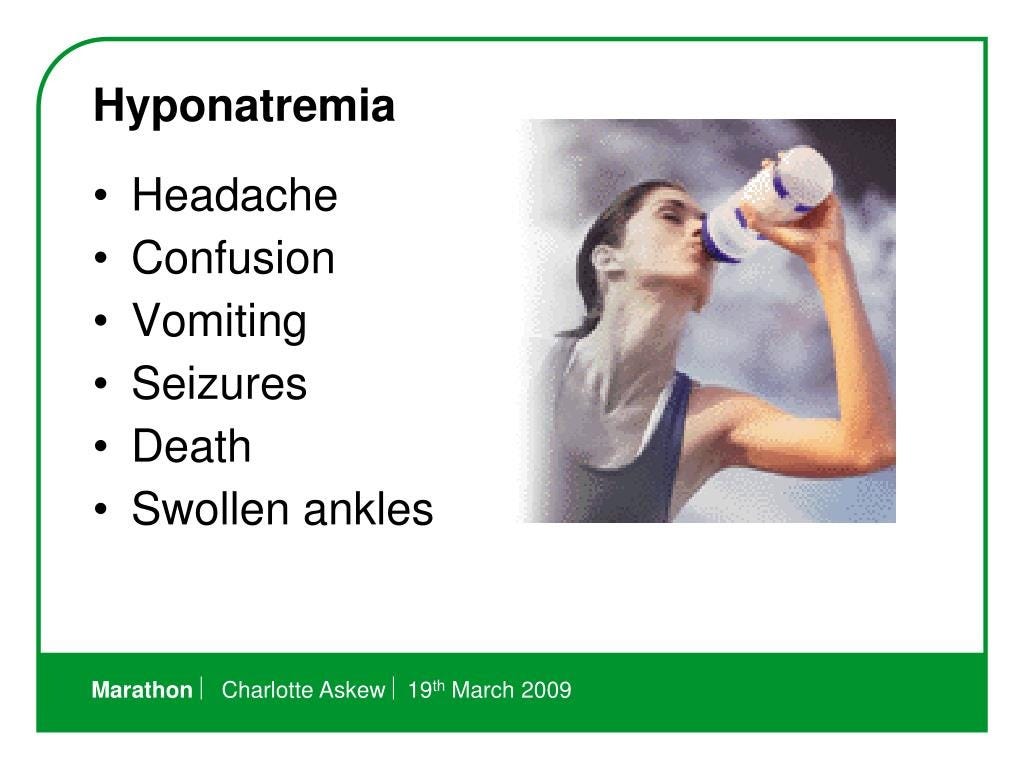
In his book Waterlogged, Dr. Timothy Noakes explains that over-consuming fluid forces water out of the blood and into the cells. In most tissues, this is a nuisance. In the brain, it’s a crisis. Swelling in the cranial vault can lead to symptoms ranging from a dull headache and confusion to seizures—and in extreme cases, death.
The Math of the “Safety” Myth: Many runners assume sports drinks are a shield against this. They aren’t.
Human Blood: 135–145 mEq/L of sodium.
Standard Sports Drink: ~18–20 mEq/L.
Tap Water: < 0.1 mEq/L.
Even with a sports drink, if you “bolt” massive quantities, you are still diluting your blood. Noakes’ advice is simple but profound: Drink only to quench thirst.
One factor that complicates race-day medicine is that the symptoms of hyponatremia mimic its opposite: dehydration. Both present with headaches, nausea, confusion, and wheezing.
In major races like Pittsburgh, medical tents use specialized lab equipment to check sodium levels before acting. Attempting to “fix” a runner with a low-sodium IV when they are actually hyponatremic can be catastrophic.
Statistically, the risk is higher for:
Slower runners: You have more time to hit every single aid station.
Smaller-framed runners: It takes less volume to dilute your total blood supply.
Between 1985 and the mid-2010s, roughly 12–15 deaths were attributed to hyponatremia in marathons. While that percentage is minuscule, it is entirely preventable. Notably, there are virtually no recorded cases of a runner dying from dehydration in a marathon. Your body is designed to handle a 1–3% loss in body weight (about 3–9 lbs for a 175 lb runner); it is not designed to handle a flooded brain.
1. The Three-Day Lead-In Start increasing water intake 72 hours before the start. Drop the alcohol now; your body cannot store water at an optimal rate if it’s playing catch-up from a Friday night beer.
2. The Morning “Pee Test” Check your second urination of the morning. You aren’t looking for clear water—you’re looking for light lemonade.
Clear: You’re over-drinking. Back off or add electrolytes.
Apple Cider/Maple Syrup: You’re dehydrated. Drink up.
Tomato Juice: This isn’t always a kidney crisis, but it’s a “see a doctor immediately” signal.
3. The Night Before Observe the Two-Hour Rule: No significant fluids two hours before bed. This increases the odds of sleeping through the night without a 3:00 AM bathroom trip—though “race-day jitters” may have other plans for your sleep.

4. During the Race This is personal, but here is my practice: I carry two 10-ounce flasks. I take about 5 ounces every 15 minutes. By refilling at the one-hour mark, I avoid the congestion and “cup-throwing” chaos of the aid stations. It keeps the water in my mouth and off my clothes.
5. The Recovery It ain’t over til it’s over. Replace lost fluid weight slowly over 48–72 hours, not all at once. Use a replacement fluid with a 4:1 carbohydrate-to-protein ratio. The carbs don’t just refuel your muscles; they trigger the insulin response needed to help your kidneys reabsorb the sodium you lost.
Salut!
Pre-load: Hydrate well 3 days out.
Trust your thirst: Don’t drink on a schedule; drink when you’re thirsty.
Monitor: Know the signs of EAH (confusion/headache).
Recover: Slow, steady rehydration with protein and carbs.
Reference List
Noakes, T. D. (2012). Waterlogged: The serious problem of overhydration in endurance sports. Human Kinetics.
No posts
Comments
Nothing yet. Say the first thing.
Sign in to join the conversation.