
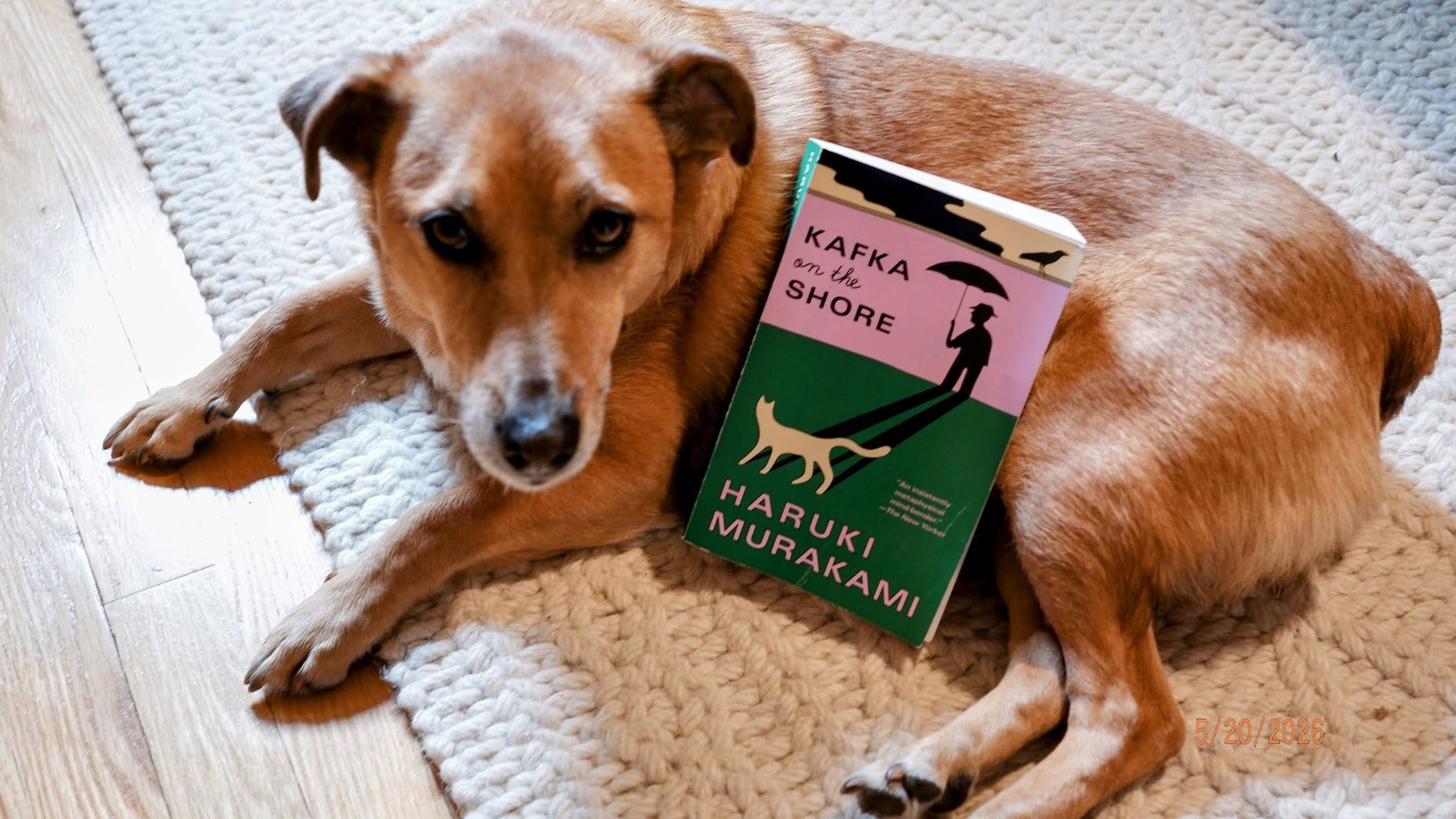
Kafka on the Shore by Haruki Murakami
467 Pages. Fiction. 2006. Vintage Books.
Read between 5/12/26-5/19/26 while in Pittsburgh, PA. Book #9 of 2026
(I don’t know if I would describe my summary as containing spoilers, but I thought I came close enough to begin with this disclaimer)
I finished Murakami’s book What I Talk About When I Talk About Running: A Memoir last week and I liked it so much that I immediately ordered one of his novels. The title seemed familiar so I went with this one and I’m glad that I did.
At first, I wasn’t sure what I was getting into. The storytelling was confusing. There were multiple narratives going on and I was not sure if one was real and one fantasy, both fantasy or both real. One narrative was written in a more or less straightforward third person style while the second took on the characteristic of a military intelligence report.
It reminded me of how in Japanese animation like Spirited Away, there is an unseen spirit world presumed to be operating in parallel to our own. If you only know the secret you can tap into it.
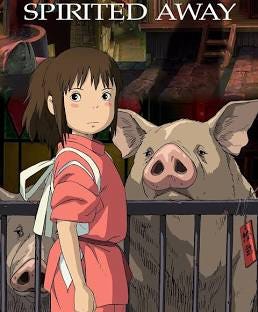
Spirited Away. Directed by Hayao Miyazaki, Studio Ghibli, 2001. Promotional poster.
Craig Mod in his book Things Become Other Things talks about Japanese gods in Shinto. Everything is imbued with divinity. The rocks, clouds, mountains. And if you stand back and look at it the right way you can appreciate that divinity. Christianity too holds that we should not limit ourselves to seeing the world as it is but see the holiness underlying everything. See God’s world and God’s order.
Similar to his book on running, Murakami weaves in several big themes familiar to students of Japanese literature and philosophy. He addresses fate and destiny. He talks about impermanence and change.
Two existential themes struck me as being quintessentially different from American sensibilities. Murakami handles sex and death differently. Death is seen as a transition. It is handled with greater acceptance and inevitability. There is a sense that it’s OK to die because it has to happen to propel the story forward. It seems like a Buddhist sensibility to me. We are not done with our work. We need to move on. So we die and do more in the next version of our life.
And the sex is explicit but never seems vulgar. Still we are talking about descriptions of sex with someone that is underage (even in Japan, where the age of consent is 16). So there’s that.
Throughout the book there are mythological references and cultural references that really refine and add to the book. Everything is useful. Nothing is an ornament. And in the end, Kafka’s journey is an Odyssey. He grows, changes and ultimately returns home.
I gave this book at +2/2 and intend to read more of this author.*
Next book up: Cold Mountain.
*My rating system uses a -2 to +2 system. Most material gets a 0. This is considered average. +1 is for pretty good material and only about 10% of things get that rating. +2 is reserved for truly outstanding material and only 5% get that. -2 is reserved for truly horrible content, like Nickelback.
Have you read this book? Others by Mr. Murakami? What did you think?
Comments
Nothing yet. Say the first thing.
Sign in to join the conversation.