
When Uganda’s Chief of Defence Forces General Muhoozi Kainerugaba, son of President Museveni and heir to the family’s appetite for dramatic public statements, posted on X demanding $1 billion from Turkey plus “the most beautiful woman in that country” as a personal wife, threatening to close Turkey’s embassy in Kampala if refused, the internet had a collective meltdown. He deleted the post shortly afterwards, presumably once someone reminded him that this is not, in fact, how diplomacy works. General Muhoozi is known for highly provocative and unconventional diplomacy (e.g., in 2022, he threatened to “capture Rome”).
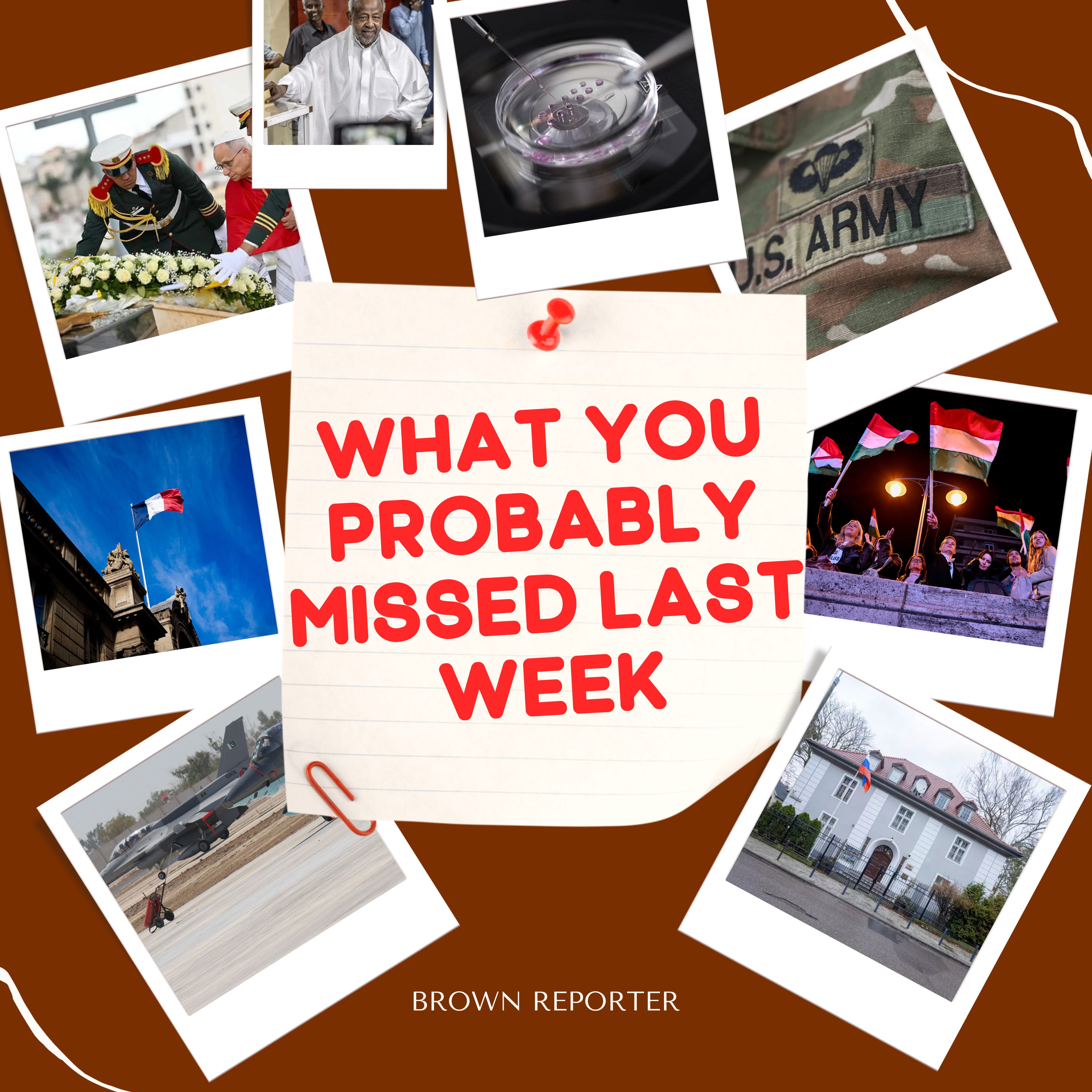
That’s the share of the vote with which President Ismail Omar Guelleh of Djibouti has just “won” his sixth presidential term, extending his personal grip on the country to 27 years. Most opposition parties boycotted the election, which tells you roughly as much as the number itself. Djibouti hosts US, Chinese, French, Italian, and Japanese military bases simultaneously, making it the world’s most militarised small country and the de facto gatekeeper to the Red Sea and Gulf of Aden. When your geography is that strategically valuable, a 97.8% result barely registers as a scandal. It gets noted, filed, and quickly forgotten.
What It Is: After 16 years in power, Viktor Orbán has conceded electoral defeat to Péter Magyar and his Tisza party, which swept a landslide two-thirds parliamentary majority, 138 of 199 seats on 53.6% of the vote. Orbán’s Fidesz was reduced to just 55 seats.
Why It Matters: Orbán was one of Europe’s most consequential and most obstructive leaders. He routinely used Hungary’s EU membership as a blocking mechanism, most damagingly holding up a €50 billion EU aid package to Ukraine for months, demanding concessions before finally relenting. Magyar’s victory ends that veto. Vice President JD Vance flew to Budapest just days before the election to campaign personally for Orbán in what was billed as a “Hungarian-American friendship day.” His intervention appears to have done the precise opposite: Orbán’s polling numbers reportedly dropped after the rally. Online, the jokes are already writing themselves, with commentators cheerfully suggesting Vance book the next flight to campaign for Reform UK, with precisely the same intention.
The Big Picture: This ranks among the more significant European political results in recent years. Orbán was the figurehead of the global nationalist-populist movement, a spiritual ally of Trump, Putin’s closest partner at the EU table, and a working example of how an illiberal leader could entrench power within a liberal institution without formally breaking its rules. His defeat shows that even deeply embedded, well-funded governments of that kind can eventually be voted out. For Russia, this is a real strategic loss: Hungary was a reliable voice for Moscow in Brussels. That voice has gone quiet, and with it a key instrument of obstruction that frustrated EU cohesion for years.
What It Is: France has ordered all government ministries to submit formal plans to migrate away from Microsoft Windows to Linux by autumn 2026, with operational migrations expected by 2027. The drive is led by DINUM, France’s Interministerial Digital Directorate. France’s Gendarmerie already runs Linux on 103,000+ workstations, saving roughly €2 million per year.
Why It Matters: France is treating this as a strategic necessity, with officials saying so explicitly. Growing dependence on US technology is cited as a “strategic risk,” a concern that has sharpened given the changed relationship with Washington under the Trump administration. Earlier this year, the government announced that 2.5 million civil servants would stop using Zoom and Microsoft Teams in favour of Visio, a homegrown French alternative, with savings of around €1 million per year per 100,000 users. The Linux migration applies the same logic at the operating system level: France is systematically reducing its reliance on American platforms, and the motivation is practical insurance.
The Big Picture: France is the largest Western nation to commit to a government-wide migration of this kind. If it works, every other EU government has a real-world example to point to, and the knock-on effects could be considerable. Microsoft stands to lose a significant share of G7 public-sector business. For European digital policy, this may be the year’s most significant move. The message coming out of Paris is fairly plain: European governments are no longer comfortable treating American tech dominance as a permanent given. Under Trump, the dependency on American tech has started to feel like a genuine liability.
What It Is: Pakistan deployed approximately 13,000 ground troops and at least 10 fighter jets to King Abdulaziz Air Base in Saudi Arabia’s Eastern Province on April 11, the first formal invocation of a mutual defence agreement signed in September 2025. It’s Pakistan’s largest overseas military deployment since the 1991 Gulf War, and it landed on the same day that US-Iran ceasefire talks, being brokered in Islamabad, collapsed.
Why It Matters: Pakistan has been careful to frame the deployment as routine. Officials have stated clearly that Pakistani forces are not stationed to attack anyone. The timing is hard to ignore, though: troops arrived the same day the ceasefire talks fell apart, and Saudi Arabia’s Eastern Province is home to the bulk of the kingdom’s oil infrastructure. The financial side is also worth looking at: Saudi Arabia and Qatar confirmed a $5 billion support package for Pakistan, timed to cover $4.8 billion in external obligations, including a $3.5 billion repayment owed to the UAE by month’s end. Pakistan provides the military capacity, and the Gulf states provide the financial lifeline. The arrangement isn’t particularly subtle.
The Big Picture: The Saudi-Pakistan relationship has quietly upgraded from a diplomatic partnership to a hard security arrangement. With US engagement in the region increasingly uncertain and tensions with Iran running high, regional powers are building their own defence structures, and Pakistan is positioning itself as the Gulf’s preferred military partner. The stakes are significant for Islamabad, both strategically and financially. The deeper question is what happens if the situation in Iran deteriorates further. Pakistan insists its troops are not there to fight. Assurances like that are always easier to make before a crisis develops.
🇰🇷 South Korea: The country has guaranteed all 7.17 million subscribers who exhaust their monthly data a free 400 Kbps fallback connection, enough to message, email, and navigate, saving consumers an estimated $219 million per year. It’s the first time a government has formally classified internet access as a basic telecommunications right.
⛪ Pope Leo XIV: The pontiff has embarked on an 11-day, four-nation tour of Africa, with Algeria as the first stop, making him the first pope in history to visit the predominantly Muslim country.
🧬 Japan: The government is set to pass legislation banning the implantation of gene-edited human embryos for childbirth, with penalties of up to 10 years in prison.
🪖 United States: Starting in December 2026, all eligible American men will be automatically registered for the Selective Service when they turn 18, closing a gap in which roughly 25% currently fail to self-register.
🇮🇹 Italy: Italy’s population has stabilised at 58.94 million, ending 12 consecutive years of decline, almost entirely thanks to net migration of +296,000. With a fertility rate of just 1.14 children per woman, immigration is now the only thing keeping Italy’s economy and pension system viable.
🇵🇱 Poland: Warsaw has cut electricity and heating to the former Russian consulate in Gdańsk after Russia evacuated its diplomats but refused to hand the building back, citing post-WWII property rights while accumulating months of unpaid utility bills.
🐊 India: India’s Border Security Force is reportedly exploring whether snakes and crocodiles could serve as natural deterrents along 371 km of the India-Bangladesh border that cannot be fenced due to flooding and riverine terrain.
The European Commission’s DiscoverEU initiative is offering 40,000 free Interrail travel passes to 18-year-olds across the EU, allowing them to explore Europe by train for up to seven days within a 30-day window, valid between July 2026 and September 2027. Eligible applicants, those born between 1 July 2007 and 30 June 2008, can apply via the European Youth Portal until 22 April 2026 at noon Brussels time. Each pass also comes with a DiscoverEU discount card covering accommodation, cultural activities, and local transport.
“Sovereignty is not given, it is taken.”
- Mustafa Kemal Atatürk
Thank you so much for reading my curated news stories! If you enjoyed this article, you can buy me a coffee below or share this article with a friend. Your support is hugely appreciated x
Enjoying this newsletter? The biggest compliment you can give is to share it with your friends.
Thanks for reading. You’re officially the smartest person in the room. Talk to you soon :) Have a great week ahead!
No posts
Comments
Nothing yet. Say the first thing.
Sign in to join the conversation.