
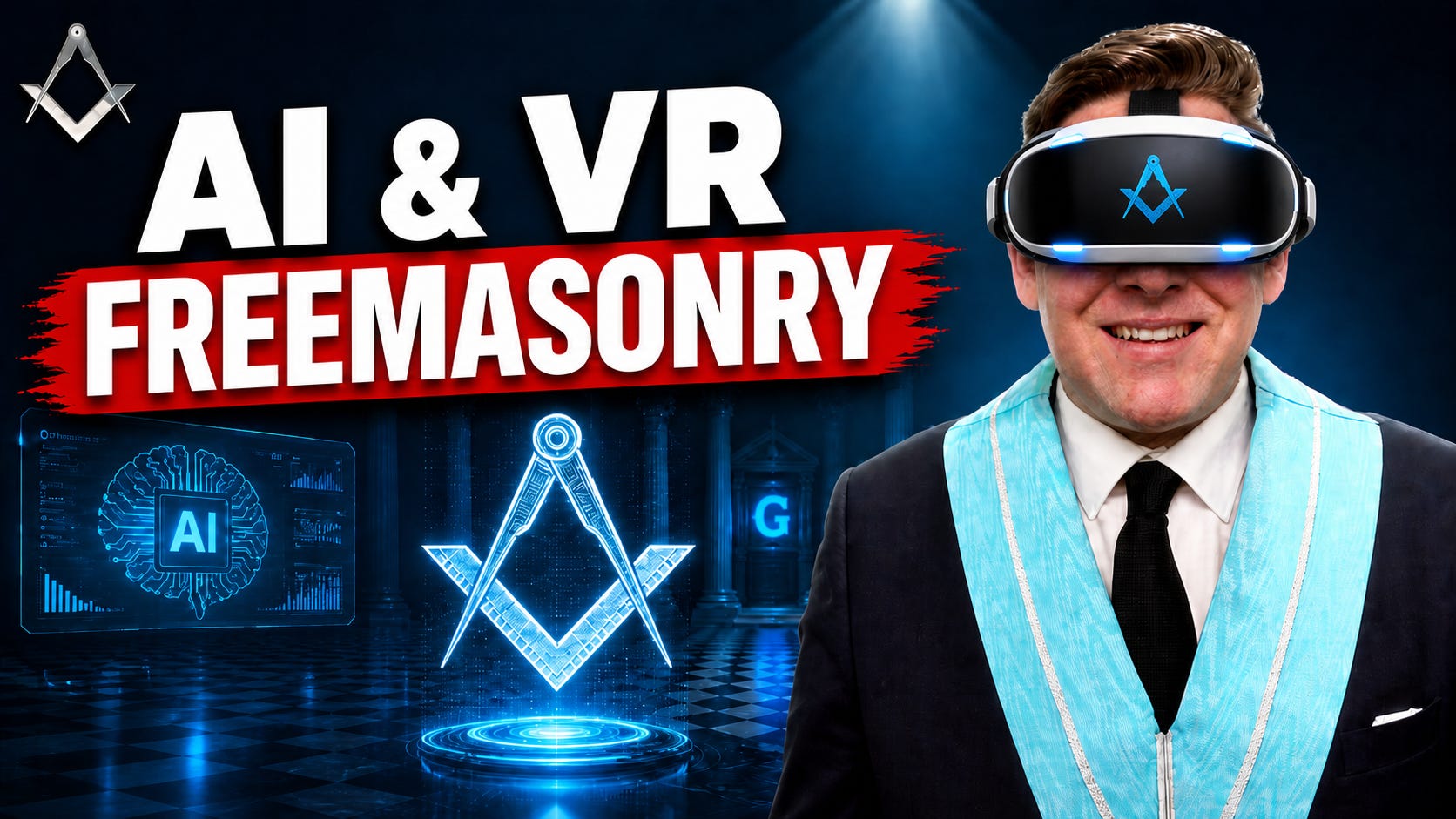
The image above which is the thumbnail for this article is 100% AI Generated. So was the thumbnail for Should we declare Masonic Membership. I provided ChatGPT Image 2.0 my photo and an array of previous thumbnails, gave it the instructions to generate the thumbnail for an article about AI & VR Freemasonry.
A brother stops driving at night. His lodge has two choices. Send him a headset to participate virtually, or have another brother give him a lift. The case for the headset is serious, sincere and properly resourced. It also, I think, asks the wrong question and prepares for the wrong shock.
In a recent episode of the Old Fashioned Masonic Podcast, (episode here) W Bro Nicholas Broadway, who runs The Square Magazine, was interviewed about the work he is doing to bring Virtual Reality (VR), Blockchain and Artificial Intelligence (AI) into Freemasonry.
The work is being delivered through Ex Libris Lodge No. 3765 UGLE and the Ex Libris Academy.
I have considerable respect and admiration for W Bro Broadway, with whom I enjoy a good working relationship. Daily Masonic Progress articles are regularly published in The Square Magazine, and I commend his effort to forge new ground with emerging technologies. That is no small thing in a fraternity where the move from wax candles to LED bulbs is sometimes treated as radical, disruptive innovation rather than as keeping up with the times.
On the substance, I disagree with my esteemed Brother. I hope we can both treat respectful, collegial discussion and constructive disagreement as essential to moving Freemasonry forward.
In this edition of Daily Masonic Progress:
The membership and accessibility problems being raised are real, but they are failures of Masonic practice, and no headset solves what a phone call could.
The companies that have spent the most to make VR mainstream are quietly retreating, and the lodge-scale economics never approached the threshold Meta and Apple couldn’t clear.
The genuine application of VR and AI in Masonic life is education and enhancement outside the tyled lodge, not the lodge meeting itself.
Ex Libris Lodge No. 3765 is not new, it was consecrated in 1916 by brethren working in the publishing and stationery trades, the Lodge takes its name from the Latin for a bookplate, the small printed plate inside the cover of a book that records its owner.
It holds Hall Stone status, denoting a substantial contribution to the construction of Freemasons’ Hall in London, UGLE’s memorial to the fallen of the Great War.
After more than a century of conventional working, the Lodge has been re-positioned as a Special Interest Research Lodge focused on digital transformation in Freemasonry, with the Ex Libris Academy incorporated separately in September 2024 as the research vehicle alongside it.
The drivers behind this work are not new:
The cost of running a Masonic Centre is escalating.
Membership is declining.
Cost-per-member compounds, because fixed costs spread across a shrinking base.
Members are geographically dispersed.
COVID demonstrated that in-person activity can be removed on three months’ notice.
Brothers in the military deploy.
Brethren age and stop driving at night.
Brethren move overseas and lose access to the lodge they were raised in.
The institutional design of Ex Libris also deserves credit. Reviving a failing 1916 City lodge is the faster path in the English or any constitution. The Books of Constitutions constrain what the lodge itself can experiment with, so standing up a separate Academy as a sandbox is a sensible workaround.
Publishing the Academy’s outputs openly is the right ethic.
Lodges aren’t losing members because the delivery medium is wrong. They’re losing members because we are failing to deliver the product Freemasonry promises.
What men actually come to lodge for is excellent ritual, well-run meetings, genuine fellowship and a decent festive board. Where lodges deliver these things consistently, retention is not the problem in the first place.
Where lodges deliver tired ritual, meandering meetings and an indifferent South, no medium will save the experience.
You can render a mediocre meeting in 4K through VR and it will still be a mediocre meeting.
Men do come to Freemasonry for education, but they come to lodge meetings for degree work, not lectures. The two have different jobs.
Education needs to be asynchronous and largely outside the lodge room, so the brother preparing for a charge can absorb the material at his own pace and the brother whose interest is the history rather than the floor work has somewhere to put his energy.
None of that requires a headset. It requires well-prepared content on a regular schedule, delivered through whatever channel suits the listener, which today is most often a podcast, a video or a book.
But that’s not to say education outside of the lodge room couldn’t be done in Virtual Reality. In many cases, Masonic Education groups unattached to any lodge or Grand Lodge run Zoom education seminars or discord communities to deliver masonic light.
Corporate experience offers a harder lesson still.
Meetings held on Teams and Zoom have shown what actually happens when people attend remotely. They tune out. They check email. They open another tab and answer it. They mute and pretend to be present. I’ve seen this first hand and I’m not the only one.
Whatever immersive properties VR adds, the disengagement that has hollowed out remote meetings everywhere else does not disappear because the avatars are 3D.
A poorly-run lodge meeting in VR will not be saved by the headset. It will be undermined by the same dynamic that has made the rest of corporate VR a graveyard.
That dynamic negates the very purpose VR was supposed to serve.
The answer to membership decline is not a new channel for the same indifferent product. It’s deliverying the product, Freemasonry, at a level and experience that members expect through the channel that has worked for three centuries.
Using VR to reach brethren is not a solution when we are already failing to apply the basic practices of the Craft and live up to the Grand Principles of Brotherly Love, Relief and Truth.
The 78-year-old brother who has stopped driving at night does not need a headset. He needs a lift. The car ride between a younger brother and an older brother is one of the most undervalued institutions in Freemasonry. It is where ritual is rehearsed before a charge. It is where the older brother passes on the corrections he received from the brother who taught him. It is where, in the unstructured time around the formal work, the social bond that lodge meetings depend on actually gets formed. A VR headset does not replicate that journey. It eliminates the very conditions that make the journey possible.
The brother who is unwell and could not attend does not need to be patched into the lodge through an avatar. He needs the phone call the next day. He needs three or four brethren ringing him to tell him he was missed, recap what happened, share what they took away from the work, ask how he is and what they can do for him.
Where this is happening, brethren do not drift into permanent absence. Where it is not, no medium recovers them. Relief is one of our grand principles, and its in this scenario which tests us. The answer is to practice the principle, not to replace it with technology.
The language barrier of attending a lodge in a country whose language you do not speak is real, and the technology that closes it already exists. On-device AI translation is the better part of solved on consumer hardware in 2026.
With a phone in his pocket and a discreet earpiece, a visiting brother can follow a foreign-language working in near real time. He and the host brethren still share the same room, the same handshake and the same meal afterwards. That is integration, not segregation into a parallel channel.
Technology should not be used to solve our failure to practice Freemasonry.
The first three grand principles are not decorative. They are the operational answer to most of the cases for which VR is being proposed.
The companies with the most resources and the strongest commercial reason to make VR work for additional-channel use cases are the ones retreating fastest.
Apple has all but given up on the Vision Pro.
The October 2025 M5 refresh failed to revive interest, lifetime sales are around 600,000 units, the return rate is reported as the highest of any current Apple product, and the team that built it has been disbanded and reassigned, including a substantial group sent to Siri. The Vision Air project was cancelled.
Apple is now developing AI-only smart glasses without an integrated display.
Meta (Facebook) is removing Horizon Worlds from their Quest headsets entirely by 15 June 2026, conceding through its CTO that the VR industry “hasn’t grown as much or as quickly as we’d hoped.” Meta also shut down Horizon Workrooms, its VR meetings product, on 16 February 2026, and stopped selling commercial Quest headsets four days later. That matters. Meta tried, with the deepest pockets in the industry, to make VR meetings happen, and concluded the use case did not earn its place.
Microsoft retired its Mesh PC application.
Google chose AI-enhanced 2D videoconferencing over VR.
The entertainment industry that originally drove 3D adoption has retreated to 2D in cinema and theme parks, for the same reasons of cost, comfort and audience preference.
I evaluate emerging technologies for production deployment for a living.
As AI Lead at one of Australia’s largest media companies, while I have also been building with AI since ChatGPT 3.5 and Claude since 2.1, (we are now at versions 5.5 for ChatGPT and 4.7 for Claude) and a substantial part of my career has been spent driving the adoption of new technology where it earns its place.
The honest professional posture is the one that says no when the technology doesn’t pass the test, even when the use case sounds sympathetic.
The technology proposed for the lodge room does not pass that test, and the companies with the strongest commercial reason to make it pass are conceding the same.
At the moment when men’s loneliness is at crisis levels, the answer is not to replicate the digital substitutes that helped produce the crisis.
Fifteen per cent of US men reported having no close friends in 2021, up from three per cent in 1990. The mortality effect of chronic loneliness is comparable to smoking fifteen cigarettes a day.
Pew’s 2024 work shows men report loneliness at the same rate as women but turn to friends and family for emotional support far less often.
Comedian Jimmy Carr has been making the point in podcast appearances that gaming has become, for many men, a proxy for a career. Gaming provides a sense of progress without the human entanglement that real progress requires.
Another digital fellowship surrogate is precisely what men do not need.
A Masonic lodge occupies a position in men’s lives that almost nothing else now occupies:
Structure,
Regular,
Ritual-anchored,
Multi-generational,
Genuinely in-person.
The men’s-shed movement has shown what happens when men simply have somewhere to turn up and do something with other men.
Loneliness measurably lifts and Lodges have been doing this for three hundred years.
Putting that on a headset is lobotomising the medicine. The reason Freemasonry has worked, continues to do so, when so many other voluntary associations have not, is that its ‘peculiar system’ is the antidote, not another instance of the disease.
The case for VR and AI in Masonic practice is real, and it sits outside the tyled lodge.
A 3D walk-through of King Solomon’s Temple.
An augmented-reality First Tracing Board lecture, where the pillars, Jacob’s Ladder, the chequered pavement and the celestial canopy render around the lecturer rather than being pointed at on a flat board.
AI-assisted Masonic research, finding cross-references through three centuries of jurisprudence, ritual variants and lecture material in seconds.
On-device translation for cross-jurisdictional working.
Asynchronous education delivered through whatever medium each brother prefers.
These are enhancements to the existing experience, and they sit mostly outside the lodge room.
The 1717 founders, often invoked as the technologists of their day, were not radical innovators.
The two advancements typically cited as examples, urban running water and public electrification, were architectural innovations in Rothaermel’s framework.
They applied existing technology to new markets.
The Roman aqueduct was already 1,700 years old by 1717. Electromagnetism was decades old by the time of Edison and Tesla. The work of electrification was distribution architecture, not new physics.
Framing these as Elon Musk-tier disruption does not survive scrutiny.
The 1877 phonograph analogy is more apt, and it lands the argument back where it belongs. The phonograph did not replace the lodge meeting, because the lodge meeting is not the kind of thing a phonograph replaces.
VR-tyled lodge meetings sit in a different quadrant again.
They apply new technology to an existing market, which is the empirical signature of attempted disruption.
The companies with the strongest commercial reason to make that disruption stick have already conceded it has not occurred.
The technology will find its place, it just wont be in the lodge room.
W Bro Broadway and the Ex Libris project deserves genuine credit for taking the question seriously and doing the institutional work.
The lodge revival, the chartering of the Academy, and the open-publication ethic are contributions to the wider Craft regardless of where the technology eventually lands.
Some of the work being done in that sandbox will earn a place in Masonic life.
I expect most of it to land in education and enhancement rather than in the tyled meeting itself.
What pulls members in, and what keeps them in, is what has always pulled them in. Excellent ritual. Well-run meetings. Brethren who phone the next day when you missed a meeting and brothers who give you a lift when you can’t drive. The festive board where the working continues over a glass. Brotherly Love, Relief and Truth, practised rather than displayed.
The Craft has been the social cohesion solution for men for three hundred years not because of the medium but because of the principle. The medium is the lodge room, and a headset is no substitute for either the room or the principle.
By the way. This edition, like every other edition has been co-authored by Claude, an AI Assistant who acts as my research assistant, thought partner and ghost writer. Claude can take my unstructured ideas, rambling and incoherent writing and turn it into something polished and articulate that I then hand edit, correct and re-phrase before publishing.
Apple Inc. 2026, Apple Vision Pro M5, Apple Inc., viewed 7 May 2026, https://www.apple.com/apple-vision-pro/.
Bosworth, A. 2026, comments at World Economic Forum, Davos, January, reported in UploadVR, viewed 7 May 2026, https://www.uploadvr.com/meta-explicitly-separating-horizon-worlds-from-quest-focusing-on-third-party-apps/.
Clover, J. 2026, ‘Apple Has Given Up on the Vision Pro After M5 Refresh Flop’, MacRumors, 29 April, viewed 7 May 2026, https://www.macrumors.com/2026/04/29/apple-vision-pro-m5-flop/.
Cox, D.A. 2021, The State of American Friendship: Change, Challenges, and Loss, Survey Center on American Life, Washington, DC, viewed 7 May 2026, https://www.americansurveycenter.org/research/the-state-of-american-friendship-change-challenges-and-loss/.
Ex Libris Lodge 2024, History, Ex Libris Lodge No. 3765, viewed 8 May 2026, https://www.exlibac.com/exlibris-lodge-3765/history/.
Grand Lodge of Ohio 2024, Brotherly Love, Relief and Truth, Free and Accepted Masons of Ohio, Worthington OH, viewed 7 May 2026,
https://www.freemason.com/
Meta Platforms Inc. 2026, Meta Horizon Workrooms is being discontinued, Meta Help Center, viewed 7 May 2026, https://www.meta.com/help/quest/2464765133873078/.
Old Fashioned Masonic Podcast 2026, ‘AI and VR Headsets Are Coming to Freemasonry’, S4 E181, conversation between Brian (host) and Nicholas Broadway, audio podcast.
Pew Research Center 2024, Americans’ Social Habits: Friends, Family and Digital Connections, Pew Research Center, Washington, DC, viewed 7 May 2026,
https://www.pewresearch.org/
Rothaermel, F.T. 2021, Strategic Management, 5th edn, McGraw-Hill, New York.
Ryan, S. 2026, ‘Our Renewed Focus in 2026’, Meta Horizon OS Developers Blog, 19 February, viewed 7 May 2026, https://developers.meta.com/horizon/blog/2026-vr-state-of-the-union-horizon-mobile-focus/.
United Grand Lodge of England 2026, Ex Libris Lodge No. 3765, Special Interest Lodges directory, UGLE, London, viewed 8 May 2026, https://www.ugle.org.uk/become-freemason/special-interest-lodges/special-interest-lodges-profiles.
Comments
Nothing yet. Say the first thing.
Sign in to join the conversation.