
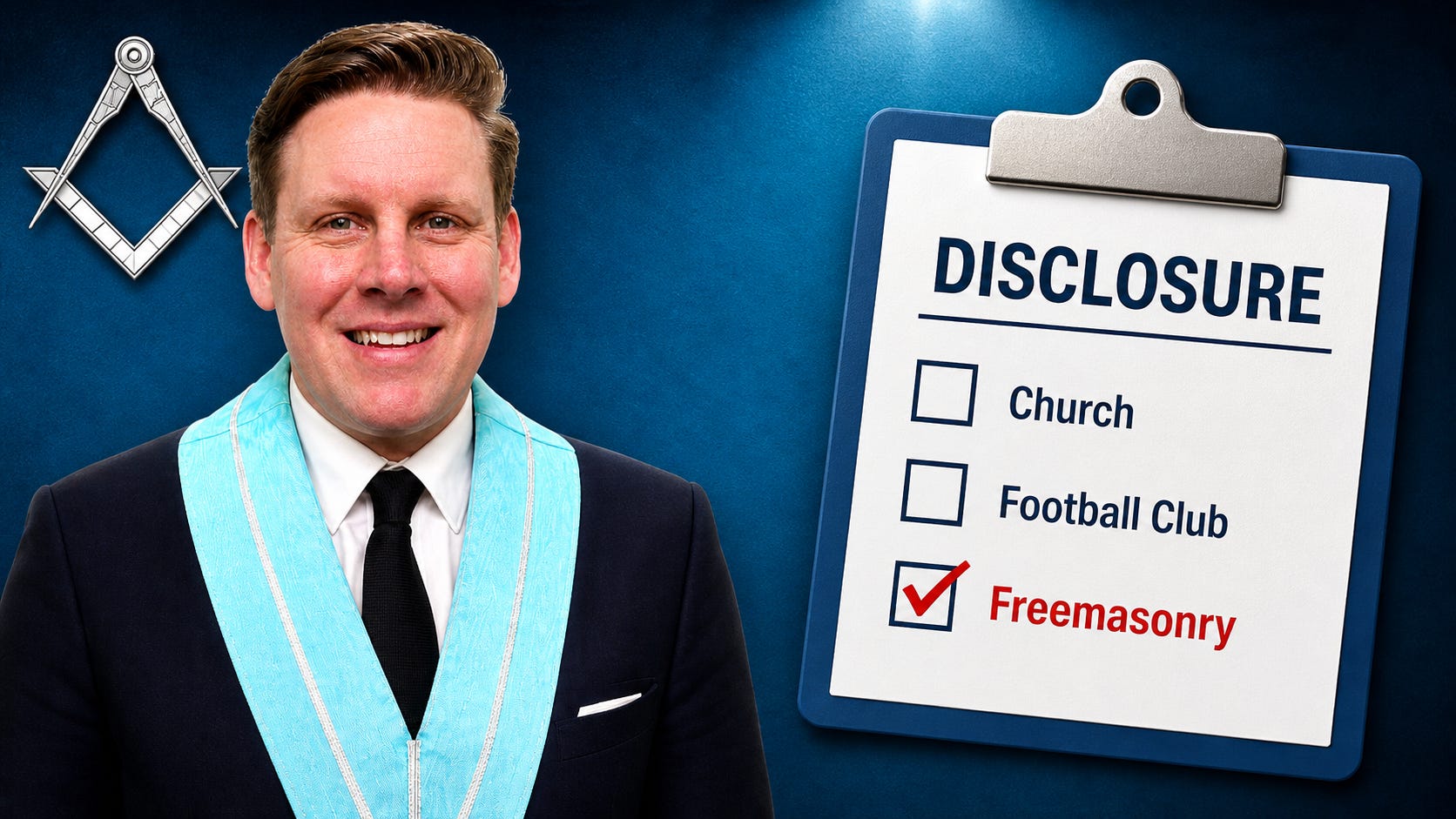
The question itself is the symptom. We are being asked whether as Masons, we should declare our membership. This is because, we as an institution have allowed a disinformation narrative to metastasise to the point where almost any answer makes us look guilty of something. Disclose and a brother’s public position is attributed to fraternal influence; refuse and we confirm the conspiracy.
In this edition of Daily Masonic Progress:
Mandatory disclosure is the price we pay for letting disinformation about us metastasise, and visibility is the only remedy that actually closes the loop.
The Met’s “support one another” criterion inverts the actual rule, which puts civic duty above fraternal loyalty in every case.
Religious belief enjoys statutory protection from compelled disclosure, fraternal membership does not, and that legal asymmetry is the real story.
I’ll work through each in turn, starting with what actually happened in London.
On 11 December 2025 the Metropolitan Police Service amended its declarable associations policy to require all officers and staff who are, or have been, members of an organisation with confidential membership, hierarchical structures and an expectation that members support and protect each other to declare that fact, confidentially, to the local professional standards unit.
Freemasonry was named as the example of such an organisation.
The change followed a consultation in which 66 per cent of officers who responded believed membership of such organisations affected perceptions of police impartiality.
The United Grand Lodge of England, the Order of Women Freemasons and the Honourable Fraternity of Ancient Freemasons brought a judicial review challenge alongside two serving Met officers who are Freemasons.
On 17 February 2026 Mr Justice Chamberlain refused permission for the claim to proceed, finding that none of the grounds were reasonably arguable. The judgment is United Grand Lodge of England v Commissioner of Police of the Metropolis [2026] EWHC 330 (Admin).
The judge described the interference with privacy as “relatively modest” and held that any risk to officers arose “not from membership itself but from undisclosed membership”. The policy stands.
That is the immediate occasion for the debate. The deeper substance is older.
I know of public figures, brothers, who on taking up senior office resigned from Freemasonry entirely.
They did so to maintain what I think of as a separation of lodge and state, a clean line between fraternal life and public duty. It is an honourable answer to a real problem.
It also doesn’t change the fact that they are masons. They were masons before, they will be masons in the sense that matters, and any future scrutiny will work backwards through the membership records.
Resignation is a cosmetic answer to a structural question.
The same trap operates the other way.
We have, for decades, used famous Freemasons as a draw card. Look at the kings, the prime ministers, the architects, the astronauts, look at how respectable our membership has been across centuries.
The argument is that one need not exchange the sceptre for the trowel, that high office and Masonic life have always coexisted. Fine. But the moment we use prominent membership as evidence of legitimacy, we make a brother’s public position fair game for fraternal attribution.
He gets the role and the conspiracy theorist says he was placed. He delivers a result and the result was rigged. He fails and he is shielded by the brotherhood.
There is no clean version of this argument that doesn’t cut both ways.
This is what mandatory disclosure runs straight into.
The Met’s policy is, on its own terms, modest, the disclosures are confidential and held within vetting. The court was satisfied that promotion and service are not affected. But the policy exists in a real social context where Masonic membership, once known, is treated by a substantial slice of the public as morally suspect by default.
The judge himself acknowledged the stigma, and noted that the Met “is not responsible for the stigma; but the defendant is responsible for addressing it”.
Confidential disclosure inside a vetting unit is one thing. Reputational consequences once the fact of membership is known, by colleagues, in promotion conversations, in misconduct panels, are another.
The Met’s stated criterion captures organisations that are hierarchical, have confidential membership, and “require members to support and protect each other”.
That third element is doing the heavy lifting.
It is also where the policy rests on a misreading of what Masonic obligation actually is.
UGLE made this point directly in its submission to the Met and again in its public statement on the policy.
The obligation of mutual support in Freemasonry is qualified, not absolute.
It is primarily a moral and charitable duty, exercised within the limits of a member’s ability and, critically, without detriment to one’s family or one’s duty to the law of the land.
It is not, and has never been, an obligation to advance a brother’s interests against merit, against equality, or against the law.
In fact our rules cut the other way.
A Freemason who uses his membership to obtain personal or business advantage is committing Un-Masonic Conduct and is liable to disciplinary action up to expulsion.
A member’s civic duty prevails over any fraternal obligation, and any attempt to shield a brother who has acted dishonourably or unlawfully is itself disciplinable.
The duty, properly read, runs in the opposite direction to the conspiracy theory.
We are required to be harder on a wrongdoer brother, not softer, because the institution’s integrity depends on it.
To frame our mutual support as a quasi-conspiratorial loyalty pact is to invert the actual rule.
This matters because the entire legal premise of disclosure rests on the assumption that the support obligation creates a foreseeable conflict of interest.
If the obligation, properly understood, is a charitable one constrained by law, family and merit, the conflict is no greater than that arising from any close friendship, professional society or religious community.
Which brings me to the asymmetry that bothers me most.
Christianity instructs its members to “carry one another’s burdens” (Galatians 6:2).
Most major religions impose comparable obligations of mutual aid on their adherents.
So do trade unions, political parties and professional associations.
None of these obligations are construed as legal grounds for mandatory disclosure to an employer.
Religious belief is treated as special category data under UK GDPR and processing it requires a specific lawful basis.
An employer cannot ordinarily compel an employee to declare their religion, and would face serious legal consequences for doing so.
The protection is rightly strong.
Freemasonry has no equivalent statutory shield.
UGLE’s High Court arguments included exactly this point, that fraternal membership engages Article 8 (private life), Article 11 (free association) and the same data protection regime.
The court, in this instance, was unpersuaded.
But the underlying inconsistency does not go away because one judgment held the policy proportionate.
A Christian Met officer is protected from being asked about church membership.
A Masonic Met officer is required to declare lodge membership.
Both belong to organisations that ask their members to support one another. Only one is treated as a vetting risk.
You can defend the asymmetry, but you have to defend it on grounds other than the bare existence of a mutual support obligation. The Met’s policy hasn’t done that work yet.
The Met’s policy, on its face, is neutrally drafted. It applies to any organisation with the three characteristics.
The court took comfort in this neutrality, observing that gentlemen’s clubs, university alumni networks and other secret societies would be caught if they met the test, and that the claimants had produced no evidence that they did.
That is technically correct and substantively unsatisfying.
The neutrality is a legal posture. Everyone involved knew what the policy was for and who it was aimed at.
The Met’s public statement on 11 December 2025 named Freemasonry. UGLE noted that the use of the broader phrase “hierarchical organisations” was, in its view, disingenuous when the operational target was a single fraternity.
The Pro Grand Master, addressing UGLE Quarterly Communication in June 2024, drew the comparison directly: freedom of association and a right to private life is protected for Freemasons as it is for individuals who are members of trade unions, political parties, religious organisations, the Round Table, football, rugby or even golf clubs.
That is not a slippery slope argument. It is an equality argument.
I support Tottenham Hotspur. If my superior officer were an Arsenal supporter, and other Arsenal supporters were in the same reporting line, would I expect to be passed over for promotion because we back rival clubs?
Of course not, and the suggestion would be ridiculous.
Football allegiance is treated as private.
So is alumni affiliation, so is party membership, so is faith, so is whether you went to a particular school.
The case for treating Masonic membership differently has to do real argumentative work, and “they support one another” doesn’t get there once you read what the support obligation actually is.
I want to be plain about my own view. I support voluntary openness.
I think every Freemason who can speak openly about his membership should, and that the institution should be visible, articulate and unembarrassed about what we do, what we believe and what we contribute.
UGLE’s own modernisation strategy of the last thirty years, the open days, the publication of senior officers, the engagement with Universities Scheme lodges, has been moving steadily in that direction, and it has worked.
Our public profile is healthier than it was in the 1990s. Our membership is younger than it was a decade ago. But the online conspiracy theories and disinformation has gotten worse.
What I don’t support is mandatory disclosure as a remedy for disinformation, because it isn’t a remedy.
It is a concession to the conspiracy frame.
It accepts the premise that fraternal membership is presumptively suspicious, then negotiates the terms of the suspicion.
The right response to “you are a secret network controlling institutions” is not “here is a register proving how many of us there are in your institution”.
The right response is to make the original claim demonstrably false through visibility, accountability and consistent behaviour.
That is slower work and less satisfying than a policy announcement, but it is the only kind that actually closes the loop.
The harder honesty is that we did not get here by accident.
The conspiracy narrative metastasised because, for a long stretch of the twentieth century, the institution gave it room.
Reticence read as secrecy.
Charity went uncredited because we wouldn’t be photographed.
The vacuum filled with fiction.
We are now paying the cost of that vacuum, and policies like the Met’s are part of the bill.
The remedy is not to argue our way out of disclosure case by case, although where it crosses into discrimination we should and will.
The remedy is to make the question of disclosure progressively less interesting, by being publicly the kind of institution that no reasonable observer could plausibly believe needs to be policed by a vetting form.
That is the work, and it is on us.
United Grand Lodge of England v Commissioner of Police of the Metropolis [2026] EWHC 330 (Admin), judgment of Mr Justice Chamberlain handed down 17 February 2026.
Metropolitan Police Service, declarable associations policy amendment, announced 11 December 2025.
United Grand Lodge of England, “Metropolitan Police Update”, press release, 11 December 2025.
United Grand Lodge of England, “Freemasons launch legal action against Metropolitan Police”, press release, 17 December 2025.
Daniel Morgan Independent Panel, Report of the Daniel Morgan Independent Panel, 2021.
UGLE Pro Grand Master, Address to the Quarterly Communication of Grand Lodge, June 2024.
Grande Oriente d’Italia di Palazzo Giustiniani v Italy (Application no. 35972/97), European Court of Human Rights, 2 August 2001.
Information Commissioner’s Office, Guide to the UK General Data Protection Regulation: Special Category Data.
Balkan Insight, “Croatia Chief Prosecutor Forced Out Over Masonic Connection”, 20 February 2020.
Comments
Nothing yet. Say the first thing.
Sign in to join the conversation.