
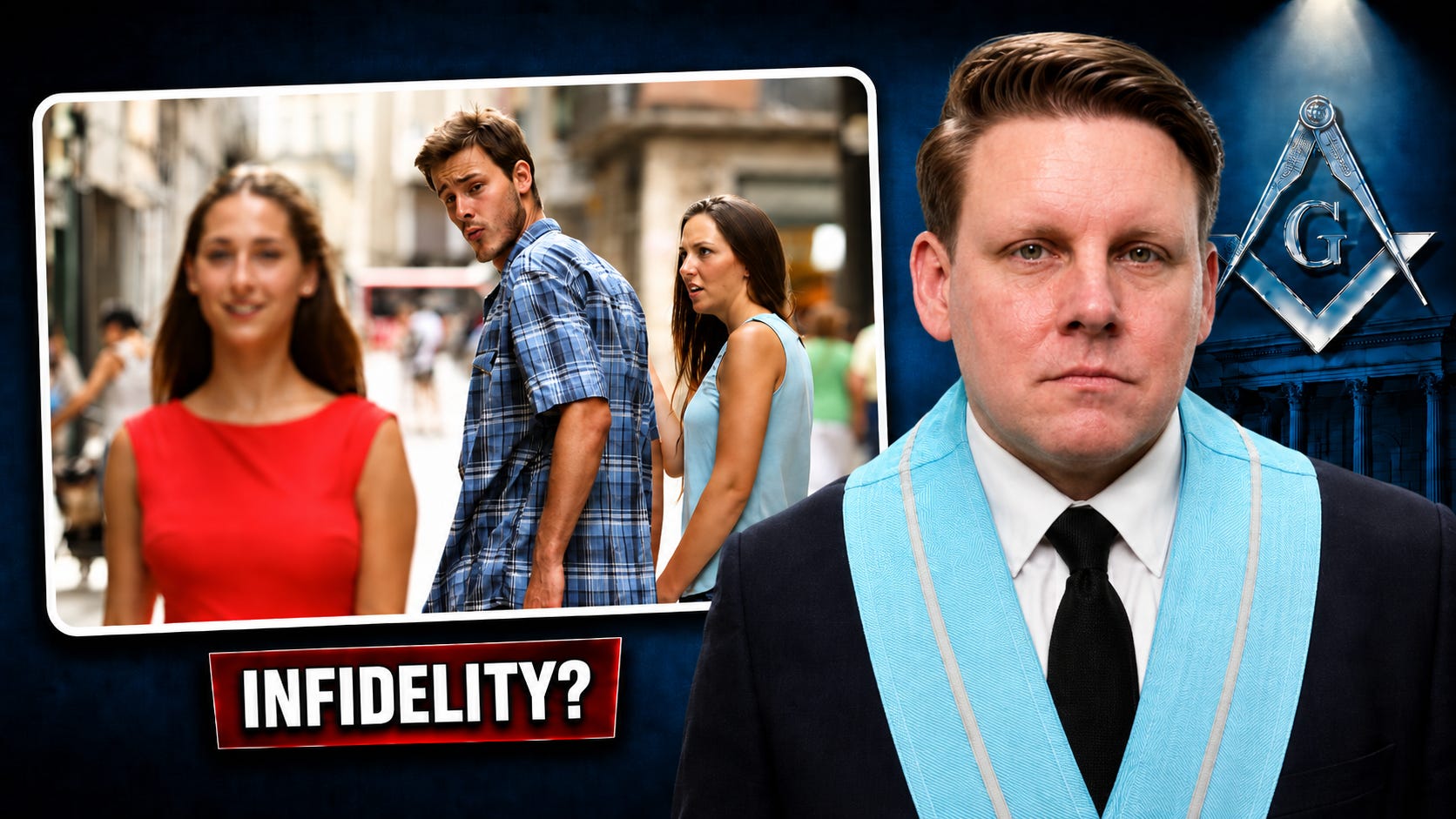
Is marital infidelity un-Masonic conduct, and what should the Craft do when a brother has committed infidelity?
These are not new questions, but they are questions where the Craft has been content to leave unanswered over the last 20 or so years. Over this time, we have, for the most part, treated this kind of personal conduct as outside our ‘due bounds’, accepted “it is a private matter” and stopped there.
Staying quiet has cost us, especially when situations of a mason cheating on his spouse are made public, we are accused, with some justice, of shielding our own.
How is it, we can have brethren who are otherwise in good standing where their conduct on the public record is incompatible with the obligation they took?
Every so often a case arrives that strips the question to its frame and asks the Craft to answer for itself.
In this edition of Daily Masonic Progress:
When a man breaks his vow of fidelity to his spouse, has he already broken the character standard Freemasonry exists to teach and uphold?
Is a candidate who have cheated on their spouse this unfit for admission, and a brother who cheats unfit to remain?
In a world where private conduct is rarely private for long, is silence in the face of a brother’s dishonour complicity?
The argument is not that the Craft needs new rules. We already have them. The argument is that fidelity is one thing, and the man who has failed his vow to his spouse has answered the question of his fitness for ours.
A case in point
The other week I was drawn into an online discussion about a public figure who was ‘outed as a Freemason’ where the comments section had erupted. The man is politician, founder of a small political party, and a ‘Freemason’.
While the conspiracy of Masons controlling politics is not new, the core issue at the centre of the comments were over allegations that he had an affair, then walked out on his partner and their newborn to pursue a relationship with the person who he had the affair with, and that he had been quietly telling people he had left Freemasonry to keep the Craft out of the story. Or, he says, he has.
In these situations, I believe as Masons, if we are true to our obligations, especially as Master Masons we are called to defend the Craft and the good will of the greater number of Brethren who are Masons.
I said what I thought being, if the allegations are true, he should resign. We believe, practice and teach integrity and truth. A man who has broken his marriage vows is not someone who can uphold a Masonic obligation.
The reply came back fast. “He’s not married. It’s not cheating or adultery.” That reply is why I am writing this article. It is the wrong answer, and regardless of being married or otherwise the modern laws which we all are obligated to follow recognise de-facto relationships as equal to formalised marriages.
Regardless of the relationship structure, we have to be honest about what the Craft teaches and about what those teachings require of us when a brother fails them.
What the Degrees actually teach
The Craft does not teach fidelity as one virtue among many. It teaches fidelity as the ground under every obligation a Mason takes.
“Fidelity, Fidelity, Fidelity…. and may God prosper the Craft?”
Is this a statement or a question at the Closing of a Lodge?
A Mason is bound, by his very admission into the Craft, to obey the moral law. The Antient Charges read at every Installation in many jurisdictions require him to act with integrity, to deal honestly with all men, and to keep a character that holds up to inspection in public and in private.
The working tools and the lessons attached to them all describe the same thing in different language. The Square teaches us to regulate our actions. The Plumb teaches uprightness of life. The Skirret marks out a straight and undeviating line of conduct. The Compassess to keep our passions within due bounds. The Common Gavel, to supress desires. They all describe a man whose word can be relied upon.
The vows and obligations a Mason takes in his Degrees are not bargains. They are public statements that he is the kind of man who keeps his word. They are made with his Deity as witness to the promise and with the brethren present as witnesses of his accountability.
Everything else in Freemasonry follows from that one point. The secrets, the right hand of fellowship, the trust between brethren. Remove the point and the rest of the structure has nothing to stand on.
A Man and a Mason only has One Character
A man does not have one character in Lodge, another at home or another behind closed doors with his mates. He has one character, and his conduct in every place tells us what it is and more importantly, who he is.
The defence that marital conduct is private, and therefore none of the Craft’s business, fails on its own terms.
The marital vow is the harder vow to keep, not the easier one. When it is taken, it asks more of a man than any Lodge obligation could ever do.
A man who has broken the harder vow has told us, on the public record of his own life, that he can break the easier one.
The question of can he uphold his Masonic Obligation is no longer a guess. He has shown us. Fidelity is not a virtue tied to one setting. It does not switch on at the Lodge door and off at the front door.
The man who keeps his word does so because of who he is, not because of where he is standing. The man who breaks it tells us the same.
The vow is the word, not the ceremony
The most common defence offered for the brother in question, was that he was not legally married, so there was no vow, so there is nothing to answer for.
The argument fails, and it fails in a way that makes the original conduct worse.
The vow of exclusivity in a marriage, civil or religious and regardless of defacto status or otherwise, is the same vow or obligation of fidelity which is implied where two consenting adults enter into a monogomous relationship.
This obligation made by the word given to the partner, not by the document signed at the registry.
Civil marriage under the Marriage Act 1961 (NSW, Australia) includes a public declaration to the exclusion of all others. Religious marriage adds a religious meaning for those who hold it.
A de facto partnership, especially where there are children, involves a vow of the same content given without a celebrant. The form changes. The content does not.
In every case the man has told his spouse that she can rely on him, and they have built their life on that promise.
A brother who tries to escape the consequence by pointing to the legal status of his relationship is making the case against himself. He is saying that he honours his word only where he can be legally held accountable for breaking it.
That is not the character Freemasonry teaches. The Craft does not measure a man’s fidelity by whether the State could take him to court for breaking it.
Public and private have collapsed
The traditional defence of Masonic silence on marital conduct rested on a sharp line between public life and private life. The Lodge dealt with the public man. The private man was the family’s concern, not the Craft’s. That line was always weaker than it looked, and it does not exist any more.
In 2026 a brother’s private conduct is rarely private for long. Partners have phones with text histories, photographs and call records. Friends and family observe and post.
A betrayed partner has a Facebook account and a story to tell, and the algorithm rewards them for telling it. If its not the partner, it’s her friends who will certainly make it known that he is a Mason and not acting Masonically.
The thread that drew me in last week is the model, not the exception.
By the time the story reaches the Lodge it has already reached everyone else, and the Lodge is one of the last places in the brother’s life where the conduct is treated as if it had not happened.
This collapse cuts two ways. It removes the brother’s protection. It also removes the Lodge’s.
Every Mason who behaves dishonourably and remains a Mason in “good standing” is evidence for the conspiracy theorists who say we shield our own, the evidence accumulates in public, on platforms anyone can search and is a permanent record.
The brother who walks away from his partner, denies he was ever a Mason for the duration of the criticism, and resumes Lodge attendance once the news cycle has moved on is not engaged in private conduct.
He is conducting a public test of whether the Craft will hold him to its standard, and the public is watching.
Unfit for admission, unfit to remain
Freemasonry admits men who are already Masons at heart, and the work of the Craft is to grow, develop and refine the character that is already there.
We do not admit men in the hope that the ceremonies will repair fundamental flaws.
We admit men whose character is already sound.
A candidate who has broken his vow of fidelity to his partner is unfit for admission.
The flaw is not something the Craft can concrete over.
The Application or Petition for Admission should ask the question directly, and the candidate should answer it honestly. A false “no” on the Petition that later turns out to be wrong is not a separate problem. It is the same problem with an additional charge attached.
Lying on the Petition is grounds for expulsion that no jurisdiction would hesitate to use.
This is not a new principle. The Book of Constitutions already treats criminal conviction, bankruptcy and civil findings of dishonesty as bars to admission, and as grounds for required resignation or expulsion in existing brethren.
The wording varies by jurisdiction. The concept does not.
The Craft did not adopt those provisions to punish bad men.
We adopted them because they tell us, before we have to ask, that the man does not have the character our obligations requires. Marital (or spoousal) infidelity tells us the same thing about the same character, and it belongs in the same category.
We adopted them to protect the Craft as a whole. This should always be the core concern of every mason.
A brother whose conduct since initiation has included this breach is in the same position as the brother who is convicted of a serious dishonesty offence after his initiation.
A man of integrity will acknowledge that he can no longer keep the Masonic obligation, resign quietly, and return his regalia.
If the matter has become common knowledge within his Lodge, his Lodge should expect him to resign.
If it has become public knowledge, he should resign or face the disciplinary process.
None of this requires a formal court finding. These are tests of character against our own principles of Honesty, Integrity, Truth and Fidelity, and the Disciplinary Authority has all the powers it needs.
For example under UGLE Rule 1(c) of the Schedule of Disciplinary Provisions (as UGLE is considered the mother Grand Lodge and their BoC’s are publicly available, for which most recongise GL’s have conceptually similar clauses), and its equivalents in every regular jurisdiction, to act on the disrepute ground up to expulsion.
Hiding it and hoping people do not find out is further demonstration of the fundamental character flaws that are incompatible with “being permitted to remain in any warranted lodge or society of men who prize honour and virtue above external advantages…”
What is missing is the will to use the standards we already hold. That gap is not procedural. It is cultural.
The Craft has spent a long time treating personal conduct as outside its remit, and a long time accepting any defence that allowed the question to be parked.
The defence I want to be plain about rejecting is the one that says we should be careful about being judgmental, that we are not a confessional, that the Craft has no business policing marriages.
The Craft is not policing the marriage. It is policing its own standard. The brother chose to take the obligation. The standard is what he obligated himself to. The conduct is the test.
The good and reputation of the Craft is paramount to protect and our forefathers did.
Silence is complicity
A brother who knows that another brother has broken his vow and says nothing has made a choice. The choice is to participate in the cover-up.
The Charge to the Master Mason instructs us to correct the errors and irregularities of our brethren. It is not a suggestion. It is a charge, delivered before the same Volume of Sacred Law that carries the rest of the obligation.
The brother who sees, and stays silent, has chosen the comfortable failure over the uncomfortable duty. He has also given the conspiracy theorists their best evidence.
We are accused of shielding our own, and silence in the face of dishonour is exactly that shielding, whatever name the brother chooses to give it.
“It is none of my business” is not Masonic discretion. It is moral evasion.
The brother who has broken his vow has made it everyone’s business by the act of breaking it.
He has made it the Craft’s business by carrying his obligation alongside the broken one. In a connected world he has often made it the public’s business as well, before anyone in his Lodge has heard. The information arrives.
The choice is what to do with it. There are two honourable options.
Speak to the brother and require him to resign, or
Report the conduct to the Master and let the disciplinary process do its work.
There is no third option. The brother who chooses silence has chosen against the Craft, whether he admits it to himself or not.
What we owe ourselves
We are not a religion. We are not in the forgiveness business.
We are a fraternity built on character, and character is indivisible.
The brother who has broken his word has not been cast out by the Lodge. He has made himself unfit, and we should recognise it.
Refuse admission to the candidate whose record disqualifies him.
Withdraw the right hand of fellowship from the brother whose conduct has broken his obligation.
Speak when the moment requires it, and report when the moment requires that.
Stop accepting the defences that let the question be parked.
“He was not legally married.” “It is a private matter.” “It is none of our business.” None of these is a Masonic answer. Each of them is the kind of answer we exist to refuse.
The brother across the ditch will answer the question himself, one way or the other. He will not be the last. The next answer is ours.
So Mote It Be.
Sources
UGLE Book of Constitutions, Schedule of Disciplinary Provisions, Rules 1, 2 and 4.
United Grand Lodge of NSW & ACT, Book of Constitutions, provisions on un-Masonic conduct, disrepute and disciplinary penalties.
Antient Charges of a Free-Mason, as printed in Constitutions of the Free-Masons (1723) and reproduced in the Book of Constitutions of UGL NSW & ACT.
Obligations of the Three Craft Degrees, traditional penal clauses concerning unfitness to be received into any warranted lodge or society of men who prize honour and virtue.
Charge to the New Mason after Initiation, as worked in the Australian and New Zealand jurisdictions.
Marriage Act 1961 (Cth), s 45 and authorised celebrant declarations.
Family Law Act 1975 (Cth), Pt VIIIAB (de facto financial causes).
Comments
Nothing yet. Say the first thing.
Sign in to join the conversation.