

🗺️ Current Dispatch: Pacific Coast Lookout, Route 1, California
⛽ Local Diesel: $4.12/gal
☕ Diner Coffee Index: $3.25 — dark roast, black, poured into a plastic gas-station cup. 8/10.
⏳ Days in trip: 38
I pulled the rig up to the edge of the West Coast today, looking out over the endless expanse of the Pacific Ocean.
Looking across that massive water barrier, you can spot dozens of container ships lined up on the horizon. Where are they actually coming from? Where are they heading? And who is footing the bill when the cargo hits the docks?
Let’s dive straight into the reality of Asia-US trade — how the capital flows, how to navigate the friction, and what the latest market signals are telling us about where this cross-Pacific relationship is headed.
While headlines in D.C. and New York are hyper-focused on escalating US-China trade rhetoric and the ongoing military logistics drag from US-Iran maritime tensions, money always tells the real story long before politicians do.
If you want to know where the real pressure points are in the Sino-American trade war, you don’t look at tariff press releases. You look at sovereign yields.
Right now, China’s 10-year government bond yield has plunged to a fresh low around 1.70% — a level that signals deep structural shifts in global trade capital.
Let’s strip away the diplomatic noise and break down the math.
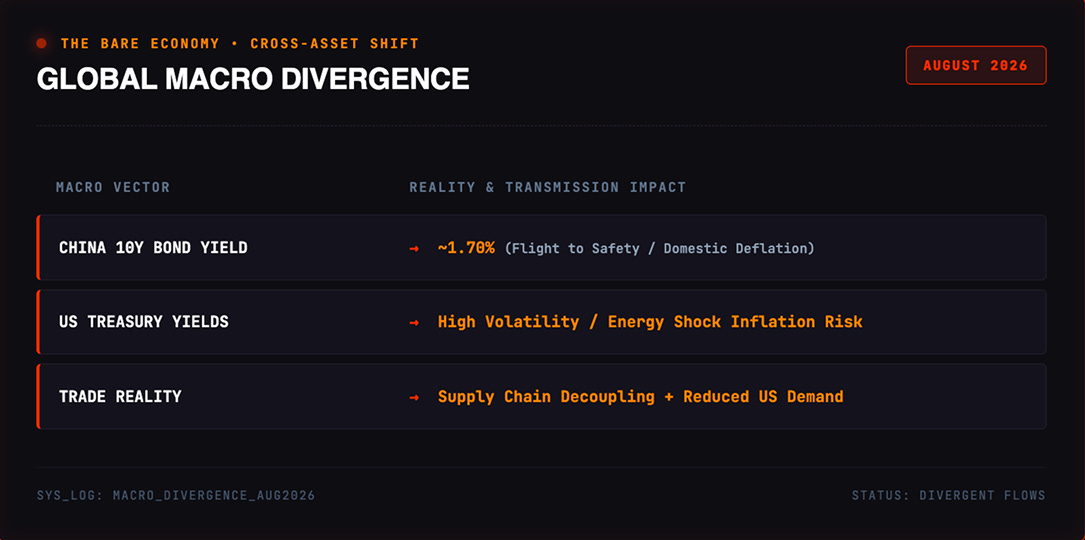
When a sovereign bond yield drops to 1.70%, the textbook financial media usually jumps to one conclusion: “central bank stimulus”. But in Beijing, this historical yield collapse is telling a very different story:
China’s internal economy is absorbing the reality of persistent export friction with the United States. As tariffs, technology export controls, and supply-chain nearshoring reduce Chinese manufacturing margins, domestic capital isn’t reinvesting into factories or real estate. Instead, it’s fleeing risk and piling directly into government paper. A 1.70% yield means domestic investors see zero growth out on the horizon.
Lower yields put downward pressure on the Yuan. In an ordinary trade war, a weaker Yuan helps China offset US tariffs by making its exports cheaper to the rest of the world. But Beijing is walking a tightrope: let the currency slide too fast, and capital flight accelerates out of the mainland. Keep yields suppressed, and domestic banks get squeezed on net interest margins.
President Trump signed Executive Order #14330 — a sweeping change that could forever alter retirement accounts, including millions of 401(k)s.
For the first time ever, physical precious metals like gold are being formally opened to retirement portfolios.
J.P. Morgan projects a massive wave of demand could send gold prices toward $6,000 per ounce.
Gold prices are up 51% in 2025
Billionaire hedge fund manager Ray Dalio now recommends a 10-15% gold allocation for all investment portfolios
If you want to capitalize on this trend, we’ve created a free guide that explains how to buy physical gold with your 401(k), IRA, or other retirement account.
Yes, Send Me My FREE Retirement-to-Gold Guide.
(ad)
While Beijing grapples with domestic deflationary pressures and falling yields, Washington is facing its own compounding economic friction.
The military and economic entanglements involving Iran have introduced a massive, unpredictable variable into the global trade equation:
Energy Grid Disruption: Escalations around Middle Eastern shipping corridors have spiked transit insurance rates and crude oil volatility. Higher energy costs act as a direct tax on American supply chains, stoking domestic inflation even as consumer spending softens.
Fiscal Supply Drain: Funding prolonged military deployments and securing maritime trade routes drains US Treasury resources at a time when national debt interest payments are already at record highs.
The Strategic Shift: Every dollar, missile, and carrier group tied up in Middle Eastern conflict zones is a resource that cannot be deployed to enforce trade or naval presence in the Indo-Pacific. Beijing knows this. The trade war isn’t happening in a vacuum; US commitments in Iran give China leverage to push its own regional trade networks without facing undivided American pressure.
It’s official.
For a moment, Elon Musk’s empire was worth more than $2 trillion.
Every trader on the planet is staring at the same ticker — chasing the most expensive IPO in history at 266 times earnings.
But here’s what the frenzy is hiding.
The one small company Musk’s Colossus cannot run without — the company building the power infrastructure behind that $2 trillion valuation — is still trading like Wall Street hasn’t noticed.
The IPO repriced SpaceX overnight.
It hasn’t repriced the supplier. Yet.
That gap is the trade.
Dylan Jovine is giving away the name and ticker — free.
Get the ticker before the gap closes >>
(ad)
The core tension between the US and China isn’t just about who sells more steel or electronics — it’s a fundamental collision of economic engines:
The US Model: Managing sticky inflation, volatile energy inputs from Middle East conflicts, and massive fiscal deficits that keep borrowing costs high.
The Chinese Model: Facing structural demand deficits, trade restrictions with its largest consumer market, and a capital market so starved for yield that government bonds are trading at 1.70%.
When trade barriers go up and geopolitical conflict spreads, capital stops flowing efficiently across borders. It retreats into safe havens, squeezes margins, and forces both economies to internalize costs that used to be spread across a frictionless global market.
But what do you call a private company worth over a trillion dollars?
Anthropic is there, right now.
The first of its kind.
It’s worth more than every American airline — combined.
Anthropic’s annualized revenue grew by 80 times in the first quarter.
They’ve already filed the paperwork for an IPO …
Some estimates say they are going public as early as October.
Now, here’s what’s really exciting.
You can take a stake in this IPO …
Right now.
Today.
Before it goes public.
(ad)
Pay zero attention to political grandstanding on TV about trade deals or foreign policy victories.
Watch the 10-year yields in Beijing and the energy/yield curve in Washington. When China’s yields crash toward zero while US energy costs stay elevated due to foreign conflict, it means both nations are absorbing heavy structural damage from the trade war — just in completely opposite ways.
Hold real, productive physical assets, watch your supply-line dependencies, and keep your balance sheet nimble.
I’m firing up the diesel engine and tracking south down the valley before nightfall.
Keep your eyes on the road, hold your ground, and stay out of the media noise.
— Brook
The Bare Economy. From the road. For the road.
No posts
Comments
Nothing yet. Say the first thing.
Sign in to join the conversation.