
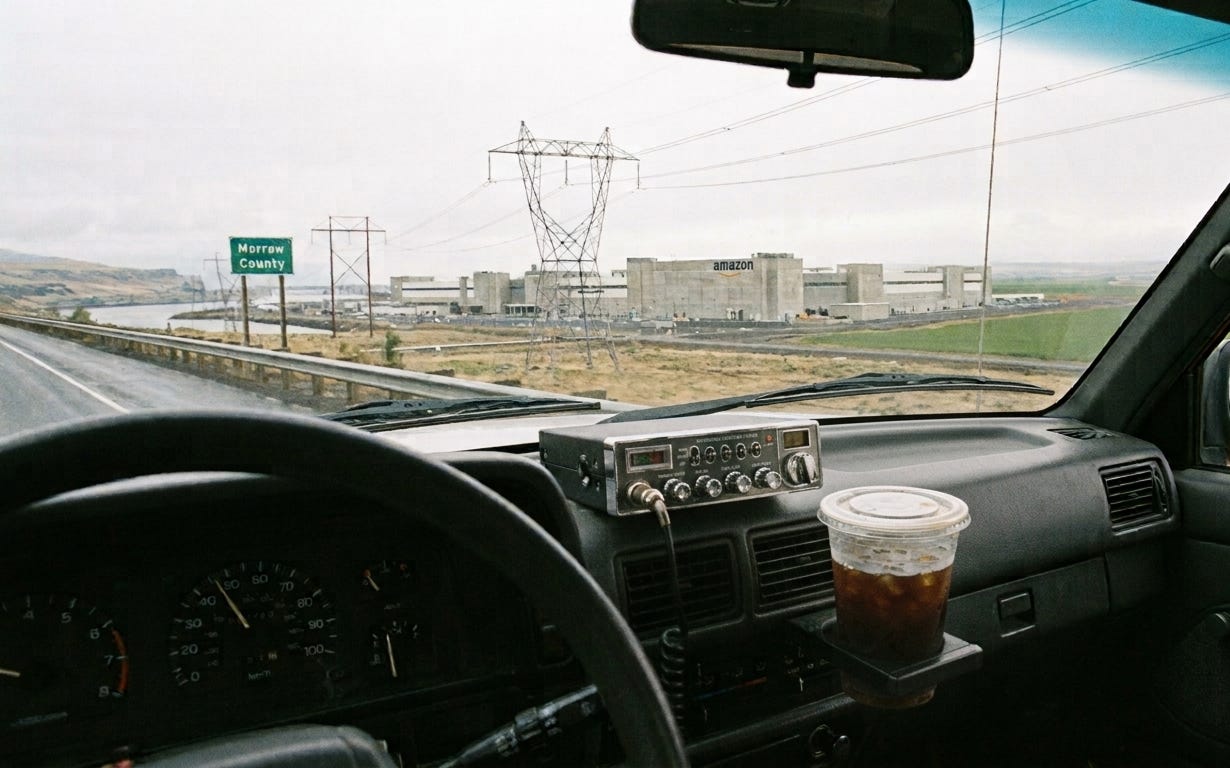
🗺️ Current Dispatch: Columbia River Gorge, Boardman, Oregon
⛽ Local Diesel: $4.18/gal
☕ Diner Coffee Index: $3.75 — dark, strong, poured into a heavy mug near the hydro-dams. 7/10.
⏳ Days in trip: 37
Let’s dive straight into the physical footprint of the AI revolution.
For decades, the narrative surrounding digital tech was all about the “cloud”—an abstract, weightless concept where data floated silently through the ether. But if you drive through Oregon right now, you quickly realize there is nothing abstract about it.
Artificial intelligence doesn’t live in the cloud; it lives in massive, concrete structures packed with high-density GPU racks, requiring millions of gallons of cooling water and ungodly amounts of uninterrupted electricity.
Oregon has become ground zero for this physical expansion. Between low-cost regional hydropower, proximity to trans-Pacific subsea fiber landings, and sprawling rural acreage, hyperscalers and venture-backed infrastructure firms are rushing to claim every available square foot of open ground across the state.
Here is a look at the ground-level map of how AI infrastructure is reshaping Oregon’s geography.
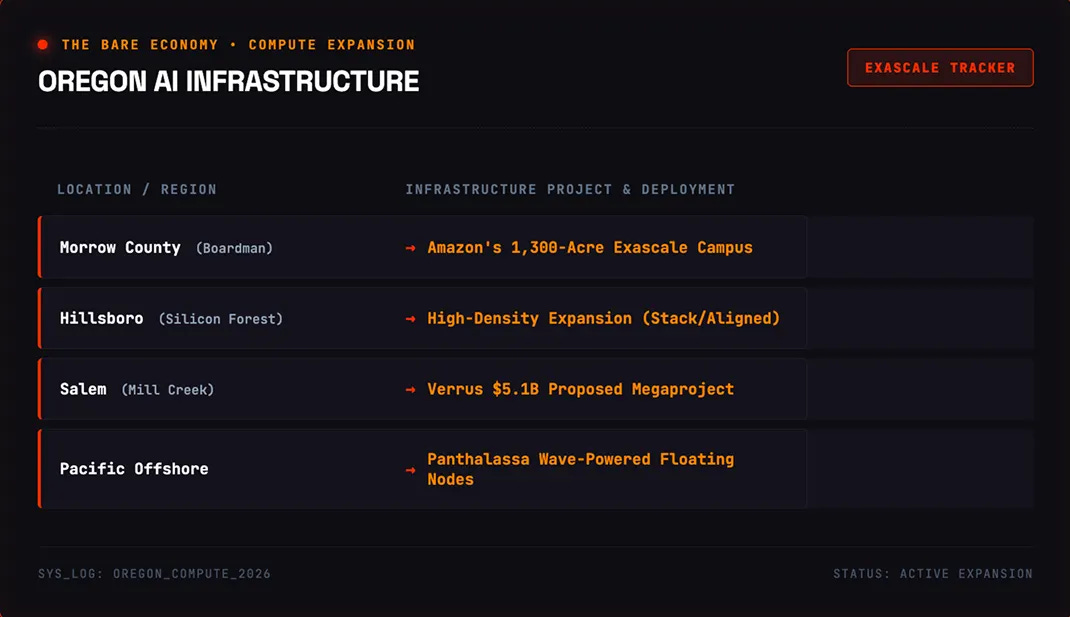
Up along the Columbia River in rural Morrow County, the transition from old agricultural capital to raw compute is on full display. Amazon (AWS) locked down over 1,300 acres near Boardman—land previously utilized for large-scale dairy grazing—to construct a multi-building, gigawatt-scale data center complex.
The Scale: A multi-billion-dollar exascale project spanning millions of square feet across 16 to 20 separate facilities.
The Load: At full buildout, this single campus will draw 1 gigawatt of power—roughly equivalent to the entire electrical demand of the Portland metropolitan area.
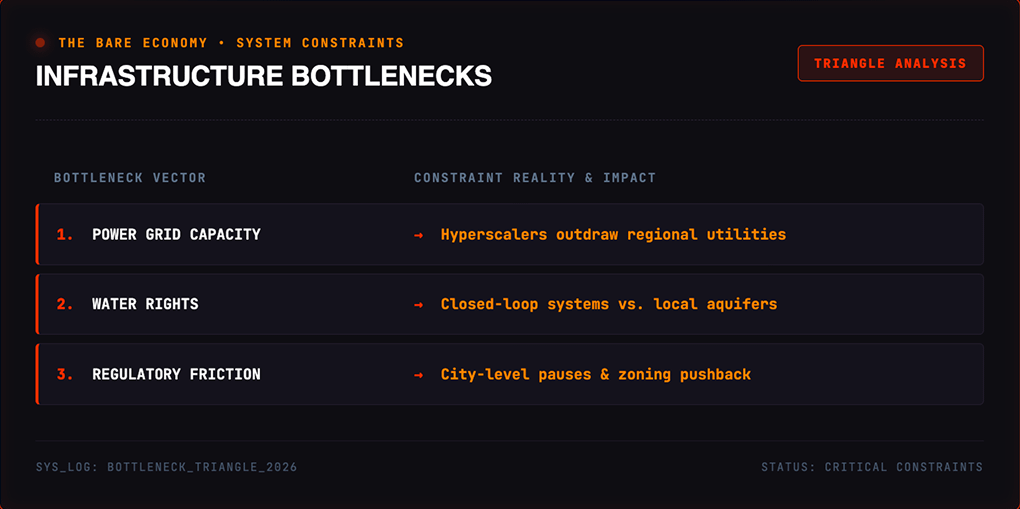
The Strain: While local Columbia River hydro power provides cheap baseline energy, local groundwater rights and transmission line allocations are becoming fiercely contested resources.
Over in the “Silicon Forest” west of Portland, Hillsboro has long served as Oregon’s traditional data center nexus due to its proximity to trans-Pacific subsea cable landings. But as AI workloads demand double or triple the power density of traditional enterprise servers, operators like Aligned Data Centers and Stack Infrastructure have engaged in a high-speed permit race.
Stack’s POR03 campus alone is engineered to pack 200 megawatts of capacity across 55 acres. However, the sprint to file advanced campus applications comes right as local city planners and utility boards implement tighter regulatory hurdles over grid access, noise pollution, and municipal water allocations.
The push for cheap land and utility connections brought data center developers straight into Oregon’s state capital. San Francisco-based Verrus (a firm spun out of Alphabet-backed Sidewalk Infrastructure Partners) pitched a massive $5.1 billion campus named Oakline at Mill Creek in southeast Salem.
The Vision: A 75-acre, three-building complex backed by a massive dedicated utility substation designed specifically to absorb high-density AI and cloud compute.
The Friction: Despite promises of tax revenue and battery-backed grid support, the proposal hit an immediate wall of local scrutiny. City leaders and local residents paused to evaluate the long-term impacts on Portland General Electric’s local grid capacity, municipal water supply, and surrounding commercial zoning.
When land acquisition stalls and terrestrial power grids hit capacity limits, radical engineering steps in. Portland-based startup Panthalassa is attempting to bypass land-based constraints entirely by constructing autonomous, floating deep-water data nodes powered by ocean wave kinetic motion.
Power & Cooling: Internal wave turbines generate off-grid electricity while cold ocean water manages thermal loads naturally.
Network: Data routes directly through satellite arrays, attempting to decouple AI scaling from terrestrial grid politics.
I remember when Roku went public. September 2017. $400 million in revenue, still losing money.
They didn’t make TVs. They made software... an operating system that sat inside other companies’ TVs. You’d buy a TV and Roku was already on it.
Every show watched, every ad served — Roku took a cut.
The stock opened at $14. Four years later it hit $479 — a 3,300% return. $10,000 turned into more than $340,000. That’s Roku’s history — it doesn’t predict what any other stock will do.
A small Chicago startup runs a similar playbook... an operating system for phones that sits inside the device and takes a cut of every ad that runs on it. And then shares that cut with the user.
The difference is the market size. Roku had 270 million smart TVs to work with. This startup has 7 billion smartphones...
Right now, shares are $0.52. The NASDAQ ticker is reserved. The SEC has qualified the offering. Anyone can invest.
On August 14, the opportunity to invest at $0.52 closes — and this price disappears forever.
INVEST at $0.52 before August 14 ->
Please read the offering circular and related risks at invest.modemobile.com. This is a paid advertisement for Mode Mobile’s Regulation A+ Offering.Mode Mobile recently received their ticker reservation with Nasdaq ($MODE), indicating an intent to IPO in the next 24 months. An intent to IPO is no guarantee that an actual IPO will occur.The Deloitte rankings are based on submitted applications and public company database research, with winners selected based on their fiscal-year revenue growth percentage over a three-year period.Pro forma revenue and EBITDA, includes full year numbers of the businesses acquired throughout 2025.
(ad)
Let’s strip away the high-tech excitement and look at the physical reality facing the Pacific Northwest.
The demand for artificial intelligence hardware is running into the hard, immutable walls of legacy infrastructure. You can write software updates in seconds, but building high-voltage transmission lines, transformer substations, and water pipelines takes years of environmental reviews, municipal hearings, and heavy construction.
When hyperscalers consume gigawatts of power, local utilities are forced to make tough calls: pass massive capital expenditure costs onto residential ratepayers or turn away billion-dollar corporate investments.
The clock is ticking on the biggest energy deadline in American history…
Aims its full firepower at ONE company.
See, on August 18th, the government holds a landmark land auction for this energy source - and the results could reshape the entire sector.
But here’s what almost nobody knows:
When the White House killed credits for solar, wind, EVs, and every other renewable energy source in America…
They left one untouched.
Not only that - they reclassified it alongside oil and nuclear…
And gave it eight years of credits.
Because last June, a drilling crew working right near the Grand Canyon…
Unearthed a well of clean energy producing almost 8 times the output of the largest oil well in Saudi Arabia…
Capable of powering civilization for two million years.
Right here on American soil.
Everything changed that day.
Google signed a 15-year contract…
Bill Gates wrote a $100 million check.
And on August 18th, the government hands this energy source its biggest advantage ever.
One company owns the entire chain.
The window to be an “early investor” is closing fast.
I recommend placing your trade at tomorrow’s market open.
Go here now for the Grand Canyon breakthrough ticker>>
If you’re tracking real estate, energy, or municipal infrastructure across the West, watch where the power lines hit capacity.
The next bottleneck in AI isn’t chip design—it’s raw electrical power and land rights. The companies and regions that solve the power-and-cooling equation without bankrupting local utility grids will inherit the next decade of commercial growth. Everyone else will be left managing blackouts and political friction.
I’m packing up the laptop and rolling south along the Columbia River corridor toward the high desert.
Keep your eyes on the grid, hold onto hard assets, and stay grounded.
— Brook
The Bare Economy. From the road. For the road.
(ad)
No posts
Comments
Nothing yet. Say the first thing.
Sign in to join the conversation.