

🗺️ Current Dispatch: Route 97, Pacific Northwest Corridor
⛽ Local Diesel: $4.14/gal
☕ Diner Coffee Index: $3.50 — black, scalding, poured into a paper road cup. 8/10.
⏳ Days in trip: 38
Oh, here we go again — Cold War 2.0 right on your screens. Stock up on canned goods and grab your sunglasses, because things are about to get hot in the digital dark.
On August 12, 2026, President Donald Trump signed a National Security Presidential Memorandum (NSPM) titled “Expanding Capabilities to Combat Transnational Cyber-Enabled Crime”.
This isn’t just another dry government policy update — it’s an unprecedented paradigm shift in national security architecture. For the first time, the White House is formally enlisting vetted private American technology and cybersecurity firms to execute offensive cyber operations on foreign soil.
Let’s strip away the Beltway press releases and break down what’s actually happening on the ground.
For decades, digital offense was strictly reserved for uniform-wearing operators at U.S. Cyber Command, the NSA, or federal law enforcement agencies. Private companies were told to stay behind their firewalls and take the hits. That era is officially over.
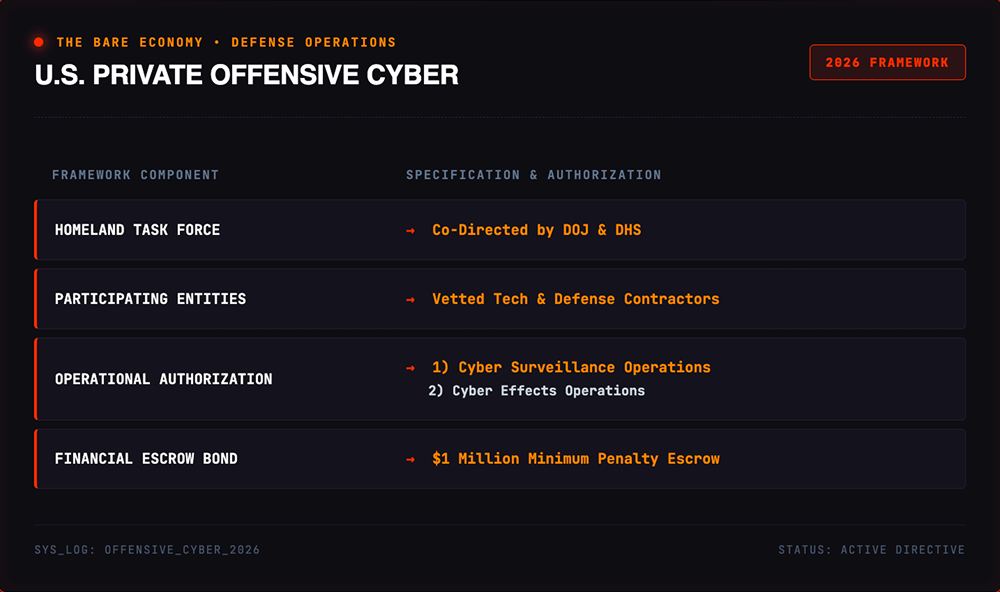
Central Oversight: The initiative operates out of the National Coordination Center (NCC) under the Homeland Security Task Force, overseen by co-executive directors from the Department of Justice (DOJ) and the Department of Homeland Security (DHS).
Two Operational Vectors: Vetted contractors will enter direct agreements with federal agencies to carry out two specific types of missions against foreign Transnational Criminal Organizations (TCOs):
Cyber Surveillance Operations: Infiltrating foreign networks to gather intelligence on ransomware rings, financial fraud syndicates, and state-adjacent threat actors.
Cyber Effects Operations: Executing active disruption—degrading, manipulating, or outright destroying foreign server infrastructure, botnets, and hardware utilized by cybercriminals.
Skin in the Game: Private contractors don’t get a blanket “license to hack”. They must undergo security background checks, get explicit written federal sign-off for specific targets, and post an escrow bond of at least $1 million that is forfeited instantly if they breach parameters or hit unauthorized systems.
His investing wisdom backs up this 32,481% growth story
Warren Buffett famously said: “If you don’t find a way to make money while you sleep, you will work until you die.” The answer may already be sitting on your nightstand… Their EarnPhone has already helped users save and earn over $1B, driving the company’s growth to an impressive 32,481%. Buffett also taught us to look for companies with: ✓ Simple business models (Mode pays users for phone usage) Now, with their Nasdaq ticker But their Buffett has spoken openly about the opportunities he missed by not recognizing certain transformative technology companies early enough. The lesson? 🚨
✓ Strong user base (490M+ users and growing)
✓ Proven revenue ($115M+ and climbing)
✓ Market leadership (#1 fastest-growing software company in 2023 - Deloitte)
(ad)
Why is Washington taking this leap now? The math simply broke down.
According to White House figures and FBI crime data, cyber-enabled crime cost American consumers and businesses over $20.8 billion in 2025 alone. Nearly three-quarters of American adults have fallen victim to online scams, ransomware extortion, or digital theft—with state-backed syndicates operating in overseas safe havens with complete impunity.
Government agencies simply do not have the operational capacity or speed to combat thousands of automated, AI-driven scams popping up daily. Enlisting the private sector’s engineering talent is Washington’s way of outsourcing the front lines.
Hi, I’m Dylan Jovine What a drilling team uncovered deep beneath Utah

This unexpected discovery in Beaver County has people saying it could change everything.Take a look for yourself >>>
(ad)
While defense contractors and cybersecurity executives are lining up to bid on these contracts, the directive is causing whiplash across legal and national security circles.
Foreign hackers don’t host attacks from neatly labeled server racks in Moscow, Beijing, or Pyongyang. They route their malware through hijacked, innocent civilian infrastructure—like a vulnerable router at an Ohio dental office or a regional hospital network. Striking back without hitting collateral targets is notoriously difficult.
If a private firm launches a disruption strike against a foreign server array, they risk accidentally destroying a server that the NSA or CIA has spent three years quietly monitoring to track higher-level nation-state intelligence.
When a private U.S. firm takes down foreign digital infrastructure, adversary nations won’t distinguish between a private contractor and the U.S. military. The risk of rapid tit-for-tat escalation against American power grids, financial systems, and domestic infrastructure is higher than ever.
Trump Warned Us: The Digital Dollar Is Coming
Back in 2024, Donald Trump stated he would never allow a Central Bank Digital Currency (CBDC) if re-elected. Why? Because he knows exactly what it means: With a CBDC in place, the government could:
Track every purchase you make
Decide what you’re allowed to buy
Freeze your accounts instantly with a click
In the wrong hands, this is the ultimate financial surveillance and control tool. Here’s the truth: 👉 That’s why we’ve created a
Click here to download your FREE report
Once CBDC becomes law, opting out may be impossible. Trump is trying to stop it, but until then, it’s up to you.Get the facts. Take action. Protect your money.
(ad)
Let’s strip away the technical jargon and look at the structural reality.
When nation-states can no longer protect their domestic economic borders using traditional military forces, they delegate the duty to private capital. Just as 18th-century empires issued letters of marque to privateers on the high seas, 21st-century superpowers are issuing digital letters of marque to cybersecurity firms.
This creates a brand-new sub-sector in the defense industrial complex: Billable Offensive Cyber. Expect venture capital to flood into private cyber-warfare startups capable of clearing the $1 million bond threshold and securing DHS/DOJ contracts.
If you’re managing capital or running a business, understand that the digital perimeter is about to get significantly more volatile.
Prepare for Retaliatory Noise: As private U.S. firms start knocking out foreign scam hubs and botnets, expect surge retaliation aimed broadly at American commercial networks.
Double Down on Defense: Ensure your organization’s air-gaps, offline backups, and zero-trust protocols are locked down tight. Don’t rely on the government—or its new private mercenaries—to protect your balance sheet.
Program directors have 60 days to publish the final operating guidelines. Keep your eyes on who gets awarded the first batch of contracts.
Keep your rigs moving, secure your networks, and stay sharp.
— Brook
The Bare Economy. From the road. For the road.
*Mode Mobile recently received their ticker reservation with Nasdaq ($MODE), indicating an intent to IPO in the next 24 months. An intent to IPO is no guarantee that an actual IPO will occur.*The Deloitte rankings are based on submitted applications and public company database research, with winners selected based on their fiscal-year revenue growth percentage over a three-year period.*Please read the offering circular and related risks at invest.modemobile.com.
No posts
Comments
Nothing yet. Say the first thing.
Sign in to join the conversation.