
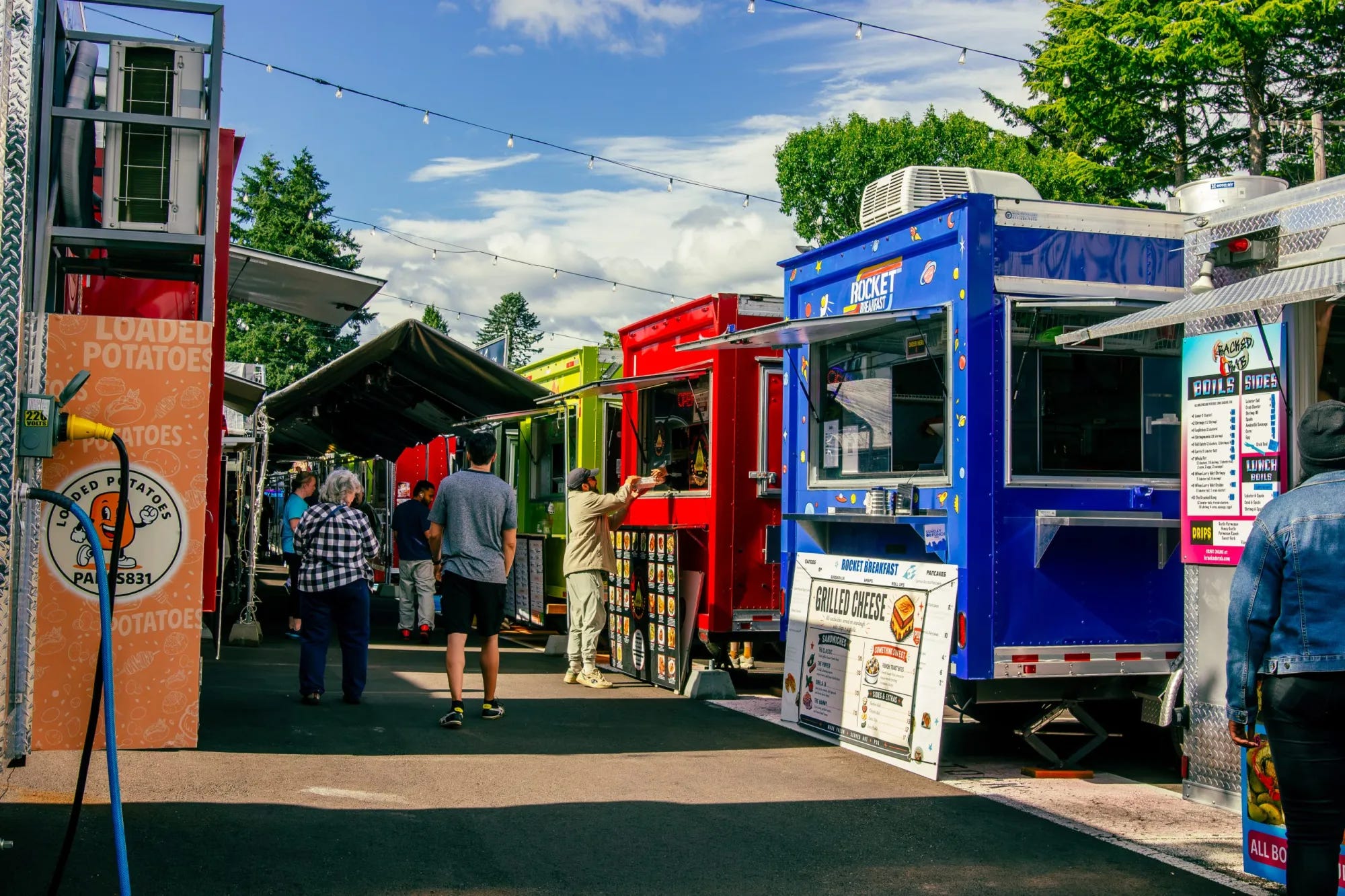
🗺️ Current Dispatch: Southeast Hawthorne & 32nd Ave, Portland, Oregon
⛽ Local Diesel: $4.15/gal
☕ Diner Coffee Index: $4.50 — dark roast, drip, poured at a timber bench near a pod. 8/10.
⏳ Days in trip: 36
Hi, I’m in Portland and I’m hungry.
I’ve parked the rig near one of the city’s iconic food cart pods on the east side. If you want a real, unvarnished look at how small business owners survive when traditional real estate math completely breaks down, you don’t look at downtown commercial leases—you look right at Portland’s street-level food cart ecosystem.
The Portland Mercury just released its updated list of the city’s top 20 food carts, highlighting everything from specialized regional tacos to high-concept Asian street food and wood-fired baking setups operating out of converted trailers.
While traditional brick-and-mortar restaurant owners across the Pacific Northwest are getting hammered by soaring commercial rents, rising utility overhead, and steep municipal permitting friction, Portland’s food carts are proving that lean, agile micro-capital can still win the street-level economic game.
Walking through a Portland cart pod isn’t just a culinary experience; it’s a lesson in lean operations.
Instead of taking on $15,000 to $20,000 a month in commercial lease liabilities, a food cart operator rents a small patch of asphalt inside a managed pod. They plug into shared greywater, electricity, and trash infrastructure, cutting fixed overhead by upwards of 70% compared to a traditional sit-down dining venue.
Here is why this model dominates the local landscape:
Low Capital Entry Barrier: An operator can launch a fully functional food trailer setup for a fraction of the build-out costs required for a permanent kitchen space.
Agile Menu Mechanics: With tight kitchen footprints, operators focus on hyper-specialized, limited menus. That means higher inventory turnover, far less food waste, and maximum yield per square foot.
Incubator Pipeline: The top carts serve as high-velocity market research labs where chefs build loyal consumer bases before ever signing a long-term commercial lease.
SpaceX's IPO made history. The stock hit $165 in a week.
But the most important part of this story may not be the rockets.
It's Starlink. T-Mobile just enabled Starlink satellite connectivity on every iPhone and billions of phones are coming online for the first time.
Starlink sells them the connection. That's where its job ends. But every hour those people spend on their phones generates ad revenue - and someone has to collect it.
I found the company doing it. 490 million users. A billion dollars earned and saved. 32,481% revenue growth - enough to make it the #1 software company according to Deloitte's fastest growing companies list in 2023. $11.8 million in EBITDA in 2025. And it hasn't gone public yet.
Series A open at $0.52/share.
But on August 14, the opportunity to invest at this price closes — and it's gone after that.
Every previous round sold out. I don't expect this one to last either.
Please read the offering circular and related risks at invest.modemobile.com. This is a paid advertisement for Mode Mobile’s Regulation A+ Offering.Mode Mobile recently received their ticker reservation with Nasdaq ($MODE), indicating an intent to IPO in the next 24 months. An intent to IPO is no guarantee that an actual IPO will occur.The Deloitte rankings are based on submitted applications and public company database research, with winners selected based on their fiscal-year revenue growth percentage over a three-year period.Pro forma revenue and EBITDA, includes full year numbers of the businesses acquired throughout 2025.
(ad)
Following that top 20 list, here are 5 standout food carts across the Rose City that showcase exactly how lean, high-velocity micro-eateries operate on the ground:
The Pitch: Central Texas-style pit barbecue served straight out of a custom trailer.
The Unvarnished Pick: The brisket and house-made jalapeño cheddar sausage. They smoke over real white oak, generating incredible bark and deep flavor without requiring a million-dollar restaurant footprint.
The Pitch: Hand-pulled, artisan Chinese noodles made fresh to order right inside the cart window.
The Unvarnished Pick: Beef La Mian or the chili oil hand-cut noodles. Watching them stretch dough by hand in a space smaller than a walk-in closet is a masterclass in spatial efficiency.
The Pitch: Massive, comforting soul food plates that draw lines around the block before the hatch even opens.
The Unvarnished Pick: The loaded smoker plate—packed with smoked ribs, mac and cheese, smoked yams, and cornbread. High volume, heavy portions, and zero corporate filler.
The Pitch: Hyper-focused, rapid-turnover dumplings that serve maximum comfort on a cold Pacific Northwest afternoon.
The Unvarnished Pick: Traditional buttered beef pelmeni topped with sour cream, dill, and a dash of hot sauce. A simple, low-waste menu item executed to perfection.
The Pitch: Local, organic Indian street food with a distinct Pacific Northwest farm-to-cart twist.
The Unvarnished Pick: Cardamom chai chicken over fragrant basmati rice or the turmeric-panko fried chicken. High-grade ingredients cooked with minimal operational overhead.
Let’s strip away the foodie reviews for sixty seconds and look at the underlying economic machinery.
When traditional commercial real estate models impose prohibitive fixed costs on small business owners, private enterprise adapts. Portland’s food cart pods are essentially decentralized retail incubators. They allow operators to test consumer demand, adjust pricing in real-time, and preserve precious liquid capital during volatile inflationary cycles.
In an environment where consumers are tightening their belts on high-end dining, a $14 street-level meal cooked right in front of you delivers maximum value for every dollar spent.
If you’re looking at launching a local business or deploying capital in the service sector, study the food cart pod model. Stop chasing high-overhead real estate built for an economic era that no longer exists. Focus on low-friction, high-turnover setups that keep fixed expenses minimal and protect your operational flexibility.
Keep your eyes on the road, hold your ground, and eat well.
— Brook
The Bare Economy. From the road. For the road.
(ad)
No posts
Comments
Nothing yet. Say the first thing.
Sign in to join the conversation.