

🗺️ Current Dispatch: I-5 Corridor, Grants Pass, Oregon
⛽ Local Diesel: $4.18/gal
☕ Diner Coffee Index: $3.75 — black, strong, served in a heavy ceramic mug near the old timber mills. 7/10.
⏳ Days in trip: 35
I’ve pulled the rig off Interstate 5 into Grants Pass, Oregon.
Around here, everyone knows the story of Dutch Bros Coffee. Founded right here in 1992 by Dane and Travis Boersma as a single pushcart near the railroad tracks, it grew into an iconic West Coast drive-thru juggernaut. It represented the raw, entrepreneurial grit of Southern Oregon: hard work, community culture, and local pride.
So when news hit that Dutch Bros quietly shifted the vast bulk of its executive leadership, corporate operations, and headquarters support functions down to Phoenix, Arizona, it sent a shockwave through the local community.
Mainstream media outlets covered it with polite corporate boilerplate—calling it a “strategic expansion” to support nationwide growth.
Let’s strip away the corporate PR spin and look through the windshield at what’s actually happening. This isn’t just a routine corporate relocation. It’s a textbook case study in how hostile state policy, rising regulatory friction, and broken regional math are forcing successful businesses to abandon the very soil that built them.
The Unvarnished Truth: Oregon’s Self-Inflicted Corporate Flight
Corporate leadership rarely moves across state lines because they suddenly fell in love with 110-degree summer heat in the Sonoran Desert. They move because staying put becomes a liability to their shareholders and operational survival.
Here is what the polished media headlines leave out about why Dutch Bros shifted its corporate center of gravity away from Oregon:
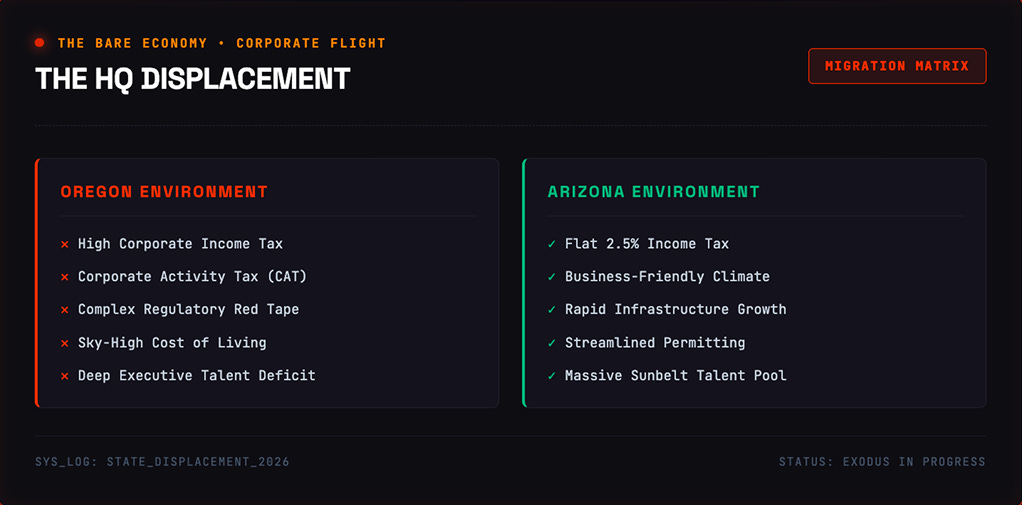
1. The Corporate Activity Tax (CAT) & Stacking Friction
Oregon introduced the Corporate Activity Tax (CAT)—a tax levied on gross receipts over $1 million, regardless of whether a business actually turns a profit. For high-volume, low-margin retail and beverage models, taxing top-line revenue rather than net income is an absolute margin killer. When you add high state personal income tax rates for upper management, attracting top-tier executive talent to Oregon becomes a steep uphill battle.
2. The Sunbelt Talent & Logistics Gravity Well
As Dutch Bros executes an aggressive national expansion—aiming for thousands of locations nationwide—Phoenix offers a massive, central logistics hub. Phoenix has turned into the capital of Sunbelt corporate relocations, offering a deep talent pool of franchise executives, streamlined municipal permitting, and direct access to major growth corridors across Texas, the Southeast, and the Midwest.
3. The Local Infrastructure Decay
While Phoenix invests heavily in regional highway infrastructure, commercial zones, and housing developments, Oregon’s metro and state corridors have struggled with severe housing shortages, escalating municipal red tape, and an increasingly hostile posture toward mid-to-large-size employers.
Before Jensen Huang says it publicly
Last time Jensen Huang made a public statement about this technology — optical stocks surged the same day.
That was the confirmation.
Not the discovery.
The people who knew before he said it were already in.
Jason Bodner is naming what Huang will confirm next — free.
Read it before Huang says it
(ad)
Comparing the Grid: Oregon vs. Arizona
When corporate boardrooms sit down to run the multi-year spreadsheet, the math leaves zero room for sentimentality.
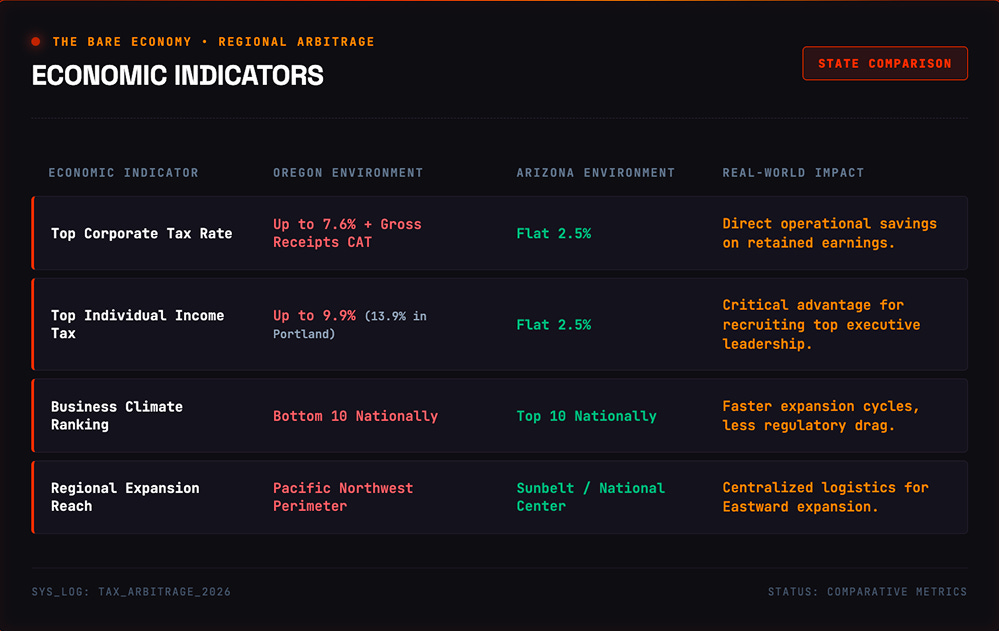
When a public company looks at that table, the decision isn’t emotional — it’s mandatory.
The Macro Extraction: The Loss of Local Economic Anchors
What hurts most about the Dutch Bros quiet departure isn’t just the loss of corporate payroll; it’s the erosion of community anchor capital.
When a homegrown company expands, it creates a localized wealth effect:
Executive salaries are spent in local shops, restaurants, and real estate markets.
Corporate charitable foundations pour millions directly into regional youth programs and local hospitals.
Secondary service providers—local law firms, accounting practices, marketing agencies, and construction contractors—thrive on corporate contracts.
When the corporate core migrates to Phoenix, those secondary and tertiary economic benefits vanish with it. Oregon is left holding the low-wage retail shop positions, while the high-yield, decision-making wealth gets exported directly to Maricopa County.
The media likes to frame this as an isolated corporate story. The reality is that this exact scenario is playing out across multiple high-tax, high-friction states. When local governments treat successful businesses like guaranteed revenue cows rather than economic partners, those businesses eventually do what any mobile asset does: they pack up and leave.
The Driver’s Execution
If you’re deploying capital or running a business today, pay attention to where corporate headquarters are physically voting with their feet.
Capital flows to where it is treated best. Watch the ongoing migration of corporate footprints out of high-friction coastal states toward the Sunbelt and Intermountain West. It tells you everything you need to know about where future job growth, commercial real estate demand, and tax base stability will land over the next decade.
Keep your eye on the physical footprints, watch the state policy trends, and hold real assets in business-friendly jurisdictions.
Keep your eyes on the road, hold your ground, and stay out of the corporate white noise.
— Brook
The Bare Economy. From the road. For the road.
The Fed just inherited Congress’s problem
House lawmakers just advanced a $95 billion package.
The vote was 216–214.
No offsetting cuts were required.
Lawmakers also passed another temporary funding bill. It only delays the next shutdown fight.
That’s Washington’s solution: extend the deadline, borrow more, and leave the Fed to handle the fallout.
See the numbers behind this spending mess.
And why some retirement savers are turning to this asset.
Claim the FREE Wealth Protection Playbook. Learn how a properly structured Gold IRA could help diversify savings before Washington delivers its next massive spending bill.
(ad)
Thanks for reading The Bare Economy! Subscribe for free to receive new posts and support my work.
Comments
Nothing yet. Say the first thing.
Sign in to join the conversation.