
As a lover of coffee shops, bars, and public gathering spaces generally, I’m almost always more interested in how I feel in a space more than the product itself. I’d rather frequent a dive bar with good vibes and a decent cider over a cold and unwelcoming environment with the most delectably made 6 ingredient cocktail (and if you know me, you know I love a cocktail).
So it follows that as a dance organizer I’ve always been (some would say overly) interested in making how our halls speak to dancers. I want the hall to embrace and energize old and new dancers. I want it to be a place that people want to return to over and over.
Having been to many small dances around the country, I often think it would help dances grow to pay just a little more attention to how our halls feel for two key reasons:
Most newcomers will not have their first, second, or third impressions of our organizations, and usually contra dancing, be of contra dancing itself. It will be the way the hall looks when the door opens, the welcome table, the experience of standing around the hall waiting for the lesson to start. By the time they step into the lesson their impression of contra is firmly established, all without ever hearing a potato.
The easiest way for organizers to communicate authentically that they care about their experienced dancers is by creating a welcoming space for them. Forming a bond with every newcomer is hard, and unrealistic. But creating a warm and welcoming atmosphere that feels like stepping into a swing with an old friend? Totally doable with a few extra minutes, a little attention, and intention, each dance.
It's important to note that there are a few very good reasons for organizers not to pay attention to how the hall feels. As long time dancers we are here to dance, and to see our friends. I could be (and have been) perfectly and completely happy waltzing anywhere at the drop of a hat with people I love, no hall necessary. Secondly, there are a million demands on our time as volunteers. Making the hall cute and welcoming is often added on top of a fairly busy and stressful experience of setting up a dance, and can involve bucking some contra dance cultural trends. But probably the biggest impediment to making a hall nice is that it requires us to look at it, warts and all, as a new person might. It's natural just to see things as “the way things are” and not think about how they are perceived by fresh eyes (or ears, or noses), and it’s easy to lose track of how we are perceived by the public over time.
However, as we strive to keep our shared tradition growing as a viable alternative to mass produced culture, it's worth looking through the eyes of new dancers who will need to carry our traditions forward.
Running through all of this is an underlying assumption of mine about business appearance: people notice far more than ever crosses their conscious mind. Similar to how meaning is communicated with body language and facial expression as well as words, our contra halls (and any place of business), communicate far more with how we look, and how the hall “feels” than we give credit for.
This idea, and the framework for addressing it, is drawn largely from the excellent book “Marketing Without Advertising” by Michael Phillips and Salli Rasberry that puts forward four key items to think about for a businesses physical space (this and a few other valuable books are in the shopping list below):
It should conform to, or exceed, the norms of the business you are in.
I think of our contra dance as in the entertainment industry, competing with other dance halls, music venues, nightclubs and other places for people to hang out and be in the evening.
It should be squeaky clean
It should have an appropriate smell
It should be uncluttered
To this I’ve always added that our dance should have a unified approach to decoration (carrying out our brand into the hall) that evoke a folky and rural feel.
While I could go on and on about the why’s of making our halls more welcoming, I think that most organizers probably share the view, but feel hamstrung by how to move forward. If you're convinced, find below a few easy ways we’ve made our hall cute over time!
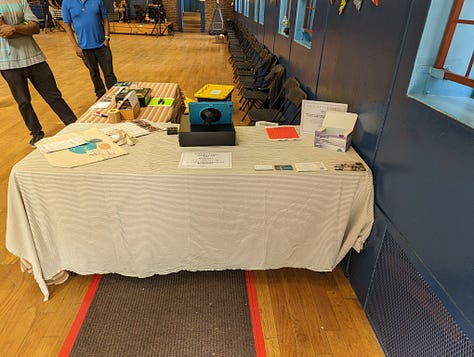
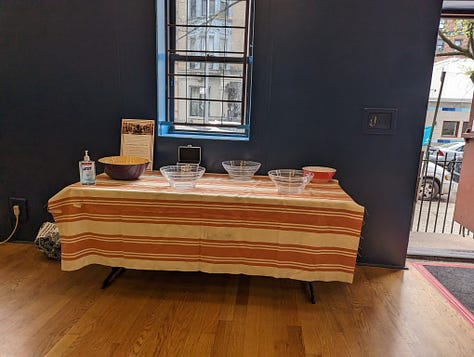
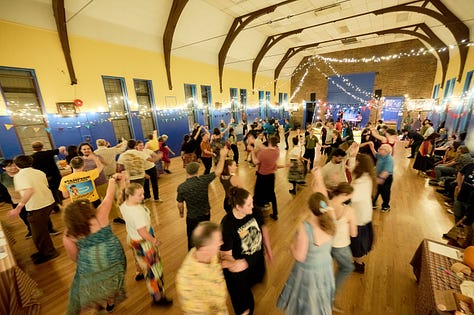
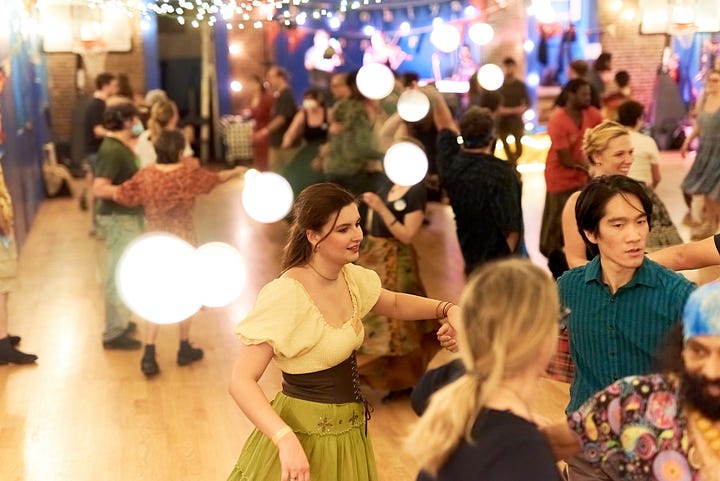
(where cheap is defined as “you could do all of this stuff with one $500 grant from CDSS”):
Turn Down the Lights (Free)
I will never ever forget being walked up to by a blues dancer I knew and being asked “Joe, why are contra dances so (expletive) bright.” A deliberately lit hall can signal to people they are in a social space, make folks feel like they are out for an evening of fun, and generally set the mood. What level you set the lights at is up to you, but here is something to think about: Most gyms, rec rooms, assembly spaces, etc., when fully lit are more than 50 foot-candles (a measure of brightness that is in fact like standing one foot away from a candle). For dining, an industry rule of thumb is 10 foot-candles at most. Same for dance halls etc. Assume that we want to double that to allow for a broad range of ages, call 30 foot-candles more than adequate for a contra dance hall. We can save energy, be more inviting, and be very inclusive, all at the same time. You can easily find an app for your phone to measure foot-candles, and read more about all this at this Lighting Guide.
Turn on some tunes ($30)
Have you ever been to a music venue that didn’t play music before the opening act went on, or between sets? Music makes a hall come alive, makes setup and break down more fun and helps folks feel less awkward as they sit around waiting for the lesson to start or eat their snacks, and yet many contra dances leave newcomers to mingle in a silent hall.
It's really easy to play music from your phone into either your main soundboard (for during the dance), or directly into a monitor for before or after the dances. We’ve included an amazon list (I know, it’s terrible, but Sweetwater and other smaller stores don’t carry a lot of the weird cables) of useful tools for getting canned music into your board below (it's going to come out of your phone as stereo, so you need two channels on your board), as well as some of our favorite playlists.
As an aside, we’ve heard it said that “musicians like to only have their/live music played in the hall”, but again, all music venues play music before, between, and after live music. If every bluegrass musician who’s ever played the Ryman can handle some canned music, our folks can too.
Tablecloths ($150ish):
Buy some nice cotton fabric in colors that match your logo, have the person on your organizing committee who owns a sewing machine run some long hems, and Bob's your uncle. Nothing cuter.
Declutter Everything (including the stage) (Free)
There are a few things on this list that ask us to ask others to change their behaviors, which is not fun, I know. Decluttering is one of them. Few people like an ill thought out cluttered vibe, but it's so easy to generate. Removing it requires intention, but its easy!
Look at your front table, your flyer table, your snack table and see if you can add a little space, or take some things off.
Simplify any bulletin boards by removing old events.
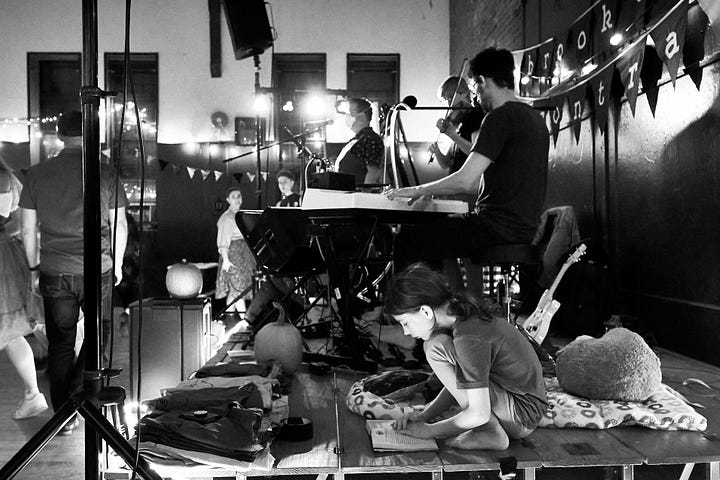
Ask your band to move their stuff off stage. Look at a stage the next time you’re at a lo-fi indie venue. Musicians don’t have their cases, coats, etc., etc. on stage. If they can do it, so can we. We’ve made a space for band gear off stage, and ask so often for stuff to be moved. We’ve also bought several types of stands for instruments (see Amazon list, but also, these things are available on Sweetwater so buy them there) to get cases off the stage.
Have a designated space for people to store their coats and bags. We recently invested in a collapsible coat rack that (almost) fits in a box.
Make Your Bathroom Nice ($60)
My dear colleague Christin has been on a tear for years about our bathrooms. After much experimentation, we’ve fixed upon a divided box for our bathroom. In it goes tampons, aspirin, ibuprofen, a box of mints, some bandages and hair ties. We open the window and light a candle. It takes three minutes to set up when we arrive, and clearly communicates to our dancers that we care about their whole experience.
Think about the Smells (Free)
I was sitting in a classy cocktail lounge during our last Brooklyn Contra meeting, when suddenly the distinct odor of fried fish invaded my nostrils. All at once I was in a British chippy, with an overly expensive glass of alcoholic carrot juice. Nothing can change the emotional character of a place like a smell. That’s why we ask everyone to eat strong smelling food outside (or in our kitchen), select odor free snacks, and do as much to aerate the place in the summer as we can. We obviously wouldn’t try to introduce artificial scents to the dance hall, but I wish I had the bandwidth to bake fresh banana bread for every dance, and relish the times when Sarah and Joanna bring their fresh baked cookies.
Re-do Your Signs and Think about Confining Them ($30)
There are three deliberate things about our signage:
They all have our unified look. Same border, same font, same orientation.
We provide guidance around our hall to bathrooms etc. etc.
We don’t use signs to instruct people how to behave. I recognize this runs counter to current popular practices, but I feel that signs that instruct behaviors all over a space feel condescending (a bit like a kindergarten), and also, often create a climate of fear when one may not be warranted (akin to a “block watch community, criminals beware” sign in a perfectly safe suburban community). The critical messages in many signs can be conveyed as part of a lesson, from stage by organizers, on websites, and in event materials like a facebook event. If you need to speak to your community as a whole it can be done at an advanced dance, or annual meeting. That said, signs can be helpful in communicating policies, and I have always appreciated the signage of the House of Yes, a very queer, very risque nightclub in NYC. HoY values consent and has clear community norms. They post their consent policy on their website, on every ticket purchase, and in one beautiful, very glittery sign that you can’t miss in the bathroom line. A set of well designed, elegant signs in the bathroom is unmissable, but doesn't become a constant presence in the hall.
Make Welcome Signs ($50)
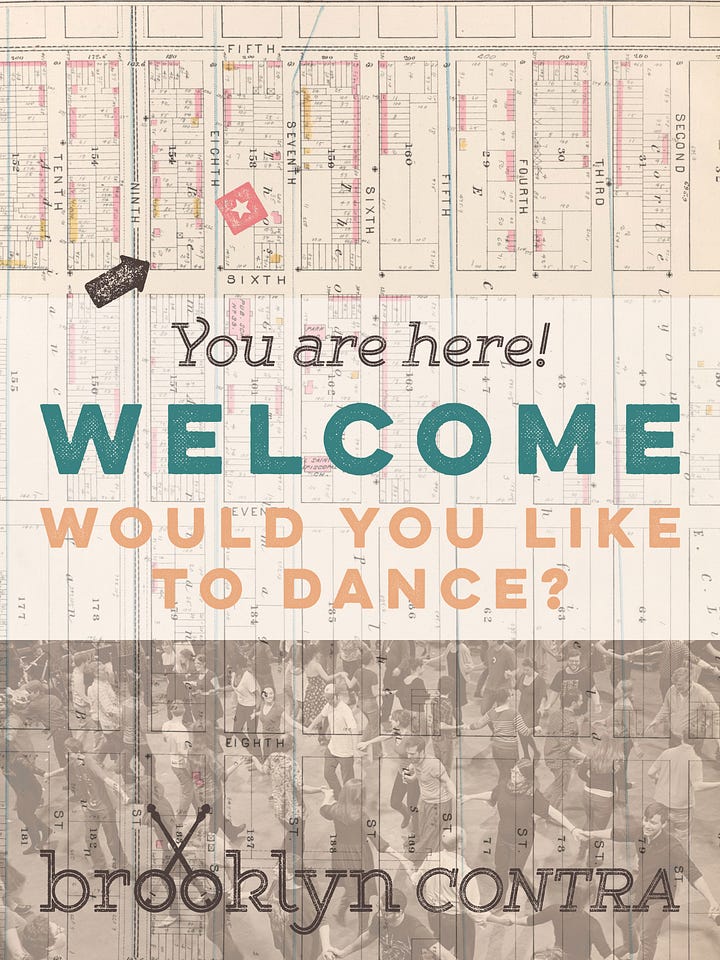
Our spaces are often hard to find, so putting up adequate signage to help people find the hall is key to newcomers arriving feeling guided and cared for, rather than stressed out and irritated. We’ve got a magnetic sign for our door from vista print that is nicely designed. A printed out set of signs with arrows would do as well. You could always print them on white paper, but you can also buy a 150 pack of printable brown craft paper that will go through a home laser printer for cheap. Instant cute, not much work.
Make a Banner ($150):
For years Brooklyn Contra has had a beautiful handmade banner by our former organizer Avia Moore, hang behind its musicians. It helps frame the stage, helps people know they are at a place that takes pride in what we do, and makes it feel much more official. We also have a pretty great printed banner (from VistaPrint), that goes out in front of our hall.
Run some bunting ($50)
Nothing helps our dull walls come alive so much as our bunting, which is just cheap cloth, cut into triangles with pinking shears to prevent unravelling, and then sewn onto ribbon. It goes up before each dance, and comes down after. Ours was made almost 10 years ago and it's still beautiful.
Brooklyn Contra has invested large sums and hundreds of human-hours in making our hall feel like home. If you're a contra dance that has that kind of resources, think about going a bit further! Some of this stuff requires significant setup, but we’ve never had a problem finding help to take it all down. We’re out of our hall in an hour, including sweeping and mopping the floors, after even the biggest special events.
Take control of your lighting:
We’re more and more interested in how far we can take our lighting. After years of a chandelier for special events that we made up every time we now run a chandelier made of Christmas lights at almost every dance that provides most of the light in the hall. It’s pre-made with wires that hold the lights, and one person can hang it in 25 or so minutes (as long as OSHA isn’t watching). It's too complicated to explain here, but email us if you want plans!
Get a Stage:
We dance in what is little more than a converted gym. For 10 years that meant bands on the floor with a lighting strip around them to keep folks off the speakers stands. About 3 years ago we got a hand me down stage for free that we used for special events, and it made all the difference. It was just 18 inches high, but totally changed the character of the space.
Make a space for socializing
Our board member Sara pointed out that most social dances have a dedicated space for socializing off the dance floor. That's not the norm in a contra dance hall. It's a hard thing to do (we don't have one), but perhaps think about if you have a downstairs, or an outside space that you could do just a bit more for. This spring we added benches to our sidewalk and people love them.
There is a fourth argument against making it cute. We don’t want contra dance to be “popular”.
I think it's important to be realistic. Many many people contra dance because it's where their friends are, and it's an activity they enjoy with their friends. We have our own subculture. Keeping our halls “ugly” (as one organizer recently described their hall of 30 plus years on the Shared Weight listserv, despite having hundreds of thousands of dollars to invest in improvements), means that we screen out people who are not immediately drawn to the people in the room. These newcomers may not be from our subculture, they won’t be our friends, and they will be bad dancers (to start). Keeping a hall “ugly” is an easy way to screen out newcomers who are there for the experience, not the people.
This said, using Contra to support a particular community can be so valuable, and beautiful; the best example being Lavender Country and Folk Dancer dances, who have done gender free calling since the 80s! But by identifying as bringing together queer community as part of their mission they are able to support a particular social group, without having to use a less appealing hall as a filter.
Worry more about setup time than breakdown time:
We’ve noticed the more lovely we make our hall, the more people like it and are willing to help make it happen. That translates into more setup volunteers, and even more people staying to help break down, so I worry much less about what it takes to break something down than to set something up. In fact, our hall is a little too inviting now! We have to shoo people out to the afters at the bar almost every time!
I know, I know, we think we’re not a business:
Several times I’ve referred to contra dance as a business, which may rub people the wrong way. Partially that is because of my background as a sustainable business person, but it’s also the reality of what we are doing. There are valuable lessons for us to take as organizers from ethical businesses and the hospitality industry that we may miss out of a proud conceptualization of ourselves as non-profits and communities. (Obviously there are also valuable lessons from folk organizing traditions, place makers, and hosts of all types!)
Finally, finally, I do want to recognize that the vast majority of us are volunteers, existing in rented halls; there is only so much we can do. It's worth being judicious with what we take on. To preserve our own time and sanity, we focus on projects that take more time up front, but are simple to set up at every dance. For an average dance, our “cuteness” probably adds about 1 human-hours worth of work to our setup (there are usually 4 or 5 people there for setup, so overall it just means we get there 15 minutes earlier). For breakdown, it's even less with the 15 or so people who help us break down every event.
This is a guest post by Joe! The views represented are not those of Brooklyn Contra. For more info see this article.
Amazon List of Books and Things for Making It Cute
We Love Sweetwater.com for sound gear
Brooklyn Contra Playlists
Music for Halls With People in Them (i.e. chill music that won’t randomly drive away dancers ;) ).
Comments
Nothing yet. Say the first thing.
Sign in to join the conversation.