
Post by Joe and Christin (all opinions are ours)
Contra dance organizers find ourselves called upon to be stewards of a tradition, conflict mediators, community shapers, marketers, bookkeepers, event planners, sound engineers and project managers of volunteers and contractors. Each of these skills are as concrete as putting together a program of dances and as creative and ethereal as musicians matching the dancers’ vibe and driving it higher and higher - and as we’ve been doing our own reading on these many topics, we wanted to share what we’ve learned and offer them as resources for other organizers.
We often jump into these tasks with giving hearts but little formal training in applying our skills to the specific work of community dancing, and are taking these roles in service to an existing community. In the current culture, contra organizing is characterized as a series of logistical boxes to check rather than as a joyful creative pursuit in and of itself. In doing so perhaps we miss an opportunity to further our shared goals of creating social connection through traditional dance. Arts programming, creating beautiful events, stewarding the future of a folk tradition, each of these are creative pursuits in and of themselves that involve hard skills that must be learned to do the creativity well.
That being said, I don’t think any of us are going back to school for dance organizing anytime soon, and adding skill-building to our existing workloads can seem like a hard ask. But there are some very amazing books on all that we do, that are often culturally aligned with the world we want to see. We’ve been delving into a few of them over the past year, and wanted to pass on some recommended reading. Each of these books are approachable reads that we hope you enjoy, and that inspire your creativity in organizing your dances!
(A quick note on monetization: BkC has not monetized any of these links! We’re providing both indie and Amazon links to the extent we can find them to let folks choose the best route for their delivery).
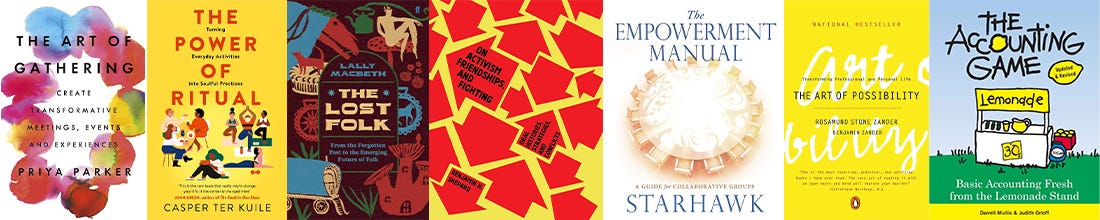
by Priya Parker
In this fundamental book on executing a gathering, author Priya Parker dares hosts to create transformative gatherings, and take risks in the process. In a guide both theoretical and practical she calls on hosts to be active, deliberate and brave. From the expectation to define a “disputable” purpose for your gathering, to the condemnation of chill hosts, to the art of deliberate exclusion, each of the chapters offers lessons and controversial arguments that - even if you don't agree - will sharpen definition of what the work of organizing a gathering is, and how you want to do it.
What practices give our lives meaning on a day-to-day level? When we better understand the practices and what they consist of, we are better able to find (or create, or join) group activities that bring structure, connection, and purpose. This book identifies a handful of aspects that many rituals share, discusses what it is about these specific qualities that serve to bring us together, and offers concrete steps alongside many, many fascinating examples. It helped me understand the existing loose rituals of our community in a new light, and affirmed quite a number of things we already do. I kept pausing to scribble down ideas or text a co-organizer with my latest “aha!” moment, and I’ll definitely be re-visiting this one.
by Lally MacBeth
The question of “who is folk culture for” is at the heart of how we design our dances. This wonderful exploration of English folk culture inquires deeply into exactly that topic, looking at those included, and those left out, of the folk culture of the past, with an eye to creating a broader folk culture of the future. Through looking at collectors and collections, objects and worlds, the author inquires into the process of folk creation, who creates it, who practices it, and who gets to benefit from it. Looking at gender and class, race and cultural identity, the author points towards a more inclusive folk past and future.
by Rosamund Stone Zander, Benjamin Zander
As perhaps the only book on leadership to ever inspire a whole series of tattoos, this is the only book on leadership I’d recommend to beginning contra organizers. Presented as a series of vignettes on topics often very suited to contra dance organizations, (taking leadership from every chair, finding learning and fascination in small failures, telling the WE story), the authors (two artists themselves) invite everyone to step into leadership, and to take joy and find possibility in that process of creation.
by John Doerr
Cue every single tech person reading this substack rolling their eyes1. Penned by the first venture capital investor in Google, this book sets out his system of organizational planning and goal setting, Objectives and Key Results. While this might seem an odd choice, at its heart it's about setting big goals, and achieving them through simple, measurable outcomes by people who have indisputably changed the world, and run effective organizations. It’s a short read, and an inspiring one. In the end any strategic planning process comes to it being appropriate to the organizational structure (for us that means simple), and engaged with on a regular basis, not left to sit on a shelf. This framework works well for that I think, and Brooklyn Contra has used it for the last few years to good effect (read more on that here).
by Benjamin Heim Shepard
An oral history of the social connections formed through participation in activist groups, by a longtime NYC activist whose political involvement has included ACT UP, Occupy Wall Street, Time’s UP, and many others. A relatively academic but easy read, sharing stories of activist/organizing community spaces where people come together for a purpose and in the process of being on the ground become friends, lovers, roommates, partners - and exes, and occasionally even opponents. As dance organizers and cultural shapers who are ourselves part of the close-knit contra-folk community, our relationships with one another affect and are affected by our shared projects - think of any time you’ve said “do you want me to answer as a friend or with my organizer hat on?” or navigated giving performance feedback to an organizer’s spouse. Even if you don’t think of your own organizing as an activist project, this book will remind you that an amount of conflict is actually quite normal when imagining a different version of community, and that with care and consideration conflict can hopefully even be rewarding and generative.
by Starhawk
How can we navigate working on an ongoing creative and logistical project, where our visions may not always align, where we are socializing as individuals within the community and forming friendships and cohabitations, when we care deeply about the shape of the outcome… and everyone is a volunteer? Starhawk’s guidance on navigating collaborative, non-hierarchal group dynamics comes from decades of participation in environmental activist groups, and addresses the unique kinds of problems faced by organizations with this particular structural bent.
Unlike in a workplace there aren’t outside structures or incentives to fall back on, and for many of us, folk cultures are where we get to “be the change” and create structures for work that are egalitarian, constructive, and based in mutual respect. As such, running an organizing committee can be a hodgepodge experience in ways that challenge the usual advice and defy easy categorization - it’s like an arts co-operative, and like a small business, and like community organizing but also isn’t quite any of these things. I found that this book is unique in that it addresses the specific social dynamics of this kind of work, and has compassionate and realistic advice about the challenges and opportunities we have.
While the framing devices can be a little - okay, very - hokey, the social leadership skills are valuable. It’s worth considering the roles present in your team, whether they’re formally assigned or not, and how our personalities and relationships with one another can constructively influence our organizing, or be tweaked to get along with productive rather than destructive conflict.
by Michael Phillips, Salli Rasberry
A large base of returning dancers (customers) who recommend our dance to their friends is the dream of every dance organizer. More and more, in a competitive and fractured advertising environment, it can be the only way for a dance to sustain itself and grow. This book is about how businesses can make just that happen. While it will feel dated now, the core concepts and approaches are still as relevant as ever, and will challenge most contra dance organizers to think deeply about how their dance welcomes new dancers (have you ever thought about how your dance smells?), and enables experienced ones to share their joy. While it’s a book strictly about commercial business, it’s written from the perspective of a business owner who sees business as the process of enabling a fair exchange of value in a way that speaks to best that business can be, and will probably mesh nicely with contra organizers’ ethos.
by Darrell Mullis and Judith Orloff
For anyone starting off as a contra organizer, gaining a basic understanding of finances is critically important, both to make sure your organization is staying on track financially, and to avoid large intragroup power imbalances that can come from different understandings of such an important and sometimes cryptic topic. This book provides a lighthearted introduction to all the basic topics of accounting and finance without too much self seriousness.
by Phil Jamison
You know how there are always books on your summer reading list you don’t quite get to? This is the one for us! But it comes highly recommended, and obviously we should read it (it’s next on the pile we swear) and we’ll update this when we get to it!
by Bob Mills
Sound mixing is a key skill for any group of organizers to have and…….sometimes folks like to make it out to be more complicated than it needs to be…..This straightforward guide gives a great overview that will equip any group of organizers to get started with sound engineering for folk music. It won’t be perfect, but you can do it! The only caveat is that the gear section is a little out of date regarding speakers and sound boards (but everything else holds up remarkably well, though it would be hard to buy anything at RadioShack anymore).
An E-Book published by the British Music Venue Trust, not all of this will apply to contra organizers, but as the only DIY guide to running music venues that sit at the crossroads of community and commercialism I could find, much of it rings true to the experience of trying to scale up and formalize a contra dance organization. From handling bands, to thinking about your business with fresh eyes, the overarching lessons are all important (and you’ll be able to skip a few chapters since they pertain specifically to British legal concerns).
If you only have time or energy for a short dive into thinking about event organizing as community-building, we recommend starting with this e-booklet. How We Gather briefly maps ways that secular communities are playing roles formerly filled by churches and religious life. If you’ve ever gone to a new dance in a new city and thought “These really are my people” while stepping right into the familiar rhythms of the event, you’ll understand how contra dances share themes like Social Transformation and Creativity with the projects and organizations listed. Recognizing similarities to other groups is a low-investment way to start thinking about dance-running as a project that’s bigger than the sum of its logistics.
I know. This book is the quintessential techy book on goal setting and strategic planning, setting forth the idea of Objectives and Key Results, to which many tech workers have been subjected relentlessly over the years. You probably don’t like Google (I don’t), but I can still find useful thinking from people I might disagree with on other points.
Comments
Nothing yet. Say the first thing.
Sign in to join the conversation.