
Hi Friends,
Remember me? It’s been a minute.
I do have something to show for my time away, though! A Practical Guide to Teaching Creative Writing: Supporting Inclusive Pedagogy, co-written with John Vigna, is now available from Bloomsbury Academic. I held the book for the first time last week at AWP in Baltimore!
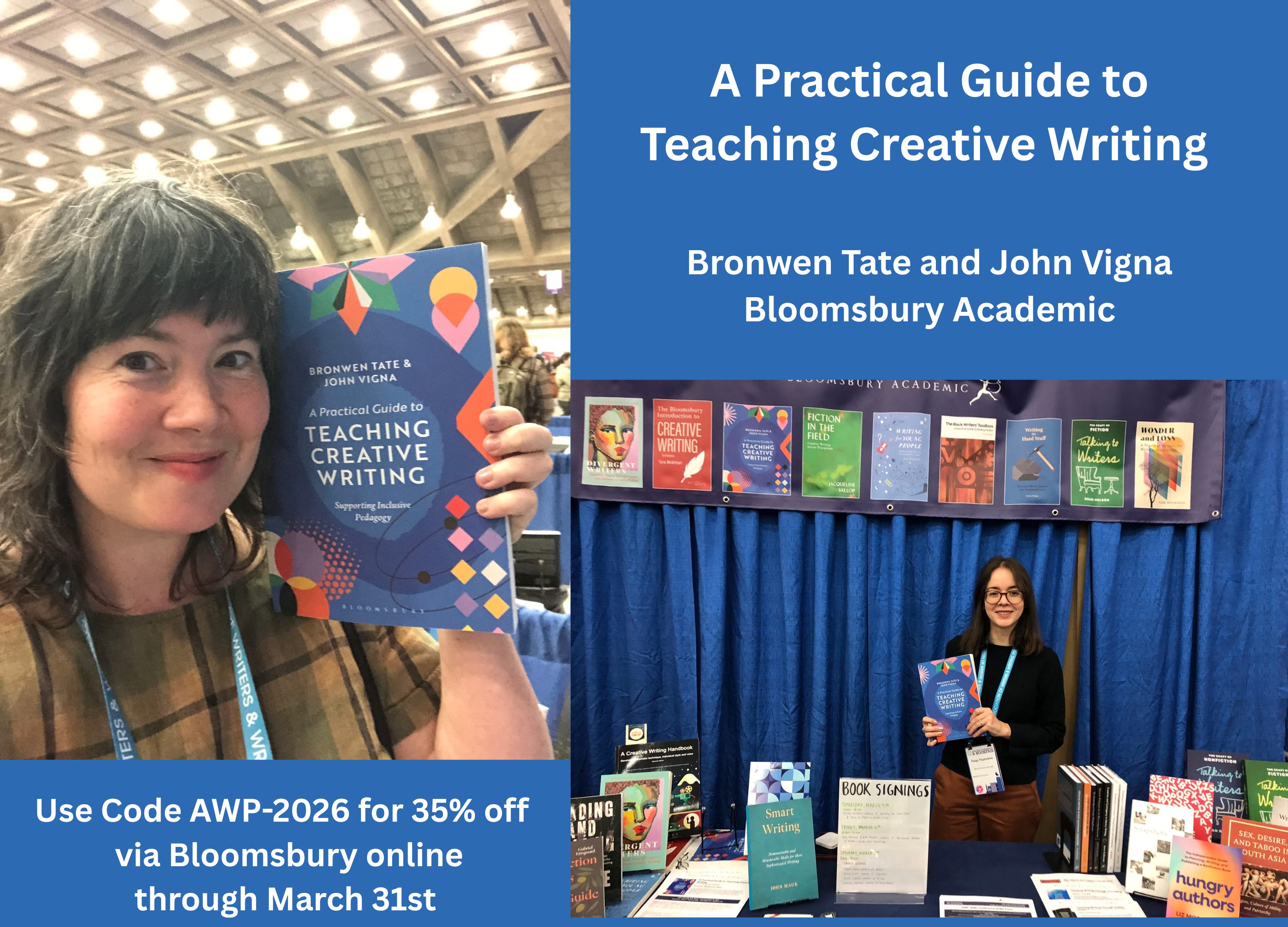
I’ll talk more about the making of this book soon, but for now I just want to share a few invitations:
[In Vancouver + via Livestream] Book Launch at Green College, UBC March 18th at 5pm. The launch will feature a preview of the book, a conversation moderated by our colleague Alix Ohlin, and a chance to connect with others who care deeply about the thorny questions and magic alchemies of creative writing classrooms.
[In Vancouver] UBC School of Creative Writing Faculty Book Showcase, March 26 at 4pm. A nerdy behind-the-scenes on the making of the book (including roughly one million collaborative Google docs)
Bloomsbury extended their AWP special through March. Use code AWP-2026 at the Bloomsbury site to receive 35% off our book and other creative writing titles.
Over time, I’ve come to realize that problems aren’t an impediment to writing. Problems are the substance of writing: we set problems for ourselves and we work them out. In this feature, I ask writers to dig into a specific writing problem and how they resolved it.
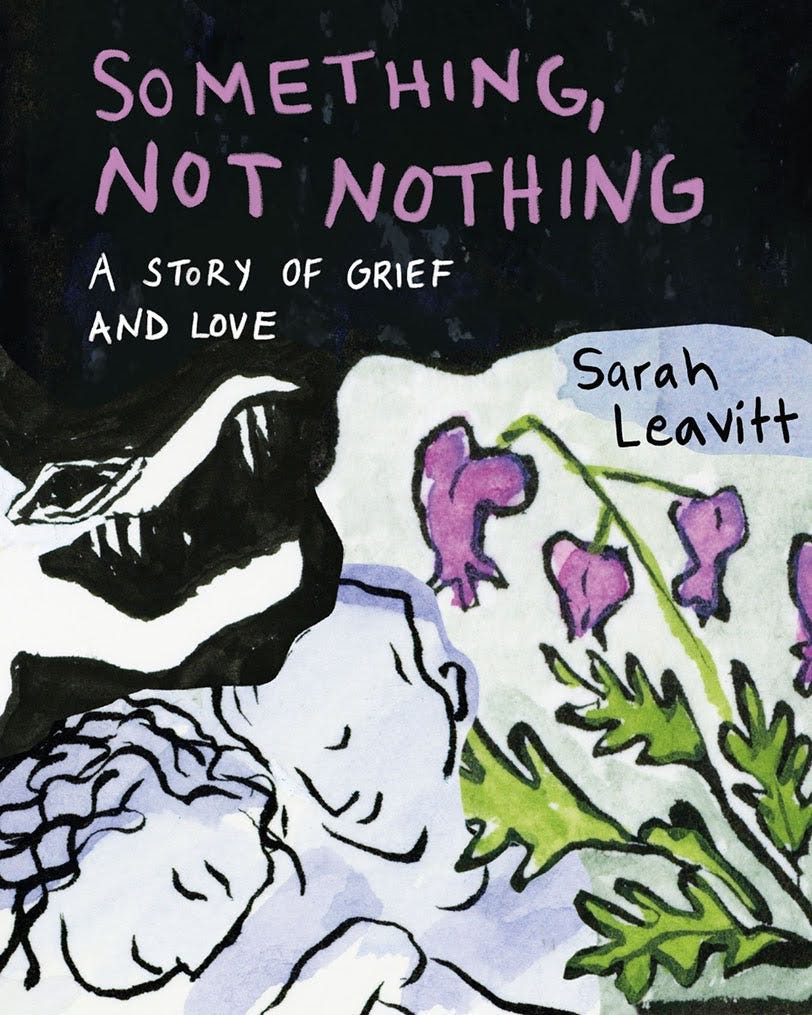
I’m especially pleased to return to your inbox with this conversation with my UBC colleague Sarah Leavitt! I have attended way too much school,1 but Sarah is the kind of teacher who makes me think, “hey, maybe I could fit a comics class into my schedule . . .” Our hallway conversations always leave me excited to try something new (or at least revived with solidarity at the depth of her artistic practice and her care for students). Her 2024 graphic memoir Something, Not Nothing (Arsenal Pulp) has been reviewed in the New York Times and featured on Oprah Daily, so maybe you’ve already come across it? But also maybe not—nobody comes across all of the things! Or remembers to track down each thing they stumble across that catches their interest. Anyway, I was super grateful that Sarah agreed to chat with me about this book. I’ve never read anything quite like it.
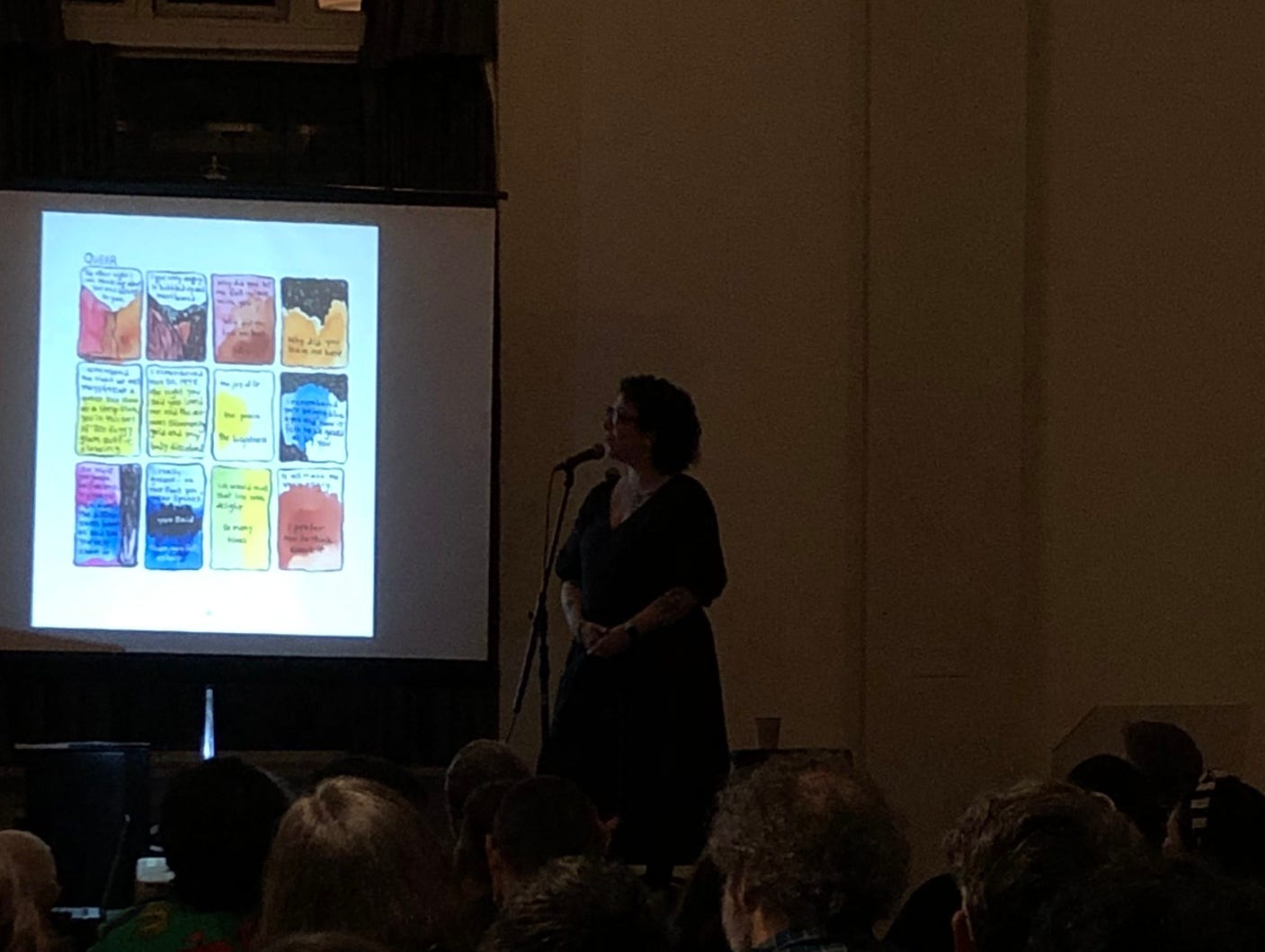
It’s a collection of short comics that I made in the first two years after my partner Donimo died in 2020. She had suffered from chronic illnesses all her life. She became very sick with myalgic encephalomyelitis (ME) and ultimately chose to have an assisted death. About a month after her death, I started to make comics about her death and what I was feeling. The book is about grief and love and loss and disorientation. It’s a documentation of a lived practice of grief.
I really was experimenting with form. I call it a collection of comics, but some pages don’t look like you might expect. There are drawings with some text underneath or a caption. Many drawings are abstract or non-representational, and a lot of the language is fragmented.
It's not reproducible. On some level, this is true of every work of art. But I don't think I could make comics like this again. They were very immediate: this is happening in my body right now. Some pages almost feel like things somebody else made. When someone dies, you can get this out-of-time experience. Some pages, I couldn’t tell you how I made them. They just emerged out of me. Of course, in putting the book together, there were things I cut, things I redid. But making the work was very intuitive and spontaneous.
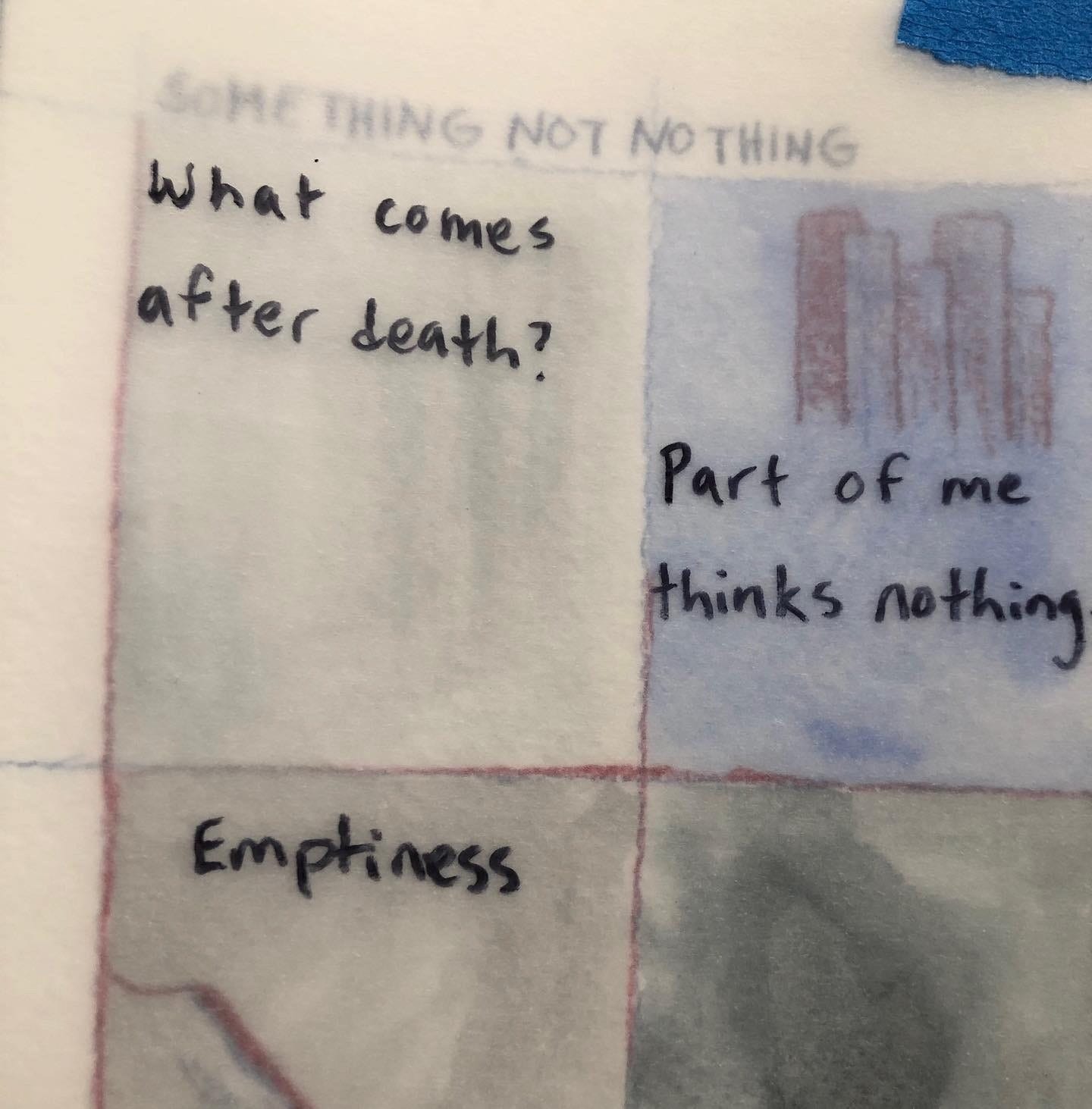
There’s a problem I didn't realize was a problem to be solved until I was thinking about this interview: “What materials could I possibly use to express this inexpressible experience?”
The first comic in the book is called “Questions,” and it uses this messy black pen. Looking back, I have this vision of myself with this liquidy black brush pen just asking: how do I possibly convey what is inside my head right now?
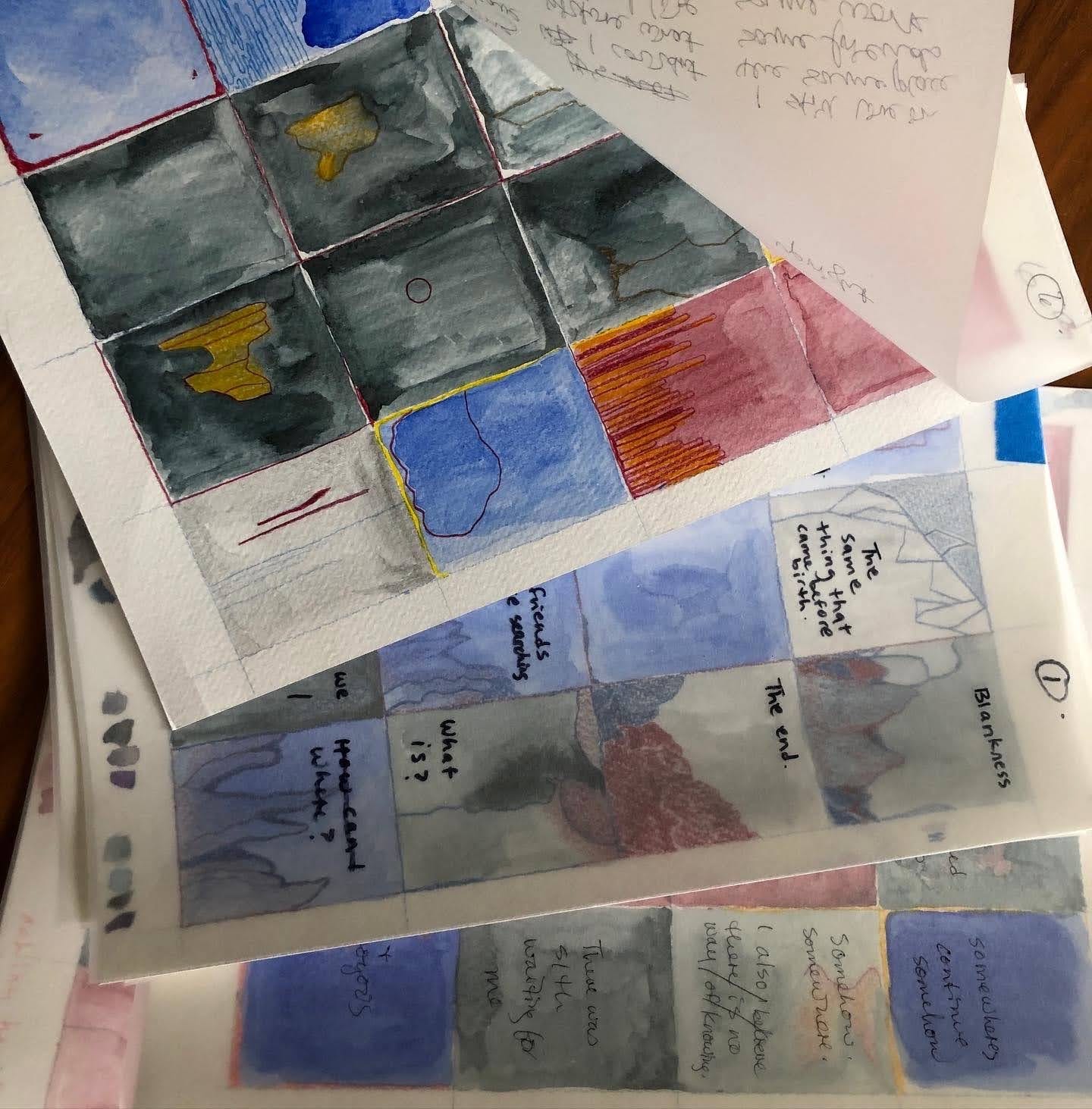
A combination of repurposing, borrowing, stealing, and experimenting!
I returned to the black brush pen I’d used for my previous book but in a different way.
In a class on on botanical illustration, artist and tattoer Sam McWilliams had us buy watercolour and coloured pencils in the same colour and layer them. It’s very, very satisfying. That class introduced me to a new kind of coloured pencil—which ended up becoming one of the main tools I used—and the concept of layering. When it came time to share our work, other people in the course were making these insane, realistic, gorgeous drawings. And I was drawing random disturbing figures.
Then when an artist friend posted on Instagram that she’d gotten these Beam watercolour paints, I was like “I want those paints.” It just felt really important. They’re natural watercolours, so some of them are very smooth and others have a bunch of sediment in them. You have to learn to use them.
I kept reaching for materials like watercolour that were flowy and hard to control and layered. Sometimes I’d have four layers of paint and pencil piled on top of one another! And then all of that uncontrolled flow and layering is contained within bordered panels. Sometimes I was conscious of experimenting with containing and failing to contain, breaking across panels or overflowing boundaries. Other times I was just working on intuition.
Maybe the biggest revelation was how working with colour, which I hadn’t really done much before this collection, felt essential for the project. Drawing and painting with colour felt so visceral and embodied.
I think it was Josef Albers who said that colour is a medium.2 What I didn’t know before this project is that colour is not just something that you add on. It has a life of its own. I have such a strong body feeling watching watercolour soak into paper.
Colour can really mess with expectations. People have very conditioned cultural and familial responses to colour. My friend Mita Mahato has talked about using bright pink to make artwork about the Arctic as a way of resisting ways the Arctic has been commodified and stereotyped.
There’s something about colour that can be so disorienting. Grief feels like disorientation because you lose so much of what’s familiar. So colour becomes a way to make things seem alien. There’s an emotional immediacy to colour that’s almost like smell or sound.
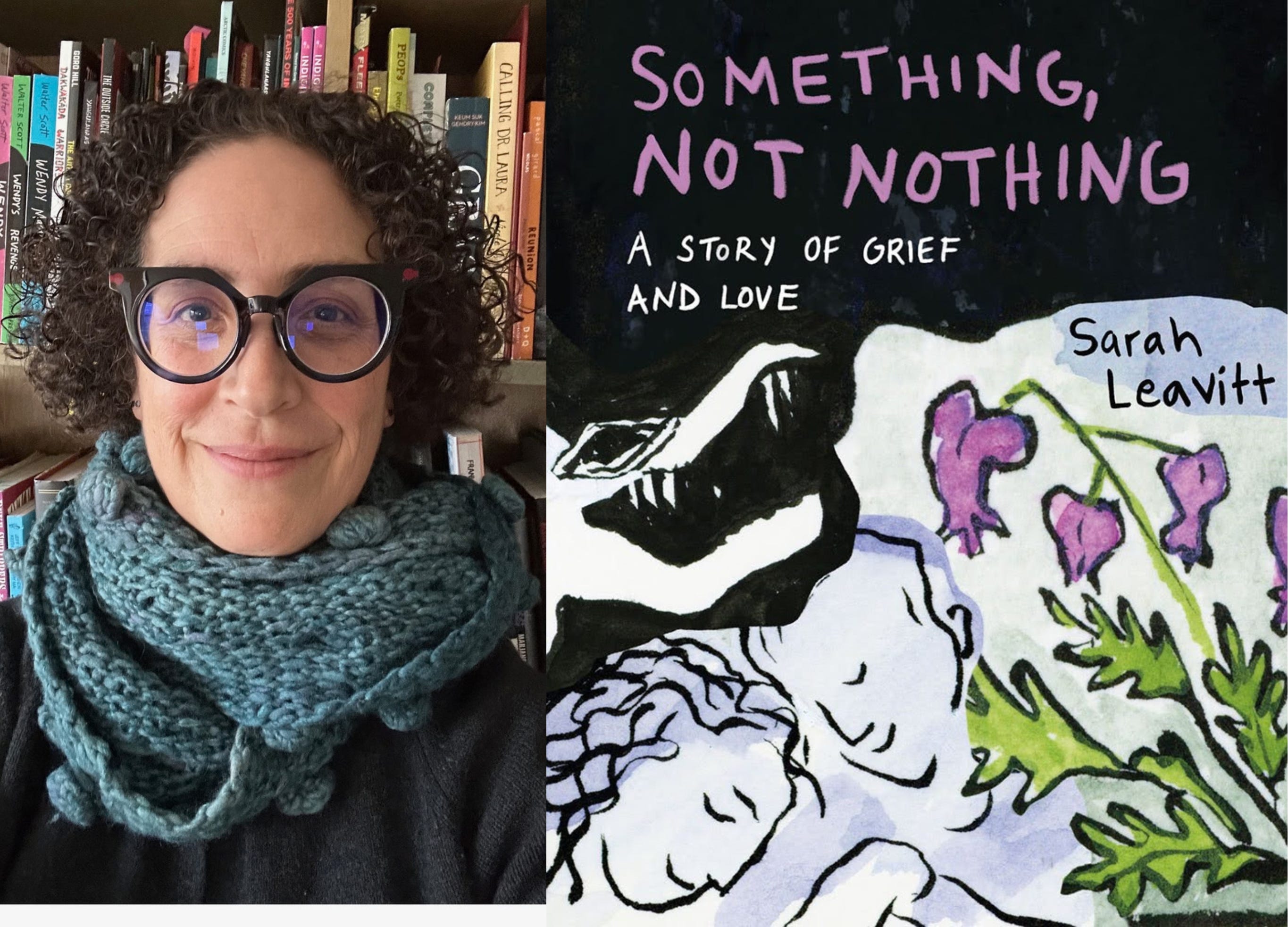
Sarah Leavitt is a cartoonist, writer and professor. She is the author of the graphic memoir Tangles: A Story About Alzheimer’s, My Mother, and Me (2010). A feature-length animation based on Tangles has just completed production, with release planned for later this year. Sarah is also the author of the award-winning historical fiction comic Agnes, Murderess (2019). Something Not Nothing: A Story of Grief and Love (2024) was a finalist for the Eisner Award for Best Graphic Memoir, a Lambda Literary Award for LGBTQ+ Comics, and a Publishing Triangle Award — the Judy Grahn Award for Lesbian Non-fiction. It won a BC/Yukon Book Prize: the Jim Deva Award for Writing that Provokes. Sarah is an associate professor in the School of Creative Writing at the University of British Columbia in Vancouver, where she has developed and taught undergraduate and graduate comics classes since 2012.
Sarah talks about the problem of finding the right materials for a new project. This is a tangible material problem for a writer working in graphic memoir (pencil? pen? paint? digital rendering?), but it’s one all writers face in our own ways. I love the solutions she proposes: repurpose, borrow, steal, experiment! What might these look like for you in your project right now?
As an example of borrowing, Sarah talks about enrolling in a botanical illustration class (which she also told me was not something she was looking to incorporate into her work). Yet signing up for a class that wasn’t directly relevant to her goals, she encountered materials that fit her project. Sarah also talked about how others were making “insane realistic gorgeous drawings” while she was making “random disturbing figures.” What a great example of stretching outside your comfort zone while also showing up fully as yourself!
As a poet, I was super interested in how Sarah talked about the tension between flowing watercolours and containing panels, which felt deeply resonant with the relationship between line and sentence in a poem. This could apply to other genres too: how do structure and flow, containing and spilling interact in your work?
Maybe most of all, as AI promises frictionless speedy automation, I’m cherishing what Sarah’s work with comics offers as a model of slow sensory material intimacy. She talks about learning to work with the sediment of Beam paints, of the pure body pleasure of watching watercolour paint soak into the page.3 This is the relationship I want with language: struggle, sediment, and soak.
Warm best,
Bronwen
PS: If you liked this post, please hit the heart to let me know! You can also support this newsletter by subscribing, sharing, or commenting.
I always think of a line from this Warren Zanes Song “I’ve been to 10 years of college and big state fairs,” except for me it was 13 years of college (BA, MFA, PhD, yikes).
“. . . color, as the most relative medium in art, has innumerable faces or appearances. To study them in their respective interactions, in their interdependence, will enrich our ‘seeing,’ our world—and ourselves.” Josef Albers, Interaction of Color (New Haven: Yale University Press, 1971), x
Comments
Nothing yet. Say the first thing.
Sign in to join the conversation.