
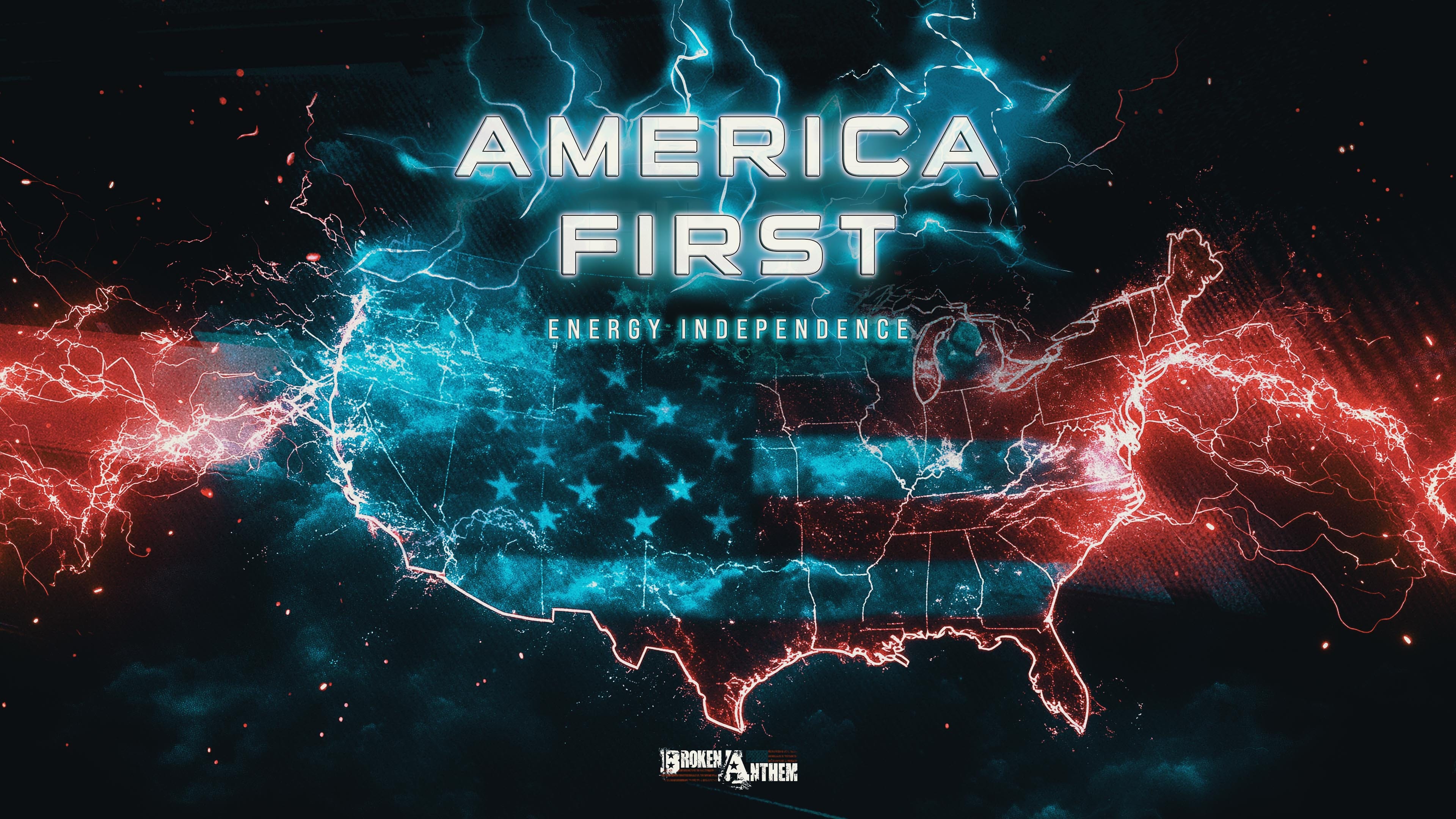
President Donald Trump declared a national ENERGY emergency at his second inauguration address. His commitment to put America First require revised United States energy policies. The day one executive orders aim to increase United States conventional energy production and achieve lower costs for citizens. New energy projects must be undertaken so a permitting process at WARPSPEED will be required, which normally can take years. The DOGE (Department of Government Efficiency) team will be working overtime demolishing the bureaucratic brick walls restricting the marketplace, hindering the greatness and potential of the United States.
President Trump will unleash natural resources in Alaska and defend gas operations from federal obstruction. Uphold his campaign promises to undo the energy policies of the prior administration. The declaration is an energy emergency, which gives the president access to special powers to achieve results. The Republican held US House and Senate delivered by the voters will lower the opportunity for DC sabotage as occurred during the border wall construction. President Trump's goals are to boost America's energy supply, replenish our strategic oil reserves and lower gas prices below $2 per gallon.
But why are the executive actions needed? How did we get there?
When President Joe Biden took office in 2021, he signed a number of executive actions that advanced environmental protection and climate change goals. The first major action, a good example of these priorities in practice, was Executive Order 13990, “Protecting Public Health and the Environment and Restoring Science to Tackle the Climate Crisis,” which instituted a moratorium on new oil and gas leases on federal lands and waters and launched a review of the federal leasing program for climate consistency.

It also revoked the Keystone XL Pipeline permit over environmental issues. On this day, Biden also signed an executive order re-entering the Paris Climate Agreement, with the U.S. to officially be back in the pact on February 19, 2021. Then, in order to meet that demand, the U.S. had to cut greenhouse gas emissions by 50 to 52 percent below 2005 levels by 2030, resulting in stricter rules on the petroleum and natural gas sector, limits on methane, inhibited drilling, and environmental reviews. Although these measures helped drive the transition to renewable energy, they have caused economic distress in fossil-fuel-producing states and communities.
In his second week, Biden signed Executive Order 14008, “Tackling the Climate Crisis at Home and Abroad,” which suspended existing drilling leases in the Arctic National Wildlife Refuge of Alaska. By June 2021, all Alaska Arctic leases were suspended by the Interior Department, which began environmental reviews that by September 2023 had resulted in the cancellation of all leases. In July 2022, Biden also reimplemented stricter offshore drilling safety regulations to reverse rollback from Trump and limit pollution risks from offshore operations. In December 2023, the EPA finalized rules to dramatically reduce methane from the oil and gas industry, focused on both new and existing sources.
On December 8, 2021, President Biden signed Executive Order 14057 directing agencies to embed sustainability in federal operations. Targets included 100 percent carbon pollution-free electricity by 2030, 100 percent zero-emission vehicles acquisitions by 2035 (with light-duty vehicles by 2027) and net-zero emissions federal procurement and operations by 2050. Hallmarks of the Green New Deal, which coincidentally would aid China’s ascendancy towards economic superiority. How can we not read into that?

One of Biden’s final energy actions on Jan. 6, 2025, was releasing two presidential memorandums. One targeting Alaska’s “Bering Sea” and the other “Gulf of Mexico, Atlantic, and Pacific areas of the Outer Continental Shelf.” Memorandums differ from executive action as they don’t carry an EO number, rather direct their departments to take action. In hopes of prohibiting new offshore oil and gas drilling on about 625 million acres of federal waters, including territory off the East and West Coasts, the Gulf of Mexico and Alaska’s Northern Bering Sea. But Republican-led states sued over the ban, contending that authority belongs to Congress. These last minute actions required executive action from President Trump to evade the sabotage and court room delays.
This was Biden’s push for net-zero emissions by 2050, also highlighting the conflict between federal climate initiatives and states that rely on conventional energy sources. Biden prioritized protecting the environment over seeking energy independence throughout his presidency, unleashing political and legal challenges throughout his single term.
On March 31, 2022, President Joe Biden made a historic announcement to release and sell the U.S. Strategic Petroleum Reserve to lower energy prices. The perceived causes cited were consumer outrage at rising gas prices due to the COVID19 pandemic fear drenched disruption of supply lines and the CIA initiated NATO war in Ukraine. The Biden administration also comically tried to stoke the public’s ire elsewhere, branding rising costs the “Putin Price Hike.” Hoping the average voter wouldn’t know who really escalated the conflict. Achieving new highs in war propaganda tenuity.
The enacted plan sold one million barrels a day over six months. Releasing a record setting 180 million barrels, the largest drawdown in the history of the Strategic Petroleum Reserve. Leaving the stockpile amount of the oil reserves around 382 million barrels by October 2024, half full. Of those sales, almost 950,000 barrels were sold to Unipec America, the American subsidiary of Sinopec Group, the Chinese Communist Party state-controlled oil behemoth.
Sinopec Group, also known as China Petrochemical Corporation, is one of China's largest integrated energy and chemical companies. Hunter Biden co-founded BHR Partners, a Chinese private equity firm, in 2013 and they invested in Sinopec Group. Through his company, Skaneateles LLC, he held a 10% stake in BHR, which has engaged in investments involving Chinese state-owned enterprises. In late 2021, Hunter Biden’s attorney stated he had divested his holdings, though as of March 2022, Chinese records still listed Skaneateles LLC as a 10% owner.

The Energy Secretary Jennifer Granholm for the Biden administration had multiple phone conversations with China National Energy Administration Chairman Zhang Jianhua days before the United States released its first 50 million barrels of oil from its strategic reserve in 2021. Granholm and Zhang met on Nov. 19 and 21, 2021, only days before the administration announced they would release oil from the strategic reserve on Nov. 23. Prior to her departure from office she awarded $14 billion in funds to companies in her state she has ties to. Kickbacks. One of the companies, DTE Energy, contributed $156,500 to a democrat PAC along with $2 million in dark money from a non-profit with four DTE officials on the board.
By November 2024 the Department of Energy made a purchase agreement for 200 million barrels of oil at an average price of $74.75 per barrel. The purchase price was lower than the $95 per barrel price at which the oil was sold during the emergency release in 2022.
At the end of the Obama administration the Strategic Petroleum Reserves were 695 million barrels, for Trump 638 million barrels. Reduced to nearly half the end of the Biden term 394.32 million barrels of crude oil. The lowest supply reached 346.8 million barrels during his term. The US has a capacity of around 714 million.
When Biden was inaugurated in January 2021, the United States average price for gasoline was $2.39 a gallon. Prices skyrocketed to an all-time high of about $5.06 per gallon in June of 2022, as the financial pinch was felt around the country. From beginning to end of the Biden Presidency, gas prices on consumers rose.
President Trump has called for U.S. energy independence and has condemned the drawdown of these strategic reserves. He has promised to back the oil and gas industry through easing regulatory burdens to boost domestic energy production. Declaring the defeat of the Green NewDeal at his inauguration.
The passing of former President Jimmy Carter 22 days before Trump’s 2nd inauguration reminds us of the ownership transfer of the Panama Canal, as well as the skyrocketing oil prices during the 1970s, also experienced during Biden’s term. The canal became a hot topic when President-Elect Trump, awaiting his 2nd term, floated the idea on Truth Social of regaining ownership. Concerns of competing nations China holding influence over this critical infrastructure, and the years prior higher rates for passage created trade costs dissolving US energy profits. What’s in the best interest of the citizens of the United States? A remarkably rare question not asked by the previous decades of former presidents prior to the Trump 2016 upset against the Clinton political dynasty.
Carter’s four years between 1977 and 1981 had challenges with energy policy and international relations. The energy crisis of his presidency was fueled by OPEC’s higher oil prices and supply constraints in the wake of the Iranian Revolution. Carter imposed price controls on domestic oil to lower consumer prices; the result was unintended shortages and eventually long gas lines. To alleviate energy concerns in the long term, he established the Department of Energy and promoted investment in alternative energy. But his policies, including the Windfall Profits Tax on oil companies, suppressed domestic production and led to price increases along the way.
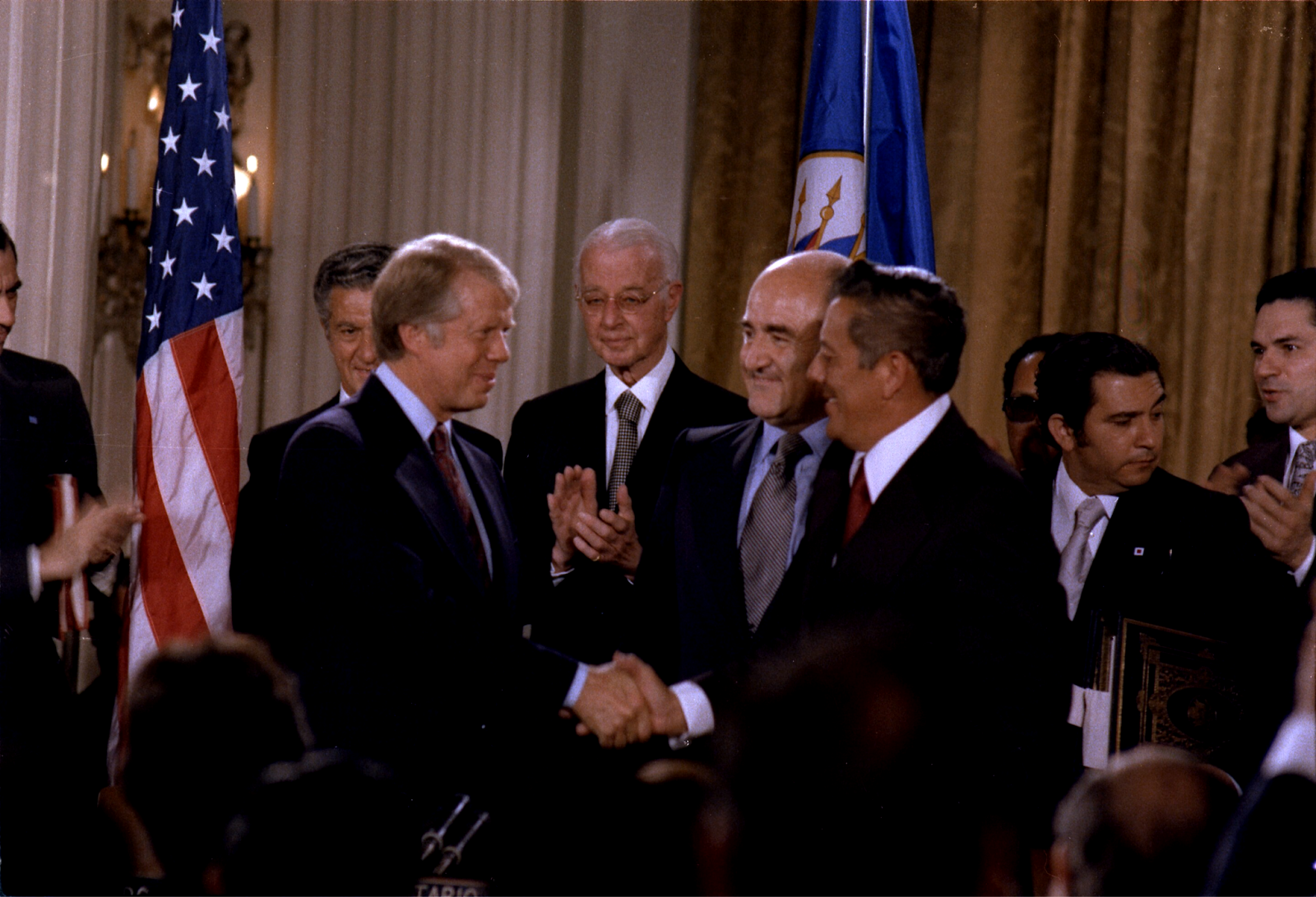
The Panama Canal Treaties were negotiated under Carter’s presidency. Transferring control of the Panama Canal from the United States to Panama by the end of 1999. These moves, at the time criticized as planting the seeds for this strategic waterway falling under weakened U.S. geopolitical influence and economic security. All under the Free Trade plan to destroy National Sovereignty.
The Panama Canal is now a crucial link in the chain of global trade, including the flow of oil and liquefied natural gas, or liquefied natural gas. But China has since expanded its footprint in Panama as a prominent user of the canal, and that has raised alarms for its influence over the crucial maritime passage. Chinese companies have been particularly active on infrastructure projects in Panama, such as railroads, ports and free trade zones. These tend to include projects that further enhance the canal's role in international trade. And a subsidiary of the Hong Kong-based empire of the billionaire Li Ka-shing runs the dock facilities at both ends of the canal: the Pacific-side Port of Balboa and the Atlantic-side Port of Cristóbal. This is a major shift in relations, as Panama severed ties with Taiwan and recognized the People's Republic of China in 2017. Since then, China has grown its economic and political power in the region.

It is these facts that have prompted President Trump to talk about ownership of the Panama Canal. America Last foreign policy agenda must change. The impact of the Panama Canal on gas prices is indirect but significant. A crucial shortcut for vessels carrying oil and refined petroleum between the Atlantic and Pacific Oceans. At his 2025 inauguration he commented on the Canal saying, "We're taking it back.” Underscoring the reason being that "American ships are being severely overcharged and not treated fairly." Hindering the revenues from the US energy trade. Which must change.
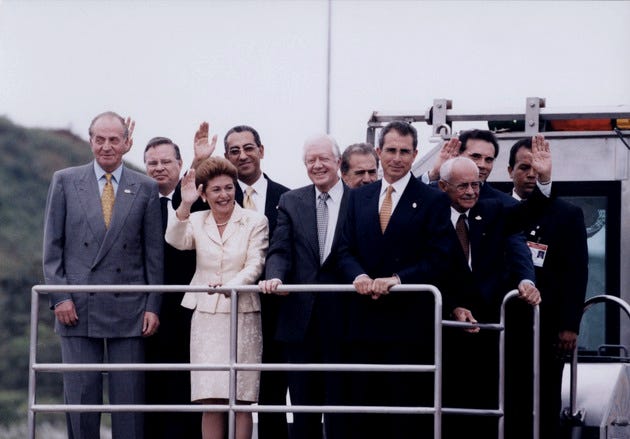
Carter’s choice to abdicate the critical canal was framed as a new approach toward the rest of Latin America. But it resulted in trade costs and losses for the US. It put America Last, ceding ground to other powers at a vital choke point in global trade. Carter’s decision to forfeit control of the canal has long been discussed, yet finally broached the spotlight under President Trump’s leadership, a topic of his 2nd inauguration address.
President Donald Trump has formulated a multi-faceted energy policy, promoting energy independence, economic growth, and a regulatory environment that fosters innovation, rather than sabotage it. His policy of boosting domestic energy supplies through hydraulic fracturing (fracking) for natural gas, strengthening America in the global energy market. Cutting regulations and accelerating permits for natural gas projects will also create good-jobs and ensure an affordable, secure energy future.
An immediate announcement a day after his inauguration to unlock a Stargate Project can only be achieved through unprecedented and unparalleled energy activation. The all hands on deck approach to energy coincides with needed AI development to out compete other large nations like China and India. Allowing China to be the global leader in ai would shift the balance of power in healthcare, technology, autonomous systems, finance, manufacturing and entertainment. Additionally the national security concerns of military autonomous weapons, battlefield ai, cyber security and espionage. The battlefield into the future will continue to evolve and the $500 billion dollar investment motivated by the new Trump administration continues to put America in a position of strength.

Trump’s plan also calls for restoring coal production by easing regulations that have hampered the industry, as a sure but not exclusive option in a diversified energy portfolio. It also features a significant focus on nuclear energy: investment in small modular reactors, geothermal energy and renewables technology improvements. An indication of its commitment to a balanced, market-oriented energy pitch.
Trump offers an alternative to the government subsidies that have driven renewables, creating a competitive level playing field for all forms of energy, not just renewables. That meant pulling out of global climate pacts like the Paris Agreement that selectively restrict US innovation allowing others to surpass us, for asinine bragging rights. The withdrawal saved American taxpayers billions in the process and changed course for domestic manufacturing away from foreign purchases to achieve Green New Deal promises.
The wealth of the United States needs to be preserved and invested in efforts for the benefit of all their people, not the bureaucrats network. Or corrupt financing of failed projects. Like the Solyndra Solar Energy Scandal under Obama and Enron's role in the California Energy Crisis under Bush Sr. and Bill Clinton. The Biden administration poured 5 billion tax dollars into the deployment of electric vehicle charging infrastructure which only achieved 7 charging stations in 3 years, dwarfed by the accomplishments of Elon Musk who has 6,700 Supercharger stations.
Tesla has been hailed by president Trump as a “great American car company.” Achieving innovation manufacturing in the USA. While the Biden administration granted incentives to their competition, Tesla continuously outperformed them in car manufacturing and electric charging stations. An additional mistake was not inviting Elon Musk to the August 2021 EV summit.

Musk went on to join the Trump campaign after the first assassination attempt, and was credited by the restored president as having helped to achieve the 2024 election victory. With his vast experience in government interactions and contracts, the appointment of Musk by President Trump to the Department of Government Efficiency is earned by his merit based accomplishments. And the innovations of US-based Tesla will be positioned as an achiever rather than sabotaged by string pulling political actors.
Why should US citizens endure sabotage preventing a prosperous future on meritless crony capitalism and bad science which has repeatedly resulted in being wrong. The climate science fortune tellers have been required to continue to adjust their narratives to preserve their cash flows as their predictions don’t pan out. Will we never learn? Are we ready to stop forgetting what they said and reminding them?
President Trump as a businessman on day one of his second term has re-positioned the United States for economic growth which requires energy activation.
Upon taking his oath of office President Trump signed Executive Order 14145 which rescinds Joe Biden’s Executive Order 13990, 14008 and 14057, among 67 in total. As well as 11 presidential memorandums, including the two energy related orders signed on January 6, weeks from his end of term.
In addition to this preliminary EO, three more contain critical updates to the energy industry.
Unleashing American Energy encompasses many aspects of the energy industry. To revoke restrictions, the order states:
to encourage energy exploration and production on Federal lands and waters, including on the Outer Continental Shelf,
Addressing control of the marketplace it also calls to:
eliminate the “electric vehicle (EV) mandate” and promote true consumer choice, which is essential for economic growth and innovation, by removing regulatory barriers to motor vehicle access;
As well as requires:
all executive departments and agencies (agencies) provide opportunity for public comment and rigorous, peer-reviewed scientific analysis;
Being peer reviewed will ensure diverse perspectives and merit based.

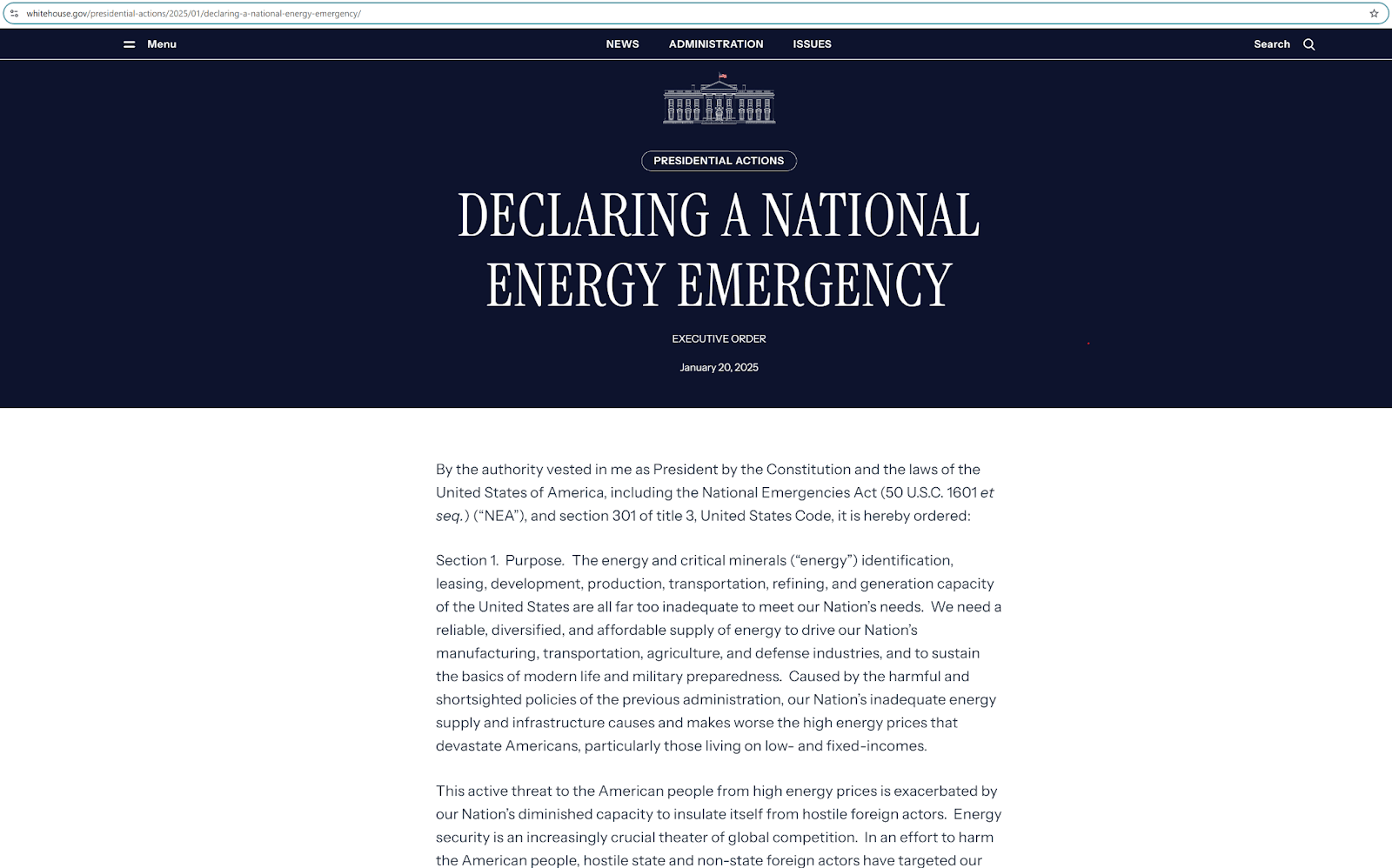
Declaring a National Energy Emergency officially puts on paper the spoken order from his inauguration speech. Casting a vision for the priorities of the administration: energy security as national security, reversing previous policy failures, deregulation and streamlining, and establishing global energy leadership. It grants emergency powers to federal agencies to address critical energy needs, prioritize domestic resource development, and reduce reliance on foreign energy.
Key measures include fast-tracking energy infrastructure projects like pipelines and refineries, utilizing eminent domain and the Defense Production Act, and streamlining regulatory approvals. Temporary waivers under the Clean Water Act and Endangered Species Act aim to accelerate development, while emergency E15 gasoline waivers address fuel shortages. Focused efforts target energy upgrades in critical regions, including the Northeast, West Coast, and Alaska. The Department of Defense is tasked with addressing vulnerabilities in energy supplies critical to national defense.
This AMERICA FIRST Energy Policy prioritizes oil, gas, and coal production, viewing energy development as a tool for economic growth, job creation, and trade. It emphasizes regulatory reform to eliminate delays and leverages U.S. energy exports to strengthen global alliances and counter adversaries.
Unleashing Alaska's Extraordinary Resource Potential focuses on the states abundant resources of energy, minerals, timber, and seafood. To achieve lower energy prices, boost jobs, and strengthen global energy dominance. The order rolls back restrictions that were put in place during the previous administration, and restores critical policies that encourage resource development on federal and state lands, including in the Arctic National Wildlife Refuge in the Bering Strait. Alaska’s liquefied natural gas potential plays a starring role, with orders to speed permitting, leasing and infrastructure projects to enable domestic-use and exports to U.S. allies across the Pacific region.
The EO stresses not only streamlining regulatory processes or removing barriers to critical projects, but also a concerted effort at federal agency-level cooperation to address energy infrastructure vulnerabilities in the state. It designates the Trans-Alaska Pipeline System as an energy corridor of national significance and instructs the Department of Defense to study its long-term viability. It also emphasizes subsistence hunting and fishing rights for Alaskans, reconciling federal policies with local interests. The order reflects a vision for U.S. energy independence, highlighting Alaska’s resources as a vehicle for economic investment and geopolitical influence. While also restoring state rights.
President Trump’s delayed 2nd term underscores the significance of these issues. Global Imperialists had held a tight grip on the presidency for decades, which necessitated the influence and theft of the 2020 election. But the people of the United States refused to quit. Refused to give up. And never backed down from restoring the rightful President. The theft of the executive office was to prevent what will happen now.
For the United States to enter the golden age, our energy resources must be maximized. And you the citizen must do your homework to support the right actions, rather than be told what to do. Our renewed dreams must be fueled by reality based strategizing. And a keen knowledge and understanding of our history. Because the citizens of the United State refuse to allow subservience to a system of plutocratic-oligarchy. Rather they are the owners, initiators and navigators of their future.
The rebirth of a citizen led America First movement has been inspired by a strong Commander in Chief, President Donald John Trump. By asserting the benefits of our energy strength go to the citizens first. Rekindling the American Dream sparks the possibility for more and future energy innovations. May our descendants reap the rewards of restored prosperity, and may God continue to bless the United States of America.
No posts
Comments
Nothing yet. Say the first thing.
Sign in to join the conversation.