
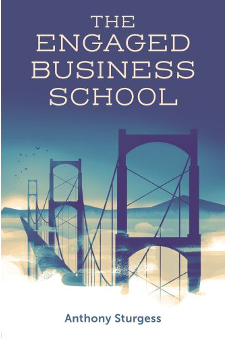
This is part of our series celebrating the winners and finalists of the Management Publication of the Year 2024 competition. This week, Anthony Sturgess introduces his work The Engaged Business School, published by Emerald in 2023 and recently released in paperback.
It seems timely to ask questions about how we respond to universities facing significant financial pressures, deficits, job cuts, closure of programmes and mergers, alongside UK PLC’s well-documented and protracted struggles with both productivity and growth. An understandable response is to feel indifferent, downbeat or even pessimistic about the future. Yet perhaps counter-intuitively, it is a time for optimism, an optimism that is tempered by realism, but crucially not dampened by it. Now more than ever, businesses and business schools should come together in response to these challenges.
The article draws upon the research in my book, The Engaged Business School, which was shortlisted for the inaugural Management Publication of the Year 2024, and points towards a broader ambition of engagement with business.
Here are four possible ways forward.
Two interesting but uncomfortable conversations with business leaders should prompt us to challenge our thinking: the first is a provocation, the second a troubling reality check.
A senior leader asked me a rhetorical question: ‘what is a business school’s greatest strength? And what is a business’s greatest need?’ The view of this leader was the same for both questions: Latest thinking. The leader then provocatively argued that there isn’t enough of it in our courses. Interestingly, the executive then noted that managers are too busy ‘doing’ to find out what the latest thinking might be, never mind applying that to their business.
The second story is perhaps of even more concern. After listening to a presentation about what a business school can do for their organisation a Non-Executive Director (NED) said you’re a ‘well-kept secret’. Whilst meant as a compliment, it betrays a significant concern that businesses are often unaware of how a business school can help them. Without doubt, business schools are more engaged than they might appear, yet not as engaged as they could or should be - more like a well-kept secret.
The first story questions the relevance of what is taught in business schools. The second that many businesses simply do not know the potential that exists. The two conversations highlight the importance of relevance and visibility, or more provocatively, the risk of being irrelevant and invisible to business.
These lessons resonate with the intentions of The Management Publication of the Year award, seeking to highlight research and ideas that are relevant and can impact for the better, and crucially making them more visible.
All too frequently, in the face of constraints, universities and businesses understandably resort to what seems like the easier route of cuts and efficiencies, without first giving sufficient time and focus to identifying opportunities for growth despite those constraints. Yet the urgency and scale of these challenges suggest the need for a collective response and for a focus on the contribution we can make. It calls for more collaboration between business schools and similarly between businesses and business schools to fuel productive growth, a green economy, and business as a force for good, in tandem with outcomes that are better for people and the planet. This is a bigger ambition: it calls for optimism but also recognises that there is so much potential in our universities and organisations that is not realised.
Universities are struggling to resolve the tensions between stagnant student funds and maintaining high standards for students and equipping them with the skills for future work. Is it possible to re-dress this tension by harnessing the business and organisation capability in a region to support the learning and development of undergraduate students? Developing the next generation of graduates in our society should be the responsibility of all of us. There is, of course, a long tradition of placements and of apprenticeships and in some of the professional schools in a university, there are very close relationships with the sectors they serve, fostering a dual responsibility for the development of students. Can the relationships a business school has with businesses significantly help to develop undergraduate students? To do this, implies the blurring of workplaces and learning places into a more comprehensive and integrated learning process.
Bringing working and learning closer together extends the boundaries of a business school. Similarly, the idea of students joining a learning community rather than simply a programme expands the relationships with students, alumni and business. So much of our education system is front-loaded at the beginning of careers, and so little to refresh, renew and equip those already in the workplace to respond to the challenges we are facing. Yet according to the UK Government, 80 per cent of the 2030 workforce is already in the workplace. That would suggest that, to address UK growth and productivity, we need to significantly change how we work with businesses now and develop those already in the workplace. Is it time to consider how business schools can more purposefully extend their relationships with students and businesses for the long term?
In making what we do visible and raising our ambition for the contribution we make to the next generation and those already in the workplace, we may find that business schools are part of the answer to business growth and productivity. Similarly, business may be part of the answer to the current financial straits higher education finds itself in.
Management Publication of the Year is a great opportunity to make relevant and impactful research visible. For me, it opened opportunities to share my work more widely. The book is about to come out as a paperback, largely due to the shortlisting, which will broaden its reach. The shortlisting has also been the spark towards extending the research with conversations with my publisher about writing a second book exploring the central role of the engaged educator in making engagement work.
Emerald offers BRU subscribers 30% off the paperback with code EME30
Anthony Sturgess is a strategic leader in higher education leadership and enterprise. His book, The Engaged Business School, published by Emerald was short-listed for the prestigious inaugural Management Publication of the Year. Anthony, whilst Director of Corporate Development at Liverpool Business School, led his team to win the Global Gold Award for leadership development from the European Foundation for Management Development (EFMD). The award celebrates leadership development, partnership and impact. Anthony served for six years on the Chartered Associations of Business Schools (CABs) national committee for executive education. He was also editor of the Journal of Management Development. Anthony’s body of work helps to build and develop executive education across institutions in the UK. He is an advocate for building best-practice in the sector, emphasising embedding enterprise as a strategic approach in business schools and Universities.
Thanks for reading Business Research Unpacked! This post is public so feel free to share it.
Comments
Nothing yet. Say the first thing.
Sign in to join the conversation.