
April 7, 2026.
Mid-term Bridge Grades just dropped—ranking Federal legislators on who is more collaborative and who is more divisive than their peers1—based on their 15 months in office so far.
119th House of Representatives
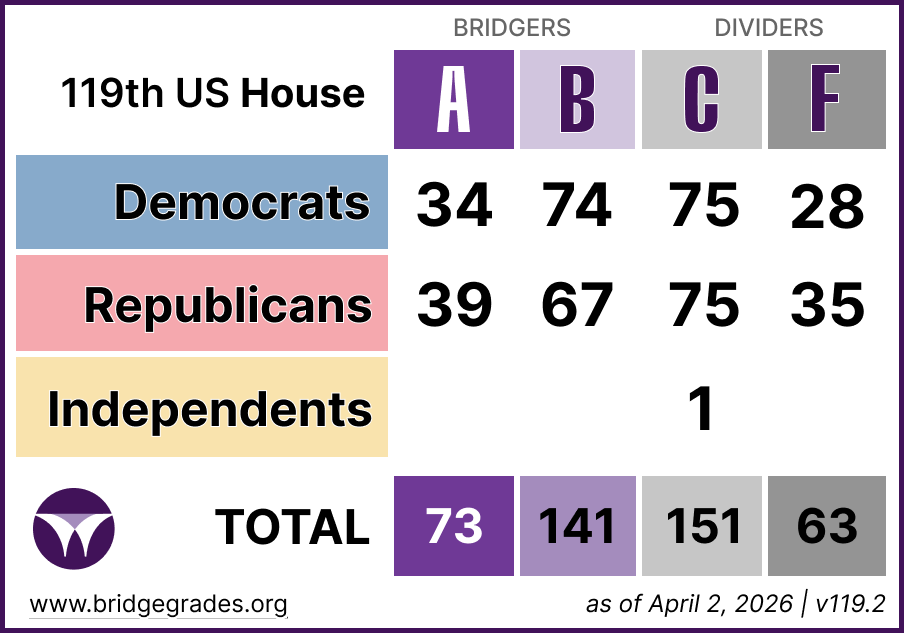
Top 20 Representatives: How many names do you recognize?
Top ranked collaborators in the House (11 Ds, 9 Rs) are Representatives Jimmy Panetta, Brian K. Fitzpatrick, Zachary Nunn, Joe Neguse, Young Kim, Chris Pappas, Michael Lawler, Josh Gottheimer, Jennifer A. Kiggans, Debbie Dingell, Nicole Malliotakis, David G. Valadao, Jim Costa, Donald G. Davis, Susie Lee, Juan Ciscomani, Nikki Budzinski, Carol D. Miller, Josh Harder, and Salud O. Carbajal.
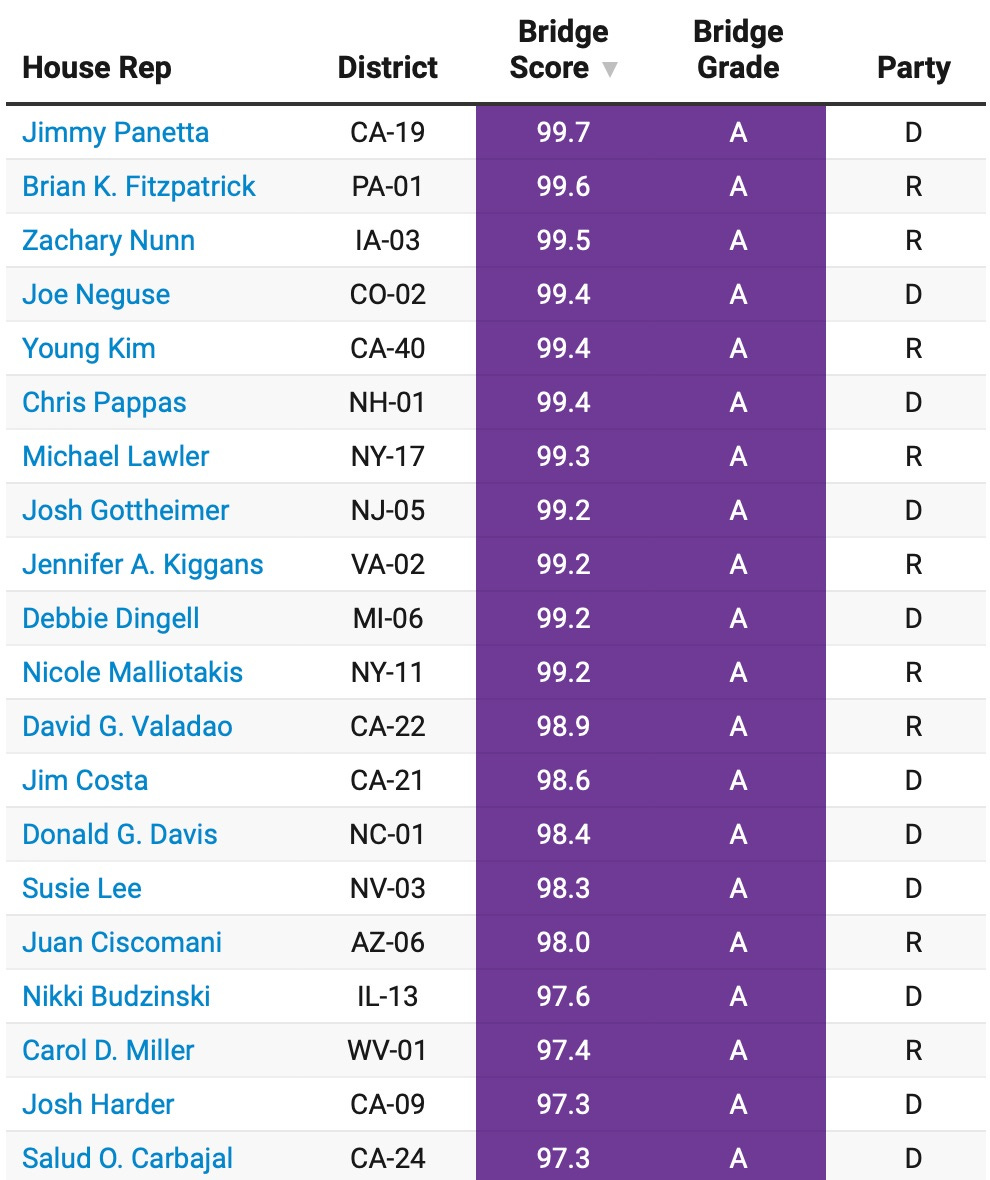
Browse the full list of Bridge Grades for the House of Representatives.
119th United States Senate
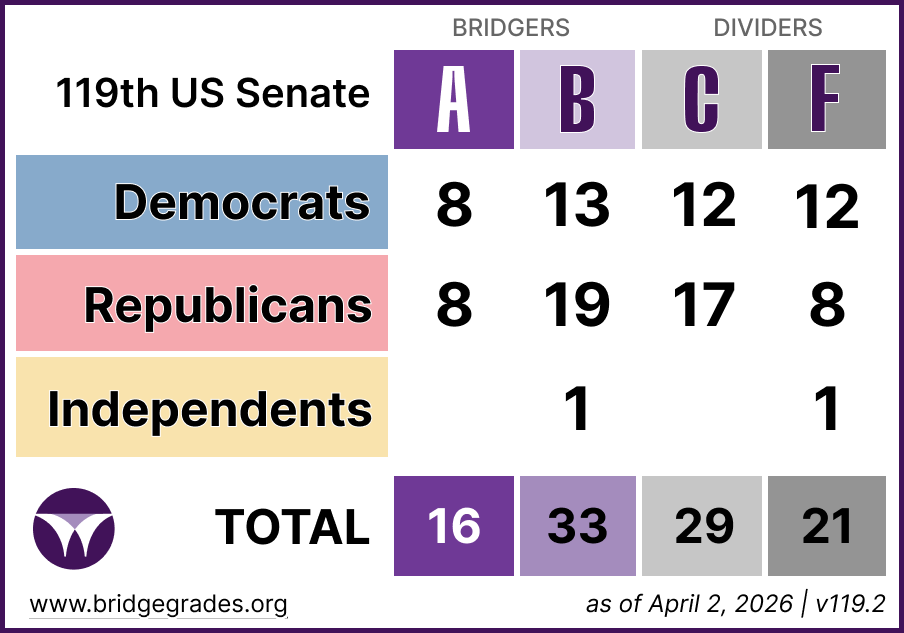
Highest-graded Senators based on non-partisan 3rd party data
In the Senate, the 16 legislative collaborators earning “A” grades (8 Rs, 8 Ds) are Senators Amy Klobuchar, Jeanne Shaheen, Catherine Cortez Masto, Chuck Grassley, Gary C. Peters, Margaret Wood Hassan, Bill Cassidy, Jerry Moran, Christopher A. Coons, Jacky Rosen, Marsha Blackburn, Susan M. Collins, Todd Young, Lisa Murkowski, John Cornyn, and Alex Padilla.
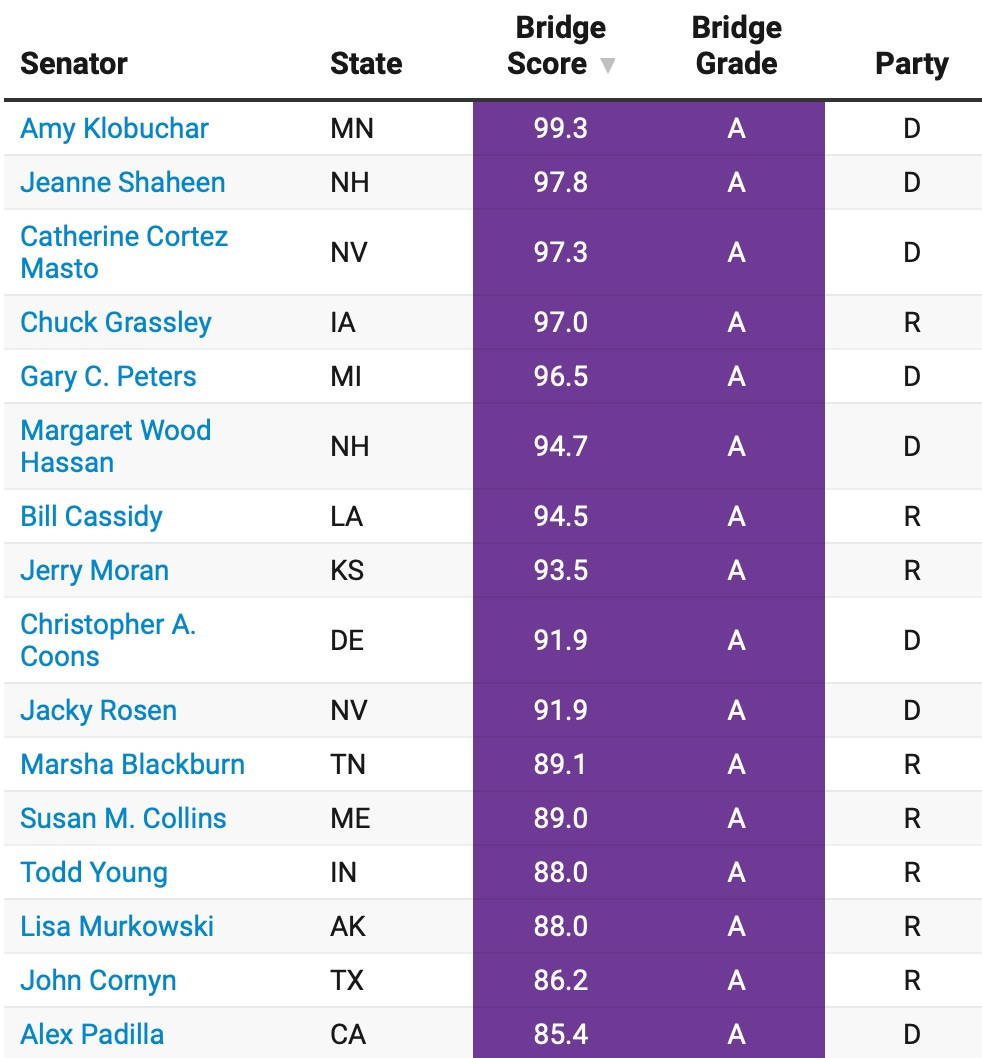
Browse the full list of Bridge Grades for the Senate.
Grade Distribution by Party
The balanced composition of grades across parties within each chamber should come as little surprise. The very definition of collaboration requires multi-party participation—after all, it takes two to tango.
Departing Senators
In the Senate (six-year terms), 35 Senators are up for re-election in 2026. Of those, 11 sitting Senators are retiring or not running for re-election.
Of the 11, Sen. Alan Armstrong (Oklahoma), named recently to temporarily replace Markwayne Mullin who left the Senate to become head of Department of Homeland Security in March, is too new to be graded in our systems and is not running for re-election.
Of the remaining 10 Senators not seeing re-election, we see an even mix of bridgers and dividers stepping away, with 2 As, 3 Bs, 3 Cs, and 2 Fs.
We recognize Sen. Gary Peters (Michigan) and Sen. Jeanne Sheehan (New Hampshire) for their collaborative leadership and service in the Senate and will be sorry to see them go.
Departing House Representatives
In the House, where all 435 lawmakers are up for re-election every two years, 57 House Representatives are proactively leaving Congress—either retiring (29) or running for another office (28).
Sixteen of these House reps are gunning for Senate seats—comprising eight bridgers (2 As, 6 Bs) and eight dividers (5 Cs and 3 Fs) amongst the 7 Democrats and 9 Republicans combined.
In some good news, of the remaining 41 who are either retiring, or running for non Congressional seats, just 32% of the leavers are bridgers (4 As and 9 Bs) while 68% are dividers (20 Cs and 8 Fs). We view this data as good news as it means on balance the House will retain net collaboration skills with a disproportionate share of dividers moving on2.
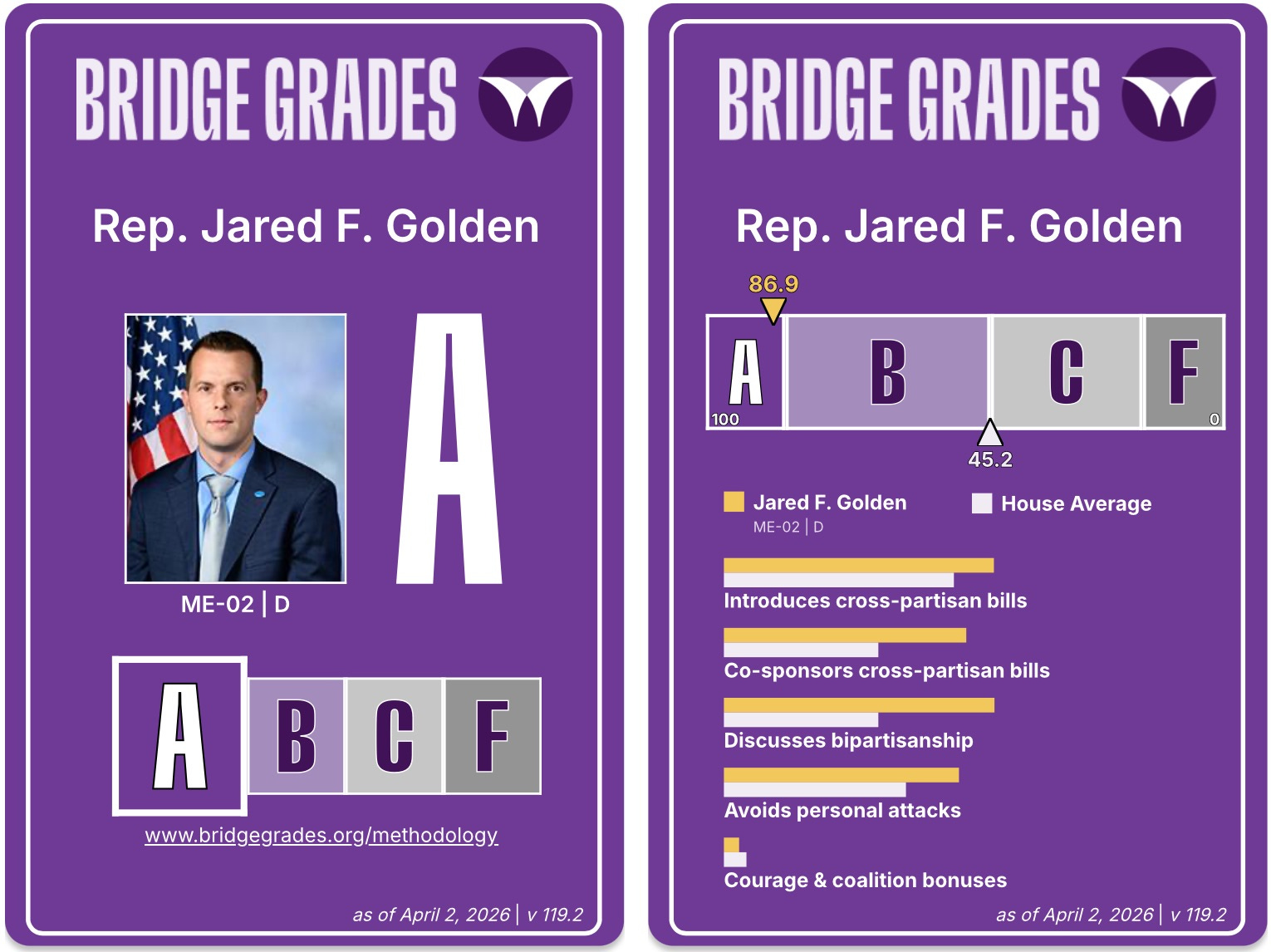
Even still, we are sorry to see high-scoring bridgers moving on, and recognize Jared F. Golden (ME-02), Vern Buchanan (FL-16), Randy Feenstra (IA-04), and Don Bacon (NE-02) for their service and leadership in the House as top collaborators.
Fun with charts
Finally, two charts that we think are interesting and noteworthy.
Play around with this fun scatterplot chart which plots Bridge Scores (top-to-bottom) against political ideology (left-to-right). Note (a) the lack of representation in the ideological center, and (b) that even strong ideologues (on both the left and right wings) are able to earn good marks on Bridge Grades (which intentionally measure how one behaves, not what one believes.)
Know someone who might like this chart? Sharing is caring.
Our map of the House Representatives color-coded by grade. It’s fascinating to see geographic clusters of bridgers in the bread basket corridor (Nebraska, Iowa, northern Illinois, southern Minnesota) that spreads up through the rust belt (Michigan, northern Ohio, western Pennsylvania, and western New York).
What patterns do you see in the data?
* Note: Bridge Grades, a project of 501(c)3 Mediators Foundation, is an educational tool and neither endorses nor opposes individual candidates for public office.
Final Bridge Grades for the 119th Congress will be calculated at the conclusion of their term at the end of 2026.
Bridge Grades are a forced curve which means 50% of grades in each chamber are As and Bs, while 50% are Cs and Fs. This 68:32 split means more divisive lawmakers are leaving than their collaborative counterparts.
Comments
Nothing yet. Say the first thing.
Sign in to join the conversation.