
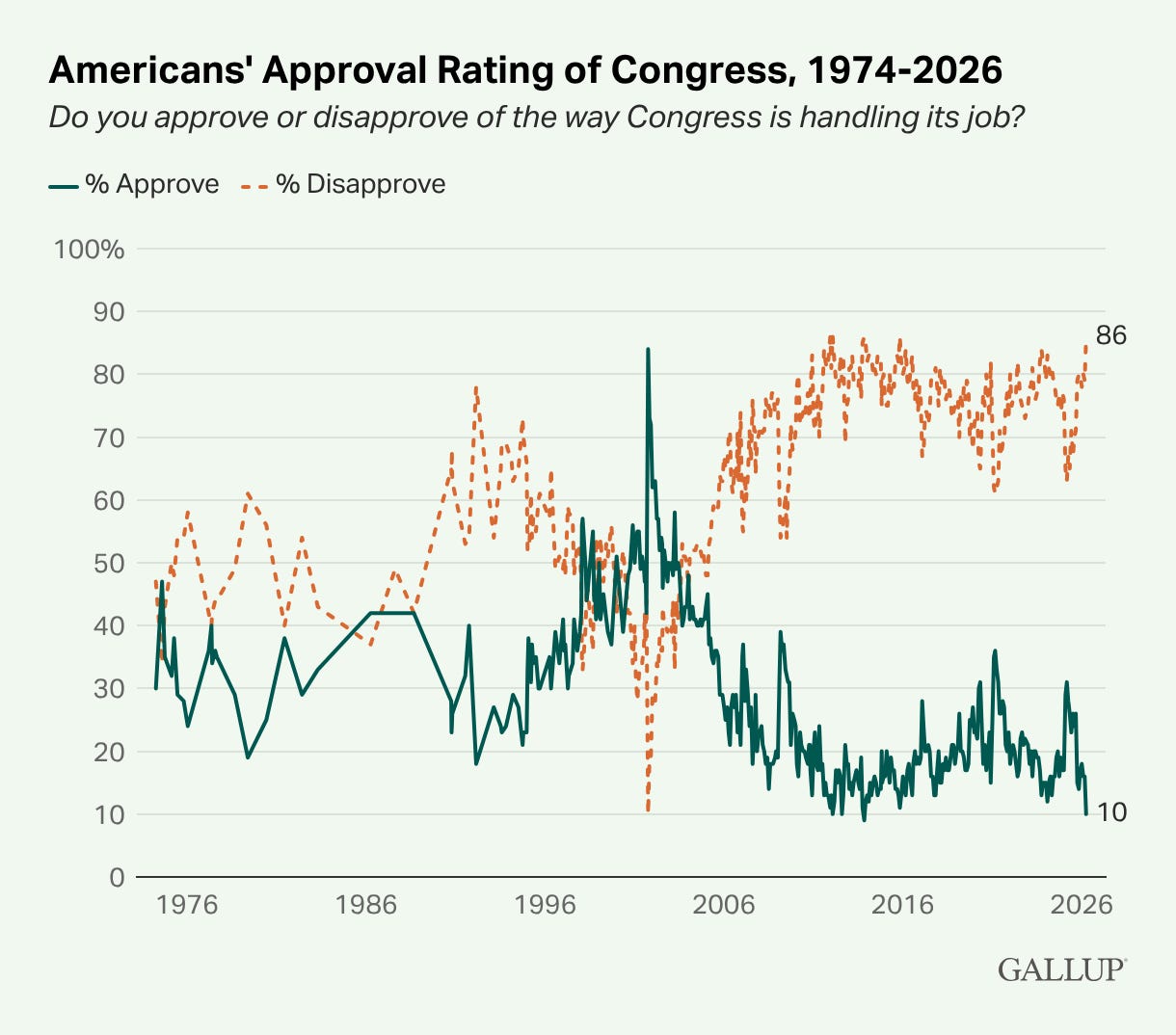
Thats our approval rating for Congress. Just one in ten Americans now “approve” of Congress according to Gallup’s most recent April survey.
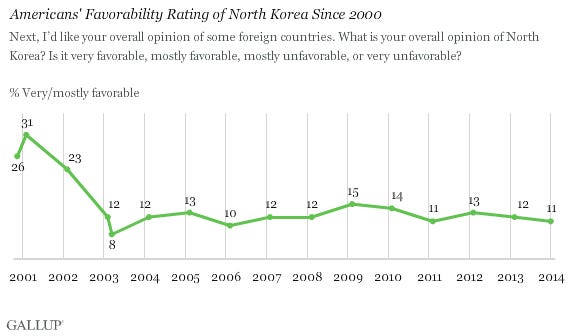
Consider that’s the same historical level of how favorably Americans rate North Korea.1
Think about that for a minute.
Our current approval rating of the branch of the people is no higher than our historial regard for the least free country in the world? Americans may seem divided, but 9 in 10 of us agree that Congress is toast.
How did we get here?
Our divided Congress, stuck playing a zero-sum tribal game of tug-of-war, has ceded its power—neither able to represent its people nor act as an effective check against executive and judicial branch overreach.
No wonder 86% of Americans disapprove of Congress.
Why collaboration in Congress is so important
Today’s incentive structures (closed primaries, gerrymandering, big money) encourage legislators to govern as dividers: donors love it (more money), media loves it (free exposure), partisan voters love it (reliable votes). No one is that surprised Congress is so divided and has become so weak.
But, some lawmakers objectively govern more collaboratively than their peers. Bridge Grades uses data to find them.2
By spotlighting top bridgers (high grades) and exposing the dividers (low grades), Bridge Grades can nudge incentives toward a more collaborative3 and healthier4 Legislative Branch.
But neither side wants their own to compromise
This is important: collaboration and compromise are not the same thing. A collab is a true win-win that makes all parties better off, while compromise cedes territory in a hard-earned turf war. To be clear, a lawmaker can be a great collaborator without ever having to compromise.
Bridge Grades measures collaboration (not compromise)
As a nation, we’ll do well to remember e pluribus unum and our origin story to work together to build a pluralistic society while celebrating our freedoms to differ. Bridge Grades are built to help us identify who is putting country ahead of party, and to be a trusted resource to help citizen voters re-elect bridgers and throw out dividers systematically over time.
When we do so, say across the next 3-5 elections, Congress will begin to heal, and, as fellow citizens, we will start to get our branch of the government back.
Because, fixing Congress may be the ultimate win-win for our common interests — and, that’s something we can all agree on.5
Sharing is caring. Plus, we could really use the exposure.
Bridge Grades is a citizen-built, citizen-funded project of Mediators Foundation, a 501(c)3 based in Boulder, Colorado.
Bridge Grades strives to become a Wikipedia-like resource widely trusted across America’s political ecosystem. With systems that are transparent, open-source, and independently governed, Bridge Grades is built to remain protected from big money, special interests, and blackbox technologies.
Human-led and citizen-funded (so far), our ambition is a low-overhead, self-sustaining public resource that maintains durability and independence for at least 10 election cycles.
We are about two-years into our multi-year quest to get there.
More fit to represent the common interests of the citizens, and reclaim its power
More fit as a check against executive and judicial branch overreach
Aside from the 10% who doesn’t think Congress is broken in the first place, that is.
Comments
Nothing yet. Say the first thing.
Sign in to join the conversation.