
It’s not often that I miss being a pastor.
Pastoral ministry comes with immense pressure: the expectation to have answers and maintain certainty. There’s also the visibility. Being seen is part of why the role attracts people with a bent toward exhibition and grandiosity, but living constantly in the spotlight exacts a cost. Pastors are expected to be beacons of morality and religiosity, and failures that would be merely embarrassing for others are often career-ending for them. Over time, the role can distance people from their own humanity. Many pastors end up playing a part—unsure of who they are, much less inviting others into wholeness.
So it surprised me that I found myself feeling nostalgic for pastoral work at the movies this week.
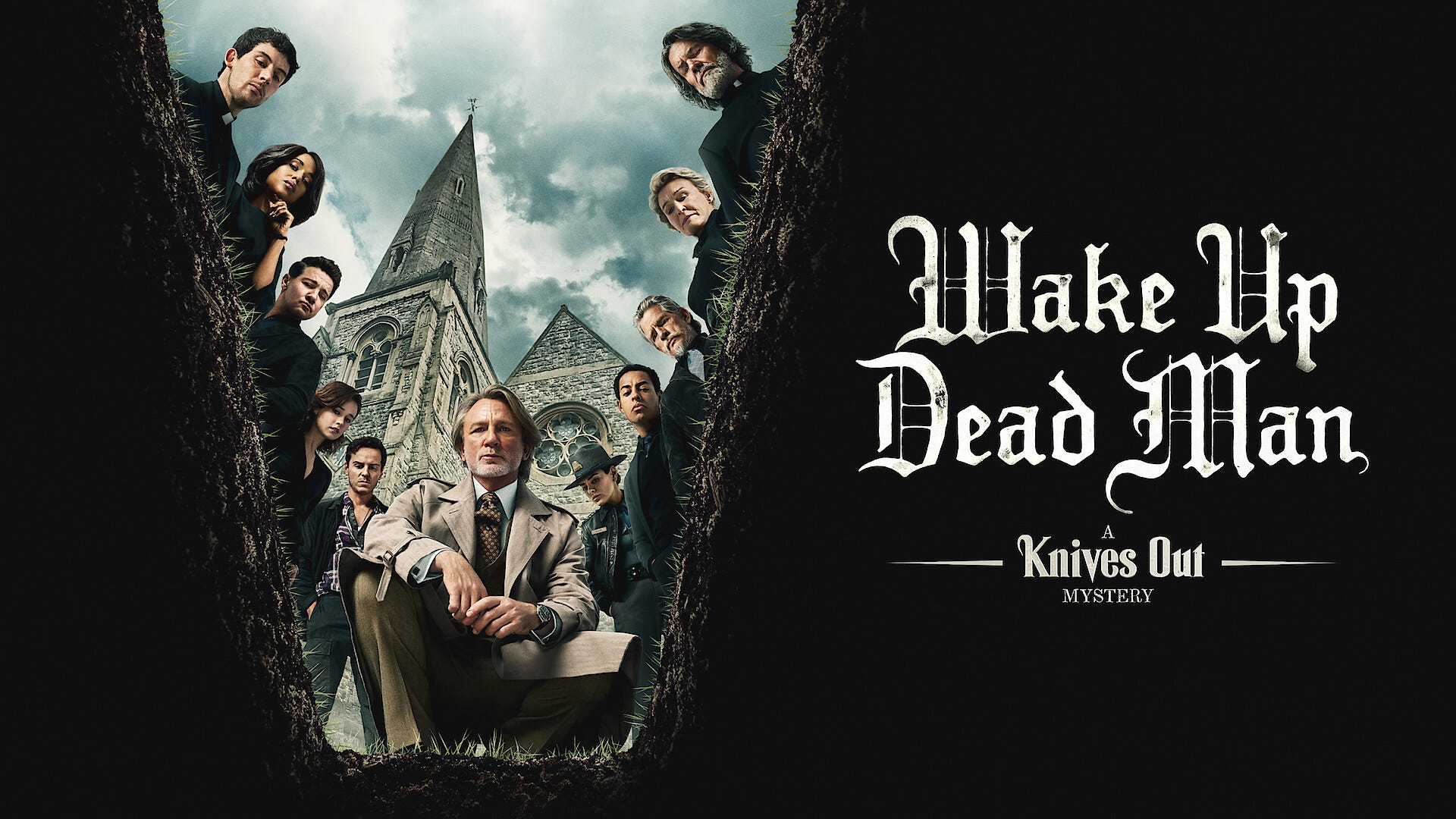
I saw Wake Up Dead Man, Rian Johnson’s new deconstruction-friendly murder mystery, where the most haunting question of the film is not simply who committed the crime, but whether the church will be a force of love in the world—or merely a reflection of our worst impulses. The two priests in the movie press us with another question: what is the purpose of a pastor? Do we need them? If a pastor is a guardian of certainty, an enforcer of hierarchies, and a gatekeeper of divinity, aren’t they more harm than good?
beloved, with Brian Recker is a reader-supported publication. To receive new posts and support my work, consider becoming a free or paid subscriber.
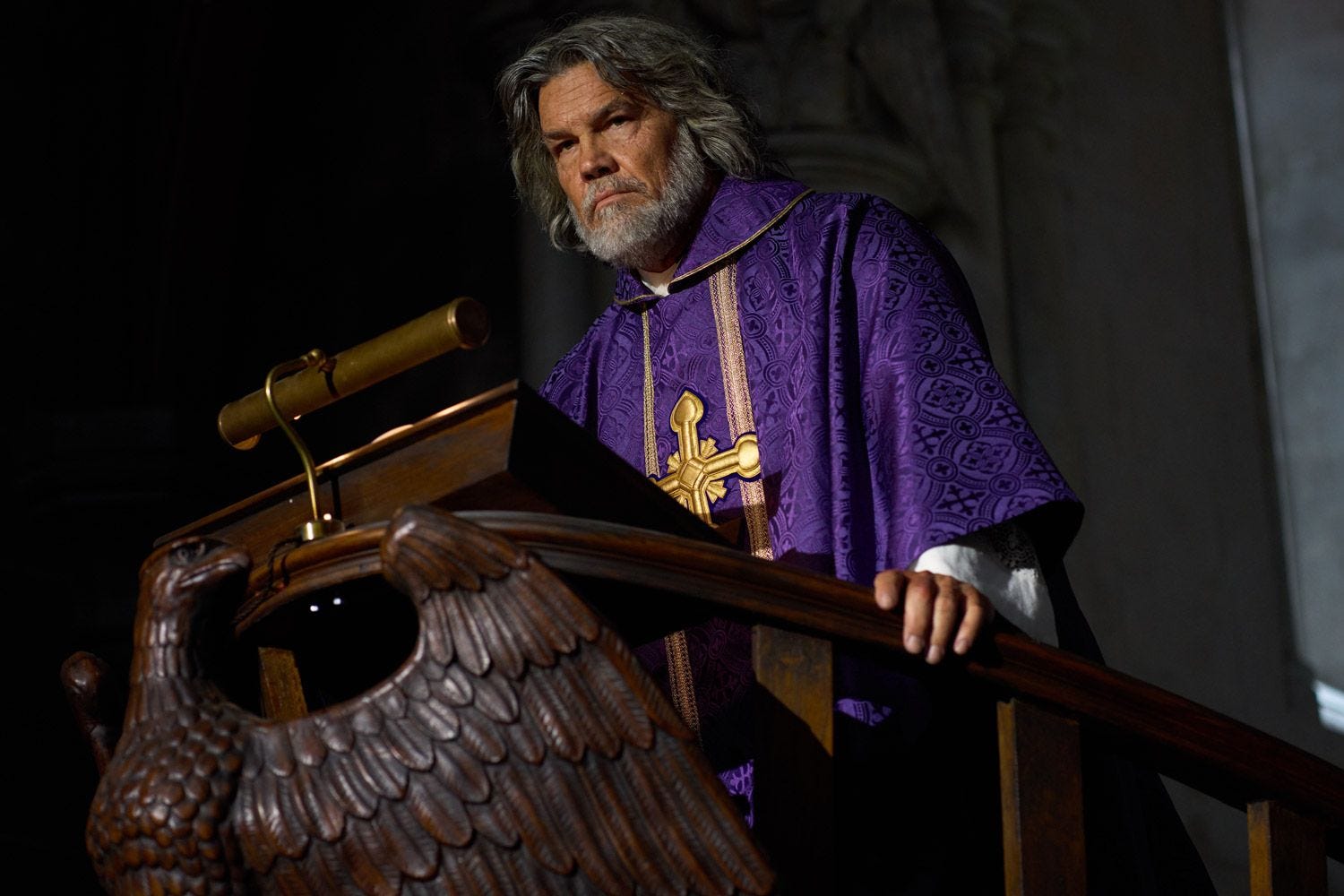
Monsignor Wicks, played by a brutish Josh Brolin, is the “Trump-y priest.” The allusion is not subtle, but then again, the year of our Lord 2025 is no time for subtlety. This is a year in which megachurches have played AI videos of a racist provocateur speaking to them from heaven. So while the film may seem heavy-handed in painting Wicks and his church with a white-nationalist brush, it barely approaches the bizarre reality we inhabit.
Wicks preaches sermons that scapegoat and divide. He drives queer people out of the church and lambasts single mothers for their sexual sin. The faithful congregants eat it up—the spiritual rush of superiority and belonging heightened by the exclusion of others. Wicks sees the church as the last bastion of morality in a diseased society. He believes it is time to fight. To take our country back.
In contrast to Wicks is Josh O’Connor’s Father Jud. He has no appetite for the culture war. He genuinely wants people to have an encounter with Christ—which is to say, an encounter with love and forgiveness. Jud is disturbed by the militant, aggressive spirituality Wicks is cultivating. He sees that this church is being formed not by love, but by a need to divide and dominate.
He makes it his mission to offer an alternative. When Jud hosts a prayer meeting, he says, “This is all about breaking down walls between us and God, us and each other, us and the world.” Jud rightly sees that the essence of spirituality is not our superiority to the world, or our possession of the right answers and doctrines, but our union with one another and with God. Jud’s ministry is one of reconciliation, not domination.
In reactions to the film online, many viewers are responding viscerally to Jud’s character. We hunger for this kind of spirituality and gentle accompaniment. We have known dozens of pastors like Wicks. We have felt their agendas for us. We have been used on volunteer teams to build their institutions. We silenced our questions because we believed in the “important work” they were doing. And we have watched it all shatter.
But few of us have experienced a pastor like Jud. We may even doubt they exist—which is why his character landed with such emotional force.
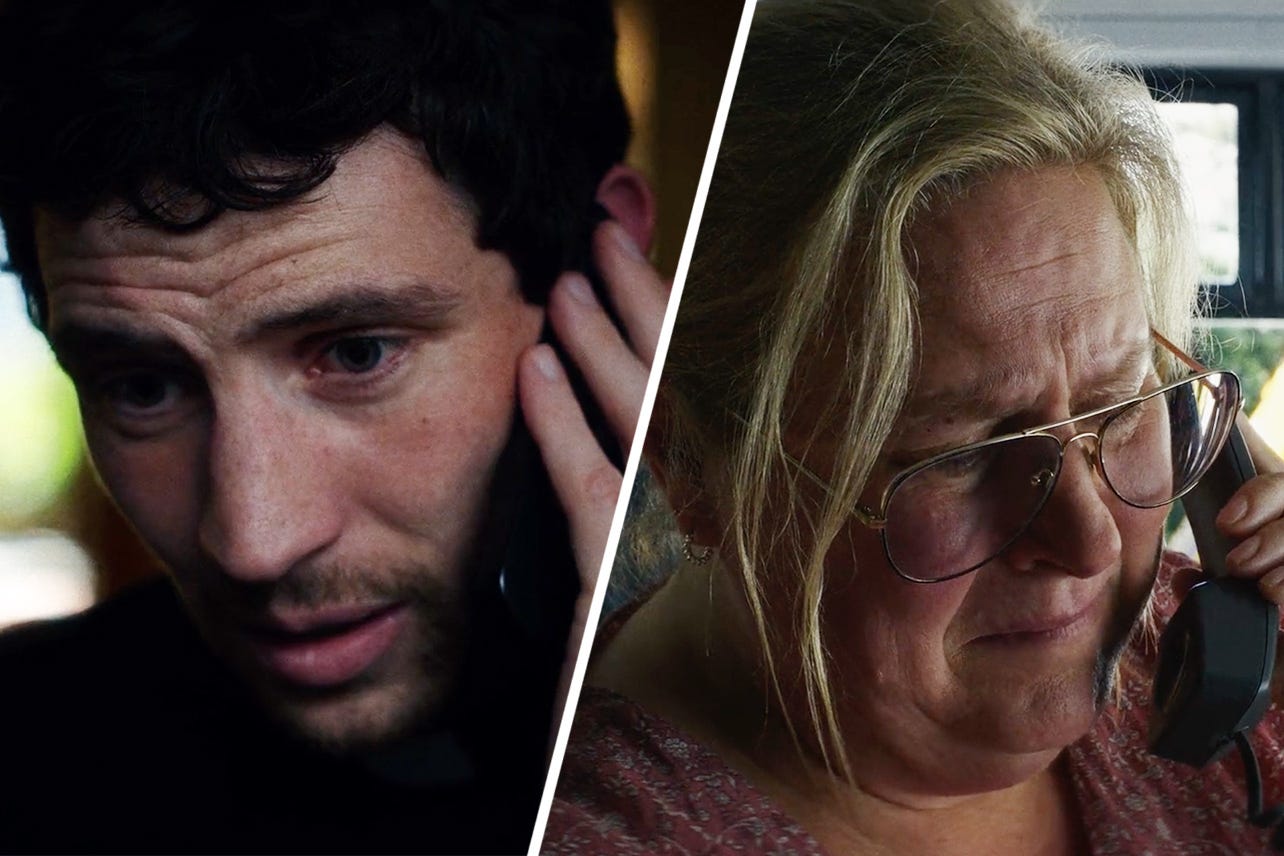
At one moment in the film, Jud is anxiously trying to gather evidence to clear his name from a murder accusation. He is rushing a receptionist on the phone for information. But when she learns he is a pastor, she asks for prayer. Jud immediately stops his line of questioning. He listens as she explains that her mother’s health is declining, and that their relationship is fractured. She cries. Jud stays with her. He points her toward everlasting arms.
I found myself weeping.
We do need pastors like this. Not pastors with all the answers and certainties, but people who stand where Christ stood—reminding us that God is not far from any of us, that God’s grace is for all of us, and that we are in this together.
For some, though, this sounds like a weak kind of Christianity.
The Gospel Coalition recently published a review of the film by Brett McCracken, who describes Jud and Wicks as two sides of the same coin:
“If Wicks is the proxy for Trump, Jud is the proxy for the progressive exvangelical’s dream pastor.”
He means this as a criticism. Brett goes on to ask whether Jud’s emphasis on grace amounts to “cheap grace,” and he zeroes in on a line that, for many of us, was the emotional heart of the film.
Jud describes the miracle Christianity offers:
“It’s not about being cured or fixed… it’s about finding the sustaining power to wake up every day and do what we’re here to do—in spite of the pain. Daily bread.”
Brett responds:
“Huh? The core of Jud’s gospel feels flimsy—more akin to ‘follow your heart’ motivation than soul-saving, sin-atoning good news.”
I found Brett’s reaction astonishing.
For me, that line went straight to my heart. Yes!—daily bread. That is the spirituality I crave.
Not certainty, but sustenance for our flesh-and-blood lives. In a world of scarcity, Christ is the sustaining power to choose generosity over hoarding. In a world of violence, Christ is the sustaining power to love and refuse vengeance.
The miracle of Christianity is not a sinner’s prayer that instantaneously changes our spiritual status from “damned” to “saved.” It is food for the long obedience in the same direction. It is not a talisman for safety in the afterlife. It is the wisdom of Christ and the presence of God that helps us love here, in this life.
Brett calls this vision flimsy. This charge is often leveled at progressive Christians—we’re told we’ve “defanged” the gospel, smoothing down its rough edges, especially the call to repentance. “Cheap grace,” Brett says.
But I think the real defanging happens when we are more concerned with converting people to our religion than living the radical way Jesus actually called us to live.
Jesus does speak of a narrow gate, but we don’t walk through it by increasing church attendance or opposing queer people. We walk through it when we do unto others as we would have them do unto us. Jesus said this was the heart of the law and the prophets. It’s not complicated—but it is difficult. What comes naturally to us is tribalism and othering. Jud is right to say that the purpose of spiritual gathering is to tear those walls down.
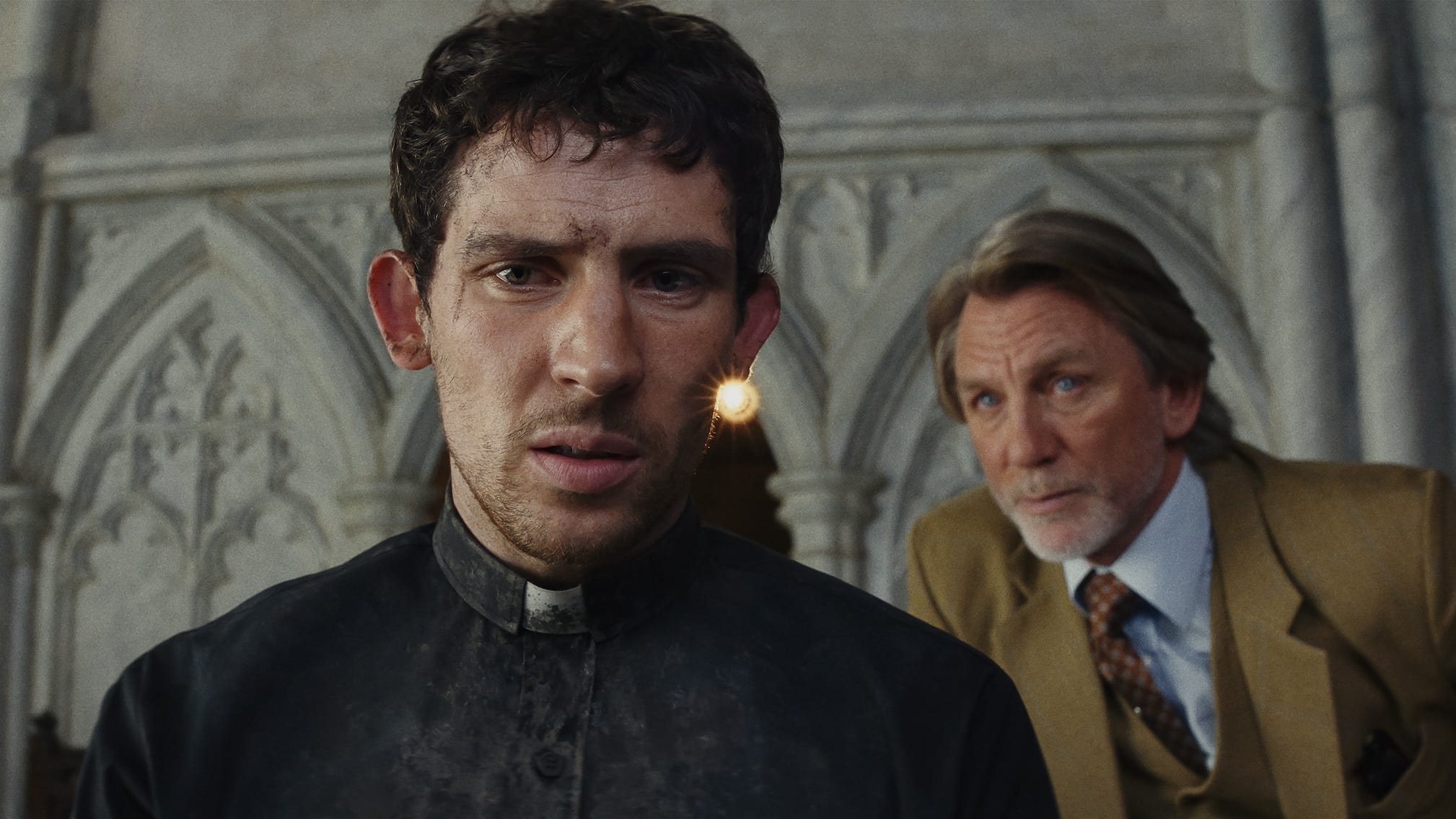
These competing visions for the purpose of Christian spirituality become even clearer in Brett’s reading of Detective Benoit Blanc, played by Daniel Craig.
Blanc is not a Christian. He rejected Christianity because of the harm it has justified, including homophobia. Although Jud and Blanc have several thoughtful conversations, Blanc does not convert by the end of the movie, and Brett finds this deeply significant, writing:
“Perhaps the “inclusive” church that Jud dreams of is the sort of Christianity that might win over a “proud heretic” like Blanc?
It’s telling that at the end of the film, when Blanc gets a goodbye hug from Jud, he brushes off a personal invitation to celebrate Mass. “That’s so nice of you,” he says to Jud. “There’s nothing I would rather not do. Toodaloo!”
Apparently, the “hugs, not fists” Christianity of Jud isn’t enough to compel a skeptic to take it seriously. It’s a nice, inoffensive, inclusive faith, but one most people can easily live without.”
Brett’s takeaway is telling all right—it tells me that for Brett, the goal of Jud’s Christian witness should be for Blanc’s conversion. To take faith seriously, Brett would want him to accept Jud’s invitation to Mass, and to convert to Christianity.
But Blanc has taken faith seriously—in the way that matters most—and Brett misses it.
In the scene immediately before Blanc declines Mass, he experiences an ego death. He shows compassion to a murderer. He relinquishes his need to be admired and creates space for confession, truth, and redemption. As he makes this choice, he is bathed in light. The film isn’t subtle. This is resurrection imagery.
Blanc is “born again,” but the evidence isn’t church attendance or doctrinal assent. It’s that he loves his enemy because he finally sees them as his neighbor. He lays down his life for a friend.
He learned this from Jud, who repeatedly offers himself for others, even attempting to turn himself in to protect the community. Jud is walking the path of Christ. Blanc sees it—and is changed.
What Blanc needed was not a Romans Road presentation or a refined atonement theory about God’s cosmic ledger of sin-debt. What unlocked empathy in Blanc was his relationship with Jud, an imperfect man who had learned to love because he himself had been loved.
That is the grace that fuels Jud throughout the film—and the grace that finally pierces Blanc’s critical shell.
Brett misses this arc entirely, writing,
“It’s no wonder Blanc leaves Wake Up Dead Man as disinterested in Christianity as he was at the start. What he sees on display from both Wicks and Jud is just not that compelling. It’s audience-captured Christianity, not true Christianity.”
But what if the goal of spirituality—of the church, of Jesus himself—is not to get people interested in Christianity?
“Conversion.” What does it mean?
This is actually one of the themes of the movie, as Jud and Blanc repeatedly discuss a “Damascus Road” experience.
In Scripture, Saul’s conversion begins when Christ asks, “Why are you persecuting me?” Saul had never met Jesus, but Jesus identifies himself with the suffering. True conversion opens our eyes to that identification—to the crucified ones of the world—and responds to the call of Christ to take up our own cross and meet him there.
Salvation is not about religious affiliation. One of the most common tragedies in Christianity is people who believe in penal substitution while missing what atonement actually means: at-one-ment. Union. Reconciliation. Right relationship.
In this sense, Blanc does have a conversion—not to the Christian religion, but from the path of ego to the path of grace, where he comes to see himself in his neighbor and his neighbor in himself.
Brett points out that Blanc’s own homosexuality could have been one of his issues with the Christian faith. When Brett accuses Father Jud of being “soft on sin,” I think Brett may have this in mind. After all, Jud never condemns Blanc’s sexuality, or calls him to a life of celibacy, and Blanc’s “conversion” has nothing to do with changing his sexual identity.
But Jud does confront sin throughout the film, directly challenging Wicks. This is not seeker-sensitive therapy. It is a battle for the soul of the church. But the sin Jud was intent on battling was not someones unchosen sexual identity, or any other arbitrary religious rule. The sin Jud confronts is lovelessness—the use of religion to dominate, exclude, and elevate oneself over others.
That, Jud recognizes, is the true betrayal of Christ.
We should be hard on sin in the way Jesus was. That will never be popular with religious people, because Jesus focused on a very different set of sins than we do. Churches often claim to be “strong on sin” because they target queer people, while remaining silent about the systems that actually harm God’s beloved.
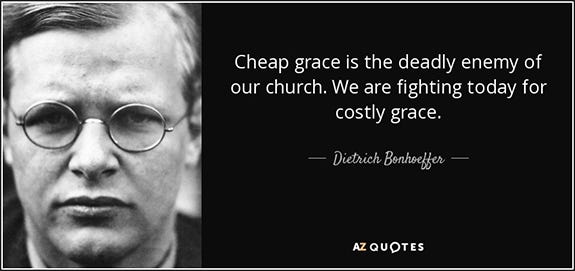
The phrase “cheap grace” comes from Dietrich Bonhoeffer, who was not condemning churches for affirming marginalized people. He was condemning the church in Nazi Germany for aligning itself with power, scapegoating the vulnerable, and offering forgiveness without transformation—all while believing it possessed the “right” orthodox doctrine. But the message of Jesus was never about doctrinal correctness, and wrapping oneself in the vestments, theology, and language of the church remains one of the most reliable ways to avoid the demands of the Gospel.
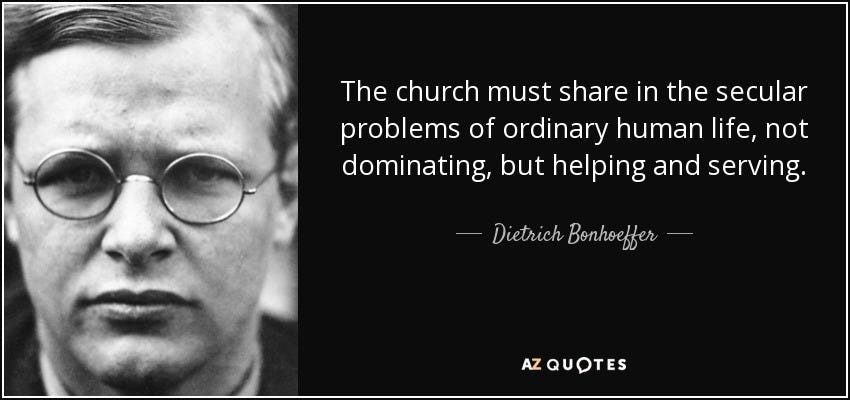
Bonhoeffer wrote, “The Church is the Church only when it exists for others… not dominating, but helping and serving.”
Maybe that’s why Wake Up Dead Man made me miss being a pastor.
Not because I miss authority or answers or the power to draw lines. We don’t need pastors to enforce boundaries or police certainty. We already do that just fine on our own! What we need are voices that call us back to the love that has always been there, even when we forget. Voices willing to remind us that the walls we’ve built—between us and God, and between one another—were never real to begin with. Voices that bring us back to grace: Our daily bread.
beloved, with Brian Recker is a reader-supported publication. To receive new posts and support my work, consider becoming a free or paid subscriber.
Comments
Nothing yet. Say the first thing.
Sign in to join the conversation.