
In the last couple of weeks, updated property assessments have been received by Winnipeg home and property owners. And, as is common in most cities, people freaked out!
During my 10 years on Calgary City Council I repeatedly tried to explain how the property tax system worked. And, for the most part, I failed! It’s not a simple system, it isn’t like other taxes we pay and the process is spread out over many months.
Following the release of the proposed 2027 assessments in Winnipeg, I was asked to go on Radio-Canada’s L’actuel to try and explain the property assessment and tax system, again, mais cette fois en français! Not sure if I succeeded any better.

In Winnipeg, the City must re-assess all properties every two years. 2027 is the year that new assessments are applied. But, the assessment for 2027 is actually based on the estimated market value on the property on April 1st, 2025.
Yeah, that is part of the confusion: at the beginning of 2026 we receive our assessments for 2027 based on 2025, that will be applied at the end of 2026.
So, let’s connect property assessments to property taxes, it definitely isn’t a straight line.
The first thing to understand is that property taxes DO NOT work like income tax, or any other tax we are used to!
With income tax if someone gets a pay increase, the government gets more money. The tax rate stays exactly the same, but is applied to the larger income, so a revenue increase for provincial or federal government. Same with sales tax, the more you spend the more money government receives. That is why we rarely hear provincial & federal governments talk about raising taxes. They don’t have to, because their revenue increases every year without raising taxes.
But the city can’t do that. City property tax systems, and they are similar across the country, are “revenue neutral”. If property values go up, the “tax rate” goes down so that home owners pay the same amount. That is why, every year, the city has to decide how much to “increase property tax” as part of the budget process. Otherwise, revenue won’t increase to manage growing expenses.
As well as how taxes are levied, the way the city develops its budget differs from federal or provincial government budgets.
First off, the feds and the provinces can run a budget deficit. And they do, regularly. Essentially they estimate how much tax revenue they will receive, and if it isn’t enough for what they want to do they will either cut or plan for a deficit.
Meanwhile, the city is prohibited from having a deficit. Their budget approach is completely different. Rather than estimating how much revenue they will receive and covering the gap with borrowing (a deficit), the city starts with knowing exactly how much money they need, and then determining the tax increase from that. They only collect the planned amount, rarely more, sometimes less. Not being able to run a deficit means that often towards the end of the year we see the city scramble with cuts or drawing from reserves to ensure that the budget is balanced at the end of the year.
Winnipeg is different. I’ve written about the City of Winnipeg budget a few times. Essentially, rather than starting the budget process with what Council hopes to accomplish, Winnipeg City Council starts with their “tax increase”, in 2026 that was 3.5%. They then fit a budget into that. Most other cities start with what they would like to achieve, see how much that would cost and what the resulting tax increase is. If they are comfortable with that, fine, if they consider the tax increase too high or too low then they adjust the budget accordingly.
Some of my previous posts on the Winnipeg budget process and outcomes:
2025
2024
2023
Sidebar Over
Okay, where were we. Oh, yeah.. the budget.
The city’s budget specifically sets how much money they need. Winnipeg’s operating budget for 2026 is $3B. Of that, $836M is raised from property taxes, a $38.6M increase over 2025, which works out to the predetermined 3.5% tax increase.
That required amount of tax revenue, $836M, is then applied to properties across the city through the “Mill Rate”. The mill rate is determined by the average value of a property times the number of properties, divided by the amount of revenue needed. For 2026, the average home assessment was $371,000, paying $2,322 in property tax.
The 2026 mill rate for residential properties is set at 13.372. That is for every thousand dollars of property value, the tax is $13.372. The mill rate fluctuates every year, going up or down, depending on property values.
Looking historically, in 2025 we had a property tax increase of 5.95%. While property taxes went up by 5.95% last year, the mill rate actually went down by 3.2%.
So, if you take the 2025 mill rate of 13.372 and apply that to the average home assessment of $371,000 then you get a total of $4,961. A lot higher than the $2,322 the city is collecting on the average home. That is because the City is only applying their tax to 45% of the property value. More than half of the taxes are not going to the city, which gets you to the municipal property tax collected by the city in 2026 on the average home of $2,322. The balance of the taxes collected on your home are collected by school boards and the province.
Now that we know how we get to the tax applied to properties, we must consider averages. As shown, the mill rate is set based on the average property value in the city. In 2026 that was $371,000. The property assessments that just went out show that the average property value in Winnipeg has increased to $411,000 (estimated at April 1, 2025). That works out to roughly an 11% increase over 2 years, on average across the city.
Of course all properties don’t go up by the same percentage, and some communities increase in value more than others. For 2027, the low end of increase is Tuxedo/River Heights at 6%, with the highest increases in North Kildonan/East Kildonan with an 18% average increase.
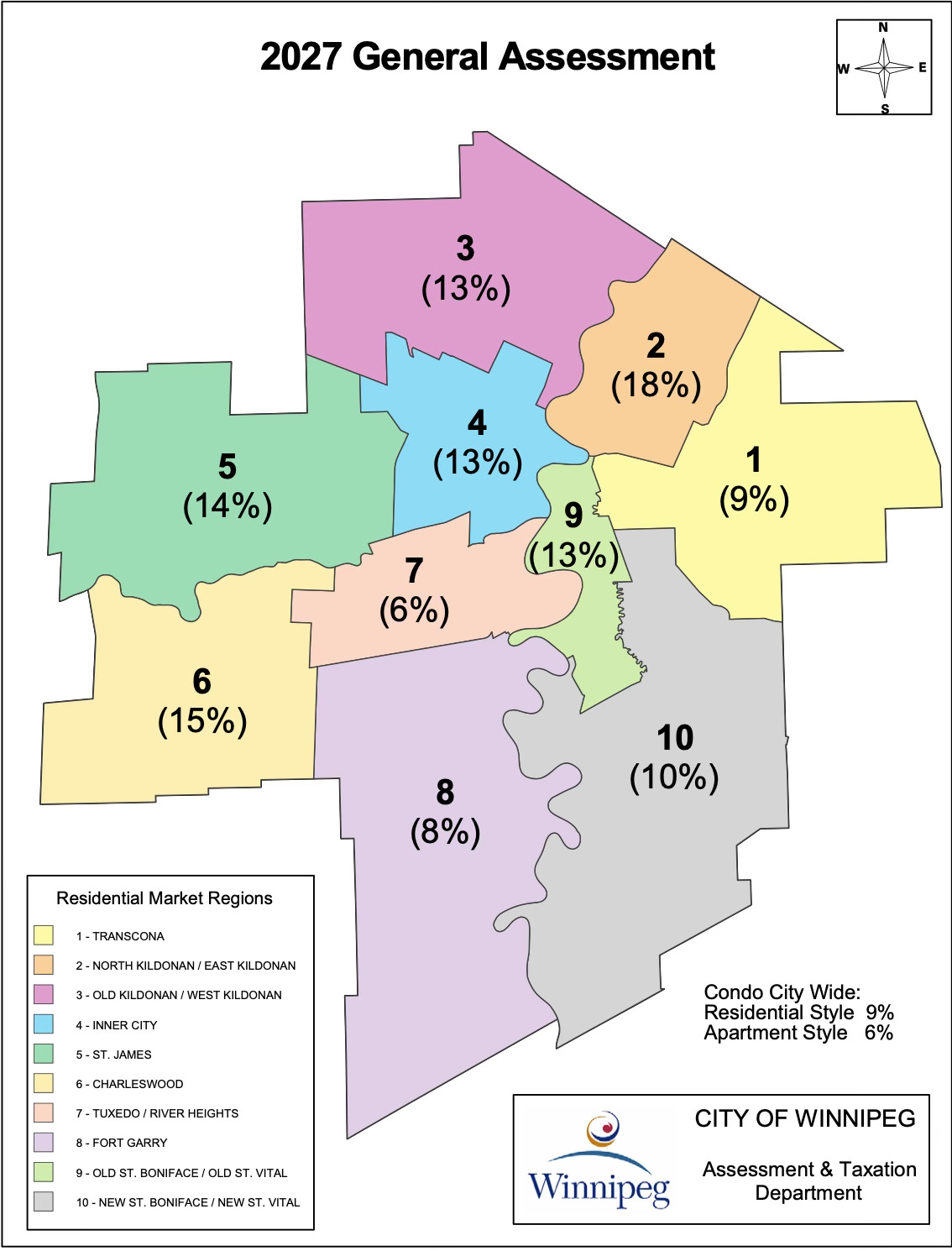
This is the assessment that all homeowners have received in the past few days.
Looking ahead to 2027 budget and subsequent property taxes, because average assessments went up by 11% city wide does not mean that taxes are going up 11%. In a revenue neutral system, where the amount of revenue needed sets the mill rate, the mill rate would go down accordingly.
Supposing Council decides to not increase taxes, approve a budget total the same as this year, then taxes would change based on how a property measures against the average change in value. If your property assessment went up 11%, then your taxes would not change. If your assessment increased less than the average of 11%, then your taxes would go down, and if your assessment increased more than the average then your taxes would increase.
If Council decides on a tax increase as part of the 2027 budget, then your increase in property tax will be smaller than the announced increase if your assessment increase was below 11%, and it will be bigger than the increase if above.
The City of Winnipeg has a pretty good explainer of how this works on their website:
Increased assessments don’t necessarily mean increased property taxes. Changes in property taxes still needs to wait until Council sets its budget at the end of 2026/early 2027. The “tax increase” set by council is then translated into the mill rate applied to the whole city. The amount of your property tax increase is based on how your property assessment fared against the average of all the other properties in the city.
Process:
Property assessment → City Budget → set mill rate → apply mill rate to properties → City Property Tax (45% of your tax bill)
Time:
2026: Set value of property based on 2025 → 2026 send out assessments for 2027 → 2027 set mill rate → 2027 tax bill based on value in 2025 sent to you in 2026.
It is no wonder this is hard to fathom, the process is disconnected over time and process. Homeowners get information today, based on last year that needs to be evaluated now before they feel the effects next year.
But, this is not the city’s fault. The tax system and process is determined by the provincial government, and every province is just a little different on how property taxes work.
Property tax remains a regressive taxation system, based on property value and not on ability to pay. This can lead to significant problems for seniors and people on fixed incomes who might have to sell their property because they can no longer afford the property taxes.
The market value system also incentivizes all kinds of things we don't particularly want in a growing city. Urban sprawl, further and further out from the city centre, is in part incentivized by property taxes. Land is cheaper on the outskirts than in established neighbourhoods, therefore relative property values are lower, so taxes are lower. Lower taxes are then a marketing tool for developers.
The market value as well delays redevelopment in the inner city. A surface parking lot has a very low value and therefore pays low property taxes. But for little effort and investment can generate significant income. There is little incentive to redevelop the site into a better and higher use. The market value taxation works against the desired outcome of higher density and intensity in our inner city.
I hope this helps a bit and allays some of the freakout reactions to an increased property assessment.
I will no doubt be trying again in the future!
brian
No posts
Comments
Nothing yet. Say the first thing.
Sign in to join the conversation.